
Curacao casinos not on GamStop: what the licence really gives UK players
 Available in GB
A Curacao licence is what most offshore casinos carry when they appear in the search results of UK players who have hit a wall with the British market. The licence looks innocuous — a small green seal at the foot of a webpage — and the marketing copy above it tends to shout. What sits between those two things is where the decision actually lives. This page is a researched guide to that gap, written for UK players who have landed on a Curacao casino site and want to know what they are looking at before they deposit a pound.

Data current as of September 9, 2026, verified against the Curacao Gaming Authority register, the UK Gambling Commission’s published guidance and operator bonus terms.
What a Curacao-Licensed Casino Actually Is (for UK Players)
A Curacao-licensed casino is an online gambling site whose operating licence was issued by the Curacao Gaming Authority (CGA), the statutory regulator established under the National Ordinance on Games of Chance (LOK) that came into force on 24 December 2024. The licence authorises the operator to run a remote casino — slot games, table games, live dealer rooms and (at many operators) a sportsbook — and nothing else. There is no land-based casino in Curacao that a UK player can visit. The word “Curacao casino” is, by definition, a website.
UK players arrive at these sites because the alternative — the British market under the UK Gambling Commission (UKGC) — does not fit them. They may have self-excluded through GamStop and want to continue playing, or they may simply want crypto deposits, autoplay, or bonuses with larger headline percentages than the UK market now permits. The search results follow the demand: affiliate guides dominate the results for terms like “non GamStop Curacao casino sites”, and operator sites themselves rarely rank. That gap is where most players first read about these sites, and where the licence is usually misrepresented.
The Curacao Licence: Caribbean Regulator, Global Reach
The CGA is the body that issues the licence, and the LOK is the statute that gives it teeth. Before LOK took effect on 24 December 2024, Curacao gambling was regulated through a sub-licence system run under the older NOOGH framework. Each master licence holder could sub-license operators, and the regulatory touch was light. The LOK reform replaced that with a single direct-licence structure: every operator now appears on a public register under its own Online Gaming Licence (OGL) number, with the CGA holding direct oversight.
The old sub-licences expired on 15 October 2025. From that date, any operator displaying an orange seal — the mark of the old sub-licence — is in breach of Curacao law. The CGA stated this directly: “From this date onward, any operator displaying an orange seal on its domains will be in breach of Curacao law. Licensed operators must ensure that only the Green Seal is displayed on their websites.” The green seal is the only valid mark today, and it is the first thing to check on any Curacao casino site a player is considering.
Online-Only: Why There Is No Land-Based Curacao Casino for UK Players
The licence covers remote gambling only. There is no Curacao casino building a UK player can walk into, no resort integrated with a hotel, no brick-and-mortar gaming floor under CGA jurisdiction. “Curacao casino” means an operator whose servers, corporate registration and licence all sit in a small Caribbean jurisdiction — and whose customers connect from anywhere in the world, including Great Britain.
This distinction matters because it sets the boundary of what the regulator actually inspects. The CGA’s mandate is the platform: the software, the game catalogue, the payments, the player-protection tools. It is not a tourism board. Any review that frames a Curacao casino as a destination is selling something that does not exist.
Why UK Players Land on Curacao Casino Sites
The path to these sites runs through GamStop. At the end of 2025, over 562,000 people were actively excluded through the national self-exclusion scheme, and registrations among 16–24 year olds rose 40% year-on-year in the second half of that year. That is a large population of players who, by their own choice, cannot use any GB-licensed site — and who may, in some cases, search for an alternative.
Search results for queries around non-GamStop play are dominated by affiliate review sites, not by the operators themselves and not by the regulator. Pages like wagerpals.co.uk, casinocuracao.co.uk and Non-gamstopcasinos.com rank consistently for these terms. Those pages do the work of explaining what a Curacao casino is to a reader who has never seen one — and they vary widely in how honestly they do it. The legal reality for the player is covered in the next section.
GamStop-Free, Not GamStop-Proof: The Legal Picture for UK Players
A Curacao casino is not licensed to serve GB customers. The Gambling (Licensing and Advertising) Act 2014 made a Gambling Commission licence compulsory at the point of consumption, and the UKGC has confirmed this unambiguously: “A licensed operator (or an operator applying for a license) based in Curaçao is not permitted to offer gambling services within the UK without a license from us.” A Curacao licence is not a substitute.
What this means in practice is layered. The operator that targets GB players is committing a criminal offence under section 33 of the Gambling Act 2005, which carries up to 51 weeks’ imprisonment, an unlimited fine, or both. The player who uses the site, however, is in a different position. No criminal penalty for a UK player who merely gambles on an unlicensed site was established by this research. Every sanction traced is aimed at operators, advertisers and intermediaries. What the player loses is protection: no GamStop coverage, no Commission complaints route, no approved ADR, no British consumer redress if funds are withheld. The licence to play remains; the safety net does not.
What “Non-GamStop” Actually Means for You
GamStop is the national multi-operator self-exclusion scheme for Great Britain, mandatory for every GB-licensed online gambling operator since 31 March 2020. It blocks the excluded person from every GB-licensed online site for a fixed period — six months, one year, five years, or five years with auto-renewal — and it cannot be cancelled early. That is the entire point of the register.
A Curacao-licensed casino is not part of the GB licensing system. It is not on GamStop’s distribution list, it does not check the register, and it cannot enforce an exclusion even if it wanted to. An excluded British player is therefore not protected on a Curacao site. The honest pairing is exactly this: “non-GamStop” means outside the UK self-exclusion net, not exempt from the reasons a player signed up for it. The decision to play at an offshore site while excluded is the player’s own, and the protection that the exclusion was supposed to provide does not travel with them.
Inside the Curacao Licence: LOK Reform, Green Seals and the CGA Register
The LOK reform of December 2024 changed what a Curacao licence is. The CGA is now a statutory regulator with a public register, and every licensed operator must appear there under its own OGL number. Old NOOGH sub-licences were automatically converted into provisional licences when LOK took effect; the sub-licence framework itself was retired in October 2025.
A player who wants to check a licence should follow three steps. First, look for the green seal on the operator’s website. If the seal is orange, the site is either displaying an expired sub-licence or no licence at all — close the tab. Second, find the OGL number, usually in the page footer or on a “licence” or “about” page. Third, look up the OGL number on the CGA portal to confirm the operator’s name, the licence holder entity and the licence status. Donbet, for example, holds OGL/2024/250/0115, issued 1 July 2024 under the LOK framework and operated by GTW B.V. — a date and a number that can be confirmed against the register.
UKGC vs Curacao: What You Keep and What You Give Up
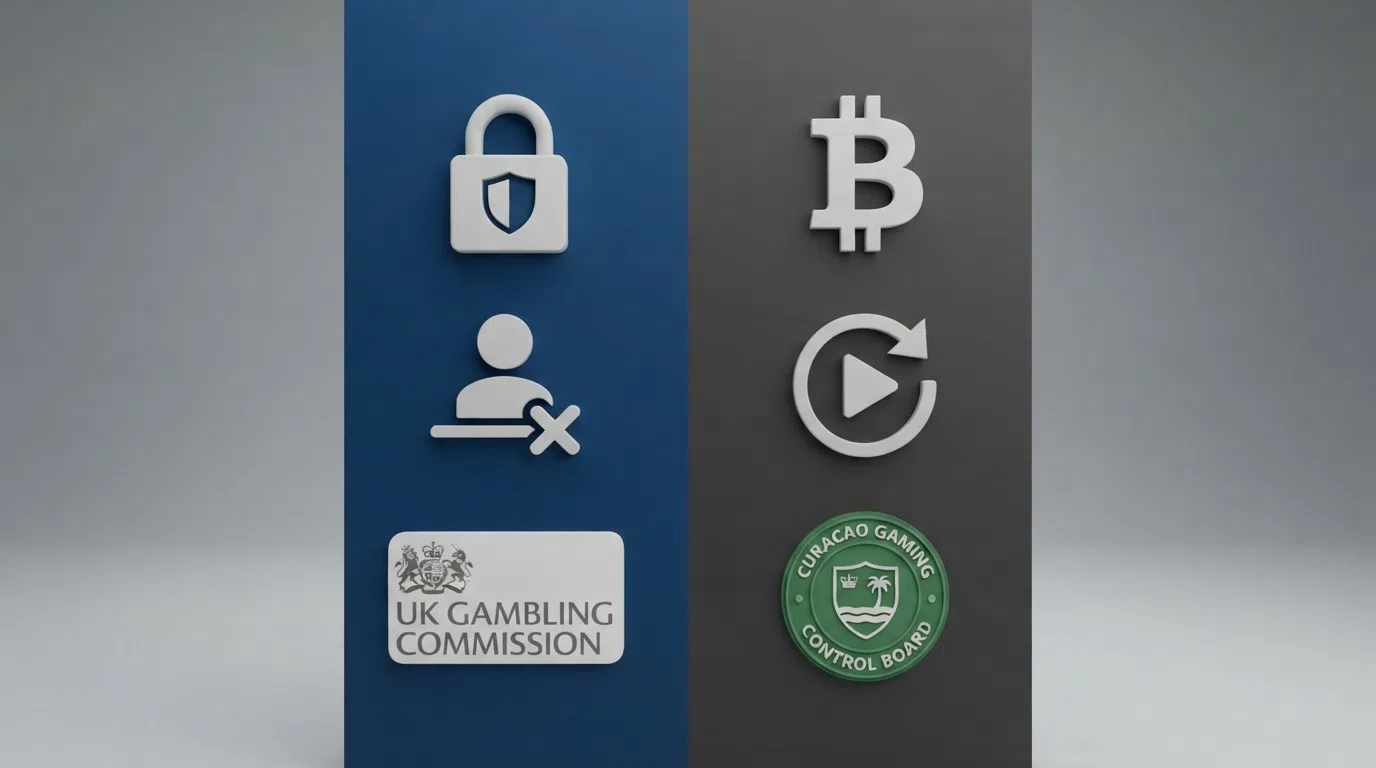
The protections below are mandatory at every UKGC-licensed casino and either absent, voluntary, or differently structured at a Curacao-licensed casino. The list is long because the GB regime is built around it, not because the comparison is stacked.
| Protection | UKGC-Licensed Casino | Curacao-Licensed Casino |
|---|---|---|
| GamStop self-exclusion (cross-industry) | Mandatory | Not part of the system |
| Fund segregation (player deposits kept apart from operating funds) | Mandatory | Not uniformly mandated; operator documents its own mechanism |
| Online slots stake cap | £5 (age 25+) / £2 (age 18–24), statutory | No mandated stake limit |
| Bonus wagering cap | 10× maximum (in force December 2025) | Typically 30×–50×, set by operator |
| Auto-play and turbo spin on slots | Banned (with 2.5s minimum spin cycle) | Permitted |
| Credit-card deposits | Banned since April 2020 | Permitted |
| Cryptocurrency deposits | Not permitted under UKGC AML rules | Fully supported |
| Approved UK ADR provider (e.g. IBAS, eCOGRA) | Available; UKGC route also exists | Operator-chosen ADR; CGA does not handle individual complaints |
| Statutory financial vulnerability check (£150 threshold) | Mandatory | Not mandated |
| British consumer redress if funds are withheld | UKGC complaints route + small claims | Civil court or chargeback only |
The two or three things a Curacao casino offers that a UKGC site cannot are listed at the bottom of that table: crypto deposits, auto-play and turbo spin, and often faster crypto withdrawals. The trade is not subtle. A player choosing a Curacao casino is giving up ten mandatory protections in exchange for three features the UK market does not permit. Whether that trade is worth it depends on what the player values — and on whether they can run the safety checklist in the section on that subject later in this page.
Can a UK Player Get into Trouble? The Real Enforcement Picture
The UKGC’s enforcement model against unlicensed operators is disruption, not blocking. Between April 2024 and June 2025, the Commission issued 3,140 disruption notices, referred 447,778 URLs to search engines for delisting, and saw 287,961 URLs removed, with an average 32% fall in engagement across 160 disrupted sites. The tools are cease-and-desist notices (with a 48-hour deadline), search-engine delisting referrals, domain registrar pressure and payment-provider referrals. They bite.
What the UKGC does not yet have is statutory ISP or DNS blocking powers. Legislation has been proposed that would let it apply to a court for a blocking order, but it has not been enacted. There is no published blocking list of the Czech *Seznam nepovolených internetových her* kind, and the Commission’s disruption model works because search visibility and payment access matter to an offshore operator more than the legal status of their hosting. Players who reach a Curacao casino through search are the audience the disruption model targets; players reached through affiliate lists are a different pipeline.
The Austrian refund ruling in June 2026 signalled a separate trend: courts in other jurisdictions are beginning to treat unlicensed online gambling differently from how they did five years ago. International enforcement risk for Curacao operators is rising, even where the player sees no immediate consequence.
The Top Curacao Casinos Not on GamStop, Compared
The ranking below is not a score. It is an ordering by three qualitative factors: how clearly the licence is verified against the CGA register, how reasonable the bonus terms are once the wagering requirement and validity window are read alongside the headline, and how long the brand has traded under its current corporate structure. Free-spin counts, minimum deposits and maximum bet limits are taken from each operator’s published terms where research captured them and left as an em dash where it did not.

A player who runs this table against the safety checklist in the section on that subject — checking the green seal, the OGL number, the operator’s own terms page — has done more than the affiliate guides did for them.
| Operator | Curacao Licence | Welcome Bonus | Free Spins | Wagering Requirement | Bonus Validity |
|---|---|---|---|---|---|
| BitStarz | OGL/2023/174/0082 (Dama N.V.) | Up to 5 BTC + 180 FS across four deposits | 180 | 40× bonus and FS winnings | 14 days |
| BC.Game | 365/JAZ (legacy; may have transitioned to OGL under LOK) | 120% first deposit + 100 FS | 100 | 20× bonus; 40× FS winnings | 30 days |
| Stake | CGA licence under new framework (UKGC licence surrendered March 2025) | 200% up to $2,000 | — | 40× deposit + bonus | — |
| MyStake | Curacao (Santeda International B.V.) | 170% up to £1,500 + 30 FS | 30 | 30× deposit + bonus | 30 days |
| Velobet | Curacao (Santeda International B.V., same group as MyStake) | Casino: 150% up to £500 + 70 FS (or 100% up to £1,000 at £500+); Crypto: 160% up to €1,000 | 70 | 30× casino bonus; 35× crypto; 35× FS winnings with £100 cashout cap | — |
| Donbet | OGL/2024/250/0115 (GTW B.V., issued 1 July 2024) | 150% up to £750 + 50 FS | 50 | 30×–35× bonus | 30 days |
| Rolletto | Curacao GCB (Vegasoo Group) | 150% up to £500 + 200 FS (50 instant + 30/day for 5 daily logins) | 200 | 30× deposit + bonus | — |
| FortuneJack | Curacao (veteran since 2014) | 500% across four deposits + up to 5,000 FS | Up to 5,000 | 10× casino or 30× deposit + bonus | 14 days |
| 7BitCasino | OGL/2023/174/0082 (Dama N.V., SoftSwiss) | 325% up to 5.25 BTC + 250 FS | 250 | 35× standard; 45× no-deposit FS | 14 days |
| Rabona | Curacao (Araxio Development N.V.) | — | — | — | — |
A worked example makes the table legible. Take MyStake as a representative mid-range Curacao welcome offer: a £100 deposit unlocks a 170% bonus of £170, and the wagering requirement applies to the deposit plus bonus combined. Required turnover is therefore £270 × 30 = £8,100. Book of Dead, the most common slot on a Curacao lobby, runs at a default RTP of 96.21%. Expected loss on that turnover, with only the bonus being wagered, is £8,100 × (1 − 0.9621) = £306.99. That figure is a statistical estimate over many spins — not a guaranteed outcome — and it is the bonus’s real cost to a player who clears it. The headline £170 bonus, on those terms, costs roughly £307 in expected house edge before the player sees a penny of withdrawable winnings. The math does not punish the player; it just stops the marketing from doing so.
BitStarz: The Multi-Crypto Veteran with a Transparent OGL
BitStarz has been live since 2014 and operates under Dama N.V. with OGL/2023/174/0082 — the same licence number carried by 7BitCasino, since both run on the SoftSwiss platform. The welcome package spreads across four deposits: 100% up to 1 BTC + 180 free spins on the first, 50% up to 1 BTC on the second, 50% up to 2 BTC on the third, and 100% up to 1 BTC on the fourth. Wagering is 40× on both the bonus and the free-spin winnings, with a $5 maximum bet while wagering and a 14-day bonus validity. The minimum deposit is $20. Pragmatic Play, NetEnt, Play’n GO, Evolution and Microgaming supply the lobby.
For a player who wants a long-tenured crypto-native brand with a verifiable OGL number and is comfortable with a 40× wagering requirement, BitStarz is a straightforward pick. The 14-day window is the tight constraint — four deposits cleared in two weeks is a serious commitment of bankroll and time.
BC.Game: The 8,000-Game Catalogue with Low Wagering
BC.Game launched in 2017, holds the legacy 365/JAZ licence number (which may have transitioned to a direct OGL under LOK, though the current register entry was not confirmed this research), and offers over 8,000 casino games alongside support for more than 150 cryptocurrencies. The welcome bonus is a 120% first-deposit match with 100 free spins, wagering 20× on the bonus amount and 40× on free-spin winnings, with a 30-day bonus validity. Maximum win from free spins is $5, and the maximum bonus is $1,000.
The 20× bonus wagering is the lowest in the featured set, which matters more than the percentage headline. Players who value catalogue depth and are comfortable with the legacy licence format — and willing to check the current CGA register entry themselves — will find this the most attractive bonus on the page.
Stake: The UKGC Dropout with a CGA Licence
Stake surrendered its UKGC licence in March 2025 and now holds a CGA licence under the new LOK framework, alongside four other active gambling licences. The welcome offer is a 200% deposit match up to $2,000 with 40× wagering on deposit plus bonus combined, no free spins, and a $10 minimum deposit. Pragmatic Play, Evolution and Hacksaw Gaming supply the games.
The interesting thing about Stake is the direction of travel: it left the GB market voluntarily, rather than being forced out by an enforcement action. For a player who values a brand with that posture — willing to walk away from one regulated market rather than dilute its offering — Stake is the obvious fit. The absence of free spins in the welcome offer is unusual for the set; the player is paying for the higher headline match.
MyStake: The High-Roller Match with Combined Wagering
MyStake operates under Santeda International B.V. and offers a 170% bonus up to £1,500 plus 30 free spins, with 30× wagering applied to the deposit plus bonus combined. The maximum bet is £5 per spin, bonus validity is 30 days, and the minimum deposit is £20. Pragmatic Play, NetEnt, Play’n GO and Evolution supply the lobby. The wagering formula — deposit + bonus combined rather than bonus alone — is what makes the math on this offer work out to the £306.99 expected loss figure shown in the worked example above.
A player with a £1,500 bankroll who wants the largest pound-denominated bonus on the page and can clear 30× combined within 30 days is the reader MyStake was built for.
Velobet: MyStake’s Sister Site with a Dual-Track Bonus
Velobet is operated by Santeda International B.V. — the same corporate group as MyStake — and runs a dual-track welcome offer. The casino track pays 150% up to £500 + 70 free spins on deposits under £500, or 100% up to £1,000 + 70 spins on deposits of £500 and above, with 30× wagering on the bonus and a £5 maximum bet. The crypto track pays 160% up to €1,000 with 35× wagering. Free-spin winnings carry 35× wagering with a maximum cashout of £100. Casino Guru rates the operator 8.4 out of 10 (“High” safety index), and the Trustpilot page carries 898 reviews as of March 2026.
For a player choosing between Velobet and MyStake, the difference is structural rather than quality: Velobet splits its offer so a fiat and a crypto player each see a tailored version, while MyStake runs a single combined-wagering track. The Velobet free-spin cashout cap of £100 is a real ceiling on what the spin side of the offer can return.
Donbet: The OGL-Verified Newcomer with a Fixed Licence Date
Donbet holds OGL/2024/250/0115, issued 1 July 2024 under the LOK framework and operated by GTW B.V. — one of the few operators in the featured set with a licence date a player can confirm directly against the CGA register. The welcome offer is 150% up to £750 + 50 free spins, with 30×–35× wagering on the bonus, a £5 maximum bet, a £20 minimum deposit and 30-day bonus validity. Pragmatic Play, NetEnt, Play’n GO and Evolution supply the games.
A player who values verifiable licence provenance over brand tenure gets the cleanest record on the page here.
Rolletto: The Free-Spins Leader with Daily Drip
Rolletto operates under the Curacao GCB via Vegasoo Group and offers 150% up to £500 plus 200 free spins — the largest free-spin count in the featured set, delivered as 50 spins instantly and 30 per day across five consecutive daily logins. Wagering is 30× on deposit plus bonus combined, the maximum bet is £5, and the minimum deposit is £20. Pragmatic Play, NetEnt and Evolution supply the lobby.
The daily drip structure is the catch: a player who skips a day loses that day’s 30 spins. By logging in for five consecutive days and clearing the 30× combined requirement within the bonus window, a player secures the set’s best free-spin return; skipping a day, however, forfeits those 150 spins entirely.
FortuneJack: The Veteran Crypto Casino with a 500% Package
FortuneJack has been live since 2014 and offers the largest headline percentage in the featured set: a 500% welcome package spread across four deposits with up to 5,000 free spins. Wagering is reported as either 10× for the casino bonus or 30× on deposit plus bonus combined, depending on the source. Only slots and the Aviator crash game count toward wagering, and the clearing window is 14 days. Responsible-gambling tools at the operator have been noted as weak in third-party reviews.
A player drawn to the 500% headline should read the source discrepancy on wagering first: 10× versus 30× is the difference between a bonus that costs a few hundred pounds in expected house edge and one that costs four figures. The 14-day window is also tight for a four-deposit package.
7BitCasino: The Dama N.V. Stalwart with 325% in BTC
7BitCasino shares its OGL number with BitStarz — OGL/2023/174/0082 — because both run on the SoftSwiss platform under Dama N.V. The welcome offer is 325% up to 5.25 BTC + 250 free spins, with 35× standard wagering and 45× on no-deposit free-spin winnings, a $30 minimum deposit and a 14-day bonus validity. Pragmatic Play, NetEnt, Play’n GO and Evolution supply the games.
The 7Bit welcome is essentially the same regulatory package as BitStarz with a different bonus shape: a higher percentage match and more free spins, against a higher minimum deposit and the same 14-day window.
Rabona: The Araxio-Backed Operator with Gaps in the Record
Rabona operates under Araxio Development N.V. and has been rated 9.2 out of 10 on at least one affiliate rating site, with CGA verification confirmed. Bonus terms were not captured by this research — the welcome offer, free-spin count, wagering requirement and bonus validity all sit empty in the comparison table for that reason. Pragmatic Play, NetEnt and Evolution supply the lobby.
A player considering Rabona should treat the empty cells as a prompt to read the operator’s own terms page before depositing, because the headline rating and the missing bonus data are not the same thing. Araxio Development N.V. is also the corporate group behind a number of other Curacao-licensed brands; cross-brand reputation may carry some signal, but the verification belongs to Rabona’s own licence entry on the CGA register.
New Curacao Casinos: More Choice, Same Rules
A “new” Curacao casino in the LOK era is an operator whose licence was issued under the reformed framework rather than converted from an older NOOGH sub-licence. The reform changed the entry route, not the operating rules: a new operator must appear on the CGA public register with a direct OGL number and display the green seal, but it is not subject to any extra compliance standard beyond what every other licensed operator faces. The fact that a casino is new does not mean it is safer, more lenient, or more generous than an established one — it means the player has fewer data points to lean on.
The Newest Curacao-Launched Casinos Worth Knowing
The clearest recent example is Donbet, with OGL/2024/250/0115 issued 1 July 2024 under the LOK framework. 1xCasino carries OGL/2024/1262/0493 issued in November 2024, with a welcome package of €1,500 plus 150 free spins across four deposits at 35× wagering. These are post-reform licences with confirmed dates a player can match against the register.
A launch date under LOK signals direct CGA registration. It does not signal track record. The newest entrants have the shortest payment histories, the smallest review volumes, and the fewest complaint threads a player can read before signing up. The trade-off is honest: a newer licence means direct regulatory contact in exchange for less historical performance data.
New vs Established: What the Launch Date Does Not Tell You
Established brands carry converted legacy licences, which means they have years of player reviews behind them — Velobet’s 898 Trustpilot reviews as of March 2026 are an example of what “established” looks like in review volume. That history is what a player falls back on when something goes wrong, because the CGA does not handle individual complaints and cannot order compensation. A new entrant has none of that buffer. Its track record is its compliance filings and the speed at which its payments clear.
The question for a player is not “newer or older?” but “which set of signals matters more for what I am about to do?” A player depositing £100 to try a new Curacao casino with a verifiable OGL is taking a different risk than a player depositing £1,500 to clear a bonus at an established brand with hundreds of reviews. Both moves are reasonable. What is not reasonable is assuming the licence date answers the question on its own.
How Payments Work at Curacao Casinos (and Why Speed Varies)
The payment methods a UK player uses at a Curacao casino are the same ones used anywhere else in online gambling — e-wallets, prepaid vouchers, cards, crypto — but the way they behave differs from the UK market in three ways: credit cards are permitted (banned at UKGC since April 2020), crypto is fully supported (not permitted at UKGC at all), and the deposit-to-withdrawal gap can be much wider on the fiat side. Crypto cashouts often clear within minutes or hours. Fiat withdrawals via e-wallet or bank wire routinely take 24 to 72 hours at the best operators.
E-Wallets at Curacao Casinos: Neteller, Skrill and Trustly
Neteller, Skrill and Trustly are widely supported as deposit and withdrawal methods at Curacao-licensed operators. The advantage over bank transfer is speed: e-wallet withdrawals typically clear faster than a wire, though still slower than crypto. The advantage over cards is that no card network sits between the player and the operator, so the chargeback route — discussed in the complaints section below — is more straightforward if something goes wrong.
The UKGC restriction on e-wallets laundering credit-card deposits does not apply at a Curacao casino because the credit-card ban itself does not apply. A player funding a Skrill account from a credit card and depositing from Skrill into a Curacao casino is not in breach of any rule the casino enforces, because the casino is not bound by UKGC source-of-funds rules. Whether the player’s card issuer treats that as a cash-advance is a separate question that sits outside this page.
Paysafecard at Curacao Casinos: Prepaid Deposits Without a UKGC Gate
Paysafecard is a voucher-based prepaid deposit method that lets a player fund a casino account without sharing bank details. The appeal at a Curacao casino is exactly what it sounds like: a deposit path that does not run through a UKGC affordability check, because there is no UKGC check here. A player who wants deposit-side anonymity gets it by buying a voucher in a shop and entering the 16-digit code at the cashier.
The limitation is also exactly what it sounds like: Paysafecard is deposit-only. Withdrawals need a separate method — usually bank transfer, sometimes an e-wallet — and the identity verification that Paysafecard avoids at deposit catches up with the player at withdrawal time.
Deposit Speed vs Withdrawal Speed: Why the Gap Exists
Deposits at most Curacao casinos clear instantly, because the rails are designed for it: crypto confirms in minutes, e-wallet deposits are push payments, and prepaid vouchers carry their own balance. Withdrawals are different. The operator must verify identity, check the bonus status, run an internal processing queue, and then push funds through a payment rail that has its own settlement time. A first withdrawal from a Curacao casino can take three to five business days for a fiat method; subsequent withdrawals are usually faster.
Crypto is the structural exception. Bitcoin and USDT cashouts often clear in minutes because there is no banking intermediary and no chargeback mechanism to wait out. The trade is that crypto is irreversible — once the funds are sent, they are sent — so the operator’s payment reliability matters more than at a fiat cashier.
Crypto at Curacao Casinos: Real Anonymity, Real Trade-offs
Curacao is the dominant licence for crypto casinos, and the dominance is structural. The UKGC has never licensed a crypto casino because anti-money-laundering and source-of-funds rules do not align with the anonymity of blockchain transactions; no crypto-native, no-KYC casino has ever obtained a UKGC licence. That leaves operators who want to take Bitcoin with two realistic regulatory homes: Curacao or Anjouan. Curacao is the one with the public register and the LOK-era reform.
A UK player choosing a crypto path at a Curacao casino gets near-instant deposits, minute-to-hour cashouts, no banking intermediary and only blockchain fees. They give up the chargeback recourse that a card or e-wallet deposit carries. That trade is the heart of the crypto-versus-fiat question, and it is what the rest of this section walks through.
Bitcoin and Beyond: Which Cryptos Curacao Casinos Accept
Bitcoin is the most widely accepted cryptocurrency at Curacao-licensed casinos, with Ethereum, Litecoin and USDT close behind. BC.Game’s 150+ supported cryptocurrencies is the extreme end of the range, and most operators support at least BTC, ETH and a stablecoin. To deposit, a player sends crypto from their wallet to the casino’s address; to withdraw, they provide a wallet address and wait for the operator to push the transaction. The blockchain fees are the only cost the casino does not absorb.
Crypto vs Fiat: Deposit, Play and Cash Out Compared
The structural differences run across the whole payment path. Crypto deposits confirm in minutes, with no banking intermediary and no source-of-funds check; fiat deposits via card or e-wallet are instant at the cashier but may trigger the operator’s internal AML queue on a first deposit. Crypto play is identical to fiat play once funds are on the account — the same games, the same bonus terms — but the wagering requirement, when applied to a crypto-denominated bonus, is denominated in the crypto unit rather than in pounds or dollars, which a player should check carefully. Crypto cashouts clear in minutes to hours; fiat cashouts take 24 to 72 hours at the best operators.
The trade-off is recourse. A fiat deposit via card or e-wallet carries a chargeback route if the operator refuses to pay — slow, adversarial, and not guaranteed, but it exists. A crypto deposit carries no chargeback, because the blockchain does not reverse. A player who chooses crypto for speed is also choosing to rely entirely on the operator’s payment reliability and on the ADR route if things go wrong.
Licensed Crypto Casino vs Unlicensed Crypto Operator: Why the Distinction Matters
A Curacao-licensed crypto casino sits inside a regulatory framework: the LOK mandates responsible-gambling tools (deposit limits, session controls, reality checks, self-exclusion, player-activity reporting, a designated RG officer, staff training), requires the operator to offer ADR, and places the operator on a public register. Fund segregation is not mandated in the same form as at the UKGC, but operators must document their chosen mechanism in a compliance manual.
A wholly unlicensed crypto operator offers none of that. No register entry to verify, no mandated RG tools, no ADR requirement, no recourse beyond whatever the operator chooses to honour. The distinction matters because “crypto casino” describes a payment method, not a regulatory status — and a player who treats it as the latter is the easiest mark for an unlicensed operator.
Slots and Games at Curacao Casinos: More Freedom, More Variance
The slot experience at a Curacao casino is built around features the UKGC has banned or capped: autoplay, turbo spin, no minimum spin cycle and no statutory stake limit. The studios supplying the lobby are largely the same as at a UKGC site — Pragmatic Play, NetEnt, Play’n GO, Evolution, Microgaming, Hacksaw Gaming — but the regulatory wrapper around them is different, and that difference shows up in how the games behave.
Autoplay, Turbo Spin and Variable RTP: What UK Players Gain
Autoplay is banned at UKGC sites and standard at Curacao casinos. Turbo spin is unconstrained at Curacao casinos, against the UKGC’s 2.5-second minimum spin cycle. The stake cap — £5 per spin for players aged 25 and over, £2 for 18-to-24-year-olds — does not apply, and wagering requirements are not capped at the 10× that the UKGC imposed in December 2025. Each of those features gives the player something: faster session pacing, higher stakes available, larger bonuses at higher wagering.
The hidden risk is variable RTP. Some slot providers — Play’n GO, Pragmatic Play and Blueprint among them — allow operators to choose from several RTP configurations for the same title. A Curacao casino may advertise a slot’s highest RTP configuration (96.21% for Book of Dead, for example) while quietly running the lowest (84.18% for the same game). The player cannot tell from the lobby which configuration is live, and the CGA does not require the operator to publish it. That asymmetry is what the UKGC removed by standardising configurations; at a Curacao casino, the player is trusting the operator’s choice.
Slot Titles with Published RTP Figures at Curacao Casinos
The five titles below are the ones research carries a verified RTP, volatility and max-win figure for. Other titles at Curacao casinos are not absent because they are untrustworthy — they are absent because this research did not capture an authoritative RTP for them, and the table deliberately leaves no-data cells rather than fabricate one. A player who wants to know what a slot actually pays should look for the RTP published in the game’s help file at the casino, which sometimes differs from the headline.
| Slot Title | Provider | RTP | Volatility | Max Win |
|---|---|---|---|---|
| Book of Dead | Play’n GO | 96.21% | High | ~5,000× |
| Starburst | NetEnt | 96.09% | Low | ~500× |
| Gates of Olympus | Pragmatic Play | 96.50% | High | 15,000× |
| Sweet Bonanza | Pragmatic Play | 96.48% | Medium–High | 21,100× |
| Big Bass Bonanza | Pragmatic Play | 96.71% | Medium | 2,100× |
Game Providers at Curacao-Licensed Casinos: Who Supplies the Lobby
Pragmatic Play, NetEnt, Play’n GO and Evolution are the four providers a player will see at almost every Curacao casino in the featured set. Microgaming and Hacksaw Gaming appear at the larger operators; the SoftSwiss platform at Dama N.V. runs both BitStarz and 7BitCasino on shared infrastructure. The crypto-native addition is provably fair originals — in-house games whose outcomes can be verified against a cryptographic seed — at BC.Game and FortuneJack. The provider mix at a Curacao casino is largely the same as at a UKGC site; what differs is the regulatory wrapper and the features the wrapper permits.
Are Curacao Casinos Safe? A Buyer’s Checklist
Safety at a Curacao casino is not guaranteed by the licence alone. The licence buys a regulatory framework, a public register entry, an ADR requirement and a set of responsible-gambling tools; it does not buy a guarantee that an individual operator will pay out cleanly. The checklist below is what a UK player should run before depositing a pound at any Curacao casino, in any order, every time.
The Safety Checklist: Licence, Encryption and Fair Play
- Verify the green seal and OGL number. The seal should be green, not orange. The OGL number should be visible in the footer or on a dedicated licence page. Look the number up on the CGA portal to confirm the operator name, licence holder entity and licence status match what the casino displays. If the number is missing, the seal is orange, or the CGA register does not return a match, close the tab.
- Confirm encryption and a responsible-gambling page. The browser should show a padlock and HTTPS in the address bar. The site should have a responsible-gambling page that names the RG tools available (deposit limits, session controls, reality checks, self-exclusion) and the RG contact. A site without a responsible-gambling page is signalling that it does not care about the LOK mandate.
- Check fair-play certification. Look for RNG certification (the casino should name the testing house — eCOGRA, iTech Labs, Gaming Laboratories International) or provably fair verification for crypto games. Check which providers are in the lobby and whether the operator publishes the RTP for the games it runs, not just the studio’s headline figure. Variable RTP configurations mean the operator’s chosen version is the only number that matters.
Reading Reviews and Player Ratings: What to Look For
Casino Guru’s Safety Index measures an operator against a published methodology that combines licence status, complaint volume, dispute resolution and terms fairness. Trustpilot review volume and recency give a player a sense of how many people have transacted with the brand recently — Velobet’s 898 Trustpilot reviews as of March 2026 is a useful benchmark for what “enough data to draw a conclusion” looks like. Affiliate-site ratings vary widely in how they are constructed, and a high rating on a single affiliate page is the weakest of the three signals.
The signal worth chasing is the withdrawal-complaint thread. A Trustpilot page full of “they won’t pay me” reviews, especially when those reviews mention specific dollar amounts and specific dates, is the single most informative data point a player can find before depositing. Affiliate ratings are secondary; complaints from real players about real payouts are primary.
When Things Go Wrong: Complaints, ADR and Your Options
The dispute-resolution path at a Curacao casino is narrower than at a UKGC site. Step one is the operator’s own complaints process — usually a support ticket, an email and an internal review. Step two is the operator’s chosen ADR provider, which is required under CGA/LOK. Step three is what the CGA itself will and will not do: the CGA has stated explicitly that it does not handle individual player complaints and cannot order operators to compensate players. Step four, if the ADR fails, is civil court or a chargeback through the payment method. Neither is guaranteed.
Civil court means a small-claims action or a higher-value claim in the operator’s jurisdiction, which is often impractical for amounts under a few thousand pounds. A chargeback means filing a dispute with the card issuer or e-wallet provider, which works best on card deposits and gets harder the longer ago the deposit was made. Crypto deposits carry no chargeback route at all, because the blockchain does not reverse.
Red Flags That Signal a Risky Operator
- Orange seal displayed anywhere on the site. That is breach of Curacao law since 15 October 2025, and the CGA’s own announcement is unambiguous about it.
- No OGL number on the site, or an OGL number that does not return a match on the CGA portal. Either the licence does not exist, or the operator is not who they say they are.
- No responsible-gambling page, or a page that does not name the RG tools or the RG contact. The LOK mandate is in writing; ignoring it is a signal.
- Consistently negative withdrawal complaints across multiple platforms. A handful of complaints is normal at any operator; a pattern is not.
- Bonus terms that are missing, contradictory, or impossible to clear within the stated window. The bonus terms are the contract; if they cannot be read in full, the player cannot tell what they are agreeing to.
Responsible Gambling When GamStop Is Not There
The responsible-gambling picture at a Curacao casino is structurally different from a UKGC site. GamStop does not apply. The UKGC’s mandatory affordability checks do not apply. The UKGC’s mandatory deposit limits and reality checks do not apply in the same form. What does apply is the CGA’s own mandate — deposit limits, session controls, reality checks, self-exclusion at the operator level, player-activity reporting, a designated responsible-gambling officer — and the UK help infrastructure that any UK resident can access regardless of where they play.
The harm data is what makes the warning concrete. In England, 1.6% of adults experience at least moderate-risk gambling (PGSI 3+) and 0.4% experience problem gambling (PGSI 8+); prevalence is highest among 25-to-34-year-olds at 3.5%. Almost 1.6 million adults who gamble may benefit from some form of treatment or support. GamCare’s National Gambling Helpline made 996 referrals in January 2026, up 48% year-on-year. The National Gambling Support Network treated 11,960 clients between April 2024 and March 2025, an 11% increase. The numbers are not theoretical.
GamStop and UK Self-Exclusion: What It Covers (and What It Does Not)
GamStop has been mandatory for every GB-licensed online gambling operator since 31 March 2020. Exclusion periods are six months, one year, five years, or five years with auto-renewal, and they cannot be cancelled early. At the end of 2025, over 562,000 people were actively excluded through the scheme, and registrations from 16-to-24-year-olds were up 40% year-on-year in the second half of the year, accounting for 29% of all new registrations.
The boundary is sharp: a Curacao-licensed casino is outside GamStop’s reach. The CGA requires each licensed operator to offer its own self-exclusion mechanism, but coverage is operator-specific, not cross-industry — a player excluded from one Curacao casino is not excluded from any other. The protection that an exclusion was supposed to provide does not travel with the player.
UK Help Resources That Work Regardless of Where You Play
GamCare runs the National Gambling Helpline and made 996 referrals to treatment and peer-based support services in January 2026, up 48% year-on-year. The National Gambling Support Network treated 11,960 clients between April 2024 and March 2025. NHS gambling harm clinics operate in England, Scotland and Wales. Gamblers Anonymous runs peer-support meetings. BeGambleAware signposts treatment and support. Every UK resident can access these resources whether they play at a UKGC site or a Curacao casino.
Setting Limits at an Offshore Casino: What the CGA Requires
The CGA mandates a responsible-gambling toolkit at platform level: deposit limits, session-time controls, reality-check messaging, a self-exclusion mechanism, player-activity reporting, a designated RG officer and staff training on problem-gambling indicators. These tools are real, but they are operator-specific — they work inside one operator only, with no cross-operator protection comparable to GamStop.
The practical advice is the same as it would be anywhere else: set deposit limits at registration, not after the first loss. Set a session-time limit before the first spin, not after the third hour. The tools work when used; they do not work retroactively.
How We Evaluated These Curacao Casinos
The ranking on this page is built from five sources: the CGA public register, operator terms pages, Casino Guru’s Safety Index, Trustpilot reviews and the affiliate operator lists that dominate online search results for this topic. UK regulation skill materials — the Gambling Act 2005, the Gambling (Licensing and Advertising) Act 2014, LCCP conditions and the UKGC’s published enforcement figures — ground the legal and enforcement sections.
The criteria were licence validity (green seal, OGL number verifiable on the CGA portal), bonus-term fairness (wagering multiple, validity window, maximum bet limit), player-review volume and complaint patterns, provider mix and game catalogue depth, and responsible-gambling tool availability. The limits of this ranking are honest: no hands-on deposit testing, no live customer-support audit and no real-money play verification. This is a researched guide, not a certification. The Rabona entry in the comparison table carries empty cells because the bonus terms were not captured this run, not because the operator is untrustworthy — readers should treat the gap as a prompt to check the operator’s own terms page.
What the Curacao Casino Landscape Means for Your Next Move
A Curacao-licensed casino is not illegal for a UK player to use. It is not licensed for the GB market, and the player who uses it gives up the ten mandatory protections listed in the comparison table earlier in this page — no GamStop, no UKGC ADR, no mandatory fund segregation, no stake caps, no wagering cap, no spin-speed limit, no credit-card ban, no statutory vulnerability checks, no cross-operator self-exclusion, no British consumer redress. The three things gained in exchange are crypto, autoplay and often faster payouts. None of those gains is unique to a Curacao licence; what is unique is the combination.
The arithmetic on the bonus side is the figure that should anchor the decision. The MyStake worked example earlier — a £100 deposit, a £170 bonus, £8,100 in required turnover and £306.99 in expected house edge to clear the bonus — is what a representative welcome offer actually costs a player, in expected loss, before any withdrawable winnings. That figure is a statistical estimate over many spins, not a guaranteed outcome for any single player. The bonus’s real cost is the number the marketing does not print.
The decision is the player’s. The checklist in the safety section above is what should run before any deposit is made. The UK help resources in the responsible-gambling section are what should run if the gambling stops being fun. The data, the ranking and the comparison are on this page — they are inputs to a choice, not the choice itself.
Frequently Asked Questions
Can I get my money back if a Curacao casino refuses to pay out?
Yes, sometimes, depending on the deposit method and the dispute path. Start with the operator’s complaints process and escalate to its chosen ADR provider. If that fails, the recourse is civil court or a chargeback through the payment method. Crypto deposits carry no chargeback because the blockchain does not reverse, so fiat players have more options here.
Are Curacao casino winnings taxable in the UK?
No. Gambling winnings are not subject to income tax or capital gains tax for UK resident individuals, regardless of where the gambling took place. The gambling operator may still be liable for remote gaming duty in its own jurisdiction, but that is the operator’s tax position, not the player’s.
How do I verify a Curacao casino’s OGL licence number?
Find the OGL number on the operator’s website — usually in the page footer or on a dedicated licence page. Enter it into the CGA public register search bar and confirm the operator name, licence holder entity and licence status match what the casino displays. If the number is missing or returns no match, the licence is not verifiable.
Do Curacao casinos accept Bitcoin and other cryptocurrencies?
Yes, fully. Bitcoin is the most widely accepted, with Ethereum, Litecoin and USDT close behind. BC.Game supports more than 150 cryptocurrencies. Crypto is not permitted at UKGC-licensed casinos at all because the AML and source-of-funds rules do not align with blockchain anonymity, which is why Curacao has become the dominant licence for crypto casinos.
What is GamStop and why do not Curacao casinos participate?
GamStop is the national multi-operator online self-exclusion scheme for Great Britain, mandatory for every GB-licensed online operator since March 2020. It blocks the excluded player from every GB-licensed site for a fixed period and cannot be cancelled early. Curacao casinos are not part of the GB licensing system, so they are not on GamStop’s distribution list, do not check the register and cannot enforce an exclusion — even if they wanted to.
Account – trustedcasinos-notongamstop
Content created by the «trustedcasinos-notongamstop» team