
Offshore Casinos for UK Players in 2026: The Real Picture
 Available in GB
A UK player who lands on a non-UK casino’s homepage in 2026 is usually weighing one specific trade-off: what they hand over versus what they take home. The headline pitch from every offshore brand is the same — bigger bonuses, looser terms, no GAMSTOP. The working-out below sits behind that pitch: what the law actually says, which protections vanish, which operators are worth a look, and where the arithmetic stops flattering the marketing.

Current as of September 9, 2026 · verified against the UK Gambling Commission’s public register, the Malta Gaming Authority’s public register, and Curaçao Gaming Authority verification pages.
Why “Non-UK Regulated” Doesn’t Mean What You Think
What “non-UK regulated” actually means
A “non-UK regulated casino” is, plainly, an online casino that does not hold a licence from the UK Gambling Commission. The phrase carries weight because the Commission is the single statutory regulator for gambling in Great Britain under the Gambling Act 2005. The Gambling (Licensing and Advertising) Act 2014 made a GB licence compulsory for any operator serving GB customers, regardless of where the operator is based. A Curaçao, Maltese or Gibraltar licence is not a substitute.
That point is harder than it looks. The Commission’s public register, last updated on 29 July 2026, lists 2,661 licensed businesses. A brand that does not appear on it has no GB operating licence, however confidently its homepage frames its credentials. The register is searchable by name, domain or account number, and is the first stop for any reader who wants to check a casino’s actual status.
The phrase “UK-friendly” is doing separate work in this market. Operators use it to mean they accept UK players and process GBP deposits. They do not use it to mean they hold a UKGC licence. The distinction matters more than most reviews admit: a UK-friendly offshore brand is one a UK player can reach, but the regulatory floor it operates under is somewhere else entirely.
The offshore licensing landscape
Four jurisdictions account for nearly every non-UK casino a British player will encounter. They differ more than the marketing copy suggests.
Curaçao is the most common. The Curaçao Gaming Authority now operates under the LOK framework, which requires certified ADR entities under Article 5.3 and an expected dispute resolution timeline of 90 days. The framework is a real step up from the old master-licence model, but enforcement rigour is still below the MGA’s.
Malta is the high-water mark among offshore regulators. The Malta Gaming Authority requires B2C licensees to maintain written dispute procedures, offer ADR referral, segregate player funds, run compliance audits, display RTP, and provide certified RNG. The MGA public register at authorisation.mga.org.mt is the second check a careful UK player should run after the UKGC’s own.
Gibraltar is rarer, but the Gibraltar Gambling Division is stricter than Curaçao on player protection. Kahnawake is rarer still, a Canadian First Nations jurisdiction that appears in this market mostly through operators holding dual Curaçao and Kahnawake credentials.
Two caveats matter for everything that follows. First, none of these licences are equivalent to a UKGC licence; the closer comparison is between UKGC and MGA, with Curaçao and Kahnawake a tier below. Second, holding a licence is not the same as operating under it. The discipline of how the operator behaves day to day is a separate question the register cannot answer.
Who plays at these casinos — and why
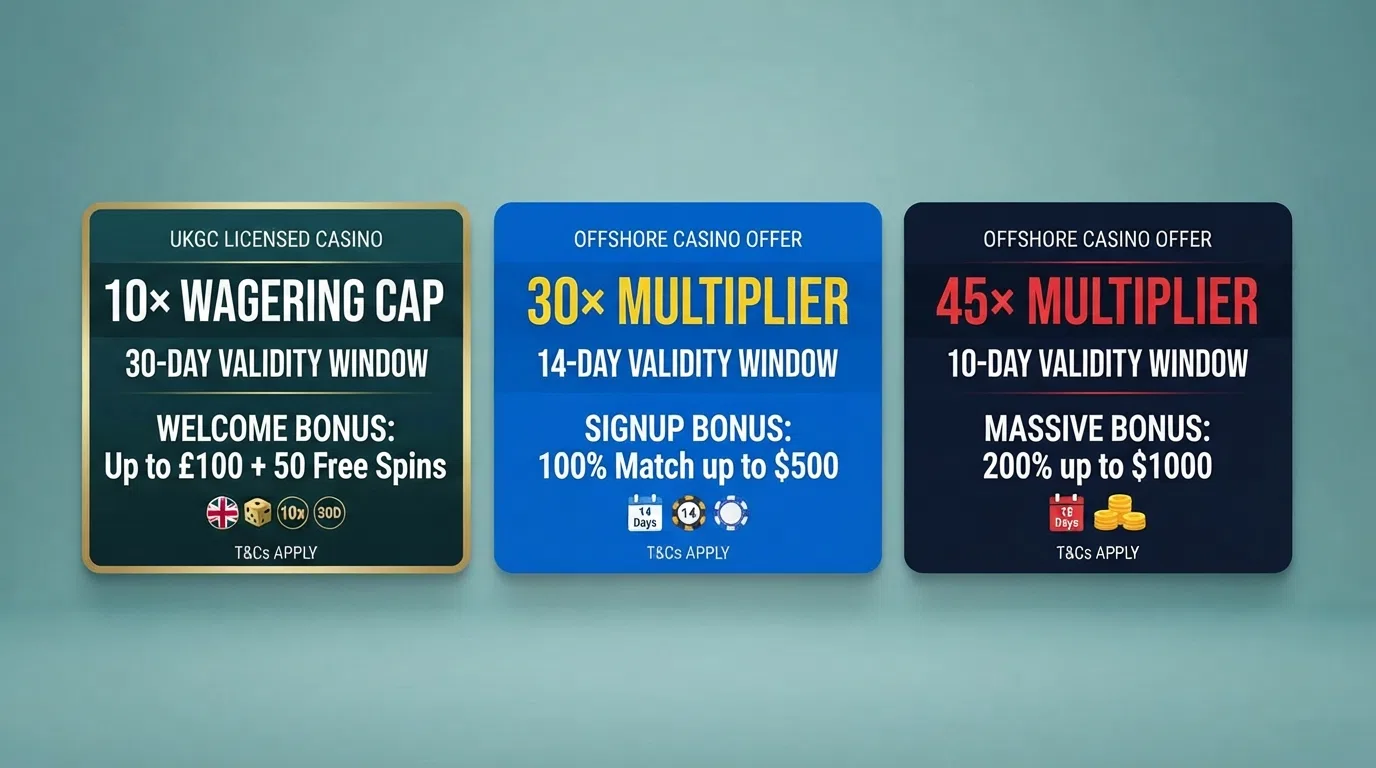
The player base is not what the framing of “non-UK” sometimes suggests. It includes people who want bigger bonuses than the UKGC’s 10× wagering cap allows, players excluded from UKGC sites by GAMSTOP and looking for a route back in, and crypto users whose payment method UKGC operators stopped accepting. None of these readers is being misled; each is making a deliberate trade.
That trade is real on its terms. Non-UK casinos typically offer 30×–50× wagering on bonus money, a multiple several times the UKGC ceiling that took effect on 19 January 2026. Credit card deposits — banned at GB-licensed operators since 14 April 2020 — are commonly accepted offshore. GAMSTOP, mandatory at every UKGC online licensee since 31 March 2020, does not cover offshore sites at all.
No UK resident has been prosecuted for gambling at an unlicensed offshore site. The Gambling Act 2005 regulates operators, not players. Section 33 creates a criminal offence for unlicensed supply to the GB market — up to 51 weeks’ imprisonment, an unlimited fine, or both — but no sanction is aimed at the player who simply opens an account. The legal risk sits with the operator. The financial risk sits with the player.
Non-UK vs UKGC casinos at a glance
A short list catches the shape of the difference before the rest of the page goes into it:
- Wagering requirements: UKGC capped at 10× on bonuses since 19 January 2026; non-UK casinos typically 30×–50×.
- Slot stake limits: £5 per game cycle for players 25+, £2 for 18–24 at UKGC sites from April/May 2025; non-UK casinos impose no statutory cap.
- GAMSTOP coverage: mandatory at UKGC licensees since 31 March 2020; absent at non-UK casinos.
- Credit card deposits: banned at UKGC sites since 14 April 2020; commonly accepted offshore.
- ADR and fund protection: UK-approved ADR and UK-standard fund segregation at UKGC sites; jurisdiction-dependent at non-UK casinos, with MGA the strongest of the offshore options.
Is It Legal? What the Gambling Act Actually Says About Offshore Casinos
The UKGC framework and your legal position as a player
The law that applies is the Gambling Act 2005, extended to remote operators by the 2014 point-of-consumption reform. The UKGC is the regulator, an executive non-departmental public body sponsored by DCMS. Its remit covers England, Scotland and Wales — Northern Ireland operates under older separate law.

The Act does two things for the player. It defines what an operator needs to do to serve GB customers lawfully, and it sets the penalties for getting that wrong. Section 33 makes unlicensed supply to the GB market a criminal offence. The penalty is severe — up to 51 weeks’ imprisonment, an unlimited fine, or both — and it is aimed at the operator supplying the site, not the player using it. No UK resident has been prosecuted for gambling at an unlicensed offshore site.
That is not the end of the story. It is the start of a different one. The player at an offshore site loses the entire UKGC complaints route. There is no Commission to write to if a withdrawal stalls; no IBAS, no eCOGRA working under UK authority. The Commission’s enforcement against non-UK operators is real but operates through disruption rather than blocking. Between April 2024 and June 2025, the Commission issued 3,140 disruption notices: 2,032 cease-and-desist notices, 774 registrar referrals, 402 host referrals and 3 payment-provider referrals. It referred 447,778 URLs to search engines; 287,961 of those URLs were removed. Across 160 disrupted sites, average engagement fell 32%.
What this means in practice: an offshore casino serving GB customers without a licence is operating in breach of the 2014 Act. The Commission can make the brand harder to find, refer its payment routes, and pressure its hosting. It cannot directly block UK access, and it does not pursue the player.
Two cost lines frame why a UKGC operator bears a structural disadvantage offshore operators do not. From 1 April 2026, Remote Gaming Duty rose from 21% to 40% on UKGC operators’ gross gambling yield. From 6 April 2025, a statutory levy of 1.1% of GGY funds treatment (50%), prevention (30%) and research (20%). Offshore operators without a GB licence pay neither. That gap is the financial reason a UKGC casino’s welcome offer looks thinner than an offshore equivalent. The offer reflects the cost.
GAMSTOP and what “non-GAMSTOP” really means
GAMSTOP has been a mandatory condition of every UKGC online operating licence since 31 March 2020. It is a centralised self-exclusion scheme. A player who registers with GAMSTOP is barred from every UKGC-licensed online operator for the period they choose — six months, one year, or five years.
Non-UK casinos do not participate. A GAMSTOP-excluded player is not blocked from opening an account at an offshore casino. That is the entire mechanism by which “non-GAMSTOP casinos” exist: there is no centralised barrier to lift, because they are not on the centralised scheme.
What an offshore casino may offer in place of GAMSTOP is operator-specific self-exclusion. Some MGA-licensed casinos maintain their own self-exclusion registers, deposit limits and reality checks. None of these is cross-operator. A player who self-excludes from one Curaçao-licensed casino can open an account at the next Curaçao-licensed casino the same afternoon. The protection is real but local; it does not travel.
This is the part of the trade a player considering an offshore site for reasons of self-exclusion most needs to hear plainly. The mechanism that GAMSTOP provides at UKGC sites — a single registration covering every operator — has no offshore equivalent.
How to verify any casino licence
Three registers matter.
For UKGC, the Commission’s public register at gamblingcommission.gov.uk/public-register/businesses is searchable by name, domain or account number. Last updated 29 July 2026, it holds 2,661 licensed businesses. A brand not on it has no GB licence.
For MGA, the public register at publicregister.mga.org.mt lists every licensee. A licence that returns no result or a different operator name is a sign of misrepresentation.
For Curaçao, the CGA portal and the Antillephone N.V. verification page are the working checks. Curaçao verification is less convenient than UKGC or MGA, partly because the post-LOK framework has reshaped how licence numbers are issued, but the routes exist.
The general test is mechanical. A legitimate casino displays a licence number on its site, footer or terms page. The reader pastes that number into the relevant register. If the search returns no result, returns a different operator name, or surfaces a licence that has been suspended or revoked, the casino is misrepresenting its licensing status. No marketing claim trumps a register search.
The protections you leave behind at the UKGC door
The table below compares what a UKGC licence provides against what an offshore operator typically offers. Empty cells are not gaps in the table. They are gaps in the protection.
| Player Protection | UKGC-Licensed Casino | Non-UK Casino |
|---|---|---|
| Wagering requirement cap | 10× maximum on bonus offers | — (30×–50× typical) |
| Online slots stake limit | £5 per game cycle (25+) / £2 (18–24) | — |
| Credit card deposit ban | Yes (since 14 April 2020) | — (commonly accepted) |
| GAMSTOP coverage | Mandatory | — |
| Mandatory deposit-limit prompt before first deposit | Yes (from 31 October 2025) | — |
| Financial vulnerability check at £150 net deposit threshold | Yes | — |
| Mandatory fund segregation to UK standards | Yes | — |
| UK-approved ADR provider | Yes | — |
| Auto-play ban | Yes | — |
| 2.5-second spin speed minimum | Yes | — |
| Ban on losses disguised as wins | Yes | — |
| Ban on reverse withdrawals | Yes (permanent) | — |
| Session loss/win/time display | Mandatory | — |
| UKGC complaints route | Yes | — |
| Statutory levy (1.1% GGY) | Borne by operator | Not paid |
| Remote Gaming Duty (40% from 1 April 2026) | Borne by operator | Not paid |
The wagering row is the one most likely to drive a player’s decision. The UKGC’s 10× cap, in force from 19 January 2026, applies only to licensed operators. Offshore casinos routinely impose 30×–50×, and a 45× bonus requires a player to wager their bonus roughly four-and-a-half times harder than a UKGC equivalent. The “magic” the marketing attaches to a 200% match wears thin fast when the wagering multiple sits at 35×.
The rows under the gambling-mechanics headings are subtler. A UKGC site cannot offer auto-play, cannot let spins run faster than 2.5 seconds per game cycle, and cannot present a win accompanied by sounds and visuals suggesting a payout when the spin resulted in a net loss. Each of these design choices is unlawful at a UKGC site. None of them is unlawful at a Curaçao-licensed casino. The reader who notices that a slot feels faster, louder or more “rewarding” offshore than at home is not imagining it; they are seeing the absence of rules the UKGC imposes by licence condition.
How slots and crypto are regulated differently
The slot rules above are one half of the offshore gap. The other is crypto.
UKGC operators do not accept cryptocurrency as a deposit method at all; it is not in their product set, and the LCCP does not contemplate it. Crypto-native casinos operate under Curaçao licences, and the regulatory framework for crypto gambling is thinner than for fiat. The Curaçao CGA’s crypto-specific oversight is less developed than MGA or UKGC standards. Transaction monitoring, source-of-funds checks and AML controls vary more sharply from operator to operator.
A reader weighing a crypto casino on a Curaçao licence is not choosing between a regulated and an unregulated option. They are choosing between a more developed regulatory regime that does not accept their payment method and a less developed one that does. The discipline of how a given operator handles that gap is something the register cannot confirm. The cashier and the terms page are where the answer sits.
The Best Non-UK Casinos We Reviewed for British Players in 2026
The ten operators below were chosen based on current industry listings and cross-referenced for active status, GBP acceptance and UK player availability. None hold a GB operating licence. The table reflects that.
| Operator | Licence Jurisdiction | Welcome Bonus | Free Spins | Wagering Multiplier | Bonus Validity |
|---|---|---|---|---|---|
| MyStake | Curaçao GCB | 150% up to £1,500 across three deposits (150% / 100% / 50%) | 30 no-deposit + additional spins with deposit | 30× on deposit + bonus | 30 days |
| DonBet | Curaçao GCB | 150% up to €750 + 50 FS (casino) / 170% up to €1,000 + 100 FS (crypto) | 15 no-deposit FS (48 h) | 30× on deposit + bonus + FS winnings | 30 days (welcome) |
| GoldenBet | Curaçao GCB | 300% up to £1,500 across three deposits | 100 bonus spins | 35× on deposit + bonus | — |
| Rolletto | Curaçao | Up to £5,500 package | Included (T&Cs) | 30× on bonus only | 30 days |
| FreshBet | Curaçao | 100% up to £500 / 250% up to £1,500 (alt code) | — | 30× on bonus only | — |
| FatPirate | Curaçao | 100% up to £500 / C$750 | 200 (20 per day × 10 days) | 35× bonus / 40× FS | 10 days from activation |
| Deal Bet | Curaçao eGaming 8048/JAZ + Kahnawake 00939 | 120% up to €600 | — | 45× on bonus | — |
| Jack | Curaçao CGA OGL/2024/1562/1139 (granted July 2025) | 100 wager-free spins on Book of Dead | 100 (winnings capped at $100, 1× turnover) | 1× | — |
| Mega Dice | Curaçao (crypto-native) | 200% up to 1 BTC + 50 FS on Le Cowboy + $5 sports FB | 50 on Le Cowboy | 6× deposit per fraction × 10 fractions | 14 days from claim |
| WinThere | Not confirmed | Two-deposit package | — | 30× or higher reported | — |
A dash in the validity column is a gap in what was available when this was written; the operator’s terms page may carry an answer. The bonus column reads in headline numbers; the wagering multiplier is the column that costs the player.
MyStake
MyStake is the longest-established brand in this set and the one whose welcome package most closely tracks a UK player’s mental model of a casino bonus. The structure is a three-stage match — 150% on the first deposit, 100% on the second, 50% on the third — topping out at £1,500 cumulative, with 30 no-deposit spins landing before the first deposit and additional spins tied to each deposit stage. Wagering is 30× on deposit plus bonus combined, with a 30-day validity window and a £20 minimum per stage.
Game supply is broad: 80+ providers including Pragmatic Play, NetEnt, Evolution Gaming and Hacksaw Gaming. For a player who has played at a UKGC site and wants the same provider footprint under a different licence, MyStake is the closest match in this set. The “magic” the marketing attaches to a 150% match wears thin fast when 30× combined wagering applies; on a £100 deposit claiming the full first-stage match, the player is wagering £250 thirty times over before any winnings become withdrawable. For GBP players who like a structured multi-stage bonus, MyStake is the entry point that asks the fewest conceptual questions.
DonBet
DonBet operates two welcome tracks running in parallel: a casino offer at 150% up to €750 plus 50 free spins, and a crypto offer at 170% up to €1,000 plus 100 free spins. There is also a small no-deposit free-spin batch — 15 spins with a 48-hour validity, the shortest window on this page — designed to land in a player’s account before any deposit decision.
Wagering is the most aggressive in the operator’s own terms: 30× on deposit, bonus and free-spin winnings combined, which is a stiffer base than MyStake’s because the free-spin winnings are pulled into the multiple. The welcome bonus itself runs 30 days; the no-deposit FS, 48 hours. Game providers include Pragmatic Play, Evolution, NetEnt and Hacksaw. The trade DonBet offers is sharper than MyStake’s: bigger percentage and more spins, but on a tighter combined wagering base. For a player who already plans to deposit in crypto, DonBet’s crypto track is the better of the two; treat the casino and crypto options as distinct products when weighing your choice.
GoldenBet
A £100 deposit at GoldenBet’s 300% match means wagering £400 thirty-five times over. The bigger the headline, the harder the clear. The percentage is higher than MyStake’s or DonBet’s, and so is the wagering base. GoldenBet runs the highest percentage match on this page at 300% across three deposits, up to £1,500 total, with 100 bonus spins attached.
Free-spin details sit inside the terms page rather than the headline banner, and bonus validity is not stated in the operator’s marketing copy; the reader should check before activating. GoldenBet is the entry for a reader who likes the largest percentage match available, with eyes open to what that headline costs in turnover.
Rolletto
Rolletto runs the lowest minimum deposit in the set — £10 — alongside the largest headline package, up to £5,500 cumulative across deposits. Wagering is 30× on the bonus amount only, not deposit plus bonus. That distinction matters: a £10 deposit that triggers a £30 bonus leaves the player wagering £30 thirty times, not £40 thirty times.
The free-spin details are in the terms page rather than the marketing copy. Bonus validity is 30 days. Game supply includes Pragmatic Play and Evolution. The arithmetic here is friendlier than MyStake’s or GoldenBet’s at small deposit sizes, because bonus-only wagering caps the total volume a small bankroll has to clear. For a player with a £50–£100 deposit budget, Rolletto’s bonus-only wagering is the cleanest of the standard offers on this page; the headline package number of £5,500 is real but distributed across multiple stages, not a single deposit.
FreshBet
FreshBet offers two welcome structures and lets the player pick. The default is 100% up to £500 on the first deposit. An alternative entry, gated by a code, raises the match to 250% up to £1,500. Wagering is 30× on the bonus amount only — the same friendlier calculation as Rolletto — at a £20 minimum deposit.
What FreshBet does not state in its headline is what the bonus does not cover. Free spins are not confirmed in available terms; bonus validity is not specified either. Both are gaps the terms page may close. Game providers include Pragmatic Play, Evolution, NetEnt and Hacksaw. For a player comparing welcome structures at the same wagering base, FreshBet is a useful comparator: same 30× as Rolletto on bonus only, but with a higher percentage match available through the alt-code path. Whether the reader can actually claim the 250% track depends on the code’s current status, which this guide cannot speak to.
FatPirate Casino
FatPirate’s structure is built around its free-spin allocation rather than its cash match. The headline is 100% up to £500 (or C$750) plus 200 free spins, delivered 20 per day over 10 days. Wagering is split: 35× on the bonus, 40× on free-spin winnings. Validity is 10 days from activation, the shortest window on this page.
The 10-day window changes the cost calculation materially. A player who activates on a Monday and clears a 35× bonus on a £100 deposit is wagering £350 thirty-five times over in 10 days. The daily free-spin drip of 20 over 10 days adds another wagering stream on a 40× multiple, with the same 10-day clock. Game providers include Pragmatic Play, Hacksaw, NowNow Gaming and Backseat Gaming. FatPirate is the operator built around a fast clear, not a month-long grind; the 30-day windows elsewhere on this page are explicitly an alternative to that pattern.
Deal Bet
Deal Bet is the only operator in the set with two confirmed licence credentials: Curaçao eGaming under licence 8048/JAZ and a Kahnawake Gaming Commission licence 00939. The operator is Famagousta B.V. The welcome bonus is 120% up to €600 — the smallest percentage in the set — but the wagering is the highest in the set at 45× on the bonus.
A £100 deposit at 120% gives a £120 bonus, wagered 45 times — £5,400 of total volume to clear. That is a different calculation from anything else on this page. Free spins are not confirmed; bonus validity and minimum deposit are not specified in available terms. The 80+ provider count is the widest in the set. A 45× bonus is a hard bar. A player weighing Deal Bet is buying dual-licence jurisdiction more than bonus economics; on the offer alone, nothing else here competes.
Jack
Jack (formerly Jackbit) is the operator with the simplest bonus arithmetic on the page. The welcome offer is 100 free spins on Book of Dead with winnings capped at $100, wagered at 1× turnover. No 30×, no 40×, no 45×. The licence is Curaçao Gaming Authority number OGL/2024/1562/1139, the only licence in this set with a regulator-verified grant date — active since July 2025. The operator is Ryker B.V. / Data Link Digital B.V.
The wager-free framing is real but bounded. The cap on winnings at $100 means the upside on the offer is fixed regardless of how the spins perform. The minimum deposit and bonus validity are not specified in available terms; the brand is crypto-focused, and crypto-native operators tend to keep welcome terms in the cashier rather than the homepage. For a player who values simplicity over headline size, Jack’s 1× turnover is the cleanest wagering condition on the page. The capped upside is the price of that cleanliness, and a reader should not ignore it.
Mega Dice
Mega Dice is a crypto-native casino with a Bitcoin-denominated welcome rather than a GBP one. The headline is 200% up to 1 BTC plus 50 free spins on Le Cowboy plus a $5 sports free bet. Wagering is released in ten fractions, each requiring 6× of the deposit to clear; bonus validity is 14 days from claim, and the minimum deposit is 20 USDT.
The fraction-based wagering is the unusual mechanic on this page. A player who deposits the 20 USDT minimum does not wager 120 USDT once; they wager 120 USDT ten times as each fraction unlocks, totalling 1,200 USDT of wagering volume to release the full bonus. The effect is to spread a single bonus across ten smaller wagering events rather than one large one, with the same total volume at the end. Game providers are the major crypto-compatible studios. Mega Dice is built for a player whose deposit currency is BTC, USDT or ETH rather than GBP. The 14-day validity is the shortest window among the larger bonuses on the page; the player should plan accordingly.
WinThere
WinThere is the operator on this page with the thinnest verified profile. The welcome package is a two-deposit structure with wagering reported at 30× or higher. Beyond that, what is verifiable is thin: licence jurisdiction is not explicitly stated, no UKGC account number has been found, game providers are not confirmed, and bonus validity is not confirmed.
The honest reading of WinThere is that this page cannot recommend it the way the others can be reviewed. A reader who lands on WinThere’s homepage and is impressed by the offer still has the verification work to do before depositing, because none of the confirmations this guide normally relies on are in place. WinThere is the entry that requires the most independent checking by the player; exercise significant caution, as this brand lacks the confirmed transparency of the other reviewed sites.
Staying Safe When GAMSTOP Isn’t There to Catch You
Player protection tools at non-UK casinos
Self-exclusion at an offshore casino is operator-specific only. A player who excludes from one Curaçao-licensed site can open an account at the next one the same afternoon; there is no centralised cross-operator scheme to register with. GAMSTOP does not cover offshore sites because offshore sites are not on its register.
Some MGA-licensed casinos offer their own self-exclusion, deposit limits and reality checks. The strongest offshore RG provision sits with MGA licensees; the weakest, with the long tail of Curaçao brands whose responsible-gambling pages are boilerplate. No mandatory standard comparable to UKGC LCCP requirements applies at the offshore tier.
Two protections UKGC licensees must offer have no offshore equivalent. The first is the mandatory deposit-limit prompt before first deposit, in force from 31 October 2025; offshore casinos do not run that prompt. The second is the financial vulnerability check at the £150 net deposit threshold; offshore casinos do not run that check either. The reader who relies on the prompt at home to set a limit will not see it offshore. The discipline has to be the player’s.
Where to get help in the UK
The help infrastructure on the British side is well-developed and free. GamCare runs the National Gambling Helpline on 0808 8020 133 — confidential, free, 24/7 — and between April 2024 and March 2025 handled more than 130,000 calls and online messages. Average waiting time for a treatment session through the National Gambling Support Network is 1.3 days. GambleAware’s network treated 11,960 clients in the same period, up 11% year on year, with 93% of those completing treatment seeing measurable improvement; one in four said their problem gambling started by age 18.
NHS gambling harm clinics operate across England, Scotland and Wales. NHS referrals totalled 4,355 in 2024/25, more than double the 2,284 recorded the year before. The NHS Adult Psychiatric Morbidity Survey 2023/24 estimated 0.4% of adults in England experience problem gambling (PGSI 8+) and 1.6% are at moderate risk (PGSI 3+) — roughly 1.6 million adults who may benefit from treatment or support.
These services are open to any UK resident regardless of where they have been playing. The casino the player has been using does not affect the help available. The page on which a player has been gambling is not the gate to treatment.
How We Chose These Casinos
The ten operators above were drawn from current industry listings and cross-checked for active status, GBP acceptance and UK player availability. Each was then checked against the UK Gambling Commission’s public register, last updated on 29 July 2026 with 2,661 licensed businesses — none of the ten appears on it. That result is the central fact of the page: a brand not on the register has no GB operating licence, no matter how the marketing frames its credentials.
Licence claims were taken from each operator’s own site display and cross-referenced against third-party review verification. One regulator-verified licence grant date is on the page: Jack’s Curaçao Gaming Authority licence OGL/2024/1562/1139, active since July 2025. For the remaining brands, licence status reflects what the operators disclose and what reviewers have corroborated; the per-brand confirmation page for each operator is the reader’s next stop.
Ranking criteria were licence jurisdiction quality, bonus terms including wagering multiplier and validity, game provider range, and transparency of operator information. The wagering multiplier was weighted highest because it is the single number that most directly determines what an offer costs the player. Where two operators offered comparable bonus value but materially different wagering, the lower-wagering option was ranked above the higher-wagering one.
What You Should Actually Weigh Before Playing at a Non-UK Casino
The trade-off the page has been working through is concrete on both sides. On the side the player gains: bonuses at 30×–50× wagering against a UKGC 10× cap, credit card acceptance, crypto deposits, and an absence of GAMSTOP coverage. On the side the player loses: the UKGC complaints route, UK-approved ADR, mandatory fund segregation to UK standards, affordability checks at the £150 threshold, and the entire LCCP rulebook that governs game design. The house still has its edge in either case; what changes offshore is how much friction sits between the player and the worst version of that edge.
The legal risk sits with the operator; no UK resident has been prosecuted for gambling at an unlicensed offshore site. The financial risk sits with the player. Section 33 of the Gambling Act 2005 makes unlicensed supply to the GB market a criminal offence — up to 51 weeks’ imprisonment, unlimited fine — but the offence is on the supply side, and the UKGC’s enforcement model is disruption-based rather than player-targeted.
The reader should verify any casino’s licence on the UKGC, MGA or Curaçao register before depositing. A casino whose licence number returns no result, a different operator name, or a suspended or revoked licence is misrepresenting its licensing status regardless of what its homepage says. The verification is a five-minute task that is the difference between playing at a known offshore brand and playing at an unknown one.
Set a personal deposit limit and time limit before the first deposit. Offshore casinos will not prompt for one, and the deposit-limit prompt that UKGC sites run from 31 October 2025 does not exist here. The discipline has to be the player’s. The “control” the marketing attaches to a player’s choices wears thin fast when there is no system asking the player to set one.
Frequently Asked Questions
Are winnings from non-UK casinos tax-free for British players?
Yes. The UK does not tax individual gambling winnings, whether the casino is UKGC-licensed or offshore. The tax point sits with the operator: UKGC operators pay Remote Gaming Duty of 40% from 1 April 2026, while offshore operators without a GB licence pay neither that duty nor the 1.1% statutory levy from 6 April 2025.
What payment methods are available at non-UK casinos that are not allowed at UKGC sites?
Two main ones. Credit card deposits have been banned at GB-licensed operators since 14 April 2020, but offshore casinos commonly accept Visa and Mastercard credit cards, including via e-wallets funded by credit. Cryptocurrency is the second: Bitcoin, Ethereum and USDT are standard at Curaçao-licensed crypto-native operators, while UKGC sites do not accept crypto at all.
How do wagering requirements at non-UK casinos compare to the UKGC 10× cap?
The UKGC’s 10× bonus wagering cap has applied since 19 January 2026 and binds only UKGC-licensed operators. Offshore casinos routinely impose 30×–50×, with Deal Bet at 45× the highest in this set. That makes a bonus three to four-and-a-half times harder to clear offshore than at a UKGC equivalent, before any difference in how wagering is calculated is even counted.
What happens if a non-UK casino refuses to pay out my winnings — can I complain to the UKGC?
No. The UKGC complaints route covers UKGC-licensed operators only; an offshore casino with no GB licence is outside its remit. The path runs through the operator’s ADR and, for MGA sites, the MGA’s Player Support Unit, or for Curaçao sites, a CGA-certified ADR entity under the LOK framework. The Commission is not where the complaint goes.
Are non-GAMSTOP casinos safe for UK players who have a gambling problem?
No — not as a substitute for GAMSTOP. Self-exclusion at an offshore casino is operator-specific only, with no centralised cross-operator scheme. A player registered with GAMSTOP will find offshore sites that accept them, but the protection GAMSTOP provides has no offshore equivalent. UK help services remain open to any UK resident at any time.
Account – trustedcasinos-notongamstop
Content created by the «trustedcasinos-notongamstop» team