
Wire Transfer Casinos UK: Where Bank Transfers Still Work in 2026
 Available in GB
Every UK-licensed online casino accepts bank transfers for deposits or withdrawals. The question is not whether you can use one; it is how long the transfer takes, what the minimum is, whether it triggers the welcome offer, and which operator treats bank transfer as a first-class payment method rather than a fallback. Nine of the ten operators in this comparison still take bank transfer for deposits. The tenth, William Hill, removed it as a deposit method in March 2022 and keeps it only for cashing out. That single fact is the clearest signal of how the UK market treats this payment rail: a withdrawal backbone, sometimes a high-limit deposit channel, but never the fastest way to fund an account.

The “wire transfer” label does most of the work. UK operators do not run separate wire transfer and bank transfer products. A “wire transfer casino” is simply a UKGC-licensed site where bank transfer appears in the cashier. The confusion traces back to the origins: a wire transfer is a SWIFT or telegraphic transfer between banks, a term inherited from the days of telegraphed payment instructions. Bank transfer is the catch-all UK banking term covering BACS (the three-day clearing system most UK salaries run on), Faster Payments (the near-instant retail system, capped at £1 million per transaction), and Open Banking rails like Trustly (where the player authenticates with their bank and the casino receives confirmation in real time). When a UK casino cashier lists “Bank Transfer” or “Wire Transfer,” it is offering one of these rails, and the difference between them is the difference between a one-day deposit and a five-day one.
*Current as of September 9, 2026 against the UK Gambling Commission’s public licence register.*
Wire Transfer vs Bank Transfer: What UK Casino Players Need to Know
The two terms get used interchangeably on UK casino sites because, for the player, they point at the same destination: a funds transfer between a personal bank account and a casino’s merchant account. The underlying rails differ, though, and the difference shows up in the deposit window.
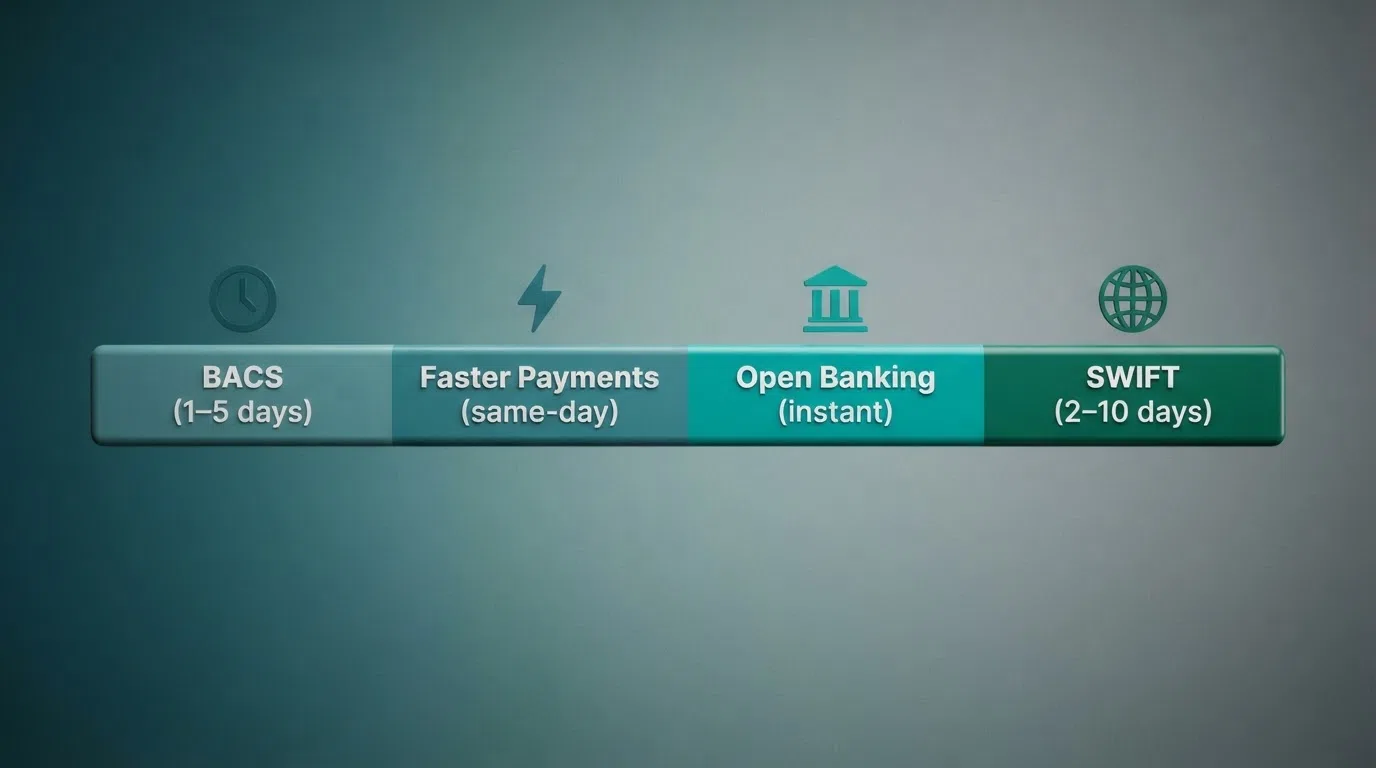
A traditional bank wire (SWIFT) is the slowest option, taking one to five business days domestically and up to ten for international transfers that route through correspondent banks. BACS, the UK system that handles most direct debits and standing orders, sits in the same one-to-five-day bracket because it runs on a three-day clearing cycle. Faster Payments, launched in 2008 and now processing most UK retail transfers, settles in seconds, but not every bank enables it for gambling transactions, and not every casino uses it. Open Banking, the newest of the three, is genuinely instant: the player authorises a payment through their banking app, and the casino receives confirmation in real time. Operators including Ladbrokes, Coral, Paddy Power, Betfair, Betfred and Sky Vegas route instant bank transfer through Open Banking providers such as Trustly or Truelayer.
In the UK casino cashier, the option a player should look for is “Instant Bank Transfer” or “Pay by Bank” if speed matters. “Bank Transfer” or “Wire Transfer” as a standalone label typically means the slower standard rail, unless the cashier specifies otherwise. The choice between the two is rarely binary; most featured operators offer both, with the instant option hidden behind a tab the player has to select.
How UK Online Casinos Process Bank Transfer Payments
The flow is straightforward. The player opens the casino cashier, selects bank transfer, and receives a set of details: the casino’s bank account number and sort code, a reference code (often the player’s account ID), and sometimes the payee name. The player then opens their own banking app or online banking portal and sends the funds to that account. Once the casino’s bank receives and identifies the payment — matching the reference to the player account — the balance is credited.
Two regulatory layers govern this process. The Payment Services Regulations 2017 require that any payment service provider processing funds for a UKGC licensee be regulated by the Financial Conduct Authority, which is why LCCP Condition 5.1.2 restricts payment processing to regulated PSPs. Open Banking providers fall within this regime, which is why they are a permissible deposit route at all. Anonymous bank transfers, where the player sends funds from an unverified account, are not possible: since 7 May 2019, every UKGC licensee must verify name, address and date of birth before the first deposit or any gambling. The pre-2019 grace period, which allowed 72 hours of play before ID checks, is gone.
The credit card ban that took effect on 14 April 2020 does not touch bank transfers. A player can still fund an account by direct bank transfer, because the card ban is restricted to credit instruments and to credit-card-funded e-wallet deposits. Debit card, bank transfer, and Open Banking are all unaffected.
What a Bank Transfer Casino Can and Cannot Offer You
The strengths of bank transfer are familiar to anyone who has used online banking. Deposit ceilings are high: bet365 caps bank transfer deposits at £100,000, Virgin Games at £250,000, far above what any debit card or e-wallet allows. The transaction is direct, with no intermediary holding the funds; the player sees a clean bank-to-casino line on their statement. There is no e-wallet account to register, no prepaid card to buy, and no card data to share. For players who prefer not to hand card details to a gambling site, bank transfer is the lowest-friction option that still works.
The weaknesses are speed, bonus access, and minimum deposit thresholds. Standard bank transfer is not instant; even Faster Payments, when a casino accepts it, may take up to two hours. Withdrawals are slower still: two to five business days after the casino’s own one-to-three-day processing stage, which means a typical cashout lands in three to eight business days for most players. Welcome bonuses frequently exclude bank transfer as a qualifying deposit method: at bet365, William Hill, Ladbrokes, Paddy Power, Betfair and Betfred, the standard bank transfer rail cannot be used to trigger the headline offer. And minimum deposits on standard bank transfer are higher than on debit cards: Betfred’s standard rail requires £85, Paddy Power’s £30, while most debit card minimums sit at £5 or £10.
One reality worth naming: no UK online casino operates a physical cashier for bank transfers. The option is online-only, processed through the same banking rails as any other online transfer. A player who wants to hand over cash in person is looking at a high-street bookmaker, not a licensed online casino.
Why UK Casinos Still Offer Bank Transfer in the Age of Instant Payments
Open Banking has closed the speed gap for six of the ten featured operators. So why does bank transfer persist as a deposit method at all?
Three reasons. The first is player demand from users who do not want to share debit card details with a gambling site, or who have hit a debit card deposit cap and need a higher ceiling. The second is high rollers: bet365’s £100,000 bank transfer ceiling and Virgin Games’ £250,000 ceiling are higher than any card or e-wallet limit and target the segment of the market that values deposit size over deposit speed. The third is structural: bank transfer remains the dominant withdrawal rail even at operators that have moved deposits to Open Banking. A casino that takes Open Banking for deposits still pays out by bank transfer to a player’s current account, because the same card a player deposited with may have expired, been cancelled, or be subject to a withdrawal limit that bank transfer does not impose.
The tax environment has not pushed bank transfer out. Remote Gaming Duty rose from 21% to 40% in April 2026, the steepest single increase in the duty’s history, but none of the ten featured operators have dropped bank transfer as a result. The rail survives the margin pressure because the alternatives, especially card processing fees, eat into operator margins on small deposits. Bank transfer costs the operator little; the cost is paid in slower settlement, not in fees.
How Long Do Wire Deposits and Withdrawals Really Take in 2026?
Marketing pages for UK casinos often describe withdrawals as “fast” or “instant.” For bank transfer, the honest answer is: it depends on which rail, and which casino.
Standard bank transfer deposits take one to five business days. That is the BACS clearing cycle plus operator processing. International SWIFT wires extend that to two to ten business days, because correspondent banks in the chain may each take a day to pass the payment along. Faster Payments, where supported, settles in seconds to two hours. Open Banking deposits are genuinely instant: the player authenticates in their banking app, the casino receives confirmation, and the balance is credited in real time.
Withdrawals are slower because they run through two stages. The casino’s own processing stage takes one to three business days, during which the operator runs final KYC checks, confirms the withdrawal amount, and prepares the payment instruction. Only then does the bank transfer begin, adding two to five business days. A typical non-urgent withdrawal therefore takes three to eight business days from request to cleared funds, and the first withdrawal is often slower than later ones because the casino runs enhanced KYC on the first cashout.
The operators that break the pattern are those that have built instant withdrawal infrastructure. Virgin Games quotes up to one working day for bank transfer withdrawals, the fastest non-Open-Banking rail in the featured set. Sky Vegas, using Trustly, processes Pay by Bank withdrawals within six hours. Betfair and Paddy Power offer instant withdrawals after the first deposit. For the rest, the three-to-eight-day window is the lived experience.
How to Deposit by Bank Transfer at a UK Casino
The deposit flow is consistent across the featured operators. The player navigates to the cashier, selects deposit, and chooses “Bank Transfer” or “Wire Transfer” from the payment methods list. The cashier then displays the casino’s banking details: account name, account number, sort code, and a payment reference. The reference is critical, because it links the incoming payment to the player’s casino account; omitting it or entering it incorrectly causes manual reconciliation that can add days to the credit time.
The player then opens their own banking app or online banking portal and sets up the transfer to those details. For Open Banking, the player selects “Instant Bank Transfer” instead, is redirected to their bank’s authentication page, approves the payment, and returns to the casino with the balance credited. For standard bank transfer, the player logs into their bank separately and initiates the transfer from their own account.
Minimum deposits vary. Ladbrokes, Coral, Betfair and Betfred’s instant rail accept £5, the lowest in the featured set. Betfred’s standard bank transfer requires £85. Paddy Power’s standard rail is £30, while its instant rail is £5. Most other operators sit at £10. Maximum deposits range from £2,000 (Ladbrokes, Coral, Gala Bingo) to £250,000 (Virgin Games). No operator in the featured set charges a deposit fee for bank transfer.
After sending the funds, the player waits. On Open Banking, the wait is over. On standard bank transfer, the player checks the casino balance the next business day, and again the day after, and usually sees the funds credited by day three. Until the casino’s bank identifies the payment and matches the reference, the casino has no way to credit the player’s account.
How to Withdraw Casino Winnings by Bank Transfer
The withdrawal flow reverses the deposit. The player opens the cashier, selects withdraw, chooses bank transfer, and enters the amount and their bank details. The request enters the casino’s pending queue.
The casino processing stage is the variable. The operator runs KYC re-verification on the first withdrawal, confirms the withdrawal amount against the player’s balance, and checks for any bonus-related restrictions (active bonus funds, for example, cannot be withdrawn until wagering is complete). The processing window is one to three business days, though most operators complete standard verifications within 24 hours.
Once the casino approves the withdrawal, the bank transfer leg begins. Standard bank transfer takes two to five business days to reach the player’s account. Open Banking withdrawals, where supported, are faster: Virgin Games quotes up to one working day, Sky Vegas six hours via Trustly, Betfair and Paddy Power instant after the first deposit.
A regulatory point worth knowing: since October 2021, reverse withdrawals are permanently banned. A player who requests a withdrawal cannot cancel it and return the funds to the casino balance. This closes a marketing practice where operators would hold withdrawals pending, hoping the player would reverse the request and keep playing, and it means a bank transfer withdrawal, once approved, will land. The player does not need to worry about the casino sitting on the funds indefinitely; the rule is the ceiling on any delay.
The first withdrawal often takes longer than subsequent ones because of KYC. Once the operator has verified the player’s identity and bank details, later withdrawals pass through the same pipeline more quickly. 888casino, which sits outside the featured set, quotes seven to ten days for standard wire transfer withdrawals and five to eight days for Gold VIP members, illustrating how tiered the speed gap is for a non-instant rail.
Real Bank Transfer Processing Times: Deposit vs Withdrawal Timelines
The gap between deposit and withdrawal is the single most-misrepresented number on UK casino banking pages. The same method, bank transfer, is slower on the way out than on the way in, because the casino adds a processing stage that does not exist on deposits.
For deposits, the rail determines the speed. Standard BACS bank transfer: one to five business days. Faster Payments, where enabled for gambling: same-day to two hours. Open Banking/Trustly: instant. International SWIFT: two to ten business days, slower when the transfer routes through one or more correspondent banks outside the UK.
For withdrawals, the casino adds one to three business days of internal processing before the bank transfer even begins. The total is therefore three to eight business days for a standard bank transfer withdrawal, even though the bank transfer leg itself is only two to five business days. Virgin Games is the exception in the featured set, quoting up to one working day for the full flow, achieved by collapsing the processing and transfer stages together. Sky Vegas achieves a six-hour withdrawal through Trustly, but that is a separate rail from the standard bank transfer.
| Transfer Type | How It Works | Deposit Speed | Withdrawal Speed | Minimum at Featured Casinos | Featured Operators Offering It |
|---|---|---|---|---|---|
| Standard BACS / Bank Transfer | Player sends funds to casino’s bank account using sort code and account number | 1–5 business days | 3–8 business days (casino processing + bank transfer) | £10–£85 (Betfred highest at £85) | bet365, William Hill (withdrawal only), Paddy Power, Betfred, Virgin Games, Gala Bingo |
| Faster Payments | UK retail instant payment system, subject to bank and merchant support | Same-day to 2 hours | Same-day to 2 hours (where supported) | £5–£10 | Limited featured-operator coverage |
| Open Banking / Trustly / Truelayer | Player authenticates in their banking app; casino receives instant confirmation | Instant | Instant to 6 hours (Sky Vegas fastest) | £5 (Ladbrokes, Coral, Paddy Power, Betfair, Betfred) | Ladbrokes, Coral, Paddy Power, Betfair, Betfred, Sky Vegas |
| International SWIFT / Wire | Correspondent-bank chain for non-UK bank accounts | 2–10 business days | 2–10 business days (plus casino processing) | £10+ | bet365 (international deposits), Virgin Games |
Why is the same method slower on withdrawal? Because deposits are a credit risk the casino controls: the player has already sent the funds, and the casino simply waits for them to arrive. Withdrawals are a debit the casino must authorise, and the authorisation stage includes KYC, fraud screening, and source-of-funds checks on large amounts. The processing window is the casino’s protection, not an arbitrary delay, and the three-to-eight-day total is the realistic expectation for any non-instant bank transfer withdrawal.
Fees and Hidden Costs of Casino Bank Transfers in the UK
The headline is simple: no operator in the featured set charges a deposit fee for bank transfer. bet365, Ladbrokes, Coral, Paddy Power, Betfred, Sky Vegas and Virgin Games all publish “no fee” for bank transfer deposits. The same is true for withdrawals, though withdrawal fees are rarer across the industry than deposit fees because operators prefer to absorb the cost of paying out.
The less visible cost is on the bank side. UK domestic bank transfers are typically free for the player, because most UK current accounts bundle free Faster Payments and BACS transfers. International SWIFT wires, by contrast, may incur intermediary-bank deductions. Each correspondent bank in the SWIFT chain can take a processing fee, typically £10–£25 per hop, deducted from the transfer amount rather than charged separately. A player sending £1,000 from a non-UK bank account to a UK casino may find £20–£50 missing on arrival.
The research here is thin. No major UK comparison site quantifies the bank-side fees a player is likely to face on international transfers, and the fee structure varies by sending bank, receiving bank, and the number of correspondent banks in the chain. What is clear is that for domestic UK bank transfers, the player pays nothing beyond their own bank’s time.
A second hidden cost is currency conversion. A player who deposits from a non-GBP bank account will see their bank or the casino’s payment processor apply a foreign-exchange margin, typically 1–3% above the mid-market rate. This is not a fee in the casino’s fee schedule; it is baked into the exchange rate. Players funding a UK casino from a euro or dollar account should expect to lose 1–3% on the conversion, on top of any SWIFT correspondent-bank charges.
Why Your Bank Transfer Casino Deposit Is Not Instant — and When It Is
The delay on a standard bank transfer comes down to the BACS clearing cycle. BACS processes payments in three-day batches: submission day, processing day, settlement day. A transfer submitted on Friday does not settle until Wednesday. Faster Payments, launched in 2008, was designed to bypass this, and it works for most UK retail payments, but support for gambling transactions is inconsistent. Some banks block Faster Payments to gambling merchants outright; others allow them but at lower priority than non-gambling transfers; still others route them through BACS anyway. The result is that a Faster Payments deposit that should take seconds sometimes takes hours or a day.
Open Banking is the genuine instant alternative. The player selects “Instant Bank Transfer” or “Pay by Bank” in the cashier, is redirected to their bank’s authentication page, approves the payment, and returns to the casino with the balance credited. The casino never sees the player’s bank login details; the Open Banking provider acts as a regulated intermediary that confirms the payment has been authorised. Six of the ten featured operators offer this: Ladbrokes, Coral, Paddy Power, Betfair, Betfred and Sky Vegas. The two that do not, bet365 and Virgin Games, rely on standard bank transfer for deposits.
Why have bet365 and Virgin Games not adopted Open Banking? bet365’s high deposit ceiling of £100,000 exceeds the £1 million Faster Payments limit, so the operator may have concluded that the standard rail serves its high-roller segment better. Virgin Games offers the highest deposit ceiling of all, £250,000, an order of magnitude above the typical Open Banking limit. Both operators have optimised for the high-roller deposit, not the small-deposit speed.
The Best UK Casinos That Accept Bank Transfer in 2026
The comparison below covers ten UKGC-licensed operators ranked on their bank transfer terms. The ranking is a payment-method comparison, not an overall casino review: it measures deposit availability, minimums, withdrawal speed, and welcome bonus eligibility via bank transfer. Game library, customer support, and live casino quality are outside its scope.
| Operator | UKGC Licence | Bank Transfer Deposit Available | Min Bank Transfer Deposit | Bank Transfer Withdrawal Time | Welcome Bonus | Bank Transfer Triggers Bonus |
|---|---|---|---|---|---|---|
| bet365 | Confirmed | Yes | £10 | 1–5 business days | Bet £10 Get £30 in Free Bets (sports) or casino equivalent | May not trigger — verify terms |
| William Hill | Confirmed | No (removed 30 March 2022) | N/A | 3–5 business days | Bet £10 Get £30 in Free Bets | No (debit card only) |
| Ladbrokes | Confirmed | Yes (instant via Open Banking) | £5 | Instant to 1–5 business days | 100 No-Wagering Free Spins | No (debit card / Apple Pay / Google Pay required) |
| Coral | Confirmed | Yes (instant via Open Banking) | £5 | 1–4 hours to 1–5 business days | 100 Free Spins + £10 Bonus (10× on bonus) | No (debit card required) |
| Paddy Power | Confirmed | Yes (standard + instant) | £5 (instant) / £30 (standard) | Instant (after first deposit) to 1–5 business days | 60 + 100 Free Spins | No (debit card / Apple Pay required) |
| Betfair | Confirmed | Yes (instant via Open Banking) | £5 | Instant (after first deposit) to 1–5 business days | £50 in free bets | No (debit card / Apple Pay required) |
| Betfred | Confirmed | Yes (standard + instant) | £5 (instant) / £85 (standard) | 3–10 banking days | £50 free bets or 200 Free Spins | Standard £85 excluded; Truelayer instant qualifies |
| Sky Vegas | Confirmed (Flutter) | Yes (Pay by Bank) | £10 | Within 6 hours via Trustly | 200 Free Spins no wagering | 0× wagering — bonus terms not gated by wagering |
| Virgin Games | Confirmed | Yes | £10 | Up to 1 working day | 100 Free Spins on Game of Thrones (£0.10 each, no wagering) | 0× wagering — no gating |
| Gala Bingo | Confirmed | Yes (capped at £2,000 per transaction) | Displayed at cashier | 1–5 business days | 100 Free Spins (10× wagering) | No |
Seven of the ten operators exclude bank transfer from the welcome bonus trigger. The exceptions are Sky Vegas and Virgin Games, where the free-spin welcome carries no wagering requirement, so the qualifying-deposit method matters less. The “Bet £10 Get £30” sportsbook offers at bet365 and William Hill require a debit card deposit, as do the casino free-spin offers at Ladbrokes, Coral, Paddy Power, Betfair and Betfred. A player who deposits by bank transfer to claim a welcome bonus is, at most of the featured operators, depositing into an account that will not receive the bonus.
bet365
bet365 sits at the top of the UK market by revenue and offers the second-highest bank transfer deposit ceiling in the featured set at £100,000. The minimum is £10, the fee is none, and the deposit window is two to ten business days, domestic faster, international slower. The ceiling makes the operator attractive to high rollers, but the speed makes it a poor choice for anyone who wants to play within minutes of depositing.
Withdrawal via bank transfer takes one to five business days, which is mid-pack in the featured set. The welcome bonus, Bet £10 Get £30 in Free Bets on the sportsbook or a casino equivalent, carries a 10× wagering cap under the December 2025 UKGC rules, and bank transfer may not qualify as a triggering deposit; the operator’s terms are explicit that debit card is the qualifying method. The game library spans Playtech, Microgaming, NetEnt, and Pragmatic Play, the broadest provider mix in the featured set, though that breadth is irrelevant to a player choosing on payment terms.
For high-roller players needing a £100,000 ceiling, bet365 remains the industry benchmark. Those chasing a welcome offer will find other operators better suited to their goals.
William Hill
William Hill removed bank transfer as a UK deposit method on 30 March 2022. The rail remains available for withdrawals, where it processes in three to five business days, but a player who arrives at William Hill looking to deposit by bank transfer will find the option absent from the cashier. The operator belongs in this ranking because it is one of the ten highest-profile UKGC-licensed brands and because its withdrawal-only status is itself a data point: William Hill decided, four years ago, that bank transfer was no longer worth offering as a deposit rail.
The welcome bonus, Bet £10 Get £30 in Free Bets, is debit-card only, matching the policy at bet365. These free bets are subject to the 10× UKGC cap and expire in seven days. Current game providers include Playtech, Microgaming, NetEnt and IGT. If you hold an existing William Hill account and only need to know if bank transfer withdrawal is still supported, the answer remains yes, with processing times of three to five business days.
Ladbrokes
Ladbrokes offers instant bank transfer via Open Banking from a £5 minimum and a £2,000 maximum, the lowest minimum and the tightest ceiling in the featured set. The instant rail processes in real time, the standard rail takes one to five business days for withdrawals. The £2,000 ceiling means Ladbrokes is not a high-roller option for bank transfer, but the £5 floor makes it the most accessible entry point.
The welcome bonus, 100 No-Wagering Free Spins on a £10 deposit, is the cleanest offer in the featured set: zero wagering requirements on free spin winnings, so the player keeps what they win. The catch is that the qualifying deposit must be made by debit card, Apple Pay, or Google Pay. Bank transfer, even the instant Open Banking rail, is excluded from triggering the welcome. A player who deposits £10 by bank transfer to claim the spins will not receive them.
The 10× UKGC wagering cap applies to any standard cash deposit bonus here, though not to the no-wagering free spins. Games are provided by Playtech, Microgaming, NetEnt and IGT. With its accessible £5 minimum, Ladbrokes is an excellent choice for casual players who value speed, provided they have a debit card handy for the welcome offer.
Coral
Coral mirrors Ladbrokes on the payment side: instant bank transfer via Open Banking from £5, capped at £2,000 per transaction, no fee. The withdrawal window is one to four hours to one to five business days, meaning the faster end of the rail is genuinely fast for a bank transfer withdrawal. The welcome bonus is a dual structure: 100 free spins plus a £10 bonus, with the £10 bonus carrying 10× wagering and the free spins fixed at 10p per spin on selected games, valid seven days.
The dual structure rewards players who want both a free-spin burst and a small cash bonus to extend their session, but the wagering on the bonus cash is the price. A player who receives a £10 bonus with 10× wagering must wager £100 before the bonus converts to withdrawable cash, assuming only the bonus amount is wagered. The free spins carry no wagering on their winnings, so that component is clean.
As with Ladbrokes, the welcome deposit must be made by debit card, as bank transfer rails are excluded. Bonus funds are valid for fourteen days to accept and thirty days to use, while free spins expire after seven days. Games are provided by Playtech, Microgaming, NetEnt and IGT. Coral offers a solid balance of free spins and cash bonuses, though you will need a separate payment method to trigger the promotion.
Paddy Power
Paddy Power is the only featured operator that runs two distinct bank transfer rails side by side. The standard bank transfer accepts deposits from £30 and takes two to five business days. The instant bank transfer, via Open Banking, accepts deposits from £5 and processes in real time. A player choosing between the two is choosing between a higher minimum and a slower window or a lower minimum and instant access.
The withdrawal side is the strongest in the featured set for speed: instant after the first deposit via the instant rail, or one to five business days via the standard rail. The welcome bonus, 60 free spins plus a further 100 free spins on a £10 deposit, is a two-stage offer, but the qualifying deposit must be made by debit card or Apple Pay. Bank transfer is excluded from triggering the welcome, both rails.
Game providers cover Playtech, Microgaming, NetEnt and Blueprint. The 10× UKGC cap applies to any cash bonus. Paddy Power’s payment infrastructure is the most flexible in the featured set for a player who wants both a low minimum and a high ceiling on the same operator, though neither rail will trigger the welcome.
Betfair
Betfair’s instant bank transfer, via Open Banking, processes deposits from £5 in real time at eligible UK banks. The withdrawal side is similarly strong: instant after the first deposit, or one to five business days via standard bank transfer. The welcome bonus is sportsbook-led: £50 in free bets on a £10 qualifying bet at minimum odds of 1/1 (2.0), qualifying bet within 30 days, free bets expiring 30 days after credit. Debit card or Apple Pay is required for the qualifying deposit; bank transfer is excluded.
For a casino player, the sportsbook welcome is a poor fit. The free bets can only be used on sports markets, not on casino games, so a player who wants to use them on slots is out of luck. The qualifying bet must be at minimum odds of 1/1, and the casino equivalent of a £10 slot spin does not count. Game providers cover Playtech, NetEnt, IGT and Red Tiger.
Standard regulatory wagering limits apply to cash bonuses here. For a player who wants instant bank transfer deposits and withdrawals and is happy to use a debit card for a sportsbook welcome, Betfair is a clean option. For a casino-only player, the welcome is irrelevant, and Betfair competes on payment terms alone.
Betfred
Betfred has the widest gap in the featured set between its two bank transfer rails. The standard bank transfer accepts deposits from £85, an unusually high minimum, and the instant rail via Open Banking/Truelayer accepts deposits from £5. Both are fee-free and instant on the instant rail. The standard rail’s £85 minimum is the highest bank transfer minimum in the featured set, and the welcome bonus explicitly excludes the standard £85 rail: only the instant Truelayer rail, debit card, or Apple Pay triggers the Bet £10 Get £50 in Free Bets or 200 Free Spins offer.
Withdrawal via bank transfer takes three to ten banking days, the longest in the featured set. A player who deposits by bank transfer and then withdraws by bank transfer is looking at a cashout window of up to two weeks. The instant rail, where supported, processes withdrawals faster, but the standard bank transfer leg remains the bottleneck for large withdrawals.
In January 2026, Betfred removed PayPal and other e-wallets from its payment options, narrowing the choice to debit cards, Apple Pay, and bank transfer. The 10× UKGC cap governs cash bonuses here. While the instant Truelayer rail offers a faster experience, the £85 minimum on the standard rail serves a different, more traditional player base. Ultimately, the bonus is best accessed via the instant payment route rather than the standard wire.
Sky Vegas
Sky Vegas, part of Flutter Entertainment, offers Pay by Bank deposits from £10, instant, no fee, alongside a standard bank transfer option. The withdrawal side is the fastest in the featured set: Pay by Bank and Trustly withdrawals land within six hours, faster than any other operator’s instant rail. Standard debit card withdrawals take one to three working days.
The welcome bonus is 200 free spins with zero wagering requirements. The player must deposit £10 and stake £10 on selected slots within 30 days, and the free spins expire seven days from credit. Because the free spins carry no wagering, any winnings are withdrawable immediately, and the qualifying-deposit method matters less than at operators where the bonus is gated by 10× wagering. A bank transfer deposit can still trigger the free spins, though the £10 minimum and the requirement to stake £10 on selected slots mean the player must use the casino balance, not the deposit rail, to clear the stake.
Game providers include Playtech, NetEnt, Blueprint and Pragmatic Play. Cash bonuses are subject to the 10× UKGC cap, but since the 200 free spins carry 0× wagering, that cap is effectively irrelevant for this welcome offer. For those prioritising payout speed, Sky Vegas is an unmatched choice in the current market.
Virgin Games
Virgin Games holds the highest bank transfer deposit ceiling in the featured set at £250,000, an order of magnitude above the next-highest. The minimum is £10, the fee is none, and the deposit is instant. The withdrawal side is the fastest non-instant bank transfer rail in the featured set: up to one working day, a meaningful improvement on the three-to-eight-day window at most operators.
The welcome bonus is 100 free spins on Game of Thrones, valued at £0.10 per spin (1p coin size, 10 lines), with zero wagering requirements on winnings. The qualifying requirement is a £10+ deposit and £10+ wagered on slots, with 30 days to complete the qualifying and 30 days to use the free spins after that. Because the free spins carry no wagering, the welcome is clean and the deposit method is less restricted, though the casino’s terms specify that a debit card is the standard qualifying method; bank transfer eligibility should be verified at the cashier.
Game providers span NetEnt, IGT, Microgaming and Evolution, the last covering live dealer. The combination of a quarter-million-pound deposit ceiling, sub-24-hour withdrawals, and no-wagering free spins makes Virgin Games the strongest high-roller option in the featured set for a player who values both ceiling size and withdrawal speed.
Gala Bingo
Gala Bingo is the only featured operator that caps all payment methods at £2,000 per transaction. The cap applies to debit card, e-wallet, and bank transfer alike, and is the most restrictive single-transaction ceiling in the featured set. On top of the per-transaction cap, players may hold a maximum of three active payment methods over a 30-day rolling period, a friction point that limits how a player can structure their deposits.
Bank transfer deposits are available, with the minimum displayed at the cashier. Withdrawals via bank transfer take one to five business days. The welcome bonus is 100 free spins at 10p per spin, valid seven days from credit, on selected games, with 10× wagering on any bonus winnings. The player must deposit £10 and spend £10 on slots, and must claim the bonus within seven days of registration.
Game providers span Playtech, Microgaming, NetEnt and Pragmatic Play. For a player who does not need a high deposit ceiling, is happy with £2,000 per transaction, and wants a straightforward welcome offer, Gala Bingo is a reasonable match. For a high roller, the £2,000 cap is a hard ceiling regardless of payment method.
How UKGC Licensing Protects Every Bank Transfer Casino Player
The UK Gambling Commission is the single statutory regulator for gambling in Great Britain, an executive non-departmental public body sponsored by the Department for Culture, Media and Sport. Every operator taking GB players must hold a GB operating licence, a requirement imposed by the Gambling (Licensing and Advertising) Act 2014, which extended the point-of-consumption regime to remote gambling. An operator based in Malta, Curaçao, or Gibraltar cannot lawfully take GB players without a UKGC licence, and the licence register, last updated 29 July 2026 with 2,663 records, is the public source a player should consult before depositing.

The Commission’s three licensing objectives, set out in section 1 of the Gambling Act 2005, frame every decision the regulator makes. The first is preventing gambling from being a source of crime or disorder, which is why every payment processor used by a UKGC licensee must be regulated under the Payment Services Regulations 2017 (LCCP Condition 5.1.2). The second is ensuring gambling is conducted in a fair and open way, which is why game RTPs are tested and published, autoplay is banned, and spin speeds are capped. The third is protecting children and other vulnerable persons, which is why identity is verified before the first deposit, GAMSTOP is mandatory, and stake caps apply to online slots.
For a bank transfer depositor, the regulatory framework means the operator has already passed a fit-and-proper test, the payment processor handling the transfer is FCA-regulated, and the player’s funds are held in segregated accounts. The credit card ban, in force since 14 April 2020, ensures no gambling transaction is funded by credit, removing a class of harm that the regulator identified as a risk factor. The anonymity that a bank transfer might otherwise offer is closed by the pre-deposit ID verification rule, in force since 7 May 2019, which means the regulator knows who is playing, even if the player never uses a card.
The UKGC Licence: What It Requires of Every Bank Transfer Casino
The UKGC operating licence comes with conditions and codes of practice that govern how an operator processes payments. The relevant conditions for bank transfer are in the Licence Conditions and Codes of Practice (LCCP), particularly the social responsibility codes and the remote technical standards.
LCCP Condition 5.1.2 requires that licensees only accept payments via regulated payment service providers under the Payment Services Regulations 2017. This is why Open Banking providers such as Trustly and Truelayer are permissible deposit rails at UKGC-licensed casinos: they are FCA-regulated. It is also why a casino cannot accept cryptocurrency directly: no UK crypto payment provider currently meets the PSR 2017 threshold. The condition is the reason a UKGC licensee’s cashier looks the way it does: card, bank transfer, e-wallet, all routed through regulated intermediaries.
The credit card ban, in force since 14 April 2020, is a standalone licence condition (6.1.2) and covers all remote gambling, including credit-card-funded e-wallet deposits. A player who tries to fund a Skrill or Neteller account with a credit card and then deposit to a UK casino will be blocked at the casino’s cashier. The ban does not affect bank transfers, because a bank transfer is funded from the player’s current account, not a credit instrument.
The pre-deposit ID verification rule, in force since 7 May 2019, requires that licensees verify name, address and date of birth before the first deposit or any gambling. The pre-2019 grace period, which allowed 72 hours of play before verification, is abolished. A player who wants to deposit by bank transfer must complete the ID check first, and the casino cannot credit the deposit until the check is passed. This is the regulatory answer to the question of whether a bank transfer can be anonymous: it cannot, at any UKGC-licensed site.
A player checking an operator’s licence status should consult the Commission’s public register, which is searchable by operator name and lists the licence number, status, and any regulatory action. The register, last updated 29 July 2026, contains 2,663 records; the ten operators in this comparison are all listed as licensed. A licence that is suspended, revoked, or under review will show on the register, and a player should not deposit at an operator whose licence status is not “active.”
Player Protections Built Into UK-Regulated Bank Transfer Gambling
The regulatory framework layers protections on top of the licence itself. The most visible is the statutory online slots stake cap: £5 per game cycle for players aged 25 and over (in force 9 April 2025), and £2 per game cycle for players aged 18 to 24 (in force 21 May 2025), imposed by SI 2025/215. A “game cycle” is the period from the moment a stake is placed to the moment all staked money is lost or all winnings are delivered, and the cap applies to the total staked within that cycle. A player who deposits £10,000 by bank transfer cannot stake more than £5 per spin at an online slot if they are 25 or over; the cap is not lifted by the size of the deposit.
Game-design rules, in force since 31 October 2021 for slots and extended to all online casino products from 17 January 2025, ban autoplay, turbo and slam-stop features, spin speeds under 2.5 seconds per game cycle, and celebrations of returns that do not exceed the stake (the “loss disguised as a win” effect). Reverse withdrawals, where a player could cancel a pending withdrawal and return the funds to their playing balance, are permanently banned since October 2021. Session totals (losses, wins, time played) must be displayed in real time.
The mandatory deposit-limit prompt, in force from 31 October 2025, requires operators to offer every customer a financial limit before their first deposit. A request to decrease a limit must be actioned immediately; a request to increase a limit may carry a cooling-off period. From 30 September 2026, only a gross deposit limit, based solely on money paid into the account, may be called a “deposit limit” (RTS 12), closing a loophole where bonus funds or net-deposit calculations were used to inflate the apparent limit.
These protections apply regardless of payment method. A bank transfer depositor who triggers the £150 net-deposit vulnerability check (discussed in the safer-gambling section below) is screened under the same framework as a debit-card depositor. The payment rail is not a regulatory carve-out.
What Happens When a Casino Breaches UK Payment Regulations
Providing gambling facilities without a UKGC licence is a criminal offence under section 33 of the Gambling Act 2005, carrying up to 51 weeks’ imprisonment, a level 5 fine, or both. The penalty applies to the operator and its directors, not to the player. A player who gambles at an unlicensed site commits no offence under UK law, but loses the protections that come with a UKGC licence: no GAMSTOP coverage, no Commission complaints route, no access to approved alternative dispute resolution (ADR), and no segregated client funds.
The Commission’s enforcement toolkit is built on disruption rather than blocking. The regulator issues cease-and-desist notices to unlicensed operators, refers domains to search engines for delisting, coordinates with domain registrars and hosting providers to take sites offline, and refers payment processors to the FCA. Published figures for April 2024 to June 2025: 3,140 disruption notices issued, 447,778 URLs referred to search engines, 287,961 URLs removed. The Commission does not currently have statutory powers to compel ISP or DNS blocking, although legislation to grant such powers has been proposed.
For a bank transfer depositor, the enforcement picture matters because offshore operators offering bank transfer deposits to UK players are a known category. A player who receives a bank transfer solicitation from an unlicensed site should check the Commission’s public register before depositing; if the operator is not listed, the deposit is unprotected. The payment may still clear, and the casino may still pay out winnings, but the player has no recourse if either fails.
The Three Licensing Objectives and What They Mean for Your Money
The Gambling Act 2005 sets three licensing objectives in section 1, and each one shapes how a UKGC-licensed bank transfer casino operates.
The first objective, preventing gambling from being a source of crime or disorder, is the reason anti-money-laundering checks exist. A player making a large bank transfer deposit, say £10,000 or more, can expect the operator to request source-of-funds documentation: payslips, bank statements, or evidence of the origin of the funds. This is not a delay tactic; it is a PSR 2017 and Proceeds of Crime Act 2002 obligation. The operator must demonstrate it has not accepted the proceeds of crime, and the player must be prepared to provide evidence if asked.
The second objective, ensuring gambling is conducted in a fair and open way, is the reason game RTPs are tested and published, autoplay is banned, and spin speeds are capped. A bank transfer depositor at a UKGC-licensed casino can check the RTP of any game on the operator’s site or via the regulator’s published game-testing records. Offshore operators are not subject to the same testing regime, and a player who values game transparency should treat the UKGC framework as the floor, not the ceiling.
The third objective, protecting children and other vulnerable persons, is the reason for GAMSTOP, the age-banded stake caps, and the financial vulnerability checks. A bank transfer depositor who has self-excluded via GAMSTOP will be blocked by the operator; the bank transfer will not process, because the operator’s system will flag the player’s details against the GAMSTOP database before crediting the account. The bank itself does not block the transfer; the operator does, and that is the regulatory design.
How the UK’s Safer Gambling System Works With Bank Transfer Payments
The safer-gambling infrastructure in the UK is built around the player, not the payment method, but bank transfer interacts with it in specific ways that are worth understanding.
The mandatory deposit-limit prompt, in force from 31 October 2025, means every player is asked to set a financial limit before their first deposit. The limit can be a daily, weekly, or monthly ceiling on net deposits (money paid in minus money withdrawn). A request to decrease the limit takes effect immediately; a request to increase it may carry a 24-hour cooling-off period. The framework applies equally to bank transfer, debit card, and e-wallet deposits, and the limit is enforced at the operator level, not the bank level.
GAMSTOP, the national multi-operator self-exclusion scheme, has been mandatory for every GB online operating licence since 31 March 2020. A player who registers with GAMSTOP is blocked from every UKGC-licensed online gambling site for the chosen exclusion period: six months, one year, five years, or five years with auto-renewal. The registration cannot be cancelled early, and the exclusion continues for up to seven years after expiry if the player does not contact GAMSTOP to confirm they want to reactivate.
The £150 net-deposit financial vulnerability check, in force from 28 February 2025 under LCCP SR Code 3.4.4, triggers when a player’s net deposits over a rolling 30-day period reach £150. The operator runs a check using publicly available data (CCJs, IVAs, bankruptcy orders) and is not a credit check. If the check flags a concern, the operator may restrict the account, but no statutory outcome is prescribed.
Prevalence data from the Gambling Survey for Great Britain (Year 3, 2025) estimates that approximately 2.4% of GB adults aged 18 and over had a PGSI score of 8 or more, the threshold for problem gambling. GamCare’s National Gambling Helpline made 996 referrals to treatment and peer-based support in January 2026, up from 674 in January 2025, a 48% year-on-year increase. The trend is upward, and the support infrastructure is being used.
Deposit Limits and Bank Transfer: How Customer-Set Caps Work
The deposit-limit framework is mandatory at the offer stage but voluntary at the level chosen. From 31 October 2025, every UKGC-licensed operator must prompt a player to set a financial limit before their first deposit. The prompt cannot be skipped; the operator must record the player’s choice, even if the choice is “no limit,” before allowing a deposit to proceed.
Once a limit is set, a request to decrease it takes effect immediately. A player who has set a £500 weekly deposit limit and requests a reduction to £200 can deposit no more than £200 from the moment the request is confirmed. A request to increase the limit may carry a 24-hour cooling-off period, during which the existing limit remains in force. The asymmetry is deliberate: lowering a limit is treated as a protective decision and actioned at once; raising a limit is treated as a decision that warrants a cooling-off period to guard against impulsive increases.
For bank transfer depositors, the limit interacts with settlement timing. A player who initiates a £1,000 bank transfer and then, before the transfer clears, requests a deposit-limit reduction to £500, will find that the £1,000 transfer still credits once it settles, because the transfer was initiated under the old limit. The framework operates at the deposit-intent stage, not the settlement stage. From 30 September 2026, only a gross deposit limit, based on money paid into the account, may be called a “deposit limit” (RTS 12), closing a loophole where bonus funds or net-deposit calculations inflated the apparent limit.
The deposit-limit framework is distinct from the statutory stake caps. The £5 and £2 per-game-cycle caps are hard limits set by the regulator and cannot be overridden by a player’s deposit history or VIP status. The deposit limit is player-set and operator-enforced. Both apply to a bank transfer depositor; they are different controls.
GAMSTOP, Self-Exclusion, and the Traceability of Bank Payments
GAMSTOP is the single most important safer-gambling tool at the UK player level. A self-excluded player is blocked from every UKGC-licensed online gambling site for the chosen period, and the block is enforced at the operator’s account-creation and deposit stages. Since 31 March 2020, GAMSTOP participation has been a mandatory condition of every GB online operating licence; a licensee that does not integrate with GAMSTOP is in breach of its licence.
The exclusion periods are six months, one year, five years, or five years with auto-renewal. Registration cannot be cancelled early, and the exclusion continues for up to seven years after expiry if the player does not contact GAMSTOP to confirm they want to reactivate. The design is deliberately sticky: a player who registers during a difficult period cannot undo the decision in a moment of clearer thinking, and the post-expiry cooling-off period guards against impulsive reactivation.
Bank transfer’s traceability is a double-edged feature for self-excluded players. On the one hand, every bank transfer links to a named bank account, making it harder for a self-excluded player to bypass the block by using a friend’s card or a prepaid voucher. The operator’s KYC checks will flag the mismatch between the depositing account and the registered player’s identity. On the other hand, GAMSTOP blocks the operator, not the bank; a self-excluded player can still initiate a bank transfer, and the funds will leave their account. The operator’s system is responsible for refusing the deposit, and a lag between the transfer and the refusal can create a window in which funds are in flight.
The practical lesson is that GAMSTOP works at the operator level, and a self-excluded player should not rely on the bank to block the transfer. The block is enforced by the casino’s cashier system, which checks the player’s details against the GAMSTOP database before crediting any deposit. If the cashier system fails to flag the exclusion, the deposit may credit, and the player may need to contact the operator to have the funds returned.
Financial Vulnerability Checks: What £150 in Bank Deposits Triggers
The £150 net-deposit threshold, in force from 28 February 2025 under LCCP SR Code 3.4.4, is the first stage of the UK’s financial-risk screening framework. When a player’s net deposits over a rolling 30-day period reach £150, the operator must run a financial vulnerability check using publicly available data: CCJs, IVAs, bankruptcy orders, and similar public records. The check is not a credit check; it does not access the player’s credit file or affect their credit score. It is a screen against published insolvency and court records.
If the check returns no concerning markers, the player can continue depositing as normal. If the check returns a marker, the operator may take one of several actions: restrict the account, request source-of-funds documentation, or apply additional deposit limits. No statutory outcome is prescribed; the framework gives the operator discretion within a set of escalating interventions.
For bank transfer depositors, the £150 threshold is reached faster than for debit-card depositors with the same spending pattern, because bank transfer minimums are often higher (Betfred’s standard rail is £85, Paddy Power’s is £30) and a single bank transfer may push the rolling 30-day total past the threshold. A player who makes one £85 Betfred bank transfer deposit and one £100 bank transfer deposit in the same month will trigger the check. The check is not punitive; it is a screening mechanism, and most players who trigger it will pass without restriction.
Stage 2 of the framework, financial risk assessments, has been announced but not yet commenced. The proposed stage 1 thresholds are £5,000 net deposits in 24 hours for players aged 25 and over, and £2,500 for under-25s. The final thresholds, after consultation, are £1,000 or £3,000 in 24 hours for 25+ and £750 or £2,000 for under-25, depending on the assessment stage. The start date has not been confirmed. When the framework commences, bank transfer depositors at operators like bet365 and Virgin Games, where deposit ceilings run to £100,000 and £250,000, will be the most likely to trigger the higher thresholds.
Where to Get Help: GamCare, NHS Clinics, and Support Resources
GamCare runs the National Gambling Helpline on 0808 8020 133, free, confidential, and available 24/7 by phone, live chat, and WhatsApp. The helpline is the first point of contact for anyone concerned about their own gambling or someone else’s. In January 2026, the helpline made 996 referrals to treatment and peer-based support services, up from 674 in January 2025, a 48% year-on-year increase. The volume reflects both growing awareness of the service and rising demand.
GambleAware funds the National Gambling Support Network (NGSN), which provides counselling and treatment across England, Scotland, and Wales. In 2024/25, the NGSN handled over 52,000 calls to the helpline, treated 11,960 clients (an 11% increase on 2023/24), and reported that 93% of clients completing treatment saw improvement. The average waiting time from referral to treatment is under two weeks.
NHS gambling harm clinics operate in England and Scotland. The NHS Northern Gambling Service covers the north of England, and the National Problem Gambling Clinic in London covers the south. Referral is typically via GP or via GamCare. The clinics provide specialist treatment, including cognitive behavioural therapy, for problem gambling.
GAMSTOP registration is at gamstop.co.uk. The registration is free, takes about five minutes, and blocks the player from every UKGC-licensed online gambling site for the chosen exclusion period. Gamblers Anonymous runs peer-support meetings across the UK; the GA website lists local groups and online meetings.
These services are funded in part by the statutory levy on GB-licensed operators, in force from 6 April 2025 at 1.1% of gross gambling yield, split 50% to treatment, 30% to prevention, and 20% to research. A player who uses GamCare, the NHS clinics, or the NGSN is using a service that the gambling industry is required to fund.
How We Selected and Ranked These Wire Transfer Casinos
The ten operators in this comparison were drawn from research covering UKGC-licensed online casinos that offer bank transfer for deposits or withdrawals. The selection criteria were: UKGC licence status confirmed on the public register, bank transfer available as a deposit or withdrawal method, and sufficient public information on the operator’s banking pages to populate the comparison table.
The ranking is a payment-method comparison. It measures bank transfer deposit availability, minimum deposit, withdrawal speed, welcome bonus eligibility via bank transfer, and licence status. It does not measure game library size, customer support quality, live casino depth, or mobile app usability, because those factors are outside the payment-method axis. A player choosing on game library will reach a different ranking; a player choosing on bank transfer terms will reach this one.
The sources consulted were the UK Gambling Commission’s public register, for licence verification (2,663 records, last updated 29 July 2026); the operators’ own banking pages and help centres, for deposit and withdrawal terms; and GamCare and Gambling Commission publications, for the responsible-gambling and prevalence data in the safer-gambling section. No operator was contacted for information; all figures come from published sources as of the research date.
The ranking should be read as a snapshot. Bank transfer terms change: minimums adjust, ceilings move, instant rails are added or removed. A player should verify the current terms at the operator’s cashier before depositing, especially the welcome bonus qualifying methods, which the operators update periodically.
Is a Bank Transfer Casino the Right Choice for You in 2026?
Bank transfer is a niche payment method in the UK online casino market, and the niche is shrinking. Open Banking has absorbed the speed advantage that bank transfer once held for high-value deposits, and most operators now offer an instant alternative that routes through the player’s banking app. The residual case for bank transfer is high-roller deposits, where Open Banking’s transaction limits fall short, and players who prefer not to share card details with a gambling site.
A player who falls into either group will find that the featured operators split into two tiers. The high-deposit-ceiling tier, bet365 and Virgin Games, offers standard bank transfer with ceilings of £100,000 and £250,000, but the deposits are not instant, and the welcome bonuses require a debit card. The instant-deposit tier, Ladbrokes, Coral, Paddy Power, Betfair, Betfred and Sky Vegas, offers Open Banking bank transfer from £5 with instant deposits, lower ceilings (typically £2,000), and welcome bonuses that may or may not qualify via the instant rail. William Hill sits outside both tiers, offering bank transfer only for withdrawals.
The welcome-bonus exclusion is the single most important practical point. Seven of the ten operators exclude bank transfer from the welcome offer trigger. A player who deposits by bank transfer to claim a free-spin or free-bet welcome will, at most operators, deposit into an account that does not receive the bonus. The two exceptions, Sky Vegas and Virgin Games, carry no-wagering free spins where the qualifying-deposit method matters less, and Betfred’s instant Truelayer rail qualifies for the welcome even though the standard £85 rail does not.
A player who is not a high roller, does not need to avoid card data, and wants the welcome bonus should use a debit card for the first deposit and bank transfer for subsequent withdrawals. A player who is a high roller, or who specifically wants to fund the account by bank transfer, should pick an operator whose bank transfer rail matches their ceiling and speed tolerance, and should not expect the welcome bonus. The Open Banking middle ground, instant bank transfer from £5 at six operators, gives the best of both worlds for most players: a bank-to-casino trail with instant speed, and, at Sky Vegas and Virgin Games, a welcome offer that is not gated by 10× wagering.
No single operator is the right pick for every player. The decision depends on the deposit ceiling needed, the speed tolerance, whether the welcome bonus is a priority, and whether the player is willing to use a debit card to claim it. The table above and the operator profiles in the ranking section are the data; the conclusion the reader draws from them is their own.
Frequently Asked Questions
Are there fees for using a bank transfer at UK online casinos?
No operator in the featured set charges a deposit fee for bank transfer. UK domestic transfers are typically free on the player’s side as well, because most UK current accounts bundle free BACS and Faster Payments. International SWIFT wires may incur correspondent-bank deductions of £10–£25 per intermediary, and currency conversion on non-GBP transfers can add a 1–3% margin. No major UK comparison site quantifies these bank-side fees in detail.
Can I use a bank transfer if I have registered with GAMSTOP?
No. GAMSTOP blocks the player at the operator level, and every UKGC-licensed casino must check deposits against the GAMSTOP database. A bank transfer from a self-excluded player’s account will be refused at the cashier, and the funds will be returned. The block is enforced by the operator, not the bank, so a self-excluded player should not rely on the bank to stop the transfer; the operator’s system is responsible.
Do bank transfer deposits qualify for casino welcome bonuses?
At most featured operators, no. Seven of the ten exclude bank transfer from the welcome trigger, typically requiring a debit card, Apple Pay, or Google Pay. The exceptions are Sky Vegas and Virgin Games, where the no-wagering free-spin welcome is not gated by the qualifying-deposit method, and Betfred’s instant Truelayer rail (but not the standard £85 bank transfer) qualifies for the welcome. A player should verify the qualifying methods at the cashier before depositing.
What is the lowest amount UK casinos let you send by bank transfer?
The lowest minimum in the featured set is £5, offered on the instant Open Banking rail at Ladbrokes, Coral, Paddy Power, Betfair and Betfred. Standard bank transfer minimums are higher: £10 at most operators, £30 at Paddy Power’s standard rail, and £85 at Betfred’s standard rail. Open Banking minimums of £5 make bank transfer competitive with debit cards for small deposits, while standard rail minimums make it a poor choice for casual low-stakes play.
Is my money protected if a UK bank transfer casino goes out of business?
Funds deposited at a UKGC-licensed casino are held in segregated client accounts, separate from the operator’s operating funds. If the operator becomes insolvent, the segregated funds are returned to players, though the process can take months. Players do not have access to the Financial Services Compensation Scheme (FSCS) for gambling balances, because casino deposits are not FSCS-protected products, but the segregation requirement under LCCP provides a parallel layer of protection. The Commission publishes guidance on what happens to player funds in an insolvency, and a player should check the operator’s “player funds” classification on its website, which ranges from “protected” (funds held in trust) to “unprotected” (funds held as part of the operator’s general assets).
Payments – trustedcasinos-notongamstop
Content created by the «trustedcasinos-notongamstop» team