
The Real Cost of Chasing a Progressive Jackpot in the UK
 Available in GB
Current as of September 9, 2026 and verified against the UK Gambling Commission’s public register.

A progressive jackpot is the only slot feature that lets a twenty-pence spin turn into a seven-figure payout, and it does so by quietly siphoning money out of every spin you and everyone else at the network ever place. The headline number on the screen is real, and the small print behind it is a game that returns less, on average, than a regular slot. Understanding that gap is the difference between buying a lottery ticket you know the price of and buying one you don’t.
This page works through the mechanics, the titles, the operators and the protections a UK player actually has when playing progressive jackpot slots under the Gambling Commission’s rules in 2026. The numbers come from operator registers, the Commission’s published technical standards and the slot providers’ own RTP disclosures. The conclusions are drawn from those numbers, not from the marketing that wraps around them.
Why Your 2026 Progressive Jackpot Costs More RTP Than You Think
A progressive slot is a regular slot with a tax on every spin. The tax is small, usually one to four per cent of the stake, and it does not go to the house. It goes into a shared pool that any player on the network can win. The pool grows until it is hit, then resets to a seed value and starts again. The mechanic is simple, and the trade is sharp: the player gives up a slice of expected return on every spin in exchange for a long-shot claim on a prize that can stretch into seven figures.
The base game that surrounds the jackpot is where the cost is paid. Strip out the contribution and a typical progressive’s regular spins return considerably less than a standard video slot. Mega Moolah’s published 88.12% return to player, for example, includes 5.3% earmarked for the jackpot pool, leaving roughly 82.8% for the base game. A regular slot returns 96% to 98% on the same measure. That ten-to-fifteen-point gap is what a jackpot costs the player, and it is paid on every spin whether the jackpot is ever won or not.
The Jackpot Pool — Where Every Penny Goes
Every time a player places a bet on a progressive slot, the software takes a small percentage, typically between one and four per cent, and routes it to the jackpot pool rather than to the regular paytable. On a networked title that percentage is collected from every spin placed at every casino carrying the game, which is why Mega Moolah’s headline regularly reads in the millions while individual stakes might be as low as 20p.
The pool grows continuously until it is won. After a hit, the displayed total resets to a seed value set by the operator or the provider. For the Mega Moolah Mega Jackpot, that seed is £1,000,000. The jackpot is not the operator’s money held in escrow; it is accumulated from player stakes and is legally required to be paid out regardless of the operator’s own financial position.
Two technical standards from the UK Gambling Commission govern what happens to those accumulated contributions. RTS 9 requires that if a progressive jackpot containing player contributions is decommissioned, the contributions are returned fairly, with priority given to the players who paid in. RTS 14 requires that the game does not celebrate a return that is less than or equal to the total stake, and forbids reverse withdrawals. Together these rules mean the prize displayed on screen is not a marketing figure; it is a liability the operator and the software provider carry.
Standalone, Local, Networked and Must-Drop — the Four Jackpot Architectures
Progressive jackpots are not all built the same way. Four distinct architectures sit behind the titles a UK player encounters, and each one changes both the size of the prize on offer and the odds of winning it.
Standalone progressives run on a single machine or a single game instance. The pool builds slowly from one player’s spins, so the prize ceiling is modest. These are increasingly rare in the UK online market but still exist at the low end.
Local or in-house progressives pool bets across every install of the game at a single operator. The prize is larger than a standalone, but the funding base is still limited to one brand’s players.
Wide-area or networked progressives pool bets across every casino carrying the title. This is the architecture behind the largest prizes. Mega Moolah is the canonical example: a Games Global network that spans hundreds of operators and feeds a single Mega Jackpot, with the average hit running at around £3.96 million. Jackpot Giant, a Playtech title, runs a similar wide-area network with a record payout in the region of £6.3 million.
Must-drop or must-hit-by progressives are the newest architecture and behave differently. Relax Gaming’s Dream Drop is the leading example, with five tiers (Rapid, Midi, Maxi, Major, Mega) each carrying a ceiling the jackpot must hit before. The Mega tier, for instance, must drop before reaching €2,000,000, which means a player watching the ticker knows the prize will not run forever. Must-drop mechanics shorten the odds of a payout at the cost of capping the maximum prize.
The four architectures also differ in how much of the game’s RTP they consume. Hall of Gods, a NetEnt networked progressive, devotes 6.9% of its RTP to the progressive pools. The take is larger on networked titles than on standalone ones because the prize on offer is larger, and that larger prize has to be funded.
The Titles That Built the Biggest UK Jackpots
The progressive slots a UK player actually encounters on licensed sites cluster around a handful of well-known titles. Six of them are listed below with the figures that matter: return to player, volatility, max win and the network that funds the jackpot. RTP figures are the published numbers, which include the jackpot contribution. The base-game return is materially lower.
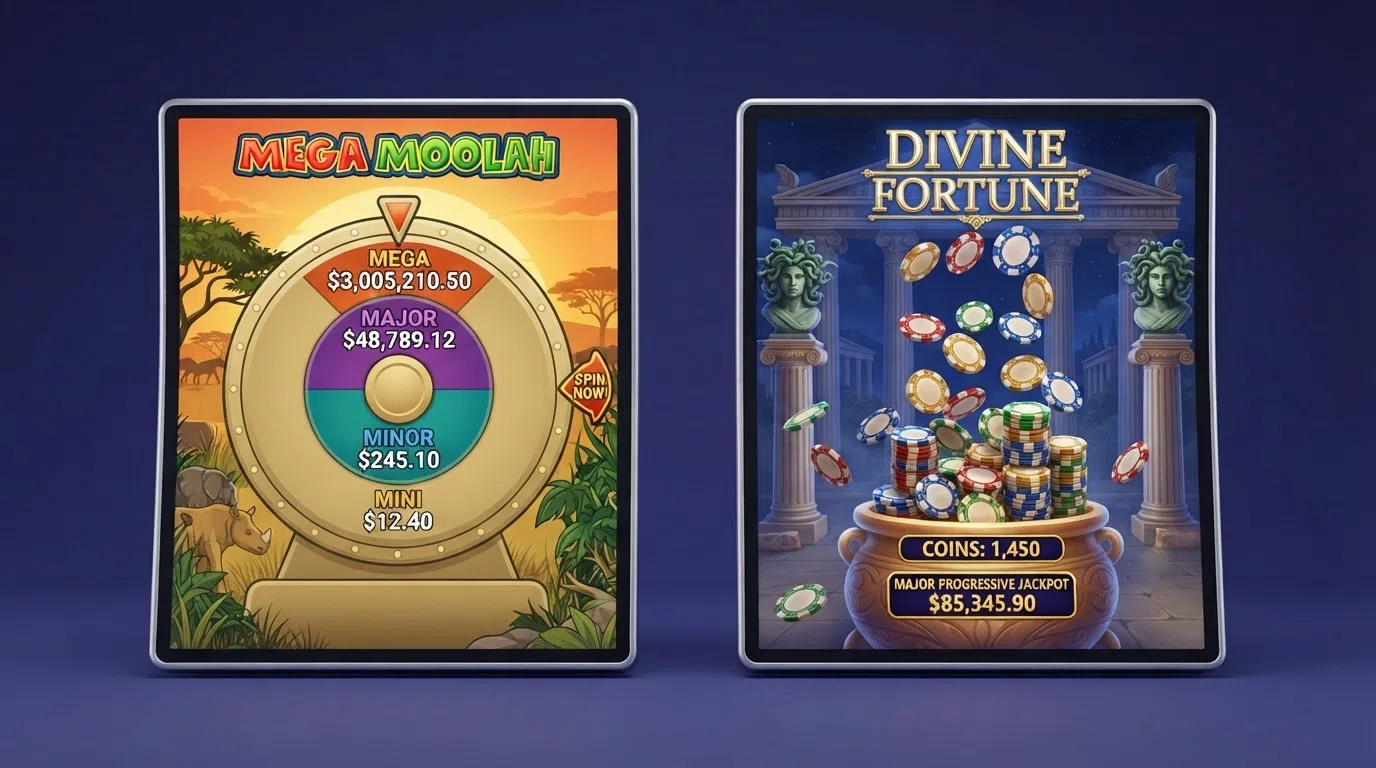
| Title | Provider | RTP | Volatility | Max Win | Progressive Network |
|---|---|---|---|---|---|
| Mega Moolah | Games Global | 88.12% | Medium | 11,250x | Mega Moolah wide-area (Mega seeds at £1,000,000) |
| Divine Fortune | NetEnt | 96.59% | Medium | 600x | NetEnt networked (local) |
| Hall of Gods | NetEnt | 95.5% | Low–Medium | 4,314x | NetEnt networked (6.9% of RTP funds pools) |
| Fishin’ Frenzy The Big Catch Jackpot King | Blueprint Gaming | 95.32% | Medium | 50,000x | Jackpot King network |
| Jackpot Giant | Playtech | ~91.25% | — | — | Playtech wide-area (averages ~£1.69m) |
| Dream Drop titles | Relax Gaming | ~94% | — | — | Five tiers, must-drop ceilings (Mega must drop before €2,000,000) |
Two things stand out across the table. First, only Divine Fortune among the six posts an RTP above 96%, and that figure includes its smaller local progressive rather than a wide-area pool. Every title with a genuinely large wide-area jackpot pays for it in base-game return. Second, the max-win column describes what the game can pay on a single spin outside the progressive; the headline-grabbing prizes are paid by the jackpot tier, not the paytable, and the max-win figure should be read as a separate ceiling on the non-progressive payouts.
Why the Published RTP Figure Hides the Real Cost
The RTP printed on a progressive slot’s information screen is a blended figure. It averages the base game’s payout rate with the expected value of the jackpot, and because the jackpot is large but rarely won, the average it produces is flattering to the base game. Mega Moolah’s 88.12% is the best illustration: it sounds close to a regular slot’s return, but the 5.3% jackpot contribution is added to a base game that returns about 82.8% on its own.
The session-level cost of that gap is concrete. A player aged 25 or over spins at the UK statutory maximum of £5 per game cycle. At the 2.5-second minimum spin speed, a one-hour session runs 1,440 spins, totalling £7,200 in bets. At Mega Moolah’s 88.12% RTP, the expected return is approximately £6,345. The expected loss is approximately £855 over that hour. Strip the jackpot contribution out and the expected loss on the base game alone is higher than that, because the 5.3% slice that funds the pool is part of the 11.88% the house keeps.
A regular slot running at 96% RTP under the same staking pattern returns £6,912 over the same hour and costs the player £288. The difference, roughly £567 in this scenario, is what the progressive structure costs. The player is paying for a ticket in a lottery that resets to a million-pound seed every time it pays out, and the ticket price is built into every spin.
The arithmetic is worth doing once, because it puts a number on the marketing line. A progressive slot is a regular slot with a lottery ticket stapled to it. The ticket is not free.
What You Give Up When You Chase a Jackpot Instead
The trade is sharper than a single RTP gap. Three things change when a player moves from a regular slot to a progressive.
The base-game return falls. Regular video slots on the UK market typically post RTPs in the 96% to 98% range. Progressive slots cluster in the 88% to 95% range once the jackpot contribution is stripped out, and the wide-area titles with the largest prizes sit at the bottom of that band. Every spin costs more in expected terms.
The volatility profile shifts. A progressive slot pays out rarely, and when it does the payout can be life-changing. A regular slot pays out more often and in smaller increments. The psychological pull of a growing jackpot counteracts the loss of expected return, and that pull is the mechanism the game is designed around. The displayed total is not information; it is the product.
The UK stake cap constrains the chase. The £5 maximum for players aged 25 and over, and the £2 maximum for players aged 18 to 24, apply to online slots across the board, including progressives. A progressive slot that historically rewarded max-bet play is now capped at a fraction of its designed maximum, which reduces the rate at which a player can fund the pool and therefore the rate at which the pool grows. The cap protects the player from a faster loss rate and also slows the path to a seven-figure prize.
Playing Progressive Slots for Real Money at UK Stakes
The Gambling Commission’s stake limits took effect in 2025, with the £5 cap for adults aged 25 and over coming in on 9 April and the tighter £2 cap for adults aged 18 to 24 coming in on 21 May, both under SI 2025/215. A “game cycle” under the regulation is the period from a game’s initiation until all money staked in that cycle is lost or all winnings are delivered, and the cap applies to the total staked within that cycle regardless of how a player tries to split a spin.
Two further game-design rules shape the experience. Auto-play has been banned on UK online slots since 31 October 2021. The minimum spin speed is 2.5 seconds, which means a player cannot blast through 1,000 spins in a few minutes the way offshore sites still allow. Both rules apply to progressive slots on the same terms as any other online slot.
A £2 or £5 maximum stake is well below the bet sizes that older progressive slots were designed around. Many of the most famous titles, including Mega Moolah, have historically required larger bets to qualify for the full progressive jackpot. On a UK-licensed site the bet ceiling is the statutory cap, and that cap is the same whether the player is on a desktop browser or a mobile app. The qualifying-bet structure of a progressive is not the player’s decision to make; it is set by the regulation.
Mobile Progressive Slots — the Same Jackpots in Your Pocket
The mobile experience on a UK-licensed site is, in regulatory terms, identical to the desktop experience. The same stake caps apply, the same 2.5-second minimum spin speed applies, the same auto-play ban applies, and the same progressive networks fund the jackpots. A player spinning Mega Moolah on a phone at 11pm is contributing to the same pool as a player at a desktop browser in the same minute.
Operator apps for the brands reviewed on this page carry progressive slots alongside their other content, and demo mode is available on mobile for the games that support it. There is no mobile-only feature that changes the jackpot mechanics, and there is no mobile-only restriction that limits the prize. The progressive is the same product on a smaller screen.
What does differ between devices is the user’s exposure to the session. A phone is in a pocket; a desktop is in a study. That difference is not in the regulator’s gift to fix, and the Commission’s mandatory reality-check pop-ups, which display time played and net spend during a session, apply on both platforms. The reality check is the same on a phone as on a laptop. The player’s attention to it is theirs.
New Progressive Slots Worth Watching in 2026
The progressive category has not stood still. The most significant structural innovation of recent years is the must-drop mechanic, popularised by Relax Gaming’s Dream Drop, which guarantees that a jackpot pays out before a ceiling rather than letting the pool run indefinitely. The mechanic changes the player experience: the prize is finite, the urgency is real, and the lower tiers (Rapid, Midi, Maxi) feed smaller but more frequent wins that keep the game in motion. The Major and Mega tiers hold the headline prizes, with the Mega required to drop before reaching €2,000,000.
The trend across providers is toward tiered jackpots with at least one must-drop element, even on networks that do not adopt the Dream Drop architecture outright. Blueprint Gaming’s Jackpot King, for instance, layers a must-drop King Prize on top of its wider Royalty Pot. New titles appear on the UKGC-licensed network throughout the year, and a player who has found a network they like will see new games added to that network rather than the entire progressive landscape changing underneath them.
What matters more than any individual release is the network a new title joins. A progressive slot’s value to the player is determined by the size of the pool, the speed at which the pool grows, and the contribution rate the game takes from each spin. Those numbers are network properties, not game properties. A new title on the Mega Moolah wide-area network has the same jackpot potential as Mega Moolah itself, because it is the same pool.
Where UK Players Can Chase Progressive Jackpots in 2026
Ten UK-facing casino operators carry progressive jackpot slots on a GB licence. The comparison below ranks them by the breadth of their progressive coverage and the size of their slot libraries, with the standout progressive title each one features. All ten are active on the Gambling Commission’s public register, and all ten are connected to GAMSTOP and offer demo mode on their progressive titles.
| Operator | GB Licence Status | Progressive Jackpot Networks | Standout Progressive Title | Slot Library Size | Game Providers |
|---|---|---|---|---|---|
| Bet365 Casino | Active | Multiple | Varies by network | 500+ games (200+ jackpot titles) | NetEnt, Playtech, Games Global, Blueprint Gaming, Pragmatic Play |
| Sky Vegas | Active | Jackpot King, MegaJackpots | MegaJackpots title | 400+ slots | NetEnt, Blueprint, Pragmatic Play, Playtech, IGT |
| Betway Casino | Active | Mega Moolah, WowPot, NetEnt progressives | Mega Moolah | 400+ slots | Games Global, NetEnt, Pragmatic Play |
| Virgin Games | Active | Local | Secrets of the Phoenix Elements Jackpot (seed £1,000) | 300+ slots | NetEnt, IGT, Games Global |
| Ladbrokes Casino | Active | Multiple (Blueprint particularly well-stocked) | Varies by network | 1,800+ slots | NetEnt, Pragmatic Play, Big Time Gaming, Play’n GO, Hacksaw Gaming, Games Global, Blueprint Gaming |
| Paddy Power Casino | Active | Jackpot Giant, Jackpot King, Age of the Gods | Jackpot Giant (~£1.69m average) | 500+ slots | Playtech, NetEnt, Blueprint Gaming, Pragmatic Play |
| LeoVegas | Active | Mega Moolah, Divine Fortune, Dream Drop | Dream Drop titles | 1,000+ slots | NetEnt, Evolution, Games Global, Pragmatic Play, Relax Gaming |
| Casumo | Active | Hall of Gods, Divine Fortune, Mega Moolah, Dream Drop | Hall of Gods | 2,000+ slots | NetEnt, Evolution, Games Global, Pragmatic Play, Relax Gaming |
| 888casino | Active | Mega Moolah, Divine Fortune, Jackpot Giant, Millionaire Genie | Millionaire Genie | 500+ slots | NetEnt, Playtech, Games Global, Pragmatic Play |
| PlayOJO | Active | Progressive and must-drop jackpots | Dream Drop titles | 7,000+ games | NetEnt, Evolution, Games Global, Pragmatic Play, Relax Gaming |
The spread across the table tells the reader where to look. PlayOJO carries the largest game library in the set and includes both progressive and must-drop jackpots, though it does not list a single named title as its flagship. Casumo and Ladbrokes are the volume players for slots generally, at 2,000+ and 1,800+ respectively. Betway, Paddy Power, LeoVegas and 888casino each have a named flagship progressive that defines their offer. Virgin Games runs the smallest library and the smallest standalone progressive. Bet365, despite its size, is a breadth play across 200+ jackpot titles rather than a flagship-driven one.
Bet365 Casino
Bet365 is the UK’s largest sportsbook-turned-casino, and its progressive offer mirrors that breadth. The casino lists more than 500 games in total, of which over 200 are jackpot titles, drawn from five major providers: NetEnt, Playtech, Games Global, Blueprint Gaming and Pragmatic Play. That spread means a player can move from Mega Moolah to Jackpot Giant to a Jackpot King title without leaving the lobby, and the demo mode on every progressive lets a player scout a game’s volatility before staking real money. As with every GB-licensed operator, Bet365 connects to GAMSTOP, so a player who has self-excluded will not be able to deposit or play.
For a player who wants one account that covers most of the progressive networks available in the UK, Bet365 is the breadth play. The trade is depth: no single progressive is featured over another, and a player looking for a flagship progressive to anchor their play will find the same network on a more focused operator.
Sky Vegas
Sky Vegas, part of Flutter Entertainment, anchors its progressive offer on two networks with different mechanics. The Jackpot King network runs Blueprint Gaming’s tiered progressive with a must-drop King Prize, while MegaJackpots carries IGT’s wide-area progressives. Behind those two networks sit 400+ slots from five providers, including NetEnt, Blueprint, Pragmatic Play, Playtech and IGT. Demo mode is available to play for free.
For a player who prefers the must-drop architecture to the pure wide-area pool, Sky Vegas sits the Jackpot King network in a clean position alongside MegaJackpots. The choice between a guaranteed-by-ceiling payout and a growing-pot payout is the choice the operator offers.
Betway Casino
Betway carries the full Mega Moolah and WowPot suites, both Games Global wide-area networks, alongside most of the NetEnt progressive catalogue. The library runs to 400+ slots from three core providers: Games Global, NetEnt Betway Casino offers demo mode. The brand’s positioning is on the Games Global networks specifically, which are the two largest and best-known progressive pools in the UK market.
For a player who wants maximum exposure to the wide-area networks, Betway is the purest specialist play among the featured set. The library is smaller than Casumo’s or Ladbrokes’, but every one of the progressive networks the operator carries is a major one.
Virgin Games
Virgin Games runs a smaller library at 300+ slots from NetEnt, IGT and Games Global, but it carries a progressive that the rest of the featured set does not: Secrets of the Phoenix Elements Jackpot, a local progressive with a seed value of £1,000. The smaller seed reflects the smaller funding base, but for a player who prefers a jackpot with a realistic ceiling to a wide-area pool that runs into seven figures, the offer is distinctive. Demo mode is available to play for free.
For a player who wants a progressive they can realistically track rather than a lottery-scale prize, Virgin Games is the place to look. The high-street brand recognition is a separate draw that the operator trades on, and the smaller library means a player is not scrolling past hundreds of non-progressive slots to find the featured game.
Ladbrokes Casino
Ladbrokes, part of the Entain Group, runs the largest slot library in the featured set at 1,800+ titles. Seven providers are named, with Blueprint Gaming particularly well-stocked through Entain’s integration. The volume means the broadest progressive coverage by title count, and a player is likely to find most of the major networks represented alongside the Jackpot King titles Ladbrokes Casino offers demo mode.
For a player who wants the largest slot library with a strong Blueprint Gaming selection, Ladbrokes is the volume pick. The trade is that the progressive coverage is broad rather than deep, and a player looking for a single flagship network will find the same network more prominently featured at an operator that specialises in it.
Paddy Power Casino
Paddy Power, Flutter’s second brand in the featured set, runs 500+ slots from four providers: Playtech, NetEnt, Blueprint Gaming and Pragmatic Play. The progressive offer is unusually varied, with three distinct ecosystems: Jackpot Giant (the Playtech wide-area progressive averaging around £1.69 million), the Jackpot King network and the Paddy Power Casino offers demo mode.
For a player who wants three different progressive architectures under one roof, Paddy Power is the set’s most architecturally diverse pick. Jackpot Giant alone is enough to put the operator on a progressive player’s shortlist, and the Age of the Gods series adds a mythology-themed set of networked prizes.
LeoVegas
LeoVegas, the mobile-first operator, carries Mega Moolah, Divine Fortune and the Dream Drop titles across 1,000+ slots from five providers, including Relax Gaming (the developer of Dream Drop). The three networks on offer represent the three most distinct trigger mechanics in the progressive market: a wide-area four-tier wheel (Mega Moolah), a falling-coin local progressive (Divine Fortune), and the must-drop tiered structure LeoVegas offers demo mode.
For a player who wants one account covering the three most mechanically distinct progressive networks, LeoVegas is the cleanest pick. The mobile-first design also makes it a natural choice for a player who expects to play on a phone rather than a desktop.
Casumo
Casumo runs the largest slot count in the featured set at 2,000+ titles and is the only operator in the set that carries Hall of Gods alongside Divine Fortune, Mega Moolah and Dream Drop. Five providers are named, including NetEnt and Relax Gaming. The Hall of Gods inclusion is the distinguishing feature: it gives Casumo the deepest NetEnt progressive coverage in the set, with two NetEnt networked progressives on top of the Games Global and Casumo offers demo mode.
For a player who specifically wants the NetEnt progressive catalogue at depth, Casumo is the set’s only option. The library size also means a player is not trading breadth for depth; both are present.
888casino
888casino, part of evoke plc, carries Mega Moolah, Divine Fortune, Jackpot Giant and Millionaire Genie across 500+ slots from four providers: NetEnt, Playtech, Games Global and Pragmatic Play. Millionaire Genie is the operator’s flagship, and it is the only 888casino offers demo mode.
For a player who wants Millionaire Genie specifically, 888casino is the only option in the featured set. The four named progressive titles span three providers, and a player who wants variety across providers without the larger library sizes elsewhere will find it here.
PlayOJO
PlayOJO runs the largest overall game library in the set at 7,000+ titles, with progressive and must-drop jackpots included alongside the rest of the catalogue. Five providers are named: NetEnt, Evolution, Games Global, Pragmatic Play and Relax Gaming. The brand’s positioning is on a no-wagering model, though the per-operator bonus terms are not catalogued in the research PlayOJO offers demo mode.
For a player who wants the largest game library in the featured set and is drawn to a no-wagering brand promise, PlayOJO is the volume pick. The trade is that the operator does not feature a single flagship progressive, and a player looking for a specific title to anchor their play will find that title at a more focused operator.
How to Try Progressive Jackpot Games Without Risking Real Money
Every operator on the featured list offers demo mode on its progressive slots. A demo session is a real-money game running on the same random number generator and the same return-to-player percentage, with one critical difference: the jackpot on screen is not payable. A demo spin can trigger the jackpot animation; the prize it shows is the in-game value, not a real-money payout. The mechanics are faithful. The money is not.
Demo play runs in a browser, with no download required on every UKGC-licensed site in the set. A few sites allow demo play without registration, though most require an account to be opened before the demo loads. The UKGC’s technical standards require demo games to use the same RNG and RTP as the real-money version, so a player scouting volatility and hit frequency in demo is reading accurate data.
Free Progressive Slots With No Download Required
Instant-play browser access is the default on UKGC-licensed sites. A player opens the operator’s site, finds the progressive title, and loads the demo directly. No software installation, no app download, no plug-in. The same applies to the real-money version, which runs in the browser without a separate client on most UK-licensed operators.
The UKGC’s Remote Gambling and Software Technical Standards require that every instance of a game, demo and real-money, uses the same underlying random number generator. A demo version of Mega Moolah generates outcomes from the same RNG as the real-money version. The RTP is the same, the volatility is the same, the trigger frequency for the jackpot wheel is the same. What differs is that the jackpot prize displayed in a demo is not paid out.
Registration requirements vary by operator, and the research underlying this page does not catalogue per-operator registration gating. A player who wants to test a progressive without opening an account should expect to find that some operators allow it and others do not, and the only way to know is to load the site.
Demo Credits vs Real Spins — What Free Play Cannot Tell You
Three things change between a demo session and a real-money session, and a player who treats demo play as a session simulator will be misled on all three.
The jackpot is not payable. A demo spin that lands on the Mega Moolah jackpot wheel shows the prize the wheel would have awarded, but the prize is credited to the demo balance, not paid to a real account. A player cannot win a seven-figure payout in demo mode, which means the headline event a progressive is built around is unreachable in practice during a scouting session.
The stake-cap experience disappears. A demo session runs on unlimited credits, and a player who wants to spin at £5 per game cycle can do so without ever feeling the cap. A real-money session at the £5 ceiling, by contrast, is constrained on every spin, and the rate at which the balance depletes is visible. The stake cap is a feature of the regulation, not the game, and demo play cannot reproduce it.
The responsible-gambling guardrails are absent. Reality checks, deposit limits, time-out prompts and GAMSTOP integration apply to real-money play only. A demo session has no reality-check pop-up, no deposit prompt, no session tracker. A player who wants to feel the regulatory environment a UK-licensed site provides will not feel it in demo.
Demo play is a game-mechanics scout. It tells a player what a progressive looks like, how often the base game pays, and what the bonus features feel like. It does not tell a player what the game costs in pounds, what a session feels like at the stake cap, or what the regulatory environment does to slow play down. Those questions require real money, and the small stakes available under the cap are the cheapest way to find out.
Why Crypto Progressive Slots Sit Outside the UK Licensed Market
Progressive jackpot slots are available at crypto-accepting casinos, including sites such as Flush, CoinPoker, mBit, 7Bit, Rocketpot and Jackbit. None of these sites holds a GB licence. All of them operate under a Curaçao eGaming sub-licence, which is issued by the Curaçao regulator and is not recognised for the GB market by the UK Gambling Commission. A UK player using one of these sites is gambling on an unlicensed site, and the protections the Gambling Commission’s framework provides do not apply.
The UKGC has not established a permissive rule on cryptocurrency deposits for GB-licensed gambling. Credit cards have been banned for all gambling payments in Great Britain since 14 April 2020 under LCCP condition 6.1.2, but there is no equivalent crypto-specific rule on the licensed side. No GB-licensed casino in the featured set accepts crypto deposits for progressive slots. A player who wants to use Bitcoin or another cryptocurrency to play progressives is, by definition, playing at an unlicensed site.
What a Curaçao Licence Actually Means for a UK Player
A Curaçao eGaming sub-licence is a commercial licence issued by the Curaçao regulator, with a fee structure and a regulatory approach that differ from the UKGC’s. A UK player who deposits at a Curaçao-licensed crypto casino is operating outside the GB regulatory framework, and the differences are not technical. They are substantive.
No GAMSTOP integration. The UK’s national multi-operator self-exclusion scheme is mandatory for GB-licensed online operators, and a player who has registered with GAMSTOP is barred from every licensed site. A Curaçao-licensed crypto casino is not connected to GAMSTOP. A player who has self-excluded from UK-licensed sites can still deposit and play at a crypto site, because the exclusion does not propagate.
No Commission complaints route. A player who has a dispute with a GB-licensed operator can take it to the operator’s alternative dispute resolution (ADR) provider, and the ADR provider’s decision is binding under the UKGC’s licence conditions. A player with a dispute at a Curaçao-licensed site has no Commission complaints route. The dispute is between the player and the operator, with whatever contractual law the operator’s terms specify.
No statutory ADR requirement. ADR is mandatory for GB-licensed operators but not for Curaçao licensees. A crypto site may offer its own dispute process, may refer to a private mediation service, or may specify arbitration in its terms. The player has no regulator standing behind the outcome.
No requirement for segregated player funds. UK-licensed operators must keep player funds in segregated accounts, separate from the operator’s own operating capital, so that player balances are protected if the operator becomes insolvent. Curaçao-licensed sites are not bound by this requirement, and the player carries the credit risk on the operator.
No UK stake cap and no spin-speed rule. The £5 / £2 stake cap and the 2.5-second minimum spin speed are conditions of the UKGC’s licence, and they do not apply to a Curaçao licensee. A crypto site can offer auto-play, sub-second spins and stakes well above the UK ceiling. The trade is faster play and larger bets in exchange for the loss of every UK player protection.
A UK player who chooses a Curaçao-licensed crypto site over a GB-licensed site is accepting all of the above. The site is not in the UKGC’s regulatory net, and the Commission has no jurisdiction over it. The only enforcement the Commission can apply is disruption: the Commission refers URLs to search engines for delisting, and between April 2024 and June 2025 it issued 3,140 disruption notices, referred 447,778 URLs and saw 287,961 removed. The player on a crypto site does not benefit from that disruption, because the player is already on the site. The protection the disruption offers is to other players who have not yet clicked through.
The Legal Framework Every Progressive Jackpot Player Should Know
The framework a UK player plays inside is built from three layers. The Gambling Act 2005 sets the statutory objectives. The Gambling (Licensing and Advertising) Act 2014 brought remote operators into the point-of-consumption regime, requiring any operator serving UK players to hold a GB licence. The Gambling Commission’s LCCP and Remote Gambling and Software Technical Standards (RTS) translate those objectives into the rules a progressive slot must follow.

The three licensing objectives in Section 1 of the Gambling Act 2005 are: preventing gambling from being a source of crime or disorder; ensuring gambling is conducted fairly and openly; and protecting children and other vulnerable persons from being harmed or exploited by gambling. Every UKGC rule, from the stake cap to the spin-speed minimum to the GAMSTOP integration, traces back to one of those three objectives.
The 2025 stake limits (SI 2025/215) sit on top of the framework. Players aged 25 and over face a £5 maximum stake per game cycle, in force from 9 April 2025. Players aged 18 to 24 face a £2 maximum stake per game cycle, in force from 21 May 2025. The cap applies to total staked within a game cycle and cannot be defeated by splitting a spin across multiple bet structures. Online slots are the only casino games subject to the cap; roulette, blackjack and other table games are not.
The game-design prohibitions are older and still in force. Auto-play has been banned since 31 October 2021. The minimum spin speed is 2.5 seconds per game cycle, and features designed to speed up play are prohibited. Losses disguised as wins are banned: a spin that returns less than or equal to the total stake cannot be celebrated as a win. Reverse withdrawals are permanently banned; a player who has requested a withdrawal cannot cancel it and return the funds to the playing balance.
The bonus rules landed in late 2025. Under LCCP social responsibility code 5.1.1, in force from 19 December 2025, wagering requirements on bonuses are capped at 10x as a hard ceiling. Mixed-product promotional offers, such as a free-spins package tied to a sportsbook deposit, are banned. Direct marketing requires a per-product, per-channel opt-in (LCCP SR 5.1.12, in force 1 May 2025). None of these rules directly changes the progressive slot itself, but they shape the promotional offers that may sit around it.
The tax position completes the framework. The player pays no tax on gambling winnings in the UK. The operator pays Remote Gaming Duty, which rose from 21% to 40% on 1 April 2026, and a statutory levy of 1.1% of gross gambling yield for remote casino operators, in force from 6 April 2025. Both taxes are on the operator, not the player, but they affect the economics of running a progressive slot on a UK-licensed site, which is why the £2 and £5 stake caps and the bonus restrictions are part of the same regulatory package.
What the UKGC Actually Enforces — Audits, ADR and the Offshore Disruption Regime
The Commission’s enforcement tools are visible to a player who knows where to look. Every GB-licensed operator must subscribe to an approved alternative dispute resolution (ADR) provider, which adjudicates player disputes that the operator’s own customer service cannot resolve. The ADR provider’s decision is binding on the operator under the UKGC’s licence conditions, and a player who has exhausted the operator’s complaints process can escalate to the ADR body without giving up the right to complain to the Commission itself.
The Commission runs a disruption programme against unlicensed operators. Between April 2024 and June 2025, the Commission issued 3,140 disruption notices, referred 447,778 URLs to search engines and saw 287,961 of those URLs removed. The programme is the Commission’s primary offshore-enforcement tool: it cannot order ISPs to block unlicensed sites, because the legislation to give it that power has been proposed but not enacted, but it can target the search-engine surface that brings UK players to those sites in the first place.
The financial-vulnerability check is the most recent addition to the player-protection layer. From 28 February 2025, every GB-licensed operator must run a light-touch check at the £150 net-deposit threshold, measured on a rolling 30-day basis. The check uses publicly available data (bankruptcy registers, county court judgments, individual voluntary arrangements, debt relief orders) and does not require customer documents. It is not a credit check, and a player who passes the check continues without further intervention. A player who flags is escalated into a fuller affordability assessment.
A harder affordability threshold is on the Commission’s announced roadmap. The Commission’s Board confirmed a staged rollout on 7 July 2026, with Stage 1 thresholds of £5,000 in net deposits over 24 hours for players aged 25 and over, and £2,500 for players under 25. The start date has not been confirmed, and the thresholds were announced but not yet commenced as of the Commission’s last published update. When Stage 1 comes into force, operators will run more detailed affordability checks at those deposit levels.
A player who experiences a problem with a GB-licensed operator has a defined escalation path: operator customer service, then the operator’s ADR provider, then a complaint to the Commission itself. A player on an unlicensed site has none of those routes, because none of the bodies have jurisdiction. The choice of site is the choice of which set of protections applies.
Staying in Control While You Play Progressive Slots
The responsible-gambling tools built into every GB-licensed progressive slot are not optional. They are conditions of the licence, and they sit on top of the national infrastructure that supports players who need help.
GAMSTOP is the national multi-operator self-exclusion scheme. Registration is at gamstop.co.uk, and a single registration excludes the player from every GB-licensed online operator at once. Exclusion periods are six months, one year, five years, or five years with auto-renewal. None of them can be cancelled early: a player who registers for five years stays excluded for five years, and the registration does not expire on request. GAMSTOP has been mandatory for all GB-licensed online operators since 31 March 2020.
Deposit limits are a feature of every GB-licensed operator and an offer the player can accept or decline. From 31 October 2025, the offer is mandatory: operators must prompt a customer to set a financial limit before the first deposit, and the prompt cannot be skipped. A decrease in a deposit limit takes effect immediately; an increase is subject to a cooling-off delay that the operator sets. The Commission’s RTS 12 standardises the “gross deposit limit” as based solely on money paid into the account, a rule effective 30 September 2026.
Reality checks and time-outs are built into the slot client. A reality check is a pop-up that displays the time played and the net spend at intervals set by the operator. A time-out is a short self-exclusion, typically 24 hours to six weeks, that the player can activate from the responsible-gambling section of the account. Both tools apply to progressive slots on the same terms as any other online slot.
The National Gambling Helpline, run by GamCare, is free and available 24 hours a day, every day of the year. The number for England and Scotland is 0808 80 20 133. The number for Wales is 0808 2819 265. Live chat and email support are also available. The TalkBanStop partnership, which combined GamCare, GAMSTOP and Gamban blocking software under one referral pathway, formally concluded in March 2026 as gambling-harm services moved to statutory-levy commissioning, but the underlying services remain.
The prevalence data behind the infrastructure is worth knowing. The NHS Adult Psychiatric Morbidity Survey 2023–24 found 0.4% of adults experienced problem gambling (PGSI 8+) and 1.6% experienced at least moderate risk gambling (PGSI 3+). The NHS Health Survey for England 2024 found 5% of adults had PGSI scores of 1 or more, indicating at-risk or problem gambling, with prevalence stable between 2012 and 2024. GambleAware’s 2024 survey of adults who gamble put the share experiencing any level of gambling problems at 13.1%, equivalent to roughly 6.8 million GB adults. The infrastructure is sized for a population that is small in percentage terms and large in absolute numbers.
Setting Deposit Limits and Self-Excluding — the Practical Steps
A deposit limit is set inside the responsible-gambling section of a GB-licensed operator’s account. The player names a daily, weekly or monthly limit on the gross amount they will deposit, and the operator enforces it. A decrease takes effect on the next deposit. An increase does not, because the Commission requires a cooling-off period that gives the player time to reconsider before the higher limit is applied.
GAMSTOP registration is at gamstop.co.uk. The player provides their name, address, date of birth and email, and the registration propagates to every GB-licensed online operator within 24 hours. The exclusion takes effect immediately at the operator end: a player who is already logged in to a gambling account will be logged out at the next session attempt, and any balance remaining in the account is returned through the operator’s standard withdrawal process. The exclusion cannot be lifted early, regardless of the player’s subsequent request.
Reality checks appear during play, usually at intervals of 15, 30 or 60 minutes depending on the operator’s settings. The pop-up shows the time elapsed and the net position, and the player can choose to continue, take a break or end the session. A time-out is a longer break the player sets themselves, from 24 hours to six weeks, and the account is locked for that period. Both tools are accessible from the responsible-gambling section of the operator’s site or app.
NHS gambling-harm clinics in England, Scotland and Wales offer treatment for gambling disorder, and a player who feels their play is no longer under control can self-refer through the NHS or be referred by a GP. The clinics are the clinical escalation pathway below the helpline and above the operator’s own tools, and they sit alongside the Commission’s regulatory framework as the clinical response to a public-health problem the regulator cannot solve on its own.
How We Chose and Ranked These Progressive Slot Operators
The ten operators on the featured list were selected on a single verification: each one holds an active remote casino operating licence on the Gambling Commission’s public register. The register, last updated 29 July 2026, is the Commission’s authoritative source for licence status, and the check was run against that register for every operator before the page was written. No operator on the list is included on the basis of marketing or affiliate arrangement; the licence check is the only inclusion criterion.
The ordering and the comparison columns reflect qualitative judgments about progressive coverage rather than a weighted score. The criteria are: GB licence status (universal across the set, and therefore a baseline rather than a differentiator); the progressive jackpot networks the operator carries, with an emphasis on the wide-area networks and the must-drop architecture; the slot-library size, which is a proxy for the breadth of progressive titles available; the provider mix, which signals the variety of progressive mechanics a player can access; and the presence of the specific progressive titles the research underlying this page has documented. No weightings or percentages have been applied because none were available, and a ranking that pretended to one would be more precise than the evidence supports.
The researched title set used to check operator coverage includes Mega Moolah, Divine Fortune, Hall of Gods, Fishin’ Frenzy The Big Catch Jackpot King, Jackpot Giant and the Dream Drop titles, and the comparison table in the operator section flags which of these each operator carries. The titles themselves are described in the section on the biggest UK jackpots, with RTP, volatility, max win and network drawn from the slot providers’ own disclosures and from industry RTP tracking.
A reader who wants to weigh the ranking against their own priorities should read the comparison table column by column rather than trusting the row order. The table is laid out to support that reading: every cell is a fact drawn from the operator’s own disclosure or the Commission’s register, and the column the reader cares about most, whether it is library size, network coverage or a specific flagship title, is the column they should look at.
What UK Progressive Slot Players Should Actually Do in 2026
The arithmetic on progressive slots is unforgiving, and the right way to play them is to know the price before paying it. The published RTP on a wide-area progressive is 88% to 95%, and the base game behind it returns 82% to 90% once the jackpot contribution is stripped out. A regular slot on the same stake returns 96% to 98%. The gap is what a seven-figure headline costs, and it is paid on every spin the player makes.
The stake cap narrows the chase. The £5 maximum for players aged 25 and over, and the £2 maximum for players aged 18 to 24, put a ceiling on the rate at which a player can fund the jackpot pool. The cap is a player protection that the operator cannot override, and a player who would have played a progressive at £10 a spin is now playing it at half that rate or less, which slows the loss rate and slows the path to a prize the regulation was not designed to optimise for.
The regulatory framework is the part of the offer that does not appear on the slot screen. GAMSTOP, deposit limits, reality checks, time-outs, ADR, the financial-vulnerability check at £150, the bonus wagering cap at 10x, the spin-speed minimum at 2.5 seconds and the auto-play ban together give a UK player on a licensed site a set of tools and protections that an unlicensed site does not provide. The Commission’s disruption programme targets unlicensed operators at the search-engine level, and the ADR route gives a player a defined escalation path when something goes wrong. None of this applies on a Curaçao-licensed crypto site, and a player who chooses one of those sites is making a deliberate trade: faster play, larger bets, no UK protections.
The decision framework that follows from the numbers is straightforward. Play progressive slots for the entertainment of the mechanic, which is a real and distinctive form of slot entertainment, and not as a wealth-building strategy. The base game is more expensive than a regular slot on every spin, and the prize is a long shot that resets to a million-pound seed every time it pays. Stay inside the licensed market, where every protection the page has described applies, and set a deposit limit before the first deposit so the operator enforces a ceiling the player has agreed to in advance. The framework is the same one the regulation is designed to support, and it is the one that costs the player the least while letting the game be played.
Frequently Asked Questions
Can I play progressive jackpot slots for free in the UK?
Yes. Every operator on the featured list offers demo mode on its progressive titles, which runs the real game on the same random number generator and the same RTP without using real money. The jackpot prize shown during a demo spin is credited to the demo balance and is not paid out in cash, so demo play lets a player test the mechanics and volatility of a progressive without risking a stake, but it cannot replicate the experience of playing for the real jackpot.
What is the maximum stake for online slots in the UK?
The statutory maximum stake is £5 per game cycle for players aged 25 and over, in force from 9 April 2025, and £2 per game cycle for players aged 18 to 24, in force from 21 May 2025, under SI 2025/215. The cap applies to online slots only, and it covers the total staked within a game cycle regardless of how a player tries to structure the bet. The cap is set by the Gambling Commission and applies to every GB-licensed operator.
Are progressive jackpot slots fair and regulated in the UK?
Yes. Progressive slots on GB-licensed sites run on random number generators that are tested and approved under the Commission’s Remote Gambling and Software Technical Standards, and the published RTP is the figure the game must return over a large number of spins. The displayed jackpot is a legally secured liability, not a marketing figure, and the operator is required to pay it regardless of the operator’s own financial position. A player who disputes a payout can escalate to the operator’s ADR provider and, if necessary, to the Commission itself.
Can I use crypto or Bitcoin to play progressive jackpot slots in the UK?
Crypto-accepting casinos that offer progressive jackpot slots, including the major Curaçao-licensed brands in the market, are not licensed by the UK Gambling Commission and do not hold a GB licence. No GB-licensed operator in the featured set accepts crypto deposits for progressive slots. A UK player who chooses a crypto casino is gambling on an unlicensed site, forfeiting GAMSTOP integration, ADR, the Commission’s complaints route and the UK stake cap and spin-speed rules, and carrying all of the credit and dispute risk on the operator.
What responsible gambling tools are available for progressive slot players?
Every GB-licensed operator offers deposit limits, reality checks, time-outs and GAMSTOP self-exclusion, and from 31 October 2025 the deposit-limit prompt before first deposit is mandatory. The National Gambling Helpline, run by GamCare, is free and available 24/7 on 0808 80 20 133 (England and Scotland) or 0808 2819 265 (Wales). NHS gambling-harm clinics in England, Scotland and Wales offer treatment for gambling disorder, and a player who feels their play is no longer under control can self-refer or be referred by a GP.
Slots – trustedcasinos-notongamstop
Content created by the «trustedcasinos-notongamstop» team