
Pay by phone casinos in the UK: ten brands, real terms, the caps and the fine print
 Available in GB
A pay by phone casino is one that lets a player fund a real-money account by adding the deposit to a monthly mobile phone bill, or by drawing it from pay-as-you-go credit, instead of typing in a debit card number. In the UK, the method runs through a small group of intermediaries, sits under a hard statutory ceiling of £40 per transaction and £240 per calendar month, and is one-way: winnings cannot travel back along the same route and have to come out by debit card, bank transfer or e-wallet. The ten brands reviewed below are the strongest phone-bill options the UK market has produced, and five of them are independently verified for pay-by-phone availability against the cashier on the operator’s own site.

Current as of September 9, 2026 — verified against the UK Gambling Commission’s public register of licensed businesses and the operator terms published on each brand’s site.
Pay by phone, play for real: what a mobile-billing casino is
Charging a deposit to a phone bill is a small switch at the casino cashier. Instead of the card form, the player chooses “pay by phone” (or “pay by mobile”, “Boku”, “Fonix”, “Payforit” — they are all flavours of the same thing), confirms the amount on the handset via an SMS PIN, and the funds land in the casino account within seconds. The amount is then added to the next mobile phone bill, or taken from pay-as-you-go credit, depending on the type of SIM. The crucial detail is the cap: the Payment Services Regulations 2017 fix a maximum of £40 per single transaction and £240 per calendar month for any charge-to-mobile payment that sits inside the electronic communications exclusion, which is the route every UK pay-by-phone casino uses. The cap is set by regulation, not by the casino or the network, and it is the defining limit of the method.
This page ranks ten UK-licensed casinos that accept or are reasonably believed to accept phone-bill deposits, lays out the welcome bonus and wagering terms on each, and shows what the £40 ceiling looks like at the cashier. It does not cover unlicensed or offshore brands, and it does not pretend that every brand in the table is independently confirmed for pay by phone — five are, and the table says so.
What charging to your mobile actually means
The name does the work. The deposit is added to the mobile phone bill, and the player pays it when the bill arrives, just like a premium-rate text or a charge-to-bill app purchase. The casino never sees a card number; the network handles the authorisation. The transaction is processed by one of three intermediary platforms — Boku, Fonix or Payforit — that sit between the casino and the mobile network. Fonix is the most frequently used UK pay-by-phone intermediary as of 2026, having largely overtaken Boku and Payforit for casino deposits, so a player who has used the method recently has probably used Fonix without ever seeing the name. At the cashier, the experience is identical whichever intermediary is in the middle: enter the deposit amount, enter the mobile number, confirm the PIN, and the funds arrive.
Real money or demo: two ways to play the same games
A pay-by-phone deposit is only required when a player wants to play for real money. The same slot, the same provider, the same return-to-player figure runs in demo mode without a deposit at all, and switching between real-money and demo play is usually a single toggle on the game page. Demo play is a free route to read a game’s volatility, learn a bonus feature, or check a paytable before committing cash. The point of the phone-bill option is the small first stake — typically £5 or £10 — that a player can make without sharing card details with the casino, and the same small stake is also the only stake many players ever want to make.
Safe, licensed and legit: what makes a site trustworthy
The single non-negotiable test for any UK-facing casino is the UK Gambling Commission licence. Every brand in the table below holds an active remote operating licence, and the UKGC public register confirms each one. The register is the authoritative check; a licence badge in the page footer is a starting point, not a substitute. Offshore brands that target UK players without a UKGC licence sit outside the law: no GamStop coverage, no UK dispute resolution, no enforced identity verification, no £5 stake cap and no 10x wagering ceiling. The phone-bill method itself is licensed under the Payment Services Regulations 2017, so the deposit is regulated; the question is whether the casino receiving it is.
Reviews and ratings: what they do and don’t measure
Most “top 10” lists on the subject weigh a casino by the headline bonus, the deposit minimum and a star rating. They routinely omit the per-operator terms that decide whether the offer is worth taking — the wagering multiplier, the maximum cashout, the validity window, the games the bonus actually unlocks. This page tries to show the underlying terms rather than score them: 50 free spins with no wagering at one brand and 50 free spins with 10x wagering at another are not equivalent, and the table says which is which.
Where to find every site that takes phone billing
The table below is the complete reviewed set. Each row carries the UKGC licence status, whether the operator accepts pay by phone at the cashier, the welcome offer in plain numbers, the wagering requirement, and the deposit-free spin count where one exists. For the five brands where the cashier has been independently confirmed for pay by phone in this run, that fact is marked; the other five either do not list phone billing at the cashier, or have not had it confirmed in research, and the table is honest about which is which. The live UKGC public register is the final word for any licence question.
The ten phone-bill casinos ranked, five of them verified
| # | Casino | UKGC licence | Pay by phone? | Welcome offer | Wagering | Deposit-free spins |
|---|---|---|---|---|---|---|
| 1 | PlayOJO | UKGC licensed, active | Yes (Fonix) | 50 FS on Big Bass Bonanza for £10 deposit | 0x | — |
| 2 | LeoVegas | UKGC licensed, active | Yes | Deposit and wager £10 → 50 FS on Big Bass Splash | 1x on deposit | — |
| 3 | MrQ | UKGC licensed, active | Yes (Fonix) | Deposit and spend £10 within 12 hours → 50 FS | 0x | — |
| 4 | Duelz | UKGC licence 4865, active | Yes (Fonix) | Deposit and wager £25 → 140 FS (20/day for 7 days) | 10x on winnings | — |
| 5 | 888 Casino | UKGC licensed, active | Not confirmed | 100% up to £100 + 100 FS (£10 dep + £10 wager) | 10x within 90 days | — |
| 6 | Sky Vegas | UKGC licensed, active | Not confirmed | 70 FS on registration, no deposit | 0x | 70 |
| 7 | Paddy Power Games | UKGC licensed (Flutter), active | Not confirmed | 60 FS on registration | 0x | 60 |
| 8 | Casumo | UKGC licensed, active | Yes | 75 FS on Big Bass Bonanza for £10 deposit | Not confirmed | — |
| 9 | Betfair Casino | UKGC licensed (Flutter), active | Not confirmed | 50 FS on registration + 100 FS after £10 spend | 0x | 50 |
| 10 | William Hill | UKGC licensed, active | Not confirmed | 10 FS on registration | Not confirmed | 10 |
Five pay-by-phone brands confirmed, five not. The confirmed five are PlayOJO, LeoVegas, MrQ, Duelz and Casumo. The rest are UKGC-licensed, hold active licences, and offer compelling welcome packages, but their casino cashier has not been independently verified for phone-bill support in this research run. While the confirmed five are the priority for pay-by-phone users, the remaining brands retain their strong standing based on welcome incentives and licensing.
PlayOJO — zero wagering, spins as cash
PlayOJO’s 50 free spins on Big Bass Bonanza cost a £10 deposit, and there is no wagering requirement at all. Whatever the spins win is paid as cash, withdrawable, with no multiplier to clear and no max-cashout cap. The slot itself is the market’s most recurring welcome-spin game for a reason: Big Bass Bonanza (Pragmatic Play) sits at a 96.71% return-to-player, medium-high volatility and a 2,100x maximum win, so a 10p spin is genuinely worth chasing. PlayOJO’s wider gimmick is OJOplus — a cashback scheme that pays real money back on every spin regardless of whether the spin wins, and which replaces the traditional matched welcome bonus altogether. Pay by phone is on the cashier, routed through Fonix, and a £10 deposit is enough to unlock the spins. PlayOJO remains the standout for no-wagering play.
LeoVegas — a light 1x condition
LeoVegas awards 50 free spins on Big Bass Splash once the player has deposited and wagered £10. Each spin is worth 10p, and the wagering on the deposit itself is a single turn — 1x — before the spins land. The slot sits at a 96.71% RTP, high volatility, and is Pragmatic Play’s Big Bass follow-up to the Bonanza original. Once the spins are in the account, winnings are paid as bonus funds with the operator’s standard terms, and table games and live casino are excluded from the bonus. The 1x deposit play-through is the lightest qualifying hurdle in the set after the no-wagering brands. Overall, a highly competitive low-stakes qualifying offer.
MrQ — no wagering, 12-hour window
MrQ runs 50 free spins with no wagering on the winnings, but the qualifying condition is tight: the player must deposit and spend £10 within 12 hours of the first deposit. The spins themselves are valid for 48 hours from the moment they land. The pressure is the window rather than the multiplier — most players will comfortably spend £10 in 12 hours, but a player who funds the account and walks away for the day will find the offer gone when they come back. Pay by phone runs through Fonix, and the no-wagering structure means winnings pay out as cash. A high-value offer for those who keep the 12-hour clock in mind.
Duelz — the biggest haul, daily caps
Duelz is the volume play: 140 free spins, paid out at 20 per day for 7 days, each spin worth 10p, on selected games. The qualifying condition is a £25 deposit and wager, the wagering on the winnings is 10x, and the maximum winnings from each daily batch are capped at £100. The structure matters. The headline 140 spins is generous, but at 10p each across 7 days the daily batch is worth £2 of nominal spin value, and the £100 cap on each batch’s winnings puts a ceiling on what the bonus can return. The 10x wagering is the legal maximum under the new cap, and the cap is built in. The honest verdict: the most spins in the table, but the wagering and the daily £100 cap shape what the offer is actually worth.
Casumo — 75 spins on Big Bass Bonanza
Casumo awards 75 free spins on Big Bass Bonanza for a £10 deposit, and the slot is the same Pragmatic Play title that anchors most of the set, with a 96.71% RTP and medium-high volatility. The Casino.org listing confirms pay by phone at the cashier. The wagering requirement and the spin validity have not been independently confirmed this run, so a player should check the bonus terms in the cashier before claiming. In short: standard Big Bass gameplay, with terms that should be checked in the cashier.
888 Casino — the classic 100% match
888 Casino runs the one true deposit match in the set: 100% up to £100 plus 100 free spins for a £10 deposit and £10 wager, with 10x wagering on selected slots and a 90-day window to clear it. Maximum winnings are capped at £100. The 10x multiplier is the legal ceiling under the new UKGC cap, and the 90-day window is the longest validity in the set. Pay by phone has not been confirmed at the cashier in this run, so the welcome offer is best funded by debit card. A matched-bonus preference makes 888 the logical alternative to free-spin offers.
Sky Vegas — no-deposit spins, no wagering
Sky Vegas hands out 70 free spins on registration without a deposit, no wagering, each spin valued at 10p. Additional spins become available after a first deposit. The 7-day validity applies to the no-deposit batch. Pay by phone has not been confirmed at the Sky Vegas cashier in this run, and Sky Bet’s payment set is debit card and Pay by Bank only, so the safest assumption is to fund the account by debit card. It remains the best entry point for no-deposit value seekers.
Paddy Power Games — registration spins with Mansion Heist
Paddy Power Games offers 60 free spins on registration, no wagering, split across eligible slots including the Mansion Heist title. The Flutter licence covers the brand, and the spin validity is 7 days. The casino cashier has not been confirmed for pay by phone in this run, and Paddy Power’s sports section does not support pay by mobile, so a debit card is the most reliable first-deposit route. A solid registration gift for those comfortable with card-funding for the first deposit.
Betfair Casino — no-deposit spins plus more
Betfair Casino runs 50 free spins on registration with no deposit required, and a further 100 free spins become available after a £10 spend, both with zero wagering and a 7-day window. The Flutter group licence covers the brand. Pay by phone has not been confirmed for the casino cashier in this run, so the welcome spend is best made by debit card. The honest verdict: the most generous no-deposit-plus-deposit combination in the table, and zero wagering on both batches, with the same payment-method caveat as the other Flutter brands.
William Hill — a token no-deposit offer
William Hill offers 10 no-deposit free spins, with the rest of the casino welcome terms not confirmed in this run. The brand holds an active UKGC licence. The cashier has not been confirmed for pay by phone at the casino. A player who wants the no-deposit spins can claim them, but the rest of the welcome package needs verification on the operator’s own site before any deposit. The honest verdict: a token no-deposit offer that earns its place more on licence and brand familiarity than on bonus weight.
How a phone-bill deposit actually reaches the casino
The deposit starts at the casino cashier and ends on a mobile phone bill. The route in between is one of three intermediary platforms, and the cap on the transaction is set by regulation rather than by the casino or the network.
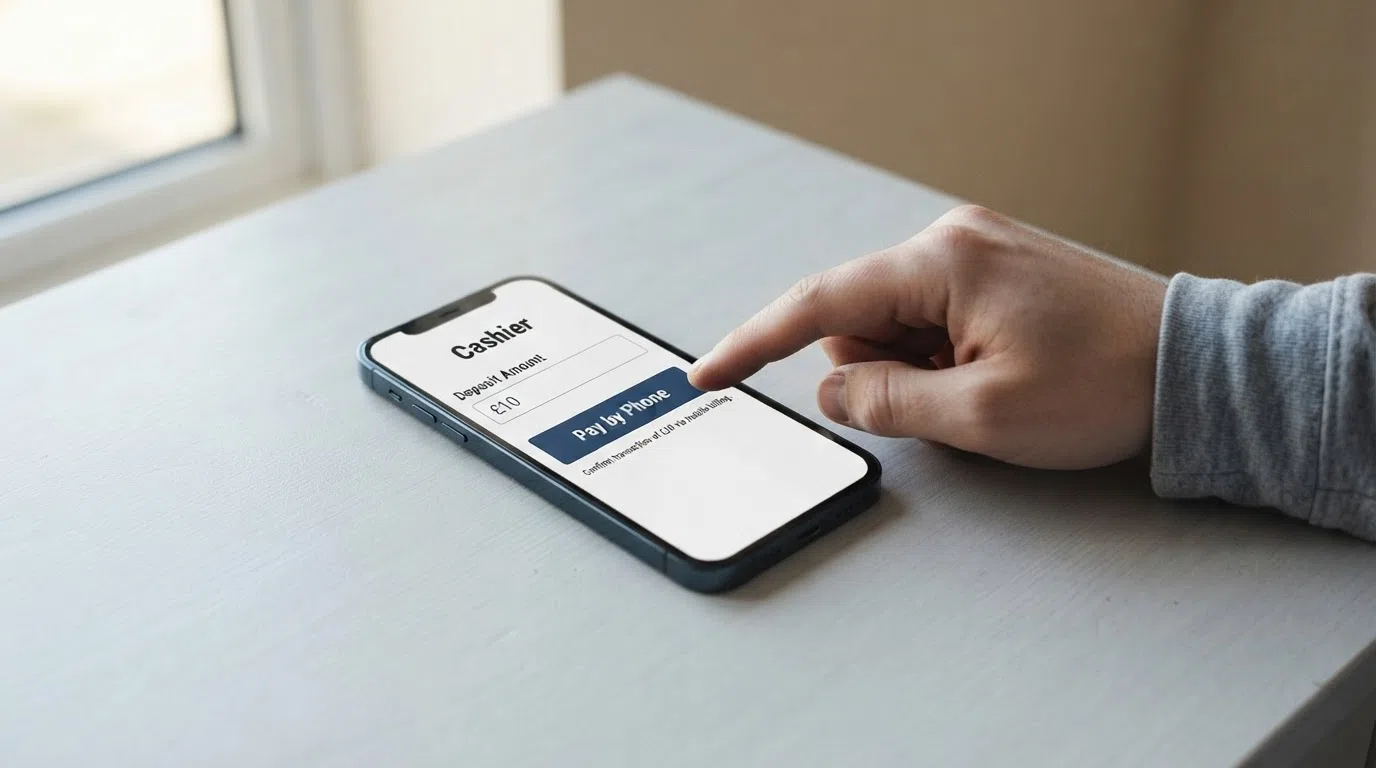
Phone bill vs mobile credit: two ways to charge a deposit
The pay-by-phone option covers two funding sources. A contract SIM — the kind that posts a monthly bill — adds the deposit to the next bill, where it sits alongside the line rental and any premium-rate charges. A pay-as-you-go SIM deducts the deposit from the available credit at the time of the transaction, which is closer to buying a premium-rate text message. The player experience is identical: a £10 deposit is a £10 deposit whichever way the SIM is set up. The choice between the two depends on the type of SIM the player carries, and most UK networks support both routes.
The deposit walkthrough, step by step
The cashier flow is short and the same on every site that supports it:
- Pick “pay by phone” (or “pay by mobile”, “Boku”, “Fonix”, “Payforit”) at the deposit screen.
- Enter the amount, up to the £40-per-transaction ceiling.
- Enter the mobile number, and wait for an SMS with a PIN.
- Confirm the PIN on the handset, and the deposit lands in the casino account within seconds.
- The amount is added to the next phone bill, or deducted from pay-as-you-go credit.
Withdrawals: why phone billing is one-way
UK mobile networks do not support withdrawals to phone bills, and no intermediary platform on the market offers the reverse route. A player who deposits £40 by phone and wins £250 will receive the £250 by debit card, bank transfer or e-wallet — whichever payout method the casino has on file. The welcome bonus page runs this caveat again because it is the single most-searched fact about the method.
UK carriers that allow casino charges
Pay by mobile is available on O2, EE, Vodafone and Three — all four of the major UK networks. The “check with your network” caveat is real: some accounts have premium-rate services blocked by default, and the charge will fail until the block is lifted. The smaller MVNO carriers (Tesco Mobile, Giffgaff, Sky Mobile and so on) typically route through the same host networks and inherit the same support. A player who has never bought a premium-rate text or a charge-to-bill app purchase should check the account settings before the first deposit attempt.
Boku, Fonix and Payforit: the middlemen
Three intermediary platforms sit between the casino and the mobile network, and the player meets all three under the same “pay by phone” label at the cashier. Boku was the early leader. Payforit is the mobile-network-owned alternative, and Fonix is the platform that has pulled ahead of both for casino deposits in the UK as of 2026. The player never deals with any of them directly: the casino integrates one of the three, and the deposit flow looks the same on the screen. The intermediary choice is the casino’s, not the player’s, and the published pay-by-phone confirmation on a casino site usually names the platform in the small print.
Deposit limits and the £5 minimum
The £40 per transaction and £240 per calendar month caps are the hard limits, set by the Payment Services Regulations 2017 and not adjustable by the casino or the network. Most UK pay-by-phone casinos set their own minimum deposit at £5 or £10, which is well inside the cap. A £5 deposit is the cheapest entry point and is the one that draws the processing fee: the majority of UK pay-by-phone casinos charge approximately £2.50 on £5 deposits, which is a 50% surcharge on a small stake and a real cost. Larger deposits carry the same percentage or no fee at all, depending on the operator.
Carrier by carrier: the small-print differences
Networks do not behave identically. Some require an opt-in to premium-rate services before any charge will land. Some cap a single bill at a different ceiling. Some block gambling-related charges by default for under-18 SIMs, which is correct but worth knowing about. None of these settings change the £40 / £240 statutory cap, but they can change whether a particular deposit goes through on a particular account.
Why your phone-bill payment may not unlock the welcome bonus
The single most common pay-by-phone frustration is also the easiest to miss: many UK casinos exclude phone-bill deposits from welcome bonus eligibility. The first deposit of £10 by phone may fund the account, but the 50 free spins or the 100% match may not credit unless the player funds by debit card instead. The exclusion is a marketing choice, not a regulatory one, and it is written into the bonus terms in small print.
No-deposit bonuses: what “free” actually costs
A no-deposit bonus looks like a gift — 70 spins on registration, no card needed, no money down. The terms attached determine whether the gift is worth having. Across the set, the no-deposit offers are Sky Vegas (70 spins), Paddy Power (60 spins), Betfair (50 spins + 100 more after a £10 spend) and William Hill (10 spins). All four carry zero wagering on the winnings, which is the cleanest structure available, but the spin values are 10p each and the validity windows are 7 days. The arithmetic: 70 spins at 10p is £7 of nominal spin value, played on whatever slot the operator assigns, and the return depends on that slot’s RTP.
Free spins: what one spin is actually worth
The free-spin value that recurs across the set is 10p, and the headline counts multiply that 10p by 50, 60, 70, 75 or 140. The number a player can affect is the underlying slot’s RTP, which is why Big Bass Bonanza at 96.71% and Big Bass Splash at 96.71% keep appearing as the bonus games: a higher RTP slot returns more per spin, all else equal. The wagering multiplier on the winnings is the second variable, and the 0x offers in the set (PlayOJO, MrQ, Sky Vegas, Paddy Power, Betfair) are materially more valuable than the 10x offers (Duelz, 888), because the winnings are paid as cash rather than as bonus funds that need clearing.
Welcome and deposit-match bonuses
The one true deposit match in the reviewed set is 888 Casino’s 100% up to £100 for a £10+ deposit. A £100 deposit returns £100 in bonus funds, the bonus carries 10x wagering on selected slots, the validity is 90 days, and the maximum winnings from the bonus are capped at £100. For a player who wants bonus funds rather than spins, this is the only structure in the set; for a player who wants spins, the 0x no-wagering offers at PlayOJO and MrQ are a different shape of value.
How to claim a bonus after charging your mobile
The exclusion is a marketing choice rather than a regulated one, and it varies by operator. The reliable move is to check the bonus terms before the first deposit, and to fund that first deposit by debit card if the welcome offer is the reason for joining. The exclusion clause usually appears in the bonus terms under “eligible deposit methods” or “how to claim”, and the cashier will mark the excluded methods on the deposit screen.
Wagering requirements and the no-wagering deals
A wagering requirement is the multiplier a player must turn over the bonus (or the winnings, depending on the structure) before the funds become withdrawable cash. A 10x cap on the bonus amount took effect on 19 January 2026 across UKGC-licensed operators, and the cap is the legal maximum — every welcome bonus in the set either sits at 10x or below, and the 0x offers sit at zero. The arithmetic behind a 10x requirement is straightforward: a £100 bonus with 10x wagering means £1,000 of qualifying slot play before the bonus converts to cash. A 0x requirement skips the entire turnover. The expected cost of clearing a 10x bonus depends on the slot’s RTP, and the next section runs the worked example for 888’s £100 offer.
Slot-specific bonuses and their fine print
Most free-spin offers in the set are tied to a named slot. Big Bass Bonanza is the most common title (PlayOJO, Casumo, and the bonus terms across the set), Big Bass Splash is LeoVegas’s title, and MrQ, Duelz, Sky Vegas, Paddy Power, Betfair and William Hill have not been confirmed for a specific bonus slot in this research run. The fine print usually excludes table games and live casino from the wagering contribution — LeoVegas’s terms are explicit on this, and most operators follow the same pattern. A player who enjoys live casino will not clear a slots bonus at the live tables.
The games a phone-bill top-up opens up
A phone-bill deposit funds the same library as any other deposit method, with the only constraints being the £5 (25+) and £2 (18–24) statutory stake caps and the casino’s own eligibility rules for bonus play. Slots dominate the bonus-friendly end of the menu, live casino and table games sit on the thinner end, and the provider mix is the strongest signal of library depth.
Slots funded by phone bill
Slots are the natural fit for a phone-bill deposit. The £40 transaction cap is comfortably above the £5 maximum stake for adults 25+, so a single deposit covers a session of 8 spins at the ceiling, and a £10 deposit covers a longer run at lower stakes. The £2 cap for 18–24 players further lowers the ceiling, but the math still works: a phone-bill deposit of £10 covers 5 spins at the legal maximum. The featured welcome offers are slot bonuses almost without exception, and the free-spin games are slots.
The strongest slot libraries for phone billing
The provider mix on the featured set is led by NetEnt, Pragmatic Play and Play’n GO, with Evolution covering the live casino end. PlayOJO, LeoVegas, MrQ, Duelz, Casumo, Sky Vegas and Paddy Power carry the same NetEnt / Pragmatic Play / Play’n GO core. 888 leans on Pragmatic Play and NetEnt. Betfair and William Hill run on NetEnt, Playtech and Blueprint. The deeper libraries — PlayOJO, LeoVegas, Casumo — give the player more titles to spend the deposit on, and the comparison table is the quickest way to compare.
Slot bonuses and free-play on phone billing
The free spins that headline the welcome offers are slot bonuses, and they attach to specific games — usually Big Bass Bonanza or Big Bass Splash in the confirmed set. The free-play demo route is the no-cost way to read a game’s volatility, learn the bonus feature and check the paytable before committing real money, and the demo runs on the same account and the same balance area as the real-money game.
The titles you’ll actually see — RTP and volatility
| Slot | Provider | RTP | Volatility |
|---|---|---|---|
| Big Bass Bonanza | Pragmatic Play | 96.71% | Medium-high |
| Big Bass Splash | Pragmatic Play | 96.71% | High |
| Book of Dead | Play’n GO | 96.21% | High |
| Starburst | NetEnt | 96.09% | Low |
Big Bass Bonanza is the most common welcome-spin game in the set, and it sits at a 96.71% RTP with medium-high volatility and a 2,100x maximum win. Big Bass Splash is the higher-volatility sibling on the same RTP. Book of Dead at 96.21% is the Play’n GO classic. Starburst at 96.09% is the low-volatility anchor and the longest-running bonus slot in the market.
Live casino and table games: the thinner end of the menu
Live casino and table games are offered across the set — Evolution powers most of the live lobbies on the featured brands — but the welcome bonuses in the table above are slot bonuses, and LeoVegas’s terms are explicit that table games and live casino are excluded from the wagering contribution. A player who wants to spend the phone-bill deposit at the live tables can do so, but the bonus will not clear there, and the live RTP is its own figure.
Apps and browsers: playing on the move
The device barely changes the deposit. Phone billing is a payment method, not a product, and it works the same on a casino app as it does in a mobile browser.
Apps that accept phone billing at the cashier
Where a casino runs a native app, the pay-by-phone option usually appears in the cashier exactly as it does on the desktop site. The confirmation PIN still comes through SMS, the deposit still lands within seconds, and the same £40 / £240 caps still apply. App-exclusive features vary by operator and are not specific to the payment method.
Browser vs app: the trade-off
A mobile browser is the no-download route. The same phone-bill cashier is in the deposit screen, the same games are in the lobby, and the same KYC flow runs at the first withdrawal. An app is heavier to install but holds the session, sends push notifications for new offers, and is usually a touch faster on repeat visits. The phone-bill deposit behaves the same in both.
iOS vs Android: the deposit works the same
The phone-bill deposit is carrier-routed, not platform-routed, so the behaviour on iOS and Android is identical. The differences live at the operator level (app availability, in-app cashier layout) and at the network level (premium-rate settings), not at the operating-system level.
Licensed or offshore: the line that decides your safety
| Rule | What it sets | Effective from |
|---|---|---|
| Remote Gaming Duty | 40% on profits from remote gaming with UK persons (up from 21%) | 1 April 2026 |
| Online slots stake cap | £5 per spin for adults 25+; £2 per spin for 18–24 | In force |
| Wagering requirement cap | 10x the bonus amount at UKGC-licensed operators | 19 January 2026 |
| Credit card gambling | Banned | 14 April 2020 |
| Pay-by-phone caps | £40 per transaction; £240 per calendar month | In force (Payment Services Regulations 2017) |
The Remote Gaming Duty increase to 40% from 1 April 2026 is the largest single tax increase in the history of the British online gambling market, and it is a tax on operator profit rather than on player stakes. The 10x wagering cap from 19 January 2026 is a player-facing limit, and every welcome bonus in the reviewed set either sits at 10x or below. The stake caps and the pay-by-phone caps are not new, but they continue to define the practical shape of the market.
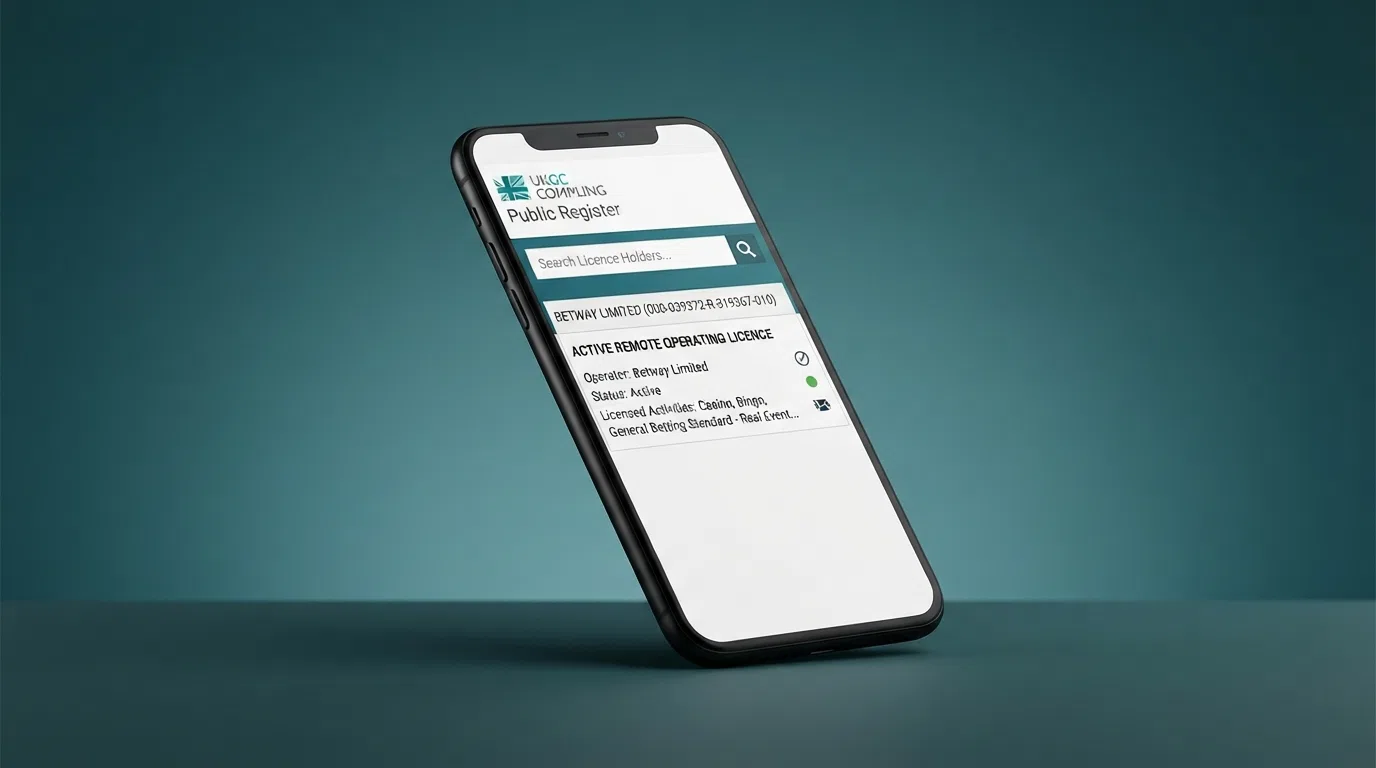
UKGC licensing: the stamp that matters
Every brand in the reviewed set holds an active UKGC remote operating licence, confirmed against the public register. The register is searchable at gamblingcommission.gov.uk and is the only authoritative check. Enforcement is real: ProgressPlay, the operator of Mobile Wins, was fined £1,000,000 by the UKGC on 21 August 2025, which is what an active regulator looks like when a licence is breached. A licence badge in a footer is a starting point; the public register is the proof.
What GamStop means for phone-bill deposits
GamStop is the UK’s national self-exclusion scheme, and every UKGC-licensed operator connects to it. A self-exclusion blocks the account at every connected operator regardless of the deposit method, which means a phone-bill deposit cannot bypass a GamStop block. The scheme covers 6-month, 1-year and 5-year exclusions, and a player who has self-excluded cannot deposit by phone bill, debit card or e-wallet at any UKGC-licensed site for the duration of the exclusion.
Not on GamStop: the label that points offshore
A “not on GamStop” casino is, by definition, not a UKGC-licensed casino. The label signals an offshore operation, and the consequences are real: no UK dispute resolution, no UKGC oversight, no enforced identity verification, no GamStop coverage, no £5 stake cap, no 10x wagering ceiling, and no recourse through UK courts. A player who values any of those protections should not play at a non-GamStop casino regardless of the welcome offer.
KYC: why “no verification” is a warning sign
UKGC-licensed casinos verify player identity before play, and verification is required before the first withdrawal. The standard request is photo ID, proof of address, and a payment-method confirmation, and the request comes from the operator, not from the payment intermediary. A “no verification” casino is either not UKGC-licensed or is operating in violation, and neither is a place to leave money.
Dispute resolution and player protection
A complaint about a UKGC-licensed casino can be escalated to the UKGC and, where appropriate, to an alternative dispute resolution provider. The £5 stake cap, the £2 cap for 18–24 players, the 10x wagering ceiling and the GamStop connection are built-in protections that follow the licence. None of these protections survive the move to an offshore brand, and the protection gap is the single largest difference between the licensed set and the not-on-GamStop alternatives.
Fresh UK casino launches: scarce this run
The reviewed set is established, not new. None of the brands above is a fresh launch in 2026, and no new pay-by-phone site surfaced in research this run. The established brands are not a limitation: they are the brands whose licensing, payment methods, and bonus terms have all been tested against the market’s rules.
New sites: none surfaced in this run
No new pay-by-phone operator surfaced in this research run. The reviewed set is the standing field, and a brand that wanted to enter the ranking would need to hold an active UKGC licence, accept phone-bill deposits, and offer a welcome package that competes on the terms the page ranks on.
What to check before you join a new casino
- Confirm the UKGC licence on the public register.
- Confirm phone billing in the cashier before depositing.
- Read the welcome bonus terms for any deposit-method exclusion.
- Check the wagering multiplier and the maximum-cashout cap.
- Check the bonus slot and the volatility before staking.
New-casino bonuses: the same 10x cap applies
The 10x wagering cap from 19 January 2026 binds every UKGC-licensed operator, including any new launch. A new site’s welcome bonus must sit at 10x or below, and the same deposit-method exclusions apply. Novelty does not waive the cap.
New vs established: licence before launch date
A licence outranks novelty. An established brand with a tested cashier and a known welcome offer is a safer starting point than a new brand with an untested cashier and a bigger headline, and a genuinely new licensed site would enter the ranking on the same terms as the established set rather than on the basis of being new.
The safeguards already built in — and where to get help
The UK market is not a single line of consumer protection; it is a stack of independent limits, each one tightening the same screws. The phone-bill method has its own, the operator has its own, the regulator has its own, and the support services sit outside the lot, ready to be contacted directly.
Phone billing’s built-in spending brakes
The £40 per transaction and £240 per calendar month caps are statutory, not casino-set. A player who wants to spend more than £240 a month on casino deposits cannot do it through a single phone-bill method, and the limit is not a feature the operator can disable. The cap is the closest thing the method has to a default deposit limit.
GamStop and operator-level self-exclusion
GamStop reported a 16% year-on-year increase in registrations in the first half of 2026, with 614,738 consumers currently self-excluded. The under-25 age group saw a 26% year-on-year increase, and nearly one in three self-exclusions now come from that cohort. More than half of the consumers on the scheme have opted for the maximum five-year exclusion. Operator-level self-exclusion runs alongside GamStop and can be set for shorter or longer windows, and individual operators also offer deposit limits, time-outs and reality checks on top of the national scheme.
Time-outs and reality checks
Beneath the headline self-exclusion options sit the session tools: short time-outs for 24 hours or a week, reality checks that surface a pop-up every 30 or 60 minutes, and operator-set deposit limits that can be tighter than the phone-bill ceiling. The session tools are configurable in the responsible-gambling section of every UKGC-licensed casino.
Where to get help in the UK
The National Gambling Helpline is 0808 8020 133, free, confidential, and open 24 hours a day, every day. GamCare made 996 referrals to treatment and peer-based support in January 2026, up 48% from 674 in January 2025. Four in five (82%) of the helpline’s 2026 callers cited online gambling specifically, the highest rate since 2021. The evidence from GamCare is that layered support — helpline, self-exclusion, blocking tools — produces stronger outcomes than any single route. GamCare, BeGambleAware and the National Gambling Helpline are the named entry points.
How we chose and checked these ten casinos
The ranking is built on five inputs: the UKGC public register (the licence check), each operator’s own published terms (the bonus and wagering figures), GOV.UK and the Finance Act 2026 (the regulatory dates), GamCare and GamStop (the player-protection numbers), and a cross-section of UK-facing affiliate reviews (Racing Post, BonusFinder, LiveScore, WhichBingo and others) for the per-operator welcome offers. Every licence was checked against the public register in this run, and every bonus figure was taken from the operator’s own site or from an affiliate review that quotes the operator. The page does not invent weightings, percentages or rankings; the order of the table is a position in a list, not a score.
Deposit by phone, verify the licence, withdraw elsewhere
The page has built a three-part verdict. First, deposit by phone, and know the £40 / £240 caps and the £2.50 fee on the smallest deposits. Second, verify the UKGC licence on the public register before joining, and treat the cashier confirmation for phone billing as a separate check. Third, plan the withdrawal through a different method, because phone billing is one-way. And finally, check the welcome-bonus exclusion before the first deposit — a debit card is the safer route if the welcome offer is the reason for joining.
Frequently asked questions
Can I fund a UK casino account straight from my phone bill?
Yes. Pick pay by phone (or pay by mobile, Boku, Fonix, Payforit) at the cashier, enter an amount up to £40, confirm the SMS PIN on the handset, and the deposit lands in seconds. The amount is added to the next mobile phone bill, or taken from pay-as-you-go credit.
Where do my winnings go if a phone-bill deposit can’t take them?
Phone billing is one-way, so winnings go out by debit card, bank transfer or e-wallet — whichever payout method the casino has on file. The withdrawal side has no £40 / £240 cap and does not route through the mobile network.
How much can I charge to my phone in a single deposit?
Up to £40 per transaction, and up to £240 per calendar month in total across all pay-by-phone casino deposits. The cap is set by the Payment Services Regulations 2017 and is not adjustable by the casino or the network.
Do I still get the sign-up offer if I pay by phone?
Often not. Many UK casinos exclude phone-bill deposits from welcome bonus eligibility, and the standard move is to fund the first deposit by debit card to qualify. The exclusion sits in the bonus terms and the cashier will mark the excluded method.
Is this a safe way to pay for gambling?
At a UKGC-licensed casino, yes. The deposit is regulated, the casino is regulated, identity is verified before the first withdrawal, and GamStop coverage follows the licence. At an offshore or non-UKGC brand, none of that holds, and the method itself is not the deciding factor — the licence is.
Will my mobile network add a fee on top?
The majority of UK pay-by-phone casinos charge a processing fee of approximately £2.50 on £5 deposits, which is a 50% surcharge on a small stake. Larger deposits carry the same fee or none, depending on the operator. The mobile network typically does not add its own fee, but premium-rate settings on the account must be on for the charge to go through.
Can I use phone billing at a casino that isn’t on GamStop?
A non-GamStop casino is, by definition, not UKGC-licensed. The phone-bill method itself does not change with the licence, but the protections that come with the UKGC licence — GamStop coverage, dispute resolution, the £5 stake cap, the 10x wagering ceiling — do not apply, and a player who values any of those protections should not play there.
Payments – trustedcasinos-notongamstop
Content created by the «trustedcasinos-notongamstop» team