Anjouan casinos and the UK player: a licence that travels nowhere near Britain
 Available in GB
Data current as of September 9, 2026; cross-referenced against the UK Gambling Commission’s published register, the Anjouan Gaming public register, GamCare, the NHS and GOV.UK.

A UK reader who searches for an Anjouan casino licence has almost certainly landed on this site through one of two doors. Either a “not on GamStop” list pointed them here, or they hit a brand whose welcome offer was too large to be British and wondered why. Either way, the underlying question is the same. What is this licence, who issues it, and what does it actually do for the person paying the deposit? The honest answer is that it does something real, and it does not do a great deal more. An Anjouan permit authorises a gambling business to operate from the Union of the Comoros. It is not a passport to any regulated market, the British one emphatically included. The pages that follow work through what the permit is, what it is not, and what a UK player concretely gives up by sitting down at one of the brands that runs under it.
Anjouan casinos explained: the offshore category UK players keep landing on
An Anjouan casino is a gambling site that holds a single offshore licence issued under the Computer Gaming Licensing Act 007 of 2005. The permit itself is granted by the Anjouan Betting and Gaming Board, with financial oversight from the Anjouan Offshore Financial Authority and day-to-day administration handled by Anjouan Licensing Services Inc. None of these is a subordinate of the UK Gambling Commission. The licence does not derive from the British regime, it is not recognised inside Britain, and it offers no route by which an operator can lawfully take customers who are physically in Great Britain.
What the licence does do is short and specific. It is a single B2C permit that covers casino, sportsbook, poker, esports and prediction markets as one bundled product, with no per-vertical carve-out, and it explicitly permits crypto-denominated play. Practical enough as a piece of paper: an operator can launch the lot under one filing, accept Bitcoin and stablecoins at the cashier, and run the marketing off a single logo. That is the entire value proposition, and it is exactly what makes the category attractive enough that roughly 1,234 B2C brands now hold one.
UK players reach these sites through search results and “best offshore” lists rather than through any British promotion or affiliate. The funnel is familiar. A reader types a query, sees a list mentioning Anjouan-licensed casinos that accept UK players without GamStop, follows a link, and finds themselves at an unfamiliar cashier. The reader has spent perhaps ninety seconds between curiosity and deposit. That is the moment this page exists to lengthen.
The framing an “authorisation to run a gambling business — it is not market access” line gets repeated for a reason. The line is the regulator’s own, and it is the single most useful sentence in this whole subject. An Anjouan licence authorises a business to operate from a particular jurisdiction. It does not cross borders. No offshore licence does.
The operators’ side: why an offshore permit looks worth the trade-off
The operator’s arithmetic is straightforward. A GB operating licence carries compliance overhead, mandatory GAMSTOP integration, statutory deposit prompts, the £5/£2 stake cap, the credit-card ban, and reporting lines into the Gambling Commission. None of that is small, and a great deal of it is not optional. An Anjouan licence is a €17,828 annual fee plus a much lighter operating footprint.
The reader who asks “but why would an operator accept the smaller licence” usually means a UK-facing audience whose header displays say non-GamStop. The answer: that is the whole reason. The £17,828 fee buys a gambling business that can market itself to the players a UKGC site cannot accept — players who have self-excluded, players who are blocked by deposit caps, players whose banks refuse payments to GB-licensed operators on affordability grounds. The market exists. The licence exists to service that market. Neither side pretends otherwise.
UK readers are still not the named customers of any of these brands. Anjouan-licensed operators are expected to geoblock the United Kingdom, alongside the United States, France, the Netherlands, Australia and the FATF blacklist. A geoblock is a wall raised by the operator, not a wall erected from outside. Some maintain it well. Some do not. The point is that an unblocked UK-facing site is breaking the licence’s own published rules, not stretching them.
The independent legal opinion issued on 19 September 2024 by a firm regulated in England and Wales and Quebec matters here. It confirmed that the Anjouan Offshore Financial Authority is the lawful regulatory authority for gaming in Anjouan, and that licences issued under the 2005 Act are legally valid. So the licence is real. That is rarely the dispute. The dispute is what a real licence from Anjouan is worth in Britain, and the answer there is the same in any reasonable reading: nothing beyond what the operator chooses to provide.
The “best Anjouan casinos” roundups are marketing, not a regulator’s ranking
The lists a reader lands on are affiliate content. Some are keener than others about disclosing that. No regulator ranks Anjouan-licensed casinos by quality. No consumer-protection body publishes the comparative payout speeds or complaint volumes of the brands on a “best of” list, because no consumer-protection body collects them. A “Tier-3 licence is not a strong consumer-protection signal. Functional protection is the operator’s own reputation, not the licence” reading is the safer mental model.
That sentence is worth sitting with. It means the licence verifies that the operator filed the right forms and paid the right fee. It does not verify that the operator pays out on time, segregates player funds, audits its random number generators, or resolves disputes. Those behaviours live or die inside the operator’s own policies, and the only clue a reader gets to them is what other players have reported publicly. A directory does not file a complaint for a reader. A “top 10” list does not lose a casino its ranking when a payout is withheld for ninety days.
A directory is not a vetting service: reading any Anjouan casino list
The Anjouan public register at Anjouangaming.com is a working tool. It is searchable by company name, licence number, or domain, and each entry carries a registered name, the licence number, the licence type (B2C or B2B) and the current status. Beyond those four fields, the register publishes nothing. There is no enforcement history, no financial data, no record of complaints, and no recentness flag. A licence that was active last year and quietly dropped this morning looks the same as one that has been clean for a decade.
That gap matters more than it sounds. A reader looking up a licence is not looking up a vetting. They are looking up a registration. A licence number leading to an active status tells them the operator filed the paperwork that year. It does not tell them whether they will receive their winnings, and it does not tell them whether the random number generators on the slots they will play are independently audited. For that, a reader is back to reading the operator’s own marketing claims and other players’ public reports.
Player reviews fill the gap the missing ADR leaves open
The structural absence of an alternative dispute resolution service makes player reviews disproportionately important in this category. There is no ADR body to mediate a complaint, no formal complaint mediation mechanism at the licensing authority, and no Commission complaints route because the site is not on the Commission’s register. When a payout is withheld and the live chat stops responding, the only recourse a player has is to write a public review that other potential depositors will read.
That makes the reviews themselves the consumer-protection layer. NationalBet drew negative withdrawal-complaint assessments for exactly this kind of pattern. BC.Game’s Curaçao bankruptcy ruling over roughly $2.5 million in unpaid player claims, currently under appeal, illustrates the same problem from a more brutal angle. The ABC News Australia put it cleanly enough: “the Anjouan licence did not come with a whole lot of oversight of the casinos operating under its name.”
The right use of those reviews is to triangulate. One angry customer does not a pattern make. A dozen reports of stalled withdrawals, repeated identity re-verification requests, and reworked bonus terms is a pattern. A pattern that has not changed in two years is the operator telling a reader what kind of company they run.
New Anjouan casinos launch fast — oversight does not
A €17,828 annual fee is a barrier against the merely curious, not against the prepared. A new Anjouan-licensed B2C brand can launch in a quarter: operations, payment stack, marketing site, support desks, the lot. MrJones launched in 2026-1. Rakebit launched in 2026-1. The register grew, and the gap between any given new operator and the regulator’s actual scrutiny of them stayed the same width.
The scrutiny direction of travel is closer than it was. Since July 2026-1 Anjouan Gaming has required every B2B provider that works with an Anjouan-licensed operator to hold either a local Anjouan B2B licence or an approved B2B licence. That pulls the game studios, the live-dealer suppliers and the platform vendors into the licensing perimeter for the first time at scale. Still, the constraint on the operator side remains what it has always been: entry cost low, oversight thin. Newness on the licence register tells a reader nothing about safety.
Crypto is the point: Anjouan permits what the UK has not regulated
The crypto permission is the licence’s clearest selling point. Anjouan explicitly permits crypto-denominated play; the UK has not legislated crypto-specific online gambling either way. That is not the same thing as it being welcome at a UK site. None of the UKGC rules currently address the question. So a reader staking Bitcoin at a UK-licensed casino is in undefined territory, while a reader staking Bitcoin at an Anjouan-licensed site is in the licence’s explicit scope.
This is the precise shape of the category. Wild.io runs as a crypto-only casino: BTC, ETH, LTC, USDT and nine other coins at the cashier, withdrawal caps set in BTC. Rakebit runs as a crypto-and-fiat operation. That is the licence paying for what the UK has chosen not to license. A wagering-cap conversation is irrelevant to many of the readers in this category, because the games that interest them were either not on offer at the UKGC site they came from or carried a stake cap that took them off the bonus ladder entirely. The licence’s “we will let crypto in” promise is the structural reason a reader is comparing the two regimes in the first place.
The reader should also know the wallet risk they carry. Crypto transactions are not reversible through the operator. A mistaken address is gone. A sanctioned wallet rejection at the exchange end is gone. The Anjouan licence’s protection does not extend to the wallet, the chain, or the price movement between deposit and withdrawal.
Anjouan bonuses look bigger because the UK’s 10× cap does not reach them
UK-licensed operators live under a 10× wagering cap from 19 December 2026-1, plus a complete ban on mixed-product promotional offers. Anjouan-licensed operators do not. The headline simply takes the British lid off.
Goldbet’s 45× on bonus. Ybets at 30× on bonus and 45× on free spins. MrJones at 30× on deposit plus bonus. BC.Game at 40× on deposit plus bonus. These are not anomalies against the Anjouan norm; they are the norm. A 700% welcome is plausibly cleared only at the cost of dozens of hours of play on the eligible slots, on a licence whose dispute resolution is absent the moment the bonus terms and the player’s reading of them disagree.
The asymmetry is the point. A 700% headline read against a 30× turnover requirement does not look like more free money than a 100% match at 10×. It looks exactly like that, until the player does the arithmetic, and by then the deposit has cleared. The matching UK offer would be faster to clear, requiring far less playtime than the Anjouan equivalent. The matching Anjouan offer might be £800 of bonus money that requires significantly longer to clear under its higher wagering requirement. The wagering load is the price of the headline. The wagering load is the price of the headline.
The Anjouan gaming licence is a real offshore permit — but it carries no weight inside Britain
Licence architecture and statutory standing are where most of the player-facing gloss breaks. The Anjouan permit is structured around one issuing act. The UK position is structured around two parallel acts. The two architectures answer to two different questions.
The Anjouan licence is issued under the Computer Gaming Licensing Act 007 of 2005 by the Anjouan Betting and Gaming Board, with financial oversight from the Anjouan Offshore Financial Authority and administration by Anjouan Licensing Services Inc. as the sole authorised administrator. The architecture is short, integrated, and targets operator entry costs above all else.
The UK position is laid down by the Gambling Act 2005 and extended to remote operators by the Gambling (Licensing and Advertising) Act 2014. The 2014 Act is the point-of-consumption reform that required any operator serving customers in Great Britain, regardless of domicile, to hold a GB operating licence. A Curaçao, Maltese or Anjouan licence is not a substitute. The 2005 Act, section 33, makes providing gambling facilities without a required GB licence a criminal offence — punishable by up to 51 weeks’ imprisonment, an unlimited fine, or both. The offences are aimed at operators, not players, but the offence itself is what excludes an offshore site from the British consumer-protection system.
The practical upshot is recorded cleanly from the regulatory comparison pages: “None of them recognise an Anjouan permit, because the Anjouan Betting & Gaming Board has no authority inside their borders.” This is not a slight. It is the British regime describing itself.
Who runs it: the three bodies behind one licence and what they each control
Three bodies sit behind the single permit. They are not interchangeable. The Anjouan Betting and Gaming Board is the issuing authority; it grants the licence and holds the statutory power. The Anjouan Offshore Financial Authority handles financial oversight, sitting inside Anjouan’s broader offshore finance structure. Anjouan Licensing Services Inc. is the sole authorised administrator — the body through which the actual paperwork moves, the public register is maintained, and the day-to-day communication with licensees happens. The independent legal opinion of 19 September 2024 confirmed AOFA is the lawful regulatory authority for gaming in Anjouan, which is the closest the licence has come to an external legal validation.
The reader’s interest in this structure is mostly about who would respond to a complaint. The honest answer is none of them in the British-consumer-protection sense. There is no ADR attached to any of these three bodies. There is no equivalent of the UKGC’s complaints procedure routed through ABGB or AOFA or ALSI. The bodies that grant licences for offshore commerce do not, as a rule, mediate between the customer and the supplier.
What the Anjouan licence covers — and the three things it does not
A single B2C permit covers casino, sportsbook, poker, esports, and prediction markets, all under one licence, no per-vertical carve-out, with crypto-denominated play allowed. That is the entire positive scope. It is dense relative to a Curaçao or Malta structure, where vertical splits and ancillary approvals are routine.
What is not there is just as important as what is. There is no mandatory player-fund segregation. There is no independent RNG auditing. There is no alternative dispute resolution service. There is no formal complaint mediation mechanism available to players. The framing from a current regulatory comparison lands it in one breath: “virtually no formal player protection mechanisms — no mandatory segregation, no independent RNG auditing, no dispute resolution service, no licensing body with enforcement authority.”
That sentence is not a marketing cut. It is the structural definition of the licence, and it never gets shorter for the reader.
The offshore trap: a jurisdiction where compliance costs are low and player recourse is near zero
Anjouan’s design is a feature for the operator and a structural risk for the player. The low compliance cost is precisely what an operator is buying. The thin recourse is precisely what an operator is not buying. The reader is the person absorbing the second half of that bargain.
Operators under the licence are expected to geoblock the United Kingdom, United States, France, Netherlands, Australia, and FATF-blacklisted countries. The expectation is contractual. It is rarely self-enforced in any meaningful sense. A UK reader who reaches an Anjouan-licensed casino has reached a site that, in formal terms, is breaking its own published rules by accepting them.
The honest framing is what the regulatory comparison pages said earlier: a Tier-3 licence is not a strong consumer-protection signal. Functional protection is the operator’s own reputation, not the licence. A reader’s deposit is therefore protected by the operator’s incentive to stay in business, not by any standing enforcement arm.
Side by side: what a GB licence adds that the offshore one lacks
A side-by-side read of the two regimes makes the gap legible at a glance. Both columns are answering the same question — what protection does a player get from the licence that lets me play here? — and the Anjouan column runs light by design.
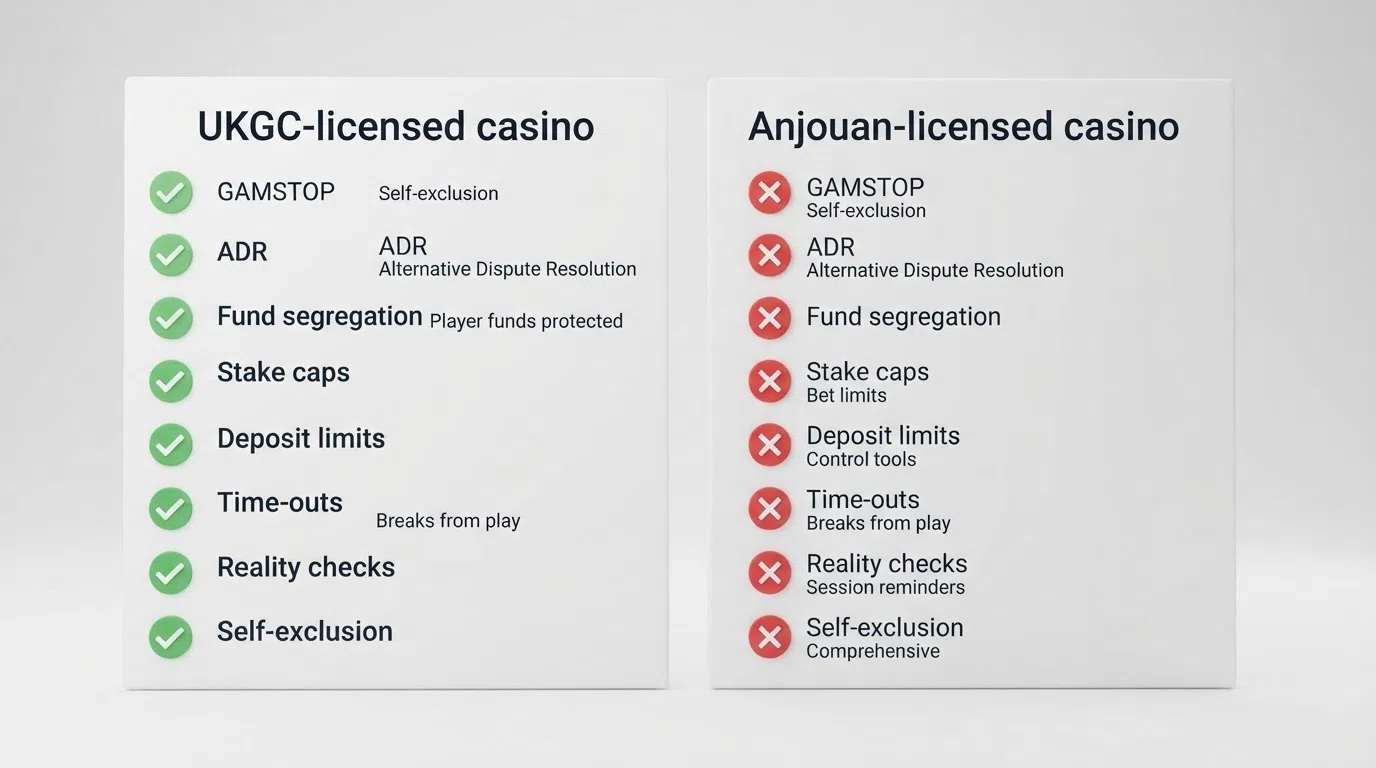
| Protection dimension | UKGC-licensed casino | Anjouan-licensed casino |
|---|---|---|
| Statutory compulsion to hold this licence to serve GB customers | Yes (Gambling (Licensing and Advertising) Act 2014) | No GB licence held |
| Self-exclusion (GAMSTOP) | Mandatory since 31 March 2020; six months / one year / five years / auto-renewing five years | Not covered |
| Alternative dispute resolution (ADR) | Available via Commission route | None attached to the Anjouan licence |
| Mandatory player-fund segregation | Required under LCCP | None |
| Independent RNG auditing | Required under RTS | None mandatory |
| Maximum stake per game cycle | £5 (25+) / £2 (18–24), SI 2025/215 | No statutory cap |
| Wagering requirements | Capped at 10× from 19 December 2026-1 | No cap; 30×–45× common |
| Mixed-product promotional offers | Banned from 19 December 2026-1 | Permitted |
| Credit card acceptance | Banned since 14 April 2020 | Permitted |
| Financial vulnerability checks | Mandatory at £150 net deposits / 30 days (from 28 February 2026-1) | None |
| Statutory levy contribution | 1.1% of GGY from 6 April 2026-1 | None |
| Remote Gaming Duty exposure | 40% from 1 April 2026-1 | None |
| Consumer redress in Britain | Full | None |
The two columns are not symmetrical. The UK column is a system of checks layered into the operating licence, each one a separate regulatory decision, each one enforced through licensing consequences. The Anjouan column runs to a single line — no GB licence held — and almost everything else that follows from a GB licence is therefore not in force.
The UK enforcement machine: disruption, not DNS blocking
The UKGC does not have statutory power to instruct British ISPs to block offshore sites. That power has been discussed in legislation and not enacted. What it does have is a relentless disruption toolkit, and the data on its operation is published regularly.
Between April 2024 and June 2026-1 the Commission’s Illegal Markets team issued 3,140 disruption notices: 2,032 cease-and-desists to operators, 774 referrals to domain registrars, 402 referrals to hosting providers, and 3 to payment providers. They referred 447,778 URLs to search engines, of which 287,961 were removed. Across 160 disrupted sites, the average engagement fell by 32 percent. In a more recent reporting cycle covering 2026 the Commission logged 208,088 enforcement actions, 397,527 URLs reported, 266,667 URLs removed, 741 cease-and-desist notices, and 1,134 websites disrupted through takedowns or geo-blocking. The Commission also issued 260 cease-and-desist notices to advertisers under section 330 of the Gambling Act 2005 alone, and reduced the deadline for an advertiser to implement a geo-block from 14 days to 48 hours.
Two practical takeaways follow. First, the British state cannot make an offshore site invisible; it can make it scarcer, slower to find, and harder to monetise. Second, the absence of ISP-level blocking is the single sharpest reason the Anjouan-licensed segment continues to attract UK-facing traffic at all. The licensed price of full blocking has not yet been paid politically.
The licence number you can check — and the gaps the register hides
The Anjouan public register at Anjouangaming.com is a working tool for one task. It verifies that the licence number a site displays is a real licence currently in the register. It can be searched by company name, licence number, or domain, and the record carries the registered name, the licence number, the licence type (B2C or B2B), and the current status.
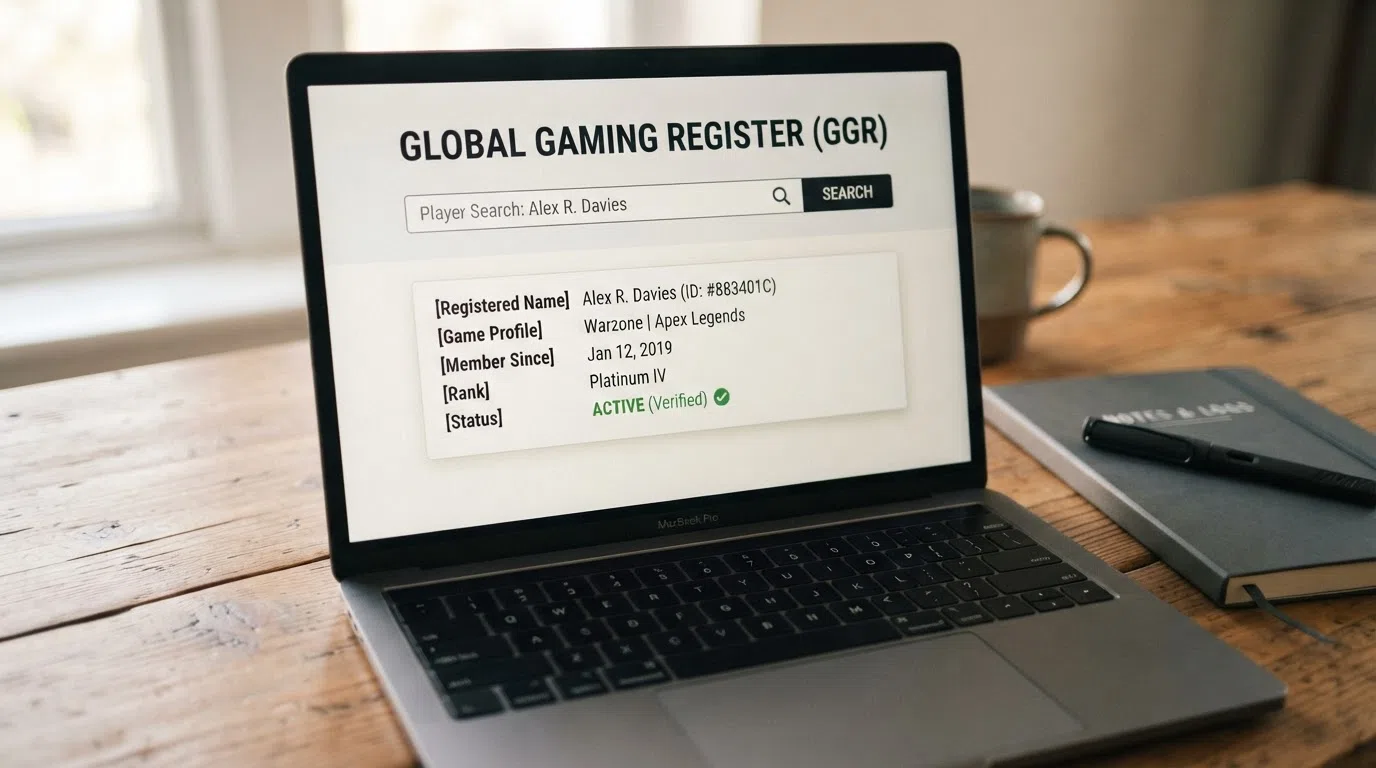
That is what the register is for. That is also all the register is for. The register does not publish enforcement actions against a brand. It does not publish financial data on the licensee. It does not publish complaint records. It does not publish the date the licence was first issued, the date it was last renewed, or whether any part of the licence’s scope has been suspended or restricted. A reader looking for any of those facts is looking for facts the register does not contain.
This matters specifically when a reader is comparing two sites. Site A, on the register, status active. Site B, on the register, status active. The reader now knows roughly the same thing about each. They need a different source to tell them that one of those is the operator that just underwent a major restructure, or that the other has had withdrawal complaints piling up publicly. The register does not substitute for that other source. It just confirms the operator hasn’t quietly dropped off the licence in the meantime.
Ten brands trading on an Anjouan licence — none holds a UKGC one
The ten operators below are all Anjouan-licensed examples. None is UKGC-licensed. They are listed as representatives of the licence framework, not as recommendations, and a UK player accessing any of them does so without the consumer protections of a GB-licensed operator. The ranking is based on relevance to the keyword topic — operator prominence in search results and bonus visibility — not on payment reliability or any consumer-side metric the Anjouan register would back.
| Operator | Anjouan licence — number or status | Welcome bonus | Wagering | Signature trait |
|---|---|---|---|---|
| BC.Game | ALSI-202410011-FI1 | Up to $4,000 + 400 FS over 4 deposits (120%/100%/80%/80% + 100 FS) | 40× on deposit + bonus | Migrated Curaçao → Anjouan late 2026-2; closed UK white-label Dec 2026-2 |
| Ybets | ALSI-202411003-FI1 | Up to $8,000 + 400 FS over 4 deposits (200%/100%/100%/100% + 100 FS) | 30× on bonus / 45× on free spins | Two-tier wagering for bonus vs spins; 60-day validity |
| Goldbet Casino | ALSI-012401005-FI1 | Up to $4,500 + 200 FS over 4 deposits (100%/125%/150%/175%) | 45× on bonus | The featured set’s only deposit-free free-spins offer |
| MrJones Casino | Not stated | 700% up to £5,200 over 4 deposits | 30× on deposit + bonus | GBP-denominated, packaged to read British |
| Wild.io | ALSI-202504044-FI2 | 400% up to $10,000 + 300 FS over 3 deposits | 40× on bonus | Crypto-only, withdrawal caps in BTC |
| OsomBet | Not stated | Multi-tier match + up to 200 FS | 35× on bonus | €5 max-bet-per-spin cap while bonus is active |
| Rakebit | ALSI-202504026-FI1 | 450% welcome bonus | Not published | 5,791 games across 66 studios; 1× AML playthrough before withdrawal |
| Bets.io | Not stated | 225% up to 1 BTC + 225 FS over 3 deposits | 40× on bonus + FS | Max bet capped at 2 USDT while bonus is active |
| Rainbet | Not stated | 250% up to $2,100 + 60 FS over 3 deposits | 40× on deposit + bonus | 20% rakeback boost for the first 72 hours |
| Cybet | Not stated | 100% match + 50 FS on selected Pragmatic/NetEnt titles | 35×–40× | Named studio titles on the free spins; threshold-triggered no-KYC |
BC.Game: the biggest name, and the clearest case study in switching licences
BC.Game holds Anjouan licence ALSI-202410011-FI1. The licence number is the readable part; the licensing history behind it is the more interesting part. BC.Game migrated from Curaçao to this Anjouan permit in late 2026-2, formally withdrew its Curaçao licence in December 2026-1, and previously operated in the UK under a TGP Europe white-label arrangement (UKGC licence 38898), which closed in December 2026-2. The casino has therefore cycled through three distinct licensing relationships in twelve months.
The welcome package runs up to $4,000 plus 400 free spins across four deposits (120%, 100%, 80%, 80% matched plus 100 free spins each). Wagering is 40× on deposit plus bonus, with 30 days’ validity. Free spin winnings carry their own 40× wagering with a $10 maximum withdrawal per batch. The withdrawal ceiling is $50,000 per week and $100,000 per month. The game catalogue is the largest in this roundup — roughly 80 studios and 8,000-plus games.
For a reader comparing BC.Game to a UKGC alternative, the relevant comparison is not the headline. The 8,000-game catalogue, the live-dealer depth and the $50,000 weekly ceiling are all things BC.Game does well that an equivalent UK site also does well. The 40× turnover is the structural difference, and the closure of the UKGC white-label is the structural fact. BC.Game traded a UK-licensed presence for an Anjouan one, and the welcome bonus design tracks that trade exactly.
Ybets: four deposit tiers, two different wagering numbers
Ybets operates under Anjouan licence ALSI-202411003-FI1. The welcome package totals 500% up to $8,000 across four deposits (200%, 100%, 100%, 100% match plus 100 free spins each), with a $15 minimum deposit per stage. The wagering structure is the part to read carefully: 30× on the bonus amount, 45× on the free-spin winnings, and a 60-day validity window.
The two different wagering numbers are unusual, and they tell a reader exactly what the bonus is doing. The deposit-matched bonus is the cheaper side to clear, slightly under the 35×–45× that offshore offers routinely carry. The free-spin side reads like a marketing cost the operator would rather pay back slowly — the 45× multiplier on what is typically a smaller free-spin-winnings pool means any meaningful win needs to be worked through. The 60-day window is generous against the typical 30-day offshore clock, but the 45× on the spin side is the number that does the work in the small print.
Ybets is a credible representative of the mid-tier Anjouan brand: a real licence number, a structured welcome, no published consumer-protection guarantees beyond the licence.
Goldbet: the one featured brand with a no-deposit free-spins offer
Goldbet Casino operates under Anjouan licence ALSI-012401005-FI1, issued to Goldkey Technologies Limitada in Costa Rica. The welcome package runs up to $4,500 plus 200 free spins across four deposits, matched at 100%, 125%, 150% and 175%, with a €/$10 minimum deposit. Wagering is 45× on bonus.
The structural distinction is the deposit-free free spins. 150 of them are attached to a code — 100 exclusive plus 50 standard — and the code carries 35× wagering on winnings, a 24-hour validity, and a maximum win of $15/$10 per batch. The 24-hour clock is the binding constraint. A reader who actually wins anything does so inside a single day of slot play, with a capped payout, and the bonus has evaporated by the next morning.
The Costa Rica operating address is worth noting in itself. It is the operator’s corporate seat, not its licence seat, and it is the kind of detail a reader can confirm against the Anjouan register without ever making contact with the Costa Rican regulator. Goldbet is the closest thing to a deposit-free welcome in this roundup, and the closest thing to a complete read on what the operator is willing to print publicly.
MrJones: a GBP-denominated package built to look British
MrJones launched in 2026-1, operated by ChapChap Technologies Ltd. The welcome package runs 700% up to £5,200 across four deposits, with 30× wagering on deposit plus bonus, a 15-day validity, and a £10 maximum bet per round while the bonus is active. The licence number is not confirmed in the public record to a level a reader can verify, but the marketing positions MrJones explicitly as non-GamStop and UK-restricted. The page header is pounds, the welcome climbs over five thousand quid, and the brand is positioned to read native to a British debaser.
The 15-day validity is the part that bites. A UK reader with a £5,200 cap to clear at 30× inside a fortnight faces roughly 50 hours of slot play at £5 spins, against the standard non-GamStop 30-day clock — and likely with a £10 cap that halves the spin count by half the time. The marketed header looks British; the timeframe makes it Anjouan. A reader who treats the welcome as the kind of offer a UK site would build is the reader most likely to find the bonus cleared into a forfeit.
The licence number is the gap here, and it is worth recording clearly: the brand claims Anjouan, the marketing takes pounds, and the Anjouan register does not currently carry a matching licence number for the MrJones name. A reader should verify that discrepancy before even creating an account.
Wild.io: crypto-only, with the licence to match
Wild.io holds Anjouan licence ALSI-202504044-FI2 and runs as a fully crypto-only operation: BTC, ETH, LTC, USDT, USDC, XRP, SOL, BNB, ADA, TRX, DOGE and BCH at the cashier. The welcome package is 400% up to $10,000 plus 300 free spins over three deposits, with 40× wagering on the bonus. Withdrawal caps are 3 BTC per week and 10 BTC per month.
The crypto denomination is the offer, not a side feature. For a reader who specifically wants to deposit in BTC without an exchange round-trip to GBP, this is the regime the UKGC has not yet written a rule on. The withdrawal ceiling in BTC shifts with the price; the ceiling in pounds is whatever 10 BTC works out to that day.
The structural point is the absence of any fiat on-ramp. There is no GBP balance. There is no card deposit. There is no bank transfer option. A reader who wants to play here funds a wallet, transfers, and withdraws back to that wallet. That is the Anjouan licence’s explicit permission in operational form.
OsomBet: the 2023 incumbent with a €5 max-bet guardrail
OsomBet launched in 2023 under OSOM Entertainment Group, one of the longer-running Anjouan brands in this roundup. The welcome package runs a multi-tier matched deposit plus up to 200 free spins, with 35× wagering on bonus, 30-day validity, and a fixed €5 maximum bet per spin while the bonus is active.
The €5 cap is the relevant constraint in active play. It is the same number the UK uses as the maximum stake per game cycle for over-25s, but here it is a self-imposed promotional cap rather than a regulatory one. A reader running 30× through a bonus has to do so at ≤€5 per spin, which lengthens the run rather than compressing it.
OsomBet is what a 2023 Anjouan brand looks like when it has not chased the 700% header. Multi-tier match, free-spin ladder, single-digit euro cap on the bonus bet. OsomBet is a practical choice for those who value the licence’s basic framework without the high-volatility marketing.
Rakebit: a casino-plus-sportsbook with a 1× AML playthrough, not a wagering term
Rakebit operates under Anjouan licence ALSI-202504026-FI1, run by Innovex Tech Holdings Limited, and launched in 2026-1. The welcome package is 450% — the exact tier structure and free spins are not published in the operator-confirmed snippets — sitting on top of 5,791 games across 66 studios. The “1× deposit playthrough” the operator describes is an AML standard for first-withdrawal verification, not a bonus turnover requirement: a reader has to have turned the deposit over at least once before withdrawing, irrespective of bonus play.
That single phrase — “1× deposit playthrough before withdrawal” — is a useful distinction for a reader coming from UKGC literature. The 1× rule is industry-standard anti-money-laundering plumbing, present at UK-licensed sites too. The absence of any published wagering multiplier alongside the 450% welcome is more interesting: the operator either treats the wagering as not-disclosed or as not-applicable, neither of which a reader should accept at face value.
KYC is threshold-triggered rather than immediate at registration. That is the same crypto-friendly pattern most Anjouan brands use, and it is the structural opposite of GB practice. A reader wanting to withdraw more than the KYC trigger will eventually be asked to verify.
Bets.io: a Bitcoin-denominated welcome across three tiers
Bets.io is Anjouan-confirmed, with some sources independently referencing a Curaçao relationship — the kind of licence-history ambiguity an offshore brand accumulates when its licence has changed hands. The welcome package runs 225% up to 1 BTC plus 225 free spins across three deposits (100% up to 1 BTC plus 100 free spins, 75% up to 1,000 USDT plus 75 free spins, 50% up to 500 USDT plus 50 free spins). Wagering is 40× on bonus and free spins. The maximum bet is capped at 2 USDT while the bonus is active, with a 20 USDT minimum deposit.
The 2 USDT max bet is unusually tight for an offshore welcome. It slows the bonus clock considerably relative to the 30×–40× headline; at typical slot spin speeds the 40× requirement through a 2 USDT ceiling extends the run to dozens of hours more than a comparable wagering cap would. The BTC denomination again does the work — the “1 BTC cap” is a moving number in pounds.
For a reader who specifically wants Bitcoin-denominated welcome terms and is willing to read the licence-history ambiguity in the source list, Bets.io sits in the mid-tier of crypto Anjouan brands: real product on top, paper-thin regulatory certainty underneath.
Rainbet: the featured brand that also pushes rakeback
Rainbet is Anjouan-confirmed. The welcome package is 250% up to $2,100 plus 60 free spins across three deposits (100%/$700 plus 20 free spins, 50%/$700 plus 20 free spins, 100%/$700 plus 20 free spins), with 40× wagering on deposit plus bonus. A 20% rakeback boost runs for the first 72 hours.
The rakeback boost is the second hook. Rakeback is a return-of-house-edge mechanic that gives back a percentage of what the house keeps; structurally it is a way to reduce the player’s expected loss over a fixed play period. The 20% boost for the first 72 hours is timed to overlap with the early part of the welcome period, when a player is most likely to be putting in volume to clear the 40×.
Rainbet is the brand on this list with the clearest combination of welcome product plus ongoing rakeback. Total expected loss during the bonus window is a better metric than headline percentages, and that makes the rakeback math decisive.
Cybet: a modest 100% match with named studio titles
Cybet is Anjouan-confirmed and staffed by Pragmatic Play, NetEnt and other named-studio content. The welcome is a 100% match plus 50 free spins on selected Pragmatic Play and NetEnt titles, with 35×–40× wagering depending on the active promotion, a $10 minimum deposit, and a $15 maximum bet while the bonus is active. KYC is threshold-triggered rather than mandatory at registration.
The 100% match is the lowest headline in this roundup, but it is also the only welcome with named-titles free spins — the reader knows which games the spins are on, which is not true for most of the roundup’s free-spin commitments. A reader who values knowing the slot name over chasing the largest percentage has the cleaner reading here.
Cybet is for the operator-curious reader: smaller welcome, transparent slot roster, crypto-friendly approach. The 35×–40× band is the standard Anjouan range; nothing more, nothing less.
Player protection is where the two frameworks truly divide
GAMSTOP is the single most concrete line a UK-reader can hold in their head. It has run mandatory for every GB-licensed online operator since 31 March 2020, with exclusion periods of six months, one year, five years, or five years with auto-renewal. The exclusion cannot be cancelled early. It does not cover unlicensed sites. That last clause is the entire practical difference between a UK player who self-excludes and a UK player who keeps playing at an Anjouan-licensed site. The lever stops at the border.
A UK player sitting at an Anjouan casino has nothing comparable. There is no mandatory fund segregation. There is no independent RNG auditing. There is no ADR. There is no formal complaint mediation. The licence does not require any of those things, and the operator does not provide them because nothing requires the operator to provide them. The only friction a player has against a stuck withdrawal is the operator’s own reputation, which the public reviews and the threat of a public review represent.
Help exists in Britain regardless of the site a player used. The National Gambling Helpline, run by GamCare, is free, confidential, 24/7 on 0808 8020 133, and took more than 52,000 calls in the most recent annual reporting period; 996 referrals in January 2026 alone, a 48% year-on-year increase. The NHS treated 4,355 referrals through its gambling services in 2024/25, up from 2,284 in 2023/24 — a near-doubling in twelve months. GambleAware/NGSN treated 11,960 clients in the year to March 2026-1, an 11% increase, with waiting times under two weeks from referral and nine out of ten completers showing improvement.
Prevalence is the larger backdrop. The GSGB 2024 estimated 2.7% of adults 18+ in Great Britain scored PGSI 8+, the problem-gambling threshold. The NHS Health Survey for England 2024 found 0.4% PGSI 8+ and 5% PGSI 1+ (at-risk or problem gambling). In treatment-need estimates, almost 1.6 million English adults who gamble might benefit from some form of support for harmful gambling; 243,000 might benefit from psychologist-led CBT. The infrastructure exists for the people who need it. The question for the page is whether the offshore site a player used breaks any of the routes that infrastructure depends on.
Self-exclusion that stops at the border: what GAMSTOP reaches and what it never will
GAMSTOP’s design is targeted, not global. It is mandatory for every GB-licensed online operator. It does not extend to offshore sites. It works on the database, not the player. A reader who has self-excluded through GAMSTOP and then loads an Anjouan-licensed operator through a separate browser tab has not violated their self-exclusion; they have moved outside the system that enforced it.
The framing matters because the worst self-exclusion stories in the GB context are not player-side failures. They are operator failures in handling exclusion. On the Anjouan-licensed set, the operator is not in the system at all. The lever exists. The lever stops at the licensed border.
The deposit-limit and vulnerability-check gap a UK player gives up
From 31 October 2026-1 a UK-licensed operator must prompt a customer to set a financial limit before their first deposit. The offer is mandatory. From 28 February 2026-1 that same operator must run financial vulnerability checks at a £150 net deposit threshold in a rolling 30-day period, using only public data — county court judgments, bankruptcy orders, IVAs, DROs. The reading of the player is automated, but the check itself is required. Anjouan sites have no equivalent. No mandatory deposit-limit offer, no vulnerability check, no obligation to surface anything to the player beyond the operator’s commercial content.
For a reader who has hit the GB side’s deposit ceiling and is now shopping offshore, the gap is precisely the gap that produced the shopping. The self-imposed GB protection got in the way of the deposit. The offshore site is simply functioning as intended by the operator, by not imposing one.
Help exists in Britain regardless — the helplines, clinics and networks a player can use today
The British help infrastructure operates independently of the site a player used. There is no exclusion boundary for it. A reader who has played at an Anjouan casino and recognises the pattern in themselves can call the National Gambling Helpline on 0808 8020 133, free and 24/7. The NHS gambling services have slots in 2026 that did not exist in 2023. GambleAware can be routed through a self-referral in under two weeks.
The infrastructure is funded through the statutory levy (1.1% of gross gambling yield from 6 April 2026-1 for remote operators). The levy is paid by GB-licensed operators. An Anjouan-licensed operator does not pay into the British treatment system. The treatment system is therefore funded by the licensed market and accessed by players regardless of which market they used. That is the asymmetry at the system level.
How we selected and checked these operators
The selection is descriptive, not endorsed. The ten operators were pulled from current search results as representative active Anjouan-licensed brands accessible from a UK IP address, and ordered by relevance to the keyword — operator visibility in search results and the prominence of their welcome offers — not by quality. They are examples of the licence framework, not commercial recommendations, and a UK player accessing any of them does so without GB consumer protections.
Verification was through the Anjouan public register at Anjouangaming.com, where each operator’s licence status can be checked by company name, licence number or domain. The register confirms the licence itself. It does not confirm how the operator runs its product, which is why this page’s editorial weight has been put on what the licence does not require.
The licensing benchmark has been the Gambling Commission’s published position. Five of the ten featured operators carry a published licence number; four carry an Anjouan-confirmed status without number research could source; licence-number confirmation was not achievable for MrJones specifically. Where the register is silent, the page records the silence rather than filling the gap with confident language.
What a UK player should actually take from this
The Anjouan licence is real. The register at Anjouangaming.com is searchable, and the operator numbers above check out against it. The 2024 independent legal opinion confirmed the issuing authority is the lawful one. None of that changes the practical fact.
What a UK player gives up by sitting at an Anjouan-licensed table is the regulated system they are inside when they sit at a UKGC-licensed one. GAMSTOP does not reach them. ADR does not. Fund segregation is not required. RNG auditing is not required. The 10× wagering cap does not apply. The £5/£2 stake cap does not apply. The credit-card ban does not apply. The £150 financial-vulnerability check is not run. The British consumer-redress machinery — complaint to the Commission, escalation to ADR, eventual court — is not available.
The player also gives up the upside. The headline bonuses are larger because the wagering is heavier. The crypto cashier is open because no UK rule permits or prohibits it. The non-GamStop positioning is the entire reason the marketing exists. The 700% welcome reads as generosity and works as a faster route to a larger turnover requirement than a UK player is used to reading.
The decision is therefore narrower than the marketing makes it look. The question is not “is the licence legitimate.” It is “do I want to play on a site where the only consumer protection between me and a stuck withdrawal is the operator’s reputation and the public reviews of their previous customers.” For a UK player who can answer that question in full possession of what the licence does and does not do, the answer comes with the price already paid. For a UK player who cannot, the £150 financial-vulnerability check at a UKGC-licensed site is the floor below which this category should not appear.
Frequently asked questions
Is it legal for a UK player to play at an Anjouan-licensed casino?
Playing on an Anjouan-licensed site is not, in itself, a criminal offence for a UK player. The criminal offence sits with the operator under section 33 of the Gambling Act 2005 for providing facilities to GB customers without a GB licence. A UK player who reaches an offshore site typically finds that the operator has breached its own licence rules, which require it to geoblock the UK. The absence of liability does not imply the presence of protection: there is no UKGC complaints route, no ADR and no British consumer redress available to a player at one of these sites.
Can I deposit in GBP at an Anjouan-licensed casino?
Some Anjouan-licensed brands accept GBP and present fiat alongside crypto at the cashier. Crypto-only brands, such as Wild.io, do not — they operate entirely in BTC, ETH, LTC, USDT and other coins. Several brands accept fiat and crypto on parallel rails. Whether GBP is accepted is operator-specific rather than licence-determined, and the cashier, not the licence, decides.
Is my money safe at an Anjouan-licensed casino if I am in the UK?
Anjouan does not require player-fund segregation. There is no compensation scheme and no ADR body. A UKGC-licensed site must hold player funds in segregated accounts; an Anjouan-licensed site is not required to do so. Funds held at an Anjouan-licensed casino sit behind whatever internal controls the operator chooses to apply, and the only public recourse a player has when those controls fail is the operator’s own response to a complaint.
Do Anjouan-licensed casinos accept credit cards and cryptocurrency?
Most accept cryptocurrencies, since crypto-denominated play is explicitly permitted under the Anjouan framework. Credit-card acceptance varies by operator and is not licence-determined. By contrast, credit cards have been banned at all UKGC-licensed sites since 14 April 2020. A reader looking for either feature will normally find it offshore without difficulty; a UK reader exercising the credit-card option does so outside the British protections that ban exists to provide.
What happens if I have a dispute with an Anjouan-licensed casino?
There is no UK alternative dispute resolution service that mediates complaints against an Anjouan-licensed brand. The Gambling Commission’s complaints route covers GB-licensed operators only. A player with a dispute against an Anjouan-licensed site is effectively limited to the operator’s own internal complaints process, after which the only public lever is the player’s own review writing and the operator’s incentive to maintain a reputation that pays them. Public reviews therefore do most of the work an ADR body would otherwise perform in a different regulatory environment.
Licence – trustedcasinos-notongamstop
Content created by the «trustedcasinos-notongamstop» team