
Where to Play European Roulette Online in the UK — and What Actually Makes It a Good Bet
 Available in GB
European roulette is the cleanest proposition on a UK-licensed casino floor. A 37-pocket wheel, a single green zero, and a house edge of 2.70% — half what an American double-zero table charges on exactly the same bets. For a British player comparing what to put money behind, that single digit is the whole story this page tells.

Data current as of September 9, 2026, verified against the UK Gambling Commission’s public register of licence holders.
How the Single Zero Puts European Roulette Ahead of Nearly Every Other Casino Game
European roulette is the version of the game built around a 37-pocket wheel: numbers 1 through 36 in alternating red and black, plus a single green zero. Every standard bet on that wheel carries a house edge of 2.70%, which is the same as saying the wheel returns 97.30% of every pound wagered over the long run. Those two figures describe the same thing from opposite sides of the table, and they apply uniformly to every wager — inside or outside — that the layout accepts. The Wizard of Odds puts the underlying arithmetic plainly: “roulette played on a 37-number wheel, with one zero only… the house edge is cut to 1/37, or 2.70%, on all bets.”
That 2.70% puts European roulette below most slot games, well below American roulette’s 5.26% on identical bets, and on a par with — sometimes below — a fair-deal blackjack table. It is the single number a serious comparison turns on. Where another table game carries side bets with a higher house edge, or a slot hides its hold rate behind a feature buy, European roulette is unusually honest: the 2.70% is the 2.70%, and it does not move.
British players access European roulette at virtually every UKGC-licensed online casino. Free-play versions sit on the same operator sites, usually with no registration needed, and live-dealer studios stream the same single-zero wheel from Malta, Latvia, Romania and beyond. The experience differs in pace, the mathematics does not.
European Roulette vs American Roulette: Same Bets, Half the House Edge
The American wheel is the European wheel plus one extra pocket — a double zero (00) in green, sitting opposite the single zero. That one addition almost doubles the house edge, from 2.70% to 5.26% on every standard bet. The bet types are identical across both wheels; the payouts are identical; the only thing that changes is the chance of the ball landing somewhere the house owns. The single extra pocket turns a 1-in-37 losing outcome on a European straight-up into a 2-in-38 losing outcome on an American one, and the house edge scales accordingly.
The reason UK-facing casinos almost exclusively offer European roulette is simple: under a regulator that publishes fairness and consumer-protection standards, an operator carrying the worse game would be visibly leaving value on the table for no commercial reason. American roulette still appears in some software catalogues and in some offshore lobbies, but the licensed UK market treats the single-zero version as the default.
Where to Find UK Online Casinos That Offer European Roulette
The UK Gambling Commission licence is the single necessary filter. Every operator reviewed on this page holds an active GB operating licence, verifiable on the public register at gamblingcommission.gov.uk. That licence, not the welcome bonus, the game lobby size or the brand recognition, is what determines whether a British player can sign up, deposit, and play with the protections British law provides.
European roulette is a standard table game at every major UK-licensed casino. The two live-dealer studios powering most British roulette lobbies are Evolution Gaming and Playtech, both of which sit on the provider lists across the featured operators. NetEnt covers the RNG side. The choice of studio is a matter of presentation and platform interface, as the underlying RTP and wheel layout remain consistent across the UK-licensed market.
Common Payment Methods at UK Roulette Casinos
| Payment Method | Availability | Typical Processing Time |
|---|---|---|
| Debit Cards | Wide | Instant |
| PayPal | Selected | Instant |
| Apple Pay | Selected | Instant |
| Trustly | Selected | Instant |
Free-play roulette uses the same RNG or the same live stream as the real-money version. The 97.30% RTP applies identically in both modes, and the wheel does not know which kind of stake it is taking. What changes is the player.
In demo mode, a £5 chip on red is a graphic on a screen. In real-money mode, the same chip is the difference between a quiet evening and a conversation with the bank. The pace of play tends to slow in demo — there is no real clock to beat, no session to budget — and that gap is the point. Free-play teaches the layout, the bet types and the spin cycle perfectly. It does not teach what a losing streak feels like when real money is on the felt, which is why the responsible transition is from demo to the lowest-stake real-money table the operator offers.
A practical note on the safer-gambling layer: free-play does not require GAMSTOP registration to access. The self-exclusion register is wired into the real-money product at every UKGC-licensed site, and a person who has registered with GAMSTOP will be blocked from depositing but typically not from launching a demo wheel. Real money is where the protective scaffolding engages.
Online European Roulette vs the Land-Based Experience
The wheel, the odds and the payouts are identical whether a player is sitting at a felt in a London casino, standing at a terminal in a bingo hall or tapping a screen on a phone. The 2.70% does not move. What changes is everything around the bet.
A physical European roulette table runs at roughly 40 to 60 spins an hour, paced by the croupier, the betting window and the players at the felt. Online RNG roulette can run at a player’s chosen speed — 200 spins an hour is achievable with no waiting. Live-dealer roulette online sits between the two, throttled by a real wheel and a real dealer but free of the queue for a seat. Minimum stakes online are routinely 10p, 20p or 50p per spin; a land-based UK casino floor starts at £1 or £2 and often goes higher. That gap, more than any other, decides who finds online roulette useful.
The UKGC’s game-design rules — auto-play banned, losses disguised as wins banned, reverse withdrawals banned — apply across the online product. They do not, and were never intended to, change the wheel.
The Best UK-Licensed Casinos for European Roulette in 2026
The ranking below compares ten UKGC-licensed operators on the factors that matter for a European roulette player in the current year: licence standing, welcome offer, free-spin volume, wagering on winnings, bonus validity and game-provider line-up. Every operator was verified as holding an active GB operating licence against the UK Gambling Commission’s public register on 29 July 2026.

One structural note before the table. The UKGC’s bonus rules changed materially in January 2026. From 19 January 2026, the LCCP Social Responsibility Code 5.1.1 caps wagering requirements on bonus funds at 10× — the highest any of the offers below charge — and bans mixed-product promotional offers such as “bet on football, get free spins”. The Commission framed the rule in plain terms: “capping the wagering requirement to ten decreases the likelihood of harm, reduces complexity, and improves transparency while maintaining consumer choice,” as noted in the 2025 UK Gambling Commission promotional guidance. Every featured offer was checked against the new cap.
A second structural note, and a critical one for roulette readers specifically. Most welcome offers at UK-licensed casinos are free-spin packages, and almost every free-spin welcome offer in the licensed market is slot-only. The spins are not playable on the roulette wheel. Only one welcome bonus in the featured set is a cash offer that a European roulette player can actually use at the table: the 888 Casino deposit match. The free-spin packages are valuable, and the table ranks on them, but a player who wants to put their bonus money behind a straight-up or a red-or-black bet needs to read the offer type before the headline number.
| Metric | European Roulette | American Roulette |
|---|---|---|
| Pockets | 37 (1-36, 0) | 38 (1-36, 0, 00) |
| House Edge | 2.70% | 5.26% |
| Return to Player (RTP) | 97.30% | 94.74% |
| Standard Payout (Straight-up) | 35 to 1 | 35 to 1 |
The wagering column is the one that determines what an offer is actually worth. An offer that drops 500 free spins at zero wagering is structurally different from one that drops 200 spins at the maximum 10× multiplier, even before the slot-vs-roulette question is settled. A player who values simplicity tends to gravitate to the 0× offers; a player chasing raw spin volume will accept the 10× playthrough if the spin count and stake size make the math work. The free-spin packages below are not roulette bonuses in any direct sense; they are welcome offers whose headline terms have to be read alongside the offer type.
Bet365: Up to 500 Free Spins, Zero Wagering on Winnings
Bet365 is the largest online bookmaker in the UK by handle and runs a casino product on UKGC account 38721 (Hillside UK Gaming ENC). The welcome offer for the casino product is up to 500 free spins distributed randomly as 5 to 50 spins per day over 10 days, valued at £0.10 each, on a min £10 deposit. The headline feature is 0× wagering — anything the spins win is paid in cash, with no playthrough step before withdrawal. The spins expire 7 days after they are credited, and the offer must be claimed within 30 days of registration.
The game-provider line-up behind the offer includes Playtech, NetEnt and Blueprint Gaming, which means the live-dealer and RNG roulette lobbies cover the standard single-zero European wheel. The verdict for a roulette reader: this is one of the cleanest welcome offers in the featured set on wagering terms, and the spin volume is the highest. The spins themselves are slot-only, so the value is in the welcome-credit cash, not in roulette play. Solid choice for a player who wants the zero-wagering structure and does not mind that the free-spin package does not extend to the felt.
William Hill: 200 Free Spins, 10× Wagering, £30 Cap on Redeemable Winnings
William Hill is a long-established UK high-street name, operating online on UKGC account 39225 (WHG International Ltd). The casino welcome offer is 200 free spins on Big Bass Splash at £0.10 each, with a min £10 deposit and stake. Wagering is 10× on any winnings — the maximum the UKGC now permits under the post-January 2026 cap — and the maximum redeemable winnings from the bonus are capped at £30. Spins expire 72 hours after credit, and the offer must be opted into within 7 days.
That £30 cap is the line to read. The 10× playthrough reduces a 200-spin welcome to a small, fixed ceiling; a player who runs hot is paid the same £30 as a player who runs average. Pragmatic Play, Evolution and NetEnt populate the game-provider list. The verdict: this is a high-street-branded welcome offer that prices itself in a particular way, and the £30 ceiling is the deciding number. For players prioritizing the brand’s high-street presence, the offer remains a standard inclusion, though the bonus limit restricts the upside compared to uncapped alternatives.
Sky Vegas: Up to 200 Free Spins, No Wagering, 30-Day Validity
Sky Vegas is the casino brand of Flutter Entertainment, the Flutter group that also runs Paddy Power and Betfair. The welcome offer is up to 200 free spins at a £5 or £10 stake threshold, with no wagering on winnings and a 30-day expiry — the joint-longest validity window in the featured set, matched by Virgin Games. There is no stated cap on free-spin winnings.
The 30-day window is the structural advantage here. Most of the offers below expire in 7 days; a player with a busy week can lose the entire bonus before finding time to use it. The 30-day window removes that pressure. NetEnt, Evolution and IGT are the core providers. The verdict: a clean, no-wagering welcome offer whose 30-day validity is the practical edge for a player who cannot always sit down at the table the moment the spins land.
Paddy Power: 60 No-Deposit Spins Plus 200 More on First Deposit
Paddy Power sits in the same Flutter Entertainment licence group as Sky Vegas and Betfair. The welcome offer has two parts: 60 free spins with no deposit required, and a further 200 free spins on a £10 first deposit — 260 in total before a penny is spent on the roulette table. Wagering is 0× on winnings, and the offer includes a max conversion of 250 free spins to the player’s choice of game, with a 7-day expiry on the spins.
The no-deposit allocation is the headline. It is the only featured offer that lets a new player put the casino to the test without committing any money, and the 260 total is the highest in the set. Playtech, NetEnt and Evolution are the providers. The verdict: the highest headline spin count in the featured set and the only no-deposit entry point — but a player who treats the no-deposit 60 as “free roulette” will find, on opening the terms, that the spins are slot-only, and the bonus value lives in the cash-equivalent of what those spins return. A strong choice for a player who values spin volume and the no-deposit test drive.
Ladbrokes: 100 Free Spins Credited as Cash, Zero Wagering
Ladbrokes runs on Entain licence 54743, the same parent licence that covers Coral. The welcome offer is 100 free spins on Big Bass Bonanza or a featured slot at £0.10 each, with a £10 minimum deposit and stake. Wagering is 0× and the winnings are credited as withdrawable cash — no bonus-funds step in between. The spins expire 7 days after credit.
The “credited as cash” wording is the operative clause. A zero-wagering offer that routes through bonus funds is not the same as one that pays directly into the withdrawable balance; Ladbrokes’ structure is the latter, and it is the cleaner of the two. The provider line-up is Entain in-house titles plus Evolution and Pragmatic Play. The verdict: a tight, no-wagering welcome whose structure is simpler than most of the set. Players prioritizing transparency in bonus structure will find this offer particularly clear, as it avoids the complexity of bonus-balance conversion entirely.
Coral: 100 Free Spins, 10× Wagering Requirement on Winnings
Coral sits on the same Entain licence 54743 as Ladbrokes, which is the simplest way to frame the contrast: same parent, identical headline spin count, materially different wagering. Coral’s 100 free spins on selected slots, at £0.10 each with a £10 min deposit and stake, carry 10× wagering on winnings — the maximum the regulator permits. Spins must be accepted within 48 hours of credit and are valid for 7 days.
The 48-hour accept window is short. A player who registers on a Friday evening and does not return to the site until Monday will find the offer closed. The 10× wagering reduces effective value in the same way it does at William Hill. The provider mix is Entain in-house, Evolution and Pragmatic Play. The verdict: a brand-name offer that competes with Ladbrokes on spin count but loses on both the wagering structure and the accept window. A player loyal to Coral over Ladbrokes has reasons; a player choosing between them on bonus terms does not.
Betfair: 50 No-Deposit Spins Plus 100 More with a £10 Stake
Betfair is the Flutter-owned exchange and sports brand, sharing the Flutter licence group with Sky Vegas and Paddy Power. The welcome offer is 50 no-deposit free spins plus 100 more after depositing and wagering £10 — 150 in total. Wagering on winnings is 0×. Spins expire 7 days after credit.
The 150 total is below Paddy Power’s 260 but ahead of every other no-deposit offer in the set, and the £10 trigger on the second batch is on the lower end of featured deposit thresholds. Playtech, NetEnt and Evolution are the providers. The verdict: a tidy no-deposit entry that sits between Paddy Power’s 260 and the deposit-only offers below on raw spin count. A reasonable choice for a player who values the no-deposit test drive but does not need Paddy Power’s headline 260.
Betfred: 200 Free Spins, Zero Wagering, Debit Card Only
Betfred is a long-established UK bookmaker with its own UKGC licence group. The casino welcome offer is 200 free spins at £0.10 each on a min £10 deposit and stake, with 0× wagering on all winnings. The deposit must be made by debit card — a payment-method filter that excludes e-wallets and prepaid cards. Spins are credited within 48 hours and are valid for 7 days after credit.
The debit-card-only restriction is the practical filter. A player who normally funds their gambling through an e-wallet cannot claim this offer without changing their payment habit, which is a feature of the bonus structure and a deliberate operator choice. Playtech, IGT and Blueprint Gaming are the providers. The verdict: 200 zero-wagering spins at a competitive stake size, with a payment-method filter that decides whether the offer applies. A clean choice for a debit-card player; a non-starter for an e-wallet player.
888 Casino: 100% Deposit Match Up to £100 — the Only Cash Bonus for Roulette Players
888 Casino runs on the evoke / 888 Holdings UKGC licence group. The welcome offer is a 100% first-deposit match up to £100 on a min £10 deposit, with 10× wagering on bonus funds within a 90-day window and a £100 maximum bonus-winnings cap. A 100-free-spin package is included alongside the match. The provider line-up is NetEnt, Evolution, Playtech and Red Tiger.
The deposit match is the structural exception in this table. Every other featured offer is a free-spin package — slot-only, by definition, because free spins are slot-only. The 888 match is a cash bonus, credited to the bonus balance, and the 10× wagering requirement can be cleared on table games, including European roulette, subject to game-weighting rules in the offer terms. A player who intends to put their welcome bonus behind a wheel is reading this row already. The 90-day wagering window is the longest in the featured set, and the £100 max-bonus-winnings cap is the trade-off — the ceiling is the same as the maximum bonus amount, which means a winning streak that would have produced more is paid up to £100. NetEnt, Evolution, Playtech and Red Tiger cover the lobby. The verdict: the only welcome offer on the page a roulette player can actually use on the table, with a 90-day clearance window that removes the time pressure of every 7-day offer above. The £100 ceiling is the real cost; everything else is in this offer’s favour for a roulette-first reader.
Virgin Games: Play £10, Get 100 Free Spins, No Wagering, No Winnings Cap
Virgin Games runs on Nozee Limited, the Gamesys / Bally’s-owned licence. The welcome offer is 100 free spins at £0.10 each after playing £10, with 0× wagering on all winnings, no cap on what the spins can return and a 30-day expiry — matching Sky Vegas for the longest validity window in the set. Gamesys, NetEnt and Evolution are the providers.
The combination of zero wagering, no winnings cap and 30 days is the cleanest structure in the set after Ladbrokes’ cash credit. The trade-off is the trigger — a £10 stake before the spins are credited, which is on the lower end of featured thresholds but is not free. The verdict: a structurally clean welcome with no ceiling on what the spins can return, and a 30-day window that respects a player’s actual schedule. A strong fit for a player who values no-cap and no-wagering equally.
How European Roulette Actually Works: Rules, Odds and the Table
The mechanics of European roulette are simpler than any other table game in the casino. A ball is spun around a wheel, lands in one of 37 numbered pockets, and the players who covered that pocket — by number, by colour, by range, by parity — are paid according to a fixed table. The wheel does not know what the player is betting; it is a random device, and every spin is independent of the one before it.
What the player controls is the bet selection. Every wager on the European layout pays a fixed multiple of the stake against a fixed probability, and the house edge on each wager is the same 2.70%. The differences between bets are about how often they hit and how much they pay when they do, not about how generous the casino is being.
The Single-Zero Wheel and Table Layout
A European roulette wheel is a wooden or composite disc carrying 37 numbered pockets around its inner edge. Numbers 1 through 36 alternate red and black; a single green pocket, marked 0, sits at one position on the wheel. The ball is spun in the opposite direction to the wheel rotation and drops into a pocket as the wheel slows.
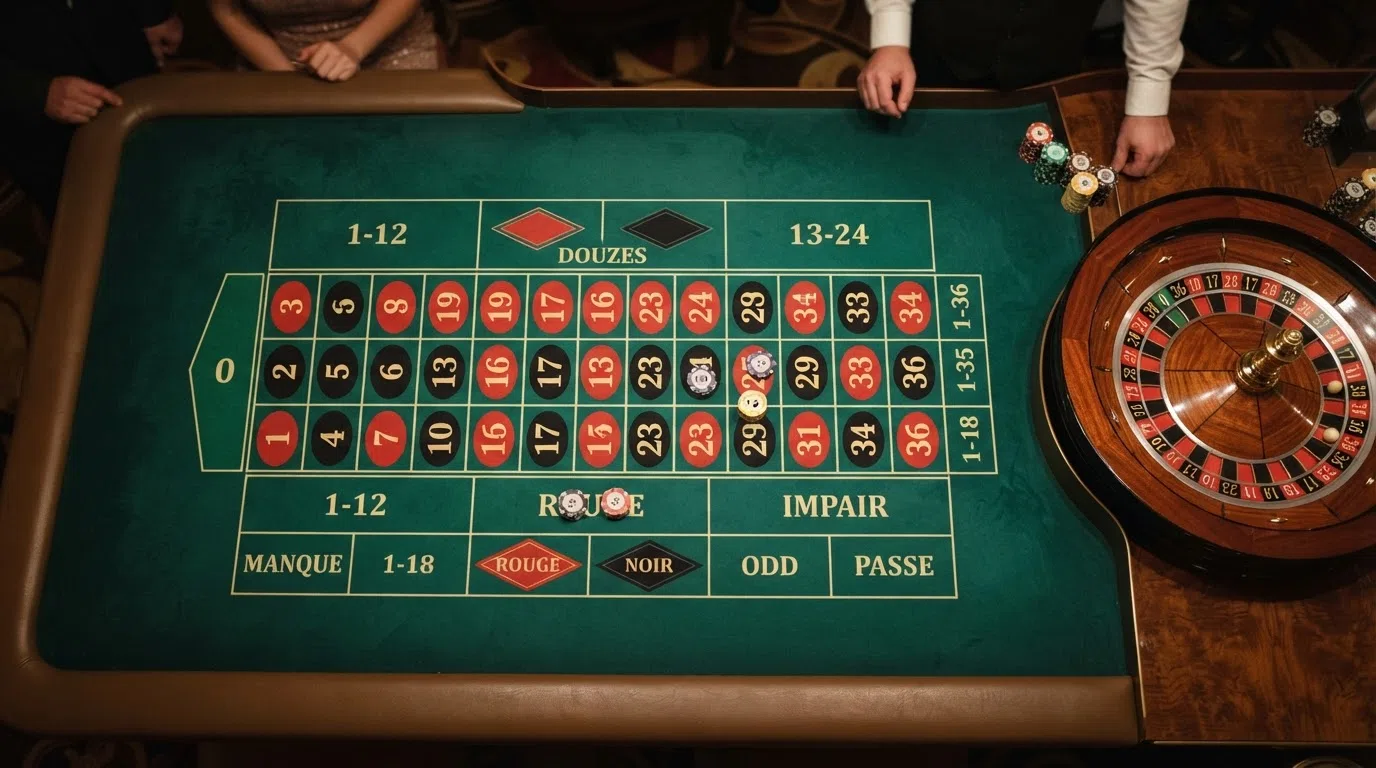
The table felt beside the wheel — the betting layout — is a single grid showing every number 1 through 36 in a 12-by-3 matrix, with the 0 above and to the left of the first column. Outside that matrix sit the outside-bet sections: red or black, odd or even, high (19–36) or low (1–18), three dozen boxes (1–12, 13–24, 25–36) and three columns running down the length of the layout. A racetrack — a separate oval layout showing the numbers in wheel order — sits beside or above the main grid for call bets and neighbour wagers.
The single zero is the whole reason the house edge is 2.70% rather than 5.26%. On a 38-pocket American wheel the same layout would carry the same payouts and the same bet types, and the house edge would double. The layout does not change; the wheel does.
Inside Bets: Straight-Ups, Splits, Streets and Corners
Inside bets are the wagers placed on the numbered grid itself. They cover fewer numbers per wager, pay more when they hit, and lose more often.
A straight-up is a chip on a single number, including 0. It pays 35 to 1, and on a 37-pocket wheel it wins on exactly 1 of 37 spins. A split is a chip on the line between two adjacent numbers, paying 17 to 1 on 2 of 37. A street — also called a line on some layouts — is a chip on the end of a row of three numbers, paying 11 to 1 on 3 of 37. A corner is a chip on the intersection of four numbers, paying 8 to 1 on 4 of 37. A six-line is a chip on the line between two streets, paying 5 to 1 on 6 of 37.
The pattern is consistent: the payout multiple times the winning-pocket count, divided by the total pocket count, leaves the same 2.70% on every inside bet. A 35-to-1 straight-up looks more generous than an 8-to-1 corner; in expectation they cost the player the same per pound wagered, because the corner hits four times as often. Inside bets are not for a player chasing lower house edge; they are for a player accepting the same edge in exchange for the variance of longer odds.
Outside Bets: Even-Money Wagers, Dozens and Columns
Outside bets are the wagers placed in the sections around the grid. They cover more numbers per wager, pay less, and lose less often.
An even-money bet — red or black, odd or even, high or low — covers 18 of 37 numbers and pays 1 to 1. The probability is 18/37, or about 48.65% per spin. The remaining 19 pockets (the 18 numbers on the opposite side plus the green zero) all lose. The dozen and column bets cover 12 of 37 numbers at 2 to 1 — three dozens across the layout, three columns down — and win on roughly 32.43% of spins.
The zero is the only thing keeping the even-money bets from being a true 50/50. On a wheel with no zero, red and black would be 18-out-of-36, a coin flip. The single green pocket tilts the coin to about 48.65%, and the 2.70% house edge is the price the player pays for the green. La Partage and En Prison are the two rules that cut that price on even-money bets, which is the subject of the next section.
La Partage and En Prison: How the House Edge Falls to 1.35%
La Partage is a rule found on some European roulette tables — most often in the “French” or “premium” live-dealer variants — under which an even-money bet is split with the house when the ball lands on zero. Half the stake is returned to the player; the other half is collected by the house. The effect on the house edge is precise: on even-money bets, the standard 2.70% drops to 1.35%.
En Prison is the related rule under which the even-money stake is not collected on zero but is held “in prison” on the layout for the next spin. If the next spin wins, the stake is returned to the player without winnings; if the next spin loses, the stake is collected. The expected outcome is identical to La Partage over many spins — both rules reduce the even-money house edge from 2.70% to 1.35% — but the player experience differs. La Partage returns half the cash immediately; En Prison locks the stake for one spin.
The effect is restricted to even-money bets. A straight-up on 17 pays the same 35 to 1 on a La Partage table as on a standard one; the rule does not extend to dozens, columns, or inside bets. For a player who plans to spend most of their time on red, black, odd, even, high or low, a La Partage table is the single best proposition the European layout offers — a 2.70% edge on the worst part of the wheel, reduced by half.
Live Dealer European Roulette vs RNG Versions
A live-dealer European roulette game is a real wheel in a real studio, streamed to the player’s device over a video feed, with a real croupier taking bets and announcing results. An RNG roulette game is a software simulation: a random-number generator selects a winning pocket on each spin, the layout is animated, and the result is computed without a physical wheel.
The mathematics are the same. The 97.30% RTP applies to both formats, on the same single-zero wheel, with the same payouts. The differences are about pace, trust and atmosphere. A live-dealer table runs at the speed of a real wheel — 40 to 60 spins an hour, paced by the betting window and the dealer — and shows the player a physical ball dropping into a physical pocket. An RNG table runs as fast as the player clicks, with no waiting for other players or for the dealer’s rhythm.
For a player who values trust signals and a slower pace, live dealer is the format of choice. For a player who wants to grind through a bonus playthrough at maximum speed, RNG is the practical option. Both are available at every featured UK-licensed operator; the choice is about how the player wants to spend their session.
VIP and High-Stakes European Roulette Tables
VIP roulette is the same single-zero wheel at the same 2.70% house edge, with the minimum and maximum stake limits raised. A standard live-dealer table might run from £1 to £5,000; a VIP table from £5 or £10 to £50,000 or higher. Some operators offer private tables — a single player at a dedicated wheel, no other bettors, no waiting — for high-stakes play.
The percentage does not improve with the stake. A 2.70% house edge on a £100 straight-up is the same 2.70% as on a 50p straight-up, because the edge is a ratio of expected loss to wager, not a fee. VIP tables exist for the table-limit reason, not the value reason: a player who wants to put £10,000 behind a single number cannot do it on a standard table, but the cost of doing it on a VIP table is the same per pound as on the cheapest table in the lobby.
European Roulette Strategy: What the Numbers Actually Say
No betting system changes the house edge on a European roulette wheel. The Martingale, Fibonacci, Labouchère and other progressive systems alter the shape of the loss curve — they recover previous losses faster when they hit, at the cost of larger bets when they do not — but the expected value per spin is identical under any system. The gambler’s fallacy is the mental model that makes them tempting: a belief that past spins predict future ones, which they do not, because each spin is independent.
The one genuine strategy lever is the bet selection. A player who bets only even-money on a La Partage table is playing a 1.35% edge rather than a 2.70% one. A player who bets dozens and columns is playing a 2.70% edge with higher variance. A player who bets straight-ups is playing a 2.70% edge with the highest variance of the layout. None of these choices moves the expected value by more than the La Partage difference; all of them change the player’s session experience.
The other real lever is session management. A deposit limit set before the first spin, a loss limit that triggers a break, and a time budget that respects the rest of the player’s week are the only structural defences against the variance of a 2.70% game. No system on the table beats the wheel; a bankroll plan beats the player’s own impulses.
Why Playing European Roulette for Free Is Smarter Than You Think
Free-play European roulette is the same wheel at the same RTP, with the stake denominated in credits rather than pounds. The 97.30% return applies identically in demo mode; the layout, the spin cycle and the bet types are unchanged. What free-play offers is a way to learn the table without learning what losing money feels like.
A first-time player who has never placed a roulette bet has more to learn than the rules suggest. The timing of the betting window, the position of the chips for a corner or a split, the speed at which the croupier closes the layout, the difference between a La Partage table and a standard one — these are mechanical habits that free-play teaches by repetition. The first session at a real-money table is not the time to discover that a corner chip sits on the intersection of four numbers, not on a single one.
The other use of free-play is operator due diligence. A player who has narrowed the choice to two or three UK-licensed casinos can launch each roulette lobby in demo, run a few spins, and compare the interface quality, the bet-placement ergonomics and the live-stream resolution. A welcome bonus is paid on real money, but the casino that hosts it is selected on how its product feels to use.
Free European Roulette vs Real-Money Play: What You Gain and What You Miss
Free-play teaches the wheel, the bets and the payouts perfectly. It does not teach the emotional load of a losing streak, the discipline of a stop-loss, or the timing of a session break. A player who has spent twenty hours on a demo table can sit down at a real-money table and place bets confidently; the same player may discover, on the first £100 session, that they handle losses very differently from how they handle credits.
The transition from free to real money is best made at the lowest stake the operator offers. A 10p or 20p straight-up is the same bet as a 10-credit chip in demo, with real pounds attached. The point is not to win at that stake; the point is to learn the player’s own behaviour under real conditions, on stakes small enough that a session’s losses are an educational cost rather than a financial one.
Demo and No-Registration European Roulette Games
Most UK-licensed operators host demo tables that load in a browser without an account, a deposit or any personal detail. The games are the same product as the real-money version — same RNG or same live stream, same 97.30% RTP, same layout — wrapped in a balance-of-credits interface. The games are accessible from the casino’s game lobby under a “demo” or “play for fun” tab.
Demo mode is the cleanest way to test an operator before committing. A new browser tab, a search for the European roulette lobby, a click into demo mode, and a few minutes of play is enough to judge the lobby quality, the bet-placement interface and the live-stream smoothness if it is a live table. A player who has done this across two or three operators before depositing knows which casino they are walking into.
UK Gambling Law and Your European Roulette Play: What Actually Protects You
The legal framework around European roulette in Great Britain is built on the Gambling Act 2005 and enforced by the UK Gambling Commission. The Commission is the single statutory regulator for the GB market, an executive non-departmental public body sponsored by the Department for Culture, Media and Sport. It licenses operators, software and personnel, and it publishes a public register of every licence holder at gamblingcommission.gov.uk.
The Act sets out three licensing objectives that the Commission must advance: preventing gambling from being a source of crime or disorder, ensuring gambling is conducted in a fair and open way, and protecting children and other vulnerable persons from harm or exploitation. The day-to-day work of the Commission is captured in the LCCP — the Licence Conditions and Codes of Practice — and the Remote Technical Standards, or RTS, which together form the binding rulebook for licensed operators.
For a roulette player specifically, the most important regulatory fact is also the one most often missed: the UKGC’s online slots stake limits — £5 per spin for players aged 25 and over, £2 for players aged 18 to 24 — apply only to online slots. They do not apply to roulette, blackjack or any other table game. A roulette player faces no statutory per-spin stake cap under current GB regulation. That distinction is material and almost never surfaced by competing pages.
The other rules the Commission enforces from 19 January 2026 cap wagering requirements on bonus funds at 10× and ban mixed-product promotional offers — the kind of “bet on football, get free spins” deal that allowed operators to recycle gambling products across each other. The maximum-wagering ceiling reshaped the welcome-offer market and is the reason every featured offer on this page carries a 10× cap at most.
The UK Gambling Commission Licence: What It Means for Roulette Players
A UKGC licence is not a rubber stamp. It imposes binding conditions on every operator a British player can use safely: game fairness, fund segregation, complaints handling, advertising standards, and the integration of safer-gambling tools. The public register is the first place to check any operator, and the licence account number is the second.
A small set of game-design rules have reshaped the online product since 31 October 2021. Auto-play is banned across the online casino. Losses disguised as wins — slot features that celebrate a payout smaller than the triggering stake — are banned. Reverse withdrawals — the ability to cancel a withdrawal request and return the funds to the playable balance — are permanently banned. The spin-cycle minimum of 2.5 seconds applies to slots specifically and does not constrain the wheel. None of these rules change the roulette mathematics; they change the surrounding product.
A separate point-of-consumption rule, in force since the Gambling (Licensing and Advertising) Act 2014, requires any operator taking GB customers to hold a GB operating licence regardless of where the operator is based. A Malta-licensed operator that accepts British players without a GB licence is operating illegally in the GB market, even if its Malta licence is in good standing.
GAMSTOP and Self-Exclusion: How They Work
GAMSTOP is the national self-exclusion register for online gambling in Great Britain. Once a player registers with GAMSTOP, the exclusion is enforced at every UKGC-licensed online operator — not just the site the player used to sign up. Exclusion periods are six months, one year, five years, or five years with auto-renewal, and the exclusion cannot be cancelled once active.
GAMSTOP participation has been a mandatory condition of every UKGC online operating licence since 31 March 2020. A licensed operator that fails to check GAMSTOP before allowing a self-excluded player to deposit is in breach of its licence conditions. The system is not foolproof — no system is — but for a player who wants to step away from licensed online gambling for a defined period, GAMSTOP is the single most reliable mechanism available, because it operates across the market rather than at a single site.
A practical note: GAMSTOP applies to the real-money product. Demo games and free-play versions of European roulette are typically still accessible to a self-excluded player at the same operator, because no deposit is being made and no real-money account is being touched. The exclusion blocks the wallet, not the game.
Playing at an Unlicensed Casino: What You Actually Lose
The protections that vanish at an unlicensed casino are precisely the protections a player is most likely to want in the moment they need them. No GAMSTOP enforcement: a self-excluded player who finds an unlicensed site can deposit without being blocked. No UKGC complaints route: a dispute over a withheld withdrawal has no British regulator to escalate to. No ADR — alternative dispute resolution — service is required. The fairness testing under the Remote Technical Standards applies only to GB-licensed operators, and the testing is the only way a player has independent confirmation that the wheel is unbiased.
The criminal liability sits with the operator, not the player. Under section 33 of the Gambling Act 2005, providing remote gambling facilities to GB customers without a GB licence is a criminal offence, punishable by up to 51 weeks’ imprisonment, an unlimited fine, or both. The Gambling Commission’s enforcement is disruption-based rather than ISP-blocking-based: between April 2024 and June 2025 the Commission issued 3,140 disruption notices and referred 447,778 URLs to search engines for downranking. The player on the other end of the screen is not the person being prosecuted, but the player is the person who loses every protection described in the section above.
Safer Gambling Tools Every UK Roulette Player Should Use
The safer-gambling infrastructure at a UK-licensed casino is built into the product by regulatory requirement. A player does not have to ask for deposit limits, reality checks, time-outs or financial vulnerability checks; the operator is required to offer them. A player does, however, have to use them — and the difference between an operator that offers the tools and a player who sets them up is the entire point of the system.
The headline figures for the year ending March 2025 are worth keeping in mind. The National Gambling Support Network treated 11,960 clients in that period, an 11% increase on the prior year. An estimated 4.3 million adults in Great Britain are affected by a family member or friend’s gambling, and around 2 million children live in households where problem gambling is present. The safer-gambling tools are not a theoretical safety net; they are the equipment that a meaningful number of British players need, and a much larger number benefit from setting up in advance.
Deposit Limits, Reality Checks and Time-Outs
A deposit limit is a cap the player sets on the amount they can deposit into their account over a chosen period — daily, weekly or monthly. The rules around how limits are changed are themselves regulated. A decrease in the limit takes effect immediately; an increase takes effect only after a cooling-off period, and the operator is required to prompt a deposit limit before the first deposit is made, so a player does not have to remember to set one in the heat of signing up.
A reality check is a pop-up reminder that appears at an interval the player chooses — typically every 15, 30 or 60 minutes — showing the time elapsed and the player’s net position for the session. It is a nudge to step back, not a hard stop. A time-out is a short-duration block on account access — 24 hours, 48 hours, a week, up to six weeks — for a cooling-off period that does not require the multi-month commitment of a GAMSTOP registration.
The three controls are independent and stack. A player can set a weekly deposit limit, a 30-minute reality check, and a 24-hour time-out for the next day, all at the same operator, in the same settings page. Setting them up takes longer than reading this paragraph.
Where to Get Help: GamCare, the NHS and More
The free, confidential support infrastructure around problem gambling in Great Britain is wider than most players realise. The National Gambling Helpline, run by GamCare, is the single front door: freephone, live chat and face-to-face counselling. NHS gambling harm clinics operate in England, Scotland and Wales with specialist treatment pathways, accessed through a GP or directly. GambleAware funds research, prevention and signposting. Gamblers Anonymous runs peer-support meetings across the country, in person and online.
The scale of the system is matched by the scale of the need it serves. Almost 1 in 3 adults in Great Britain who experience any level of gambling problems want treatment, support or advice — a figure that has nearly doubled since 2020. Of the clients treated by the National Gambling Support Network, the proportion meeting the threshold for problem gambling fell from 87% at initial assessment to 27% at final assessment, a measure of the system’s effect on the people who use it.
A player who recognises a problem — in their own play, in a partner’s, in a friend’s — does not have to be certain to call. The first conversation is a conversation, not a commitment, and the help lines do not require the caller to be ready to stop.
How We Selected and Ranked the Casinos on This Page
The ranking on this page was built against the UK Gambling Commission’s public register as the primary gate. Every operator listed was verified as holding an active GB operating licence as of 29 July 2026. An operator without a current GB licence was excluded by definition, regardless of how the welcome offer or the game lobby compared.
The criteria applied to rank the licensed operators were: UKGC licence standing; welcome-offer structure under the 10× wagering cap introduced on 19 January 2026; free-spin volume and the wagering requirements applied to winnings; bonus validity window; and the game-provider line-up behind the roulette lobby. The first criterion is a filter; the remaining four are the ranking order.
The sources consulted in building the comparison included competitor pages at The Independent, Racing Post, talkSPORT, OLBG and a small set of UK-focused affiliate sites, plus each operator’s own terms page and the UKGC register itself. The comparison does not claim to be exhaustive — the licensed UK market carries more operators than the ten featured here — and it is not based on first-hand testing of every roulette lobby. The ranking reflects the data on the public record, not a player-experience review.
Two things the ranking does not do. It does not recommend a casino to a reader; it compares the offers on a consistent set of terms and lets the reader decide. And it does not claim that any single operator is the best for every kind of player; a player who values no-wagering structure will rank the table differently from a player who values spin volume, and a player who wants to use a bonus at the roulette wheel has only one realistic choice in the set.
European Roulette: Should It Be Your Casino Game?
European roulette is a 2.70%-edge game with a 97.30% return to the player, a single-zero wheel and a flat layout that does not change between bets, sessions or operators. American roulette’s 5.26% edge on the same bets is the direct comparison, and the European version wins that comparison on every bet type without exception. La Partage, on the even-money bets, halves the edge again to 1.35% on the bets most players actually make.
For a British player, the regulatory environment is unusually favourable to roulette relative to slots. No statutory per-spin stake cap applies to the wheel, the way it does to online slots from April and May 2025 onwards. The 10× bonus-wagering cap that came in on 19 January 2026 has simplified the welcome-offer market and made the worst offers less punitive. The UKGC’s public register, GAMSTOP, financial vulnerability checks at a £150 net deposit threshold and the wider safer-gambling infrastructure are all in place to protect the player who needs protection.
The caveats are the same caveats that apply to every other casino game. No betting system changes the expected value per spin. The wheel does not remember past spins, and no streak predicts the next one. A 2.70% house edge means the casino keeps 2.70p of every pound wagered over the long run — over a session, over a year, over a lifetime of play. The math does not negotiate.
The practical judgement, for a British player choosing what to do with an evening and a bankroll, comes down to three points. Play European roulette rather than American — the edge is half, and the difference is one pocket. Play even-money on a La Partage table when one is available — the edge is half again, at 1.35%, on the bets with the highest hit frequency. Set a deposit limit before the first spin — the only structural protection that depends on the player, rather than the regulator or the operator, is the limit the player sets for themselves.
The rest is the wheel.
Frequently Asked Questions
Can I play European roulette for real money at a UK-licensed casino?
Yes. Every featured operator on this page is licensed by the UK Gambling Commission, and every one of them carries a European roulette lobby with RNG and live-dealer tables. The minimum stake online is typically 10p to 50p per spin, the maximum depends on the table, and the house edge on every standard bet is 2.70%. A player signs up, deposits via a debit card or accepted e-wallet, and plays.
What deposit methods can I use at UK online roulette casinos?
UK-licensed casinos accept debit cards, bank transfers and a set of regulated e-wallets — PayPal, Apple Pay, Google Pay and Trustly are common. Credit cards have been banned for all remote gambling in Great Britain since 14 April 2020, and that ban extends to credit-card-funded e-wallet deposits. A small number of welcome offers further restrict the eligible deposit method to debit card only — Betfred’s 200 free-spin offer is the example in the featured set.
How have UK bonus rules changed wagering for roulette players?
From 19 January 2026, the UKGC’s LCCP Social Responsibility Code 5.1.1 caps wagering requirements on bonus funds at 10× and bans mixed-product promotional offers like “bet on football, get free spins”. Every welcome offer in the featured set carries wagering at or below the new cap, and the worst historical offers — 40× or 65× wagering on bonus funds — are no longer permitted under a GB licence.
Does the new UK slots stake cap apply to European roulette?
No. The UKGC’s online slots stake limits — £5 per spin for players 25 and over, £2 for players 18 to 24, in force from April and May 2025 — apply only to online slots. European roulette, blackjack and other table games carry no statutory per-spin stake cap under current GB regulation. This is the single most material regulatory difference for a roulette player, and it is the reason a roulette player is not constrained at the stake-size level that slots players are.
Are my roulette winnings taxable in the UK?
No. Gambling winnings are not subject to income tax or capital gains tax for individual players in the UK. The tax is operator-borne: Remote Gaming Duty is charged on the operator’s gross gaming yield at 40% from 1 April 2026, separate from the statutory levy of 1.1% of GGY split across treatment, prevention and research. A player who withdraws winnings from a UK-licensed casino receives them in full, with no tax withheld at source.
What is GAMSTOP and does it affect my roulette play?
GAMSTOP is the national self-exclusion register for online gambling in Great Britain, mandatory for every UKGC online operating licence since 31 March 2020. A player who registers with GAMSTOP is blocked from depositing at every GB-licensed online operator for the chosen exclusion period — six months, one year, five years, or five years with auto-renewal. Free-play and demo games typically remain accessible, but the real-money roulette tables are closed for the duration. A player who wants to step away from online gambling is the player GAMSTOP is built for.
Slots – trustedcasinos-notongamstop
Content created by the «trustedcasinos-notongamstop» team