
Best progressive jackpot slots in the UK — where the eight-figure pots really live
 Available in GB
A progressive jackpot slot looks like the only bet a casino has to lose. The reel total climbs past eight figures, a winner photo lands in the news, and the next deposit feels like a lottery ticket. It is not. The pot is built from every spin on every machine in the network, the base game is paying back a smaller share than its non-progressive cousins, and the odds against any single spin landing the prize are long enough that a player’s lifetime of play will, in expectation, never see it. The numbers behind the headline are the subject of this guide: which titles carry the biggest pools, which UK sites carry those titles, what the bonus money does and does not pay for, and what the stake caps and self-exclusion rules mean for the player chasing one.

*Current as of September 9, 2026 — UK Gambling Commission public register.*
What a progressive jackpot really is — and why the prize is only half the story
A progressive jackpot is a slot prize that grows every time someone plays the game and resets to a floor — the “seed” — when it pays out. It is not a separate game; it is a piggybacked payout layered on top of an ordinary video slot. Every real-money spin on a participating title takes a small cut of the stake and adds it to a shared pool. When the pool crosses a threshold, or when a random trigger lands on a lucky spin, the prize drops. The next spin starts the seed again.
That description is accurate and it is also the place where a player’s mental model starts to drift. The number shown above the reels is not money the machine owes you on the next spin. It is the accumulated contributions of thousands of players playing thousands of spins, and the base game on the same machine is paying out a smaller percentage than its non-progressive peers to fund that growth. The pot is large precisely because the rest of the game is lean.
How the pot builds — the seed and the share of every spin
Every progressive starts with a seed. The seed is the floor the prize resets to after it has been won — it is paid by the game studio or the network operator, not by the previous winner’s stake. Mega Moolah’s flagship Mega jackpot seeds at £2,000,000. Wheel of Wishes on the WowPot network seeds at $2,000,000. Jackpot King’s top tier carries a £100,000+ seed across more than 70 participating titles. The seed is the studio’s money, and it is what guarantees a player is never playing for an empty pot.
From the seed, the prize climbs. Each spin deducts a contribution from the stake — somewhere around 8% on a typical progressive — and adds it to the running total. A £1.50 stake on Mega Moolah once fed a jackpot that paid £11,498,211.89 to a Betfred customer on 5 June 2025; the contribution from that single spin was a fraction of a penny. The wow factor is the pool, not the contribution; the maths is the other way around.
A jackpot displayed as one large number is in fact many players’ money. It is a shared pool. When it drops, it does not return to the studio; it returns, in a literal sense, to the small contributions of every spin that fed it. That is what the pot is, and recognising it is the first step in reading the page the rest of this guide writes.
Standalone vs networked — why one game can pool millions
There are two ways to build a progressive prize. A standalone jackpot is tied to a single machine; only spins on that one title feed the pot, and the maximum it can climb to is bounded by the play on a single game. A networked jackpot pools the contributions of every participating title across a studio’s range — or across an entire platform of studios — and the ceiling on the prize is, for practical purposes, the entire player base playing the entire network.
The contrast is what separates five-figure prizes from eight-figure ones. Jackpot King spans more than 70 Blueprint Gaming titles and feeds three tiers. Age of the Gods runs across 25+ Playtech slots and carries four tiers, with the Power jackpot paying £500,000 or more every 40 days. A standalone progressive on a single slot at a quiet site stays at five figures; a networked pot on a popular title at a busy site reaches eight.
That is why the most-written-about titles in this category are networked. The networks are bigger than any single slot, and the prize they print is correspondingly larger.
The return you actually get — base game, contribution and long odds
Mega Moolah is the worked example, and the numbers are uncomfortable. Its published RTP is 96.12% — and that figure includes the jackpot contribution. Strip the contribution out and the base game returns 88.12%. The non-progressive slot sitting next to it in a typical UK lobby returns somewhere between 95% and 97% on its base game alone. The progressive is paying back less, per spin, to fund the prize it advertises.
The trade is explicit. Roughly 8% of every stake feeds the jackpot pool. That contribution is the price of admission to the eight-figure prize. A player who never wins the prize has paid into a lottery they did not win; a player who does win has paid into a lottery the rest of the network has been paying into too. The expected value of the jackpot contribution, per spin, is a tiny fraction of a penny. The base game does the work; the progressive is the long-tail event on top.
One industry assessment put it in plain terms: playing a progressive jackpot slot is not a strategy for making money. The base-game RTP is lower than non-progressive alternatives, the jackpot odds are astronomically long, and the expected value of the jackpot contribution per spin is a tiny fraction of a penny. The phrase worth carrying away is *fraction of a penny*. That is what an entire spin costs in expected contribution to the prize a player is hoping to win.
The largest prizes ever paid out — two eight-figure wins
The record book on online progressive slots is short. Three wins define it.
- Mega Moolah, £11,498,211.89 (5 June 2025). A Betfred customer placed a £1.50 stake and landed the Mega jackpot on Mega Moolah — the largest prize Betfred has paid in its 58-year history. The Betfred boss phoned the customer personally to congratulate the new multi-millionaire.
- Wheel of Wishes (WowPot), $15,827,028 (7 June 2026). The WowPot Mega progressive dropped on the Games Global Wheel of Wishes slot. It is the biggest WowPot payout since the network’s December 2023 all-time record of €38,461,200, which remains the largest verified online slot jackpot ever awarded.
Two of the three sit in the eight-figure range; the third sits at nine. They are real, and they are rare. The odds of landing the Mega tier are extremely long, and the maths of getting there is not in the player’s favour; the maths of being the one who did is, by definition, on the side of whoever won.
Where UK players should spin for the biggest jackpots — our ranked sites
The ranking below weighs the size of the progressive library, the licence status of the operator, and the terms of the welcome offer. Every operator is UKGC-licensed and was checked against the UK Gambling Commission public register. The order is editorial, not algorithmic; the criteria are described in the methodology section at the end of this guide.

| Rank | Casino | UKGC licence | Progressive library | Welcome offer | Signature trait |
|---|---|---|---|---|---|
| 1 | Bet365 | 39198 (LeoVegas Gaming PLC) | 200+ titles | New player bonus package | Jackpot King and Mega Moolah shelf |
| 2 | LeoVegas | 39198 (Casino Remote, active since Nov 2014) | 300+ titles | Match bonus + free spins | Largest listed progressive library |
| 3 | BetMGM UK | 39198 (Entain/LeoVegas Group) | MGM Millions + Mega Moolah + Jackpot King + WowPot | Varies by promotion | Exclusive MGM Millions network |
| 4 | Mr Vegas | 39380 (Videoslots, active since 2014) | 8,000+ games, 150+ providers | Deposit bonus | Deepest library and provider mix |
| 5 | PlayOJO | Active (SkillOnNet) | Divine Fortune and Mega Moolah | 50 wager-free spins | No wagering on free spin winnings |
| 6 | Casumo | Active | 3,000+ slots | £150 + 100 free spins, 10x wagering | Strong progressive section |
| 7 | William Hill | Active (888 Holdings) | 200+ titles | Deposit match | Heritage brand |
| 8 | 888 Casino | Active (888 Holdings) | 150+ titles incl. exclusive in-house games | No-deposit free spins + deposit bonus | In-house progressive exclusives |
| 9 | Fun Casino | 039372-R-319367-028 (L&L Europe) | Dedicated jackpot section | Deposit bonus | Dedicated jackpot lobby |
| 10 | MrQ | Active | Curated progressive section | Free spins with no wagering | No-wagering spins |
The licence column is the row a UK player should read first. Every operator above carries a UKGC licence; that licence is what binds GamStop self-exclusion, the £5 and £2 stake caps, the 10x wagering cap, the gross deposit limits, and the dispute resolution route that catches a frozen withdrawal or a withheld payout. An offshore site can offer a larger prize in a marketing email and cannot offer any of that.
Bet365 — 200+ progressive titles across Jackpot King and Mega Moolah
Bet365’s progressive shelf is the deepest in the ranking by absolute count of network participation. The 200+ progressive titles include both Jackpot King and the Mega Moolah network, plus the Blueprint, Playtech and NetEnt titles those networks carry. The four major studio names sit behind the catalogue — Games Global, Blueprint, Playtech, NetEnt — and the licence is held by LeoVegas Gaming PLC under UKGC account 39198. Withdrawals on the regulated product clear in one to two hours. The welcome offer is a new player bonus package; the specifics are not the deciding factor on a progressive-heavy site, because jackpot games are bonus-excluded at almost every UKGC operator. What a player is buying here is the shelf, the licence, and the withdrawal speed.
LeoVegas — 300+ progressive titles from the market’s biggest providers
LeoVegas carries the largest listed progressive library in the ranking, with 300+ titles behind a Casino Remote licence that has been active on the UKGC register since November 2014. The four major studios appear in the provider list, and the welcome offer pairs a match bonus with free spins. Withdrawals clear inside 24 hours. The combination — a long-running licence, a broad progressive shelf, and a fast withdrawal window — is the case for placing LeoVegas second.
BetMGM UK — the MGM Millions network plus Mega Moolah and WowPot
BetMGM UK carries the exclusive MGM Millions shared progressive network alongside the full Mega Moolah, Jackpot King and WowPot catalogues. The licence sits at 39198 under the Entain / LeoVegas Group umbrella, and the welcome offer varies by promotion. Withdrawals take one to three working days. The MGM Millions network is the differentiator: a player who has tried Mega Moolah, Jackpot King and WowPot and wants a fourth pool at a UKGC-licensed site finds it here.
Mr Vegas — 8,000+ games and more than 150 providers
Mr Vegas operates under the Videoslots umbrella, with a UKGC licence at 39380 active since 2014. The catalogue runs to 8,000+ games from 150+ providers, and the progressive section is a substantial slice of that total. The welcome offer is a deposit bonus; withdrawals clear in 24 hours. The trade is straightforward: the deepest library on the ranking, with a broader mix of providers than the progressive-specialists higher up, and a withdrawal window short enough to keep bankroll management tractable.
PlayOJO — 50 wager-free spins and Divine Fortune
PlayOJO’s headline offer is the 50 wager-free spins with no wagering on winnings — a structure that means the winnings from those spins drop into the cash balance directly. The progressive section includes Divine Fortune and Mega Moolah, and the licence is held under SkillOnNet’s UKGC active registration. Withdrawals are same-day. For a player who wants the wager-free structure applied to a slot bonus, PlayOJO is the choice; for a player whose priority is the largest progressive shelf, the higher-ranked sites carry more.
Casumo — £150 plus 100 free spins with 10x wagering
Casumo’s welcome offer is the £150 bonus plus 100 free spins attached to a 10x wagering multiplier — the maximum permitted under the UKGC wagering cap that took effect on 19 January 2026. The library runs to 3,000+ slots with a strong progressive section, and withdrawals clear in one to 24 hours. The 10x cap is the upper bound, and Casumo’s offer is at it; the wagering is the maximum permitted on a UK bonus.
William Hill — 200+ titles from a decades-old name
William Hill’s 200+ progressive titles sit on a heritage brand whose UKGC licence is held through 888 Holdings. The welcome offer is a deposit match; withdrawals clear in 24 hours. The case for William Hill is the brand age and the catalogue breadth on the progressive shelf. A player who values an established UK name over a newer entrant’s promo structure finds it here.
888 Casino — 150+ games and exclusive in-house progressives
888 Casino carries 150+ progressive titles, including exclusive in-house progressive games that do not appear on other UK sites. The welcome offer combines no-deposit free spins with a deposit bonus, and withdrawals take one to three days. The in-house progressives are the trade; the no-deposit free spins element is the structural difference. For those seeking slots unavailable elsewhere in this ranking, 888 Casino is the standout choice.
Fun Casino — a dedicated jackpot section
Fun Casino operates under L&L Europe with UKGC licence 039372-R-319367-028, verified on the public register. The site curates a dedicated progressive jackpot section, and the welcome offer is a deposit bonus. Withdrawals take one to three days. The dedicated lobby is the draw: a player who wants a filtered view of the progressive catalogue, rather than a search across an 8,000-game general catalogue, finds that view here.
MrQ — a curated set of games with no-wagering free spins
MrQ closes the ranking with a curated progressive section, free spins carrying no wagering on winnings, and a same-day withdrawal window. The provider list — Blueprint, Games Global, NetEnt — covers the three studios most likely to land a player inside the Jackpot King, Mega Moolah and NetEnt families. The trade is a smaller curated section, not a 300-title shelf; the value is in the no-wagering structure applied to a small, targeted progressive set.
The studios and networks behind the top jackpot games
A progressive slot is the surface; the network is the engine. The largest prizes on the UK market come from four studios running four networks, and the networks are what make the prizes large. Understanding the network is the difference between picking a slot for its base game and picking a network for its prize cadence.
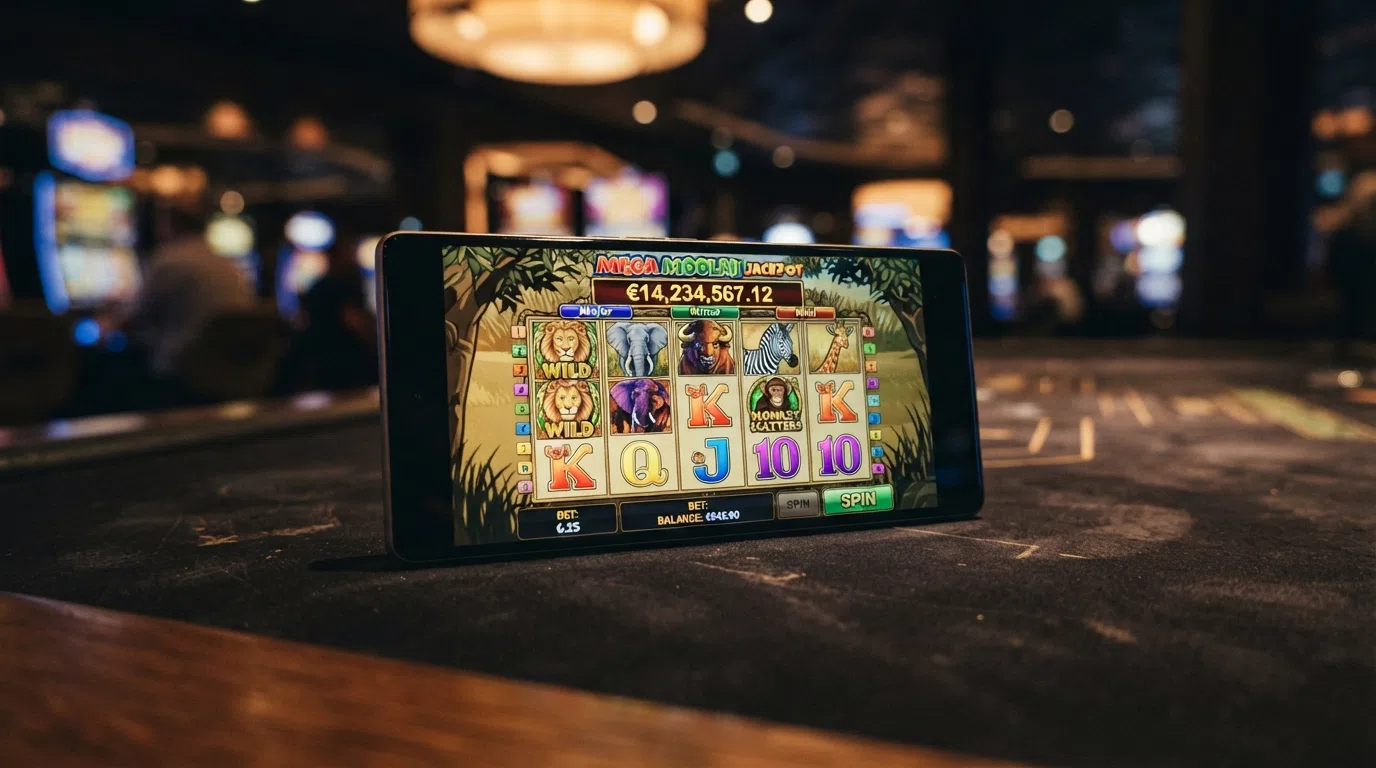
Mega Moolah — an 88.12% base return and a £2m seed that resets after every drop
Mega Moolah sits at the centre of the category. Its published RTP is 96.12% including the jackpot contribution; its base-game RTP is 88.12%, with the gap — roughly 8 percentage points — feeding the four-tier progressive pool. The Mega tier seeds at £2,000,000 every time it drops. The Mega Moolah network is Games Global’s flagship, and the slot’s run since 2006 has produced the largest verified online slot jackpot ever awarded. A player picking Mega Moolah is picking the longest-running networked prize in the category, with the deepest prize history and the highest base-cost-of-entry.
Jackpot King (Blueprint) — three tiers across more than 70 games
Jackpot King is Blueprint Gaming’s network, running across more than 70 slot titles in three tiers. The tiers are Royal Pot, Regal Pot and Jackpot King itself, with the top seed carrying £100,000 or more. The base RTP varies by the underlying game — Jackpot King contributes a share to the progressive pool, which means the base RTP sits one to two percentage points below the non-networked version of the same slot. Fishin’ Frenzy Jackpot King, the most-cited example in the network, runs at 95.32% on one published figure and 96.12% on another; the spread reflects which RTP a reviewer reports. The Goonies Jackpot King, another popular entry, sits at 93.42% on the base game.
Age of the Gods (Playtech) — a four-tier prize that pays out every 40 days
Age of the Gods is Playtech’s network, running across 25+ slot titles with a four-tier jackpot system — Power, Extra Power, Super Power and Ultimate Power. The Power jackpot pays £500,000 or more every 40 days, which gives the network a cadence the other networks do not: a player on the network knows that a £500,000 prize lands approximately every six weeks somewhere on it. The slot’s RTP sits at 95.02% with medium volatility. For a player who prefers steady top-tier payouts to rarer eight-figure drops, Age of the Gods is the network that pays on a rhythm.
WowPot and its rivals — Wheel of Wishes, Mega Fortune, Hall of Gods and Divine Fortune
WowPot is Games Global’s rival network to Mega Moolah, with Wheel of Wishes carrying the WowPot Mega at a $2,000,000 seed and the record drop of $15,827,028 paid on 7 June 2026. The slot’s RTP runs around 93.34% on the base game. The network’s headline is the €38,461,200 record set in December 2023 — the largest verified online slot jackpot ever awarded.
NetEnt’s competing titles sit alongside the WowPot catalogue rather than under one network. Mega Fortune runs at 96.60% on the base game with low-to-medium volatility and a 2,162x stake maximum. Hall of Gods runs at 95.5% to 96.06% RTP at medium volatility. Divine Fortune runs at 96.59% RTP at medium volatility with three internal jackpot tiers and a 1,000x stake maximum. The NetEnt trio offers higher base-game returns than Mega Moolah or WowPot, with smaller — though still substantial — prize pools. A player who values the base game more than the headline prize will read those numbers as the deciding factor.
The ten top titles compared — RTP, volatility and seeds
| Slot | Provider | RTP | Volatility | Max win (base) | Jackpot seed |
|---|---|---|---|---|---|
| Mega Moolah | Games Global | 88.12% base / 96.12% incl. jackpot | Low to medium | Progressive | £2,000,000 (Mega) |
| Mega Fortune | NetEnt | 96.60% | Low to medium | 2,162x stake | Network progressive |
| Hall of Gods | NetEnt | 95.5–96.06% | Medium | Network progressive | Network |
| Divine Fortune | NetEnt | 96.59% | Medium | 1,000x stake | 3 tiers |
| Jackpot King series | Blueprint Gaming | Base minus 1–2pp | Varies | 3-tier progressive | Royal / Regal / Jackpot King |
| Fishin’ Frenzy Jackpot King | Blueprint Gaming | 95.32% / 96.12% | Medium-high | Progressive | £100,000+ |
| Age of the Gods | Playtech | 95.02% | Medium | 4-tier progressive | £500,000+ (Power) |
| Wheel of Wishes (WowPot) | Games Global | ~93.34% | Medium | Progressive | $2,000,000 |
| Jackpot Giant | Playtech | 91.25–94.22% | Medium | Progressive | £50,000 |
| The Goonies Jackpot King | Blueprint Gaming | 93.42% | Low | 3-tier progressive | Royal / Regal / Jackpot King |
The numbers in this table are not a recommendation. They are the research record for the ten titles most-cited in UK progressive guides. Volatility and seed appear only where research states them; cells without a published figure stay empty. A player reading this table for the base-game return finds the non-progressive NetEnt trio and Jackpot King on the high side and Mega Moolah on the low side; a player reading it for the prize ceiling finds Mega Moolah and WowPot at the top.
What the 10x wagering cap changes about jackpot bonuses
The UKGC introduced a cap on bonus wagering at 10x the bonus amount, effective 19 January 2026. It is the headline rule for UK bonuses in the current year, and it has a particular effect on jackpot play — almost none.
Do jackpot games count toward bonus playthrough? Almost never
Progressive jackpot slots are blanket-excluded from welcome bonus wagering at almost every UKGC-licensed operator. A player who takes a £150 bonus with 100 free spins at 10x wagering cannot chip through that wagering requirement by spinning Mega Moolah or Wheel of Wishes; the spins simply do not count. Only real-money deposits, with no bonus restrictions attached, can fund progressive play. The 10x cap, on its own, has no practical effect on a player’s ability to chase a jackpot, because the jackpot cannot be chased through bonus money in the first place.
The rule that matters is not the cap. It is the exclusion list inside each operator’s bonus terms. A player reading an offer should look at the games-excluded-from-wagering section, not the wagering multiplier, when the prize on the mind is a progressive.
Free spins and no-deposit offers — what actually applies to a jackpot game
A wager-free free spin offer — PlayOJO’s 50 wager-free spins, MrQ’s free spins with no wagering — does not carry a wagering requirement and so is unaffected by the 10x cap. The winnings drop into a cash balance directly. A no-deposit free spins offer — 888 Casino runs one alongside its deposit bonus — likewise has no wagering multiplier. A bonus balance, regardless of the wagering multiplier on it, cannot trigger the progressive prize itself: only real-money stakes feed the pool. The structure of the offer matters for the cash return on the slot; the progressive prize is fed separately.
For a player choosing between offers, the wagering cap and the wager-free structure are independent dimensions. The 10x cap is the upper bound on the wagering multipliers players will see on a UK welcome offer; the wager-free structure is the elimination of wagering altogether. Progressive play is a real-money proposition in either case.
Playing for free — why demo mode never pays the jackpot
Every UKGC-licensed operator runs demo mode on its slot catalogue. A player can open a progressive slot in their browser, spin it on a fake balance, and walk through the bonus features without risking anything. The demo is honest about the base game. It is not honest about the prize.
Why the top prize is always switched off in free mode
The progressive jackpot itself is always disabled in demo mode. The base game runs as designed — the reels spin, the bonus features trigger, the sound and visuals match the paid version — and the progressive prize sits at zero. There is no jackpot being fed by the demo spins, and no jackpot is available to win on them.
The reason is mechanical. The progressive pool is funded by a contribution from each real-money stake; demo spins do not pay into it, and the prize cannot drop on a spin that did not contribute. Operators disable the prize in demo so that the displayed jackpot total is a real number — the contributions of real-money players — and not a number inflated by fictitious spins. A player who spins Mega Moolah in demo for an hour and sees the Mega jackpot at £2,000,000 should read that number as the seed the slot resets to after a real-money drop, not as a prize available in the current session.
Free-play vs real-money — what changes the moment you switch
When a player switches from demo to real money, two things change. The stake caps that govern every spin come into effect — £5 per game cycle for players aged 25 and over, £2 for players aged 18–24 — and the contribution to the progressive pool begins. Until that point, the jackpot on the screen is decoration. The moment a real-money spin lands, the prize is live.
For a player who wants to learn a slot before depositing, demo mode is the right tool. It shows the bonus frequency, the volatility profile, the look and feel of the features. It does not — and cannot — show whether the slot is about to drop its progressive. That information is private to the operator and the network.
The same jackpots on a smaller screen — playing on a phone
The progressive networks run the same prize pools on phone and desktop. A player spinning Mega Moolah on a browser at home and a player spinning the same title on a phone app at the bus stop are feeding the same WowPot or Mega Moolah pool and competing for the same prize. The pot does not care which device the spin came from.
Browser vs app — how the games actually run on a phone
The choice between browser and app is a choice of interface. The browser experience runs the slot inside the same HTML5 container the desktop version uses; the app experience runs it inside a wrapper that may handle caching, biometric login and payment flows more smoothly. Performance on modern phones is rarely the deciding factor — the games are designed for both. Compatibility questions — does the slot render correctly on a particular phone, does the app install on a particular OS version — are usually answered by trying the slot in browser first, where no installation is required.
The jackpot itself is identical whichever way a player opens the game. The RNG, the contribution, the prize pool and the trigger logic are the same. A player who switches device mid-session is the same player on the network.
Which UK sites carry the top titles on a phone — and what to check
Every operator on the ranking carries its progressive shelf on mobile. The libraries are reachable through the operator’s mobile site or app, and the titles are the same ones the desktop version exposes. The questions to check before installing an app are the same as for any regulated product: the licence status on the UKGC register, the GamStop registration step inside the app, the deposit limit controls accessible from the cashier, and the reality-check reminder cadence.
Mobile-specific progressive slot content is thin across the broader UK guide landscape; the page a player reads about a slot rarely tells them anything about how that slot performs on a phone. The honest answer is that the experience on a recent phone is indistinguishable from the desktop experience for almost every progressive slot in the ranking above.
Bitcoin casinos and the jackpots that sit outside UK rules
No UKGC-licensed operator accepts cryptocurrency. Crypto gambling in the UK is, by definition, an offshore activity, and offshore operators are not permitted to accept wagers from UK residents.
No UKGC licence means no UK protections — what crypto casinos actually offer
An offshore casino — Curaçao, Anjouan, Costa Rica — operates under a different licence regime. The games look the same; the providers are often the same; the progressive pools may even pool across the same networks. What the operator does not offer is the UKGC’s framework of player protections. There is no GamStop self-exclusion, no UKGC dispute resolution, no statutory stake cap, no gross deposit limit, no 10x wagering cap, no automatic reality check. A player who self-excludes from GamStop and then opens an offshore account will find no UK mechanism to enforce that exclusion on the new site.
The protections a UK player loses are not theoretical. Frozen withdrawals on offshore sites are documented. Disputes that would route to the UKGC under a UK licence route to nothing under an offshore licence. KYC and AML verification are operator-dependent and may not happen at all.
Crypto vs fiat — what a player gives up for anonymity
The pitch for crypto play is speed and anonymity. Crypto deposits settle faster than card or bank transfers; withdrawals can clear in minutes; the transaction does not appear on a UK bank statement. The cost is the loss of the UK regulatory framework. Credit card gambling has been banned at UKGC sites since April 2020; the same prohibition does not apply to offshore sites because the operator is not under UKGC jurisdiction. KYC verification is required by UKGC sites before play; offshore sites may or may not verify identity.
A player who values the UK protections — GamStop, the stake caps, the dispute resolution route — stays on a UKGC-licensed site. A player who values anonymity and accepts the loss of those protections plays offshore and accepts the documented risks.
GamStop, the £5 stake cap and the rules that bind UK slot play
Three statutory layers shape every UK slot session. The stake caps limit what a player can bet per spin. The deposit limits cap how much money can enter the account. The self-exclusion framework lets a player step away entirely. Each is enforced by the UKGC; each applies only to UKGC-licensed operators.
The statutory caps on every spin — £5, £2 and the 40% tax
| Limit | What it caps | In force from |
|---|---|---|
| £5 per game cycle | Maximum stake for players aged 25 and over | 9 April 2025 |
| £2 per game cycle | Maximum stake for players aged 18–24 | 21 May 2025 |
| Gross deposit limits | Total deposits over a set period | 30 June 2026 |
| Remote Gaming Duty at 40% | Operator tax on gross gaming yield | 1 April 2026 |
| 10x bonus wagering cap | Maximum wagering multiplier on bonuses | 19 January 2026 |
The stake caps are the figure most players will meet first. £5 is the maximum on a single game cycle — a single spin and any gamble or bonus-redo choices attached to it — for a player aged 25 or older. £2 is the maximum for a player aged 18 to 24. The cap applies to all online slots, including progressive jackpot slots; a player cannot spin a progressive at a stake above the cap regardless of the operator, the slot, or the size of the prize.
The cap affects the rate at which a player’s stake feeds the progressive pool. A £5 spin contributes the cap’s worth of stake to the pool; a £2 spin contributes less. The trigger for the prize on most major networks — Mega Moolah, WowPot, Jackpot King, Age of the Gods — is random rather than stake-dependent, so a smaller stake does not reduce the probability of the prize itself; it reduces the rate at which the player contributes to it. At the £5 maximum, the contribution is still a fraction of a penny per spin.
The gross deposit limits and the Remote Gaming Duty are operator-side rules with player-side effects. From 30 June 2026, every UK online operator must offer gross deposit limits, and only this form may be labelled a “deposit limit”. Operators must action limit decreases immediately, surface limit-setting on the homepage and deposit pages, and prompt customers to review their limits at set intervals. The 40% Remote Gaming Duty from 1 April 2026 is a tax on operator gross gaming yield; it is not a player charge, but it sits behind the offering a player sees.
GamStop — self-exclusion for 6 months, 1 year or 5 years
GamStop is the national online self-exclusion scheme, and every UKGC-licensed operator must participate. A player can self-exclude for 6 months, 1 year or 5 years. While excluded, the player cannot open a new account with any UKGC-licensed operator and cannot deposit into an existing one. The exclusion is enforced across the entire UK-regulated market, not just the operator the player chose.
GamStop has no reach outside the UKGC. An offshore operator is not bound to participate. A player who self-excludes from GamStop and then opens an account with a Curaçao-licensed site has self-excluded from the UK market but not from the offshore market. The exclusion is as strong as the regulatory boundary it sits inside.
Non-GamStop and offshore casinos — the risks are real and documented
The licences offshore operators carry — Curaçao, Anjouan, Costa Rica — do not accept UK wagers. UK players using these sites are not prosecuted for doing so; the operators face enforcement action. The risk for the player is the loss of UK protections: no UKGC dispute resolution, no GamStop enforcement, no statutory stake cap, no gross deposit limit, no automatic reality check, no guarantee of payout on a disputed win.
The risks are documented, not hypothetical. Frozen withdrawals on offshore sites have been reported across multiple jurisdictions. Unverified RTPs on offshore platforms are not subject to UKGC testing. Player funds protection rules, which require UKGC operators to keep customer balances in segregated accounts, do not apply. A player who chooses to play offshore accepts each of those gaps. The choice is the player’s; the trade is on the page.
Staying in control while you chase a jackpot
A progressive jackpot is a long-odds game, and the players who play it regularly are a population with elevated rates of problem gambling. The numbers behind that sentence are uncomfortable, and they are the reason this section sits where it does.
How common problem gambling really is — the UK numbers
The Adult Psychiatric Morbidity Survey 2023–24 found that 0.4% of adults in England experienced problem gambling (PGSI 8+) and 1.6% experienced at least moderate risk (PGSI 3+). The Gambling Survey for Great Britain (Year 3, 2025) found that 47% of adults had gambled in the past four weeks and 38% had gambled online. GambleAware’s Annual Treatment and Support Survey found that 13.1% of adults who gamble — equivalent to approximately 6.8 million GB adults — were classified as experiencing any level of gambling problems (PGSI 1+).
The 13.1% figure is the one to carry. Roughly one in seven GB adults who gamble shows signs of gambling-related harm. The progressive jackpot category is not the only category that produces that figure, but the long-odds structure of the slot, combined with the headline prize, is a known risk factor for chasing behaviour. The data is from the official UK surveys; it is the population-level picture behind every spin.
Where to get help — GamCare, GambleAware and the NHS
- National Gambling Helpline (GamCare): 0808 8020 133 — free, confidential, 24/7. Also available via live chat.
- GamCare referrals: The National Gambling Helpline made 996 referrals to treatment and peer-based support services in January 2026 — a 48% increase on the 674 referrals made in January 2025.
- GambleAware: Free, confidential treatment via the National Gambling Support Network (NGSN).
- NHS gambling treatment: Available via GP referral.
- GamCare self-assessment tool: Available at gamcare.org.uk for a private self-check.
Tools that keep a session in control — deposit limits and reality checks
The gross deposit limits required from 30 June 2026 are the headline session-control tool. A player sets a cap on total deposits over a set period; the operator must action a limit decrease immediately and surface the limit-setting controls prominently on the homepage and deposit pages. Reality checks and cooling-off periods sit alongside the deposit limits. Reality checks are timed on-session reminders; cooling-off periods are short breaks from play. The specific durations of reality checks and cooling-off windows vary by operator and are not covered in detail here; the existence of the tools, and the operator’s obligation to offer them, is the regulatory floor.
A player who feels the session drifting towards chasing the prize is the player who should set a deposit limit before the next spin, take a reality-check pause, or contact one of the helplines above. The page is about choosing a slot and a site; the help is about what to do when the choice stops being a choice.
How we chose the casinos and slots in this guide
The ranking was built from the UK progressive jackpot guides published by Sportsmole, Bookies, TalkSport, CasinoHawks and iGamingWriter, cross-referenced against the slot databases at SlotCatalog and iGamingNuts, and verified against the UK Gambling Commission’s public register for each operator’s licence status. The slot data — RTP, volatility, max win, seed — was drawn from the same databases and from the per-title pages on the operators’ sites.
The criteria that ordered the ranking were the size and breadth of the progressive library, the licence status on the UKGC register, and the structure of the welcome offer. Withdrawal speed was a secondary factor. No specific weightings or percentages were applied: the order is editorial, based on the joint weight of those criteria, and the operator write-ups above describe the case for each. Where research did not cover a figure, the cell stays empty rather than carrying a guessed number.
Your move — pick a slot for its base game, not its jackpot
The progressive prize is a shared pool, not a strategy. The base-game return — 88.12% on Mega Moolah, 96.60% on Mega Fortune, 96.59% on Divine Fortune — is the figure a player spends a session at. The jackpot is the long-tail event on top of it, and the expected value of a spin’s contribution to that event is a tiny fraction of a penny.
Pick a slot whose base game you want to play. Pick an operator whose licence status and withdrawal window you trust. Set a deposit limit before the first spin. If the session drifts, contact GamCare.
The figures on this page are not a strategy. They are the cost of the entry.
Frequently asked questions
What is a seed amount, and who pays to reset a progressive jackpot after it drops?
The seed is the base amount that a progressive jackpot resets to after being won, preventing a situation where a player competes for an empty prize pool. It is funded by the network operator or studio rather than by player contributions, ensuring that every jackpot always starts from a guaranteed, non-zero floor.
Does the £5 stake limit make a progressive jackpot harder to win?
The £5 cap applies to a single game cycle for players aged 25 and over; the £2 cap applies for players aged 18 to 24. The trigger on most major progressive networks is random rather than stake-dependent, so a smaller stake does not reduce the probability of the prize itself. It reduces the rate at which the player contributes to the pool.
Can I win a progressive jackpot while playing with bonus funds or free spins?
No. Progressive jackpot slots are blanket-excluded from welcome bonus wagering at almost every UKGC-licensed operator, and only real-money deposits can trigger progressive play. A bonus balance, regardless of the wagering multiplier on it, does not feed the pool.
Is it safe to play progressive jackpot slots at a non-GamStop casino?
Non-GamStop casinos operate outside the UKGC’s framework. There is no UKGC dispute resolution, no GamStop enforcement, no statutory stake cap, and no guarantee of payout on a disputed win. Frozen withdrawals on offshore sites are documented. The trade is the loss of UK protections for whatever benefit the offshore site offers.
Are progressive jackpot slots available on mobile casino apps in the UK?
Yes. Every UKGC-licensed operator in the ranking above carries its progressive shelf on mobile through the browser or a dedicated app. The progressive pools run on phone and desktop alike; the prize is the same network.
Where can I get help if I think I have a gambling problem with progressive jackpot slots?
The National Gambling Helpline (GamCare) is 0808 8020 133 — free, confidential, 24/7, with live chat also available. GambleAware offers free treatment via the National Gambling Support Network. NHS gambling treatment is available via GP referral. The GamCare self-assessment tool is at gamcare.org.uk.
Slots – trustedcasinos-notongamstop
Content created by the «trustedcasinos-notongamstop» team