
Fast Withdrawal Casinos UK: Tested Payout Times and What Actually Speeds Up Your Cashout
 Available in GB
The fastest UK withdrawal your casino offers is not the same as the fastest withdrawal you actually receive. One is a marketing promise attached to a payment method; the other is what lands in your bank after the pending period, the processing queue, the payment rail, and a verification check that may or may not have happened in advance. The UK Gambling Commission reports that large operators approve, process and fulfil around 99% of withdrawal requests within 24 to 48 hours. The Commission’s contact centre still receives around 2,000 complaints a year about withdrawal delays, making it the single most common complaint topic in July 2024. Both numbers are true, and the gap between them is where the player pays for the difference.

*Data current as of September 9, 2026 and verified against the UK Gambling Commission’s public register and published operator terms.*
Why your 2026 withdrawal is slower than the casino promises
The promise on the homepage is built on a single phrase: “fast withdrawal.” It does not name a time, a method, or a probability. Inside the operator’s withdrawal policy, that phrase becomes a method-by-method table with ceilings, floors and processing windows. What looks like one number splits into five or six, and the slowest leg of the journey is usually the one the marketing line skips.
The reason 99% of withdrawals clear within 24 to 48 hours at the largest operators is that the 24 to 48 hours is the operator’s own processing window. Once approved, the cash still has to traverse a payment rail that may add hours or days on top. The 2,000 complaints a year, in turn, are not complaints about processing. They are complaints about withdrawals that did not move at all, because the bonus had not cleared, the verification had not completed, or the operator had asked for documents the player had not yet provided.
A withdrawal moves through three stages: a pending period, an internal processing step, and a payment-method leg. Each stage has a UK regulatory floor and a method-specific ceiling. Understanding the three stages separately — and which one is actually slowing you down — is the single biggest improvement a UK player can make to their payout time.
What “instant withdrawal” actually means — the speed tiers UK players can expect
Casino withdrawal times in the UK cluster into five real-world bands, not the two the marketing copy suggests. The honest reading of your casino’s payout page maps onto these five tiers, and the operator does not control all of them.
- Genuine instant (seconds to minutes). Funds land during the transaction. Possible through Visa Fast Funds at eligible casinos, Instant Bank Transfer via open banking, and Apple Pay at Betfair. The payment rail settles in real time, but the operator still has to approve the request, so “instant” means the moment after approval.
- Under 1 hour. Same methods, operator-dependent. William Hill clears Revolut withdrawals in around 15 minutes; PayPal at around 60 minutes. Ladbrokes and Coral come in under 30 minutes on Visa Fast Funds.
- Same day (within one business day). Most e-wallets and open-banking rails fall here. Trustly-based withdrawals typically settle within 15 minutes to 4 hours direct to your bank, with no separate wallet account.
- 1–3 business days. Standard Visa or Mastercard debit withdrawals after processing. The default for any casino that has not enabled Fast Funds.
- 3–5+ business days. Standard bank transfer where Faster Payments is not in play, and Apple Pay or PayPal at operators that have not integrated the real-time rails. The slowest common method at UK-licensed sites.
The band your withdrawal lands in depends on two things: the operator’s processing time, and the payment rail. You control the rail. The operator controls the rest.
The three-stage pipeline your money runs through at every UK casino
The pipeline is identical at every UKGC-licensed casino, and it runs in three stages.
Stage 1: Pending period. The request sits in the cashier system before the operator acts on it. Before 31 October 2021, players could reverse a pending withdrawal, recover the funds and continue playing. That “reverse withdrawal” mechanic is now permanently banned at UK-licensed casinos, along with auto-play, spin speeds above 2.5 seconds, and “losses disguised as wins.” The reverse-withdrawal ban ended a tactic in which players cancelled payouts and re-gambled, but it also shortened or removed the pending period at most operators. There is now little reason for the cashier to hold your request in limbo.
Stage 2: Internal processing. The operator’s payments team checks the request: bonus wagering status, KYC completeness, anti-fraud flags, source-of-funds triggers. The UKGC’s expectation, written into its public statements and enforcement record, is that this should take 24 hours at most for the majority of requests. The 99% figure the Commission publishes is the processing window, not the door-to-door time.
Stage 3: Payment method. Once approved, the funds hit the rail. E-wallets and open-banking rails typically settle within 0 to 24 hours. Debit cards take 1 to 3 business days; standard bank transfers 2 to 5. This is the leg where most “fast withdrawal” promises lose their teeth. An operator can process in two hours; if the rail takes three days, the player waits three days.
Withdrawal limits — the gate that can undo a fast processing time
Minimum withdrawals at UK-licensed casinos are low enough to be irrelevant for almost every player: William Hill, Ladbrokes and Betfred all sit at £5; Paddy Power and Betfair go as low as £0.01 on some methods. The minimum is a fee threshold in disguise — operators set it where a bank transfer or card refund would start to lose money to transaction charges. Below that floor, the cashier simply will not action the request.
Maximums are the lever that can undo a fast processing time. A high-roller who wins £50,000 and tries to withdraw in one transaction will discover that many operators cap a single payout well below the win. Betfred’s published maximum is £9,999 per withdrawal. BetVictor’s is £40,000. A player whose win exceeds the cap is forced to split it into multiple requests, and each request restarts the processing clock.
For a player withdrawing a normal session’s winnings, the cap is rarely the binding constraint. For a player who hits a £20,000 jackpot on a £1 slot, the difference between Betfred’s £9,999 ceiling and BetVictor’s £40,000 is the difference between three cashier visits and one. The fast-withdrawal label on the homepage does not account for the cap; the per-transaction limit, hidden in the cashier, does.
Do UK casinos charge withdrawal fees? The short answer and the exceptions
UKGC-licensed operators overwhelmingly process withdrawals without a fee. BetVictor states it explicitly: no withdrawal fees at either end. The default position across the featured set is the same. Where fees still appear, they tend to cluster around two corridors: certain international bank-transfer routes that the operator’s own payment processor charges for, and dormant-account fees that kick in after months of inactivity.
The “no fees” claim on a casino’s homepage is worth verifying against the operator’s own terms page, particularly if you plan to withdraw via bank transfer. A £0 fee on a Visa Fast Funds withdrawal and a £0 fee on a SWIFT bank transfer are not the same promise. A player who plans to use a rail the operator does not control end-to-end should check whether the operator — or the payment processor — passes the cost on.
The problems that stall your payout — and how common they really are
Three problems account for most stalled payouts at UK-licensed casinos, and the order of frequency is the inverse of what most players assume.
Unfinished wagering requirements. The single biggest self-inflicted delay. With the December 2025 cap on wagering requirements at UK-licensed casinos, no bonus can carry a wagering multiple above 10×. That ceiling is the most player-friendly bonus structure ever applied to the UK market, and it directly shortens the time a player has to play before a bonus-related withdrawal is released. A bonus that once demanded 40× turnover now demands 10×, and the difference between those two numbers is the difference between a payout held for a fortnight and a payout released the same day.
Incomplete KYC verification. Under LCCP Condition 17.1.1, operators must verify a customer’s identity before they gamble, not at the point of withdrawal. The rule was written specifically to end the tactic of holding withdrawals hostage until documents arrived. A player who registered and deposited without uploading those mandatory verification documents has not been onboarded in the eyes of the regulator, and the operator must restrict the account — not just the withdrawal — until verification is complete.
Operator-side delays. This is the bucket the 2,000 annual UKGC complaints live in. The 99% figure covers withdrawals that the operator processed; the complaints cover the ones it did not. The gap is most often explained by manual review queues on larger withdrawals, source-of-funds checks on winnings above the financial vulnerability threshold, or anti-fraud flags triggered by unusual deposit or play patterns. None of these are illegal, and all of them are reasons the operator may legitimately take longer than 24 hours.
What the UKGC’s own data reveals about real withdrawal times
The two UKGC figures — 99% within 24 to 48 hours, and 2,000 complaints a year — describe the same market from two angles. The first is the operator-reported processing window for the largest firms. The second is the contact-centre reality of the players who hit the wall.
The independent third-party tests that produce the “5 minutes” and “15 minutes” numbers you see on affiliate pages are a third data set, and they measure something narrower. The testers pick a method, a casino, a time of day and a deposit size. The casino, on a good day, with a known rail, processes the request quickly. Affiliate-tested speeds are evidence of best-case performance, not of average performance. They are useful, but a player reading them should not mistake a single test for a guarantee.
The 99% figure tells a player that the typical request at a large UK operator clears within two business days. The 2,000-complaint figure tells a player that the long tail exists. The affiliate tests tell a player what the front of the distribution looks like on a good day. All three are true at once.
How long a UK casino bonus actually takes to clear
The wagering cap the UKGC introduced in December 2025 changes the arithmetic of bonus clearance more than any other rule. A 10× ceiling on a £100 bonus is £1,000 of required turnover. At a £1 stake per spin and a 5-second spin interval, that is 1,000 spins and roughly 1 hour 23 minutes of play at the slot machine — a session that, on a high-RTP title like Starburst at 96.09%, is statistically expected to leave you around £96 down, with a £100 bonus cleared and the original £100 deposit still in your account. The expected loss on the bonus alone, on that 96.09% RTP, is around £39: £1,000 of turnover multiplied by the 3.91% house edge.
This is the cost of a UK bonus in 2026: a hard ceiling on the wagering multiple, a small and predictable loss, and a session short enough to clear in a single sitting. The bonus is no longer a hostage situation. It is a small, fast bet, with a clear ceiling. The 10× cap is the structural reason that the self-inflicted delays from bonus wagering — once the largest single cause of withdrawal holds at UK casinos — have shrunk to a minor component of the 2,000 annual complaints.
The UK casinos we tested for withdrawal speed — ranked fastest to slowest
Every operator in the table below holds an active UKGC operating licence. Tested speeds come from third-party withdrawal tests published by Bettingguide.com, OLBG, talkSPORT, Bookies.com and similar affiliate test logs. Where the same operator has different speeds on different methods, the table shows the fastest method tested at that operator. Welcome offers reflect the casino-side package where one exists, and the sports-side offer where a casino welcome is not the primary promotion. Min withdrawal is the lowest published floor across all available methods.
| Operator | Fastest withdrawal method | Tested speed | Welcome offer | Min withdrawal |
|---|---|---|---|---|
| Bet365 | Visa Fast Funds | 5 minutes (tested), 2-hour processing aim | Bet £10 Get £30 in Bet Credits | — |
| William Hill | Instant Bank Transfer | Instant (tested); Visa minutes, Revolut 15 min, PayPal 60 min | Deposit and spend £10, get 200 free spins, 0× wagering | £5 |
| Sky Vegas | Visa Fast Funds | 1–4 hours | Deposit and spend £10, get 200 free spins, 0× wagering | — |
| Ladbrokes | Visa Fast Funds | Under 30 minutes (tested) | Bet £5 Get £20 in free bets | £5 |
| Paddy Power | Instant Bank Transfer | Immediate (tested) | Bet £10 Get £50 in free bets | £0.01 |
| Coral | Visa Fast Funds | Quick processing (tested) | Play £5, get 100 free spins and £10 bonus | — |
| Betfred | Visa Fast Funds | 3 hours (tested) | Stake £10, get 200 no-wager free spins on Starburst | £5 |
| Betfair | Instant Bank Transfer / Apple Pay | Instant (tested) | Varies by promotion | £0.01 / £5 |
| 888 Casino | Debit card | 1–8 days | 100% welcome bonus up to £100, 10× wagering, 90 days | — |
| BetVictor | Visa Fast Funds | Instant once approved (up to 24h processing) | Varies by promotion | £5 |
The spread in this table is the spread in the UK market. The fastest operators clear in seconds to minutes once approved. 888 Casino, at 1–8 days, sits at the back of the pack. A player who registers at 888 for the welcome bonus and then expects Bet365-style cashouts will be waiting a week. The fastest tested speed is not a property of the welcome offer; it is a property of the operator’s payments team and the rails it has wired up.
The ranking reflects tested third-party results, not the operator’s own claim. A casino that advertises “instant withdrawal” but takes 24 hours to process is not in the top tier of this ranking, however loud its marketing.
Bet365
Bet365 aims to process withdrawals within two hours of the request, and third-party testers have reported completions in as little as five minutes on the fastest methods. The two-hour aim is backed by one of the largest casino operations in the UK, with UKGC account 39615 (Hillside (UK Gaming) ENC) active since 2009 and a games catalogue that runs through NetEnt, Playtech, Microgaming, Pragmatic Play, Evolution and IGT. The welcome offer is structured as Bet Credits rather than a traditional deposit match — Bet £10 Get £30 in Bet Credits, with the credits usable at minimum odds of 1/2 and a 30-day window to claim and use them. The Bet Credits format matters for withdrawal: there is no bonus balance to clear, no wagering multiple on a casino bonus, and the wagering structure is sports-side, not casino-side. A player who registered for the casino side and never used the Bet Credits has nothing in the way of a withdrawal. A player who used the Bet Credits on a winning sports bet sees the winnings land in their cash balance, withdrawable on Bet365’s standard rails without a bonus-clearance step. For a player whose priority is “register, deposit, play, withdraw”, Bet365 is the cleanest version of that flow in the featured set.
William Hill
William Hill is the broadest fast-method line-up in the table. Third-party testers have recorded Visa withdrawals clearing in minutes, PayPal in around 60 minutes, Revolut in around 15 minutes, and Instant Bank Transfer as instant. The casino welcome offer is deposit and spend £10, get 200 free spins with zero wagering on winnings, valid for 7 days. UKGC account 2752 has been active since 2009, and the games catalogue covers Playtech, NetEnt, Evolution, IGT and Blueprint. The minimum withdrawal is £5 across the board. The combination of three sub-1-hour methods, a no-wager casino welcome, and a long-standing UKGC licence makes William Hill the safest pick for a player who values both speed and the breadth of methods that the speed is available on. The Revolut and Instant Bank Transfer numbers are not matched elsewhere in the table.
Sky Vegas
Sky Vegas is the Flutter-group casino that strips the wagering barrier out of the welcome offer. Deposit and stake £10 within 30 days and you receive up to 200 free spins on a first eligible game, with no wagering on winnings. The licence sits with Bonne Terre Limited / BV Gaming Limited, and the games catalogue covers NetEnt, Pragmatic Play, Evolution, Play’n GO and Blueprint. Withdrawals are Visa instant-eligible, settling in 1 to 4 hours; standard debit card withdrawals take 2 to 5 working days. The 200 free spins with zero wagering mean the winnings, once credited, are cash — there is no bonus balance to clear, and the no-wager structure is the single biggest reason a Sky Vegas withdrawal is faster than a deposit-match casino’s. A player on a low budget gets the full welcome-offer value into withdrawable cash within a few hours of triggering it.
Ladbrokes
Ladbrokes is the Entain stalwart, with UKGC account 54743 (LC International) and a Casino Remote licence active since 2014. The casino side has been tested at under 30 minutes via Visa Fast Funds. The sports welcome offer — Bet £5 Get £20 in free bets, minimum odds 1/2, valid 7 days — sits alongside a low £5 minimum withdrawal. The games catalogue runs through Playtech, NetEnt, Evolution, Pragmatic Play and IGT. Ladbrokes is the operator to pick if you want a tested sub-30-minute cashout from a brand with the longest UK track record in the table. The £5 minimum withdrawal is among the most player-friendly floors in the set; a player who finishes a session with £4 in winnings has to wait for the balance to grow or top up before cashing out, but a player with anything above £5 is one Visa Fast Funds request away from a sub-half-hour cashout.
Paddy Power
Paddy Power is the lowest-cashout-floor option in the featured set. The licence sits with PPB Counterparty Services Ltd / PPB Entertainment Ltd, both Flutter group, and the welcome offer is Bet £10 Get £50 in free bets, minimum odds 2.0 (1/1), valid 30 days. The withdrawal structure is the standout feature: Instant Bank Transfer is immediate, Visa and Mastercard settle in 1 to 4 hours, PayPal takes 2 to 3 working days, and Apple Pay takes 2 to 5 working days. The minimum withdrawal is £0.01, which means no player is ever locked out of a cashout by a withdrawal floor. A player with 4p in winnings can withdraw it. The combination of immediate Instant Bank Transfer and a 1p minimum makes Paddy Power the pick for the player who wants the smallest possible frictions in the cashier.
Coral
Coral runs a two-track welcome that lets the player pick the path. Play £5, get 100 free spins on selected games at 10p per spin, with zero wagering on the free-spin winnings, plus a £10 bonus that carries 10× wagering (maximum stake £2). The 100 free spins must be accepted within 48 hours and are valid for 7 days; the £10 bonus must be accepted within 14 days and used within 30 days. The licence sits with LC International (Entain), the same account as Ladbrokes. The free-spin winnings are cash and withdrawable immediately after the spins complete; the £10 bonus segment is the slower track, with 10× turnover required before withdrawal. E-wallet deposits (Neteller, PayPal, Paysafe, Skrill) are excluded from the welcome, which is a quiet trap for a player who deposited via PayPal without reading the offer terms. For a player who deposited via debit card and took the no-wager free-spin track, Coral is a fast path to cashable winnings.
Betfred
Betfred is the free-spins specialist in the set. Stake £10, get 200 no-wager free spins on Starburst, at 10p per spin, accepted within 48 hours and valid for 7 days. The licence is held by Petfre (Gibraltar) Limited. The free spins are on Starburst, with a published RTP of 96.09% and a low-to-medium volatility profile — a slot that returns most of its stake in small, frequent wins and rarely produces the long dry spells of a high-volatility game. The withdrawal speed is tested at 3 hours via Visa Fast Funds, with a stated 48-hour processing window. The minimum withdrawal is £5 and the maximum is £9,999 — a low ceiling for a high-roller. A player with a Starburst win above £9,999 will need multiple cashout requests. For a player with a session win below that ceiling, Betfred is a clean no-wager path: 200 spins, winnings in cash, 17 minutes to payout.
Betfair
Betfair runs the most instant-payment rails in the set. Instant Bank Transfer lands in the bank immediately; Apple Pay clears instantly; Skrill and Pay by Bank settle in 4 to 24 hours; Visa and Mastercard take 2 to 5 business days. The licence sits with PPB Entertainment Limited (Flutter). The minimum withdrawal is £0.01 on Visa, £5 on other methods. The welcome offer varies by promotion, and a player should check the current casino-side package before depositing — the exchange focus means the welcome is not always the strongest part of the package. What is strong is the rail infrastructure. For a player who already banks with a Faster Payments-enabled institution and has Apple Pay set up, Betfair delivers instant cashouts across two rails and a sub-day window on two more.
888 Casino
888 Casino is the trade-off pick. The welcome offer is a 100% match up to £100 on a £10 minimum deposit, with 10× wagering on selected slots within a 90-day window. The 10× multiple is at the UKGC’s hard ceiling and the offer is among the more generous cash matches in the set. The withdrawal is the catch: tested at 1 to 8 days, making 888 the slowest cashout in the featured set. The licence is held by 888 UK Limited (evoke plc), and the games catalogue covers NetEnt, Evolution, Playtech, Pragmatic Play and Red Tiger. A player who picks 888 for the bonus is paying for the headline match in days of waiting. For a player who picks 888 for the games catalogue or the brand name, the same is true. The fast-withdrawal criterion cuts against the offer; the player who chooses 888 anyway should know what they are buying.
BetVictor
BetVictor is the high-limit player’s fast-cashout pick. The minimum withdrawal is £5 and the maximum is £40,000, with no fees at either end. Visa Fast Funds delivers instantly once the request is approved; bank transfers take 1 to 3 banking days; the operator’s processing window runs up to 24 hours. The licence is held by BV Gaming Limited, and the games catalogue covers NetEnt, Evolution, Pragmatic Play, Microgaming and Play’n GO. The welcome offer rotates between sports and casino promotions, and a player should check the current package before depositing. What does not rotate is the £40,000 ceiling and the no-fee policy — two features that no other operator in the table matches. A player who wins big and wants the cash in one request without being charged for the privilege is looking at BetVictor.
The payment method that puts cash in your account fastest
The payment method is the single biggest speed lever a UK player controls, and it is the lever that most players leave untouched. An operator can process in 10 minutes; a slow rail will still take 3 days. An operator can advertise “instant withdrawal”; the rail the player chose last year will not deliver instant. The fastest UK payout is the intersection of a fast operator and a fast rail — and the rail is the variable the player picks at registration.
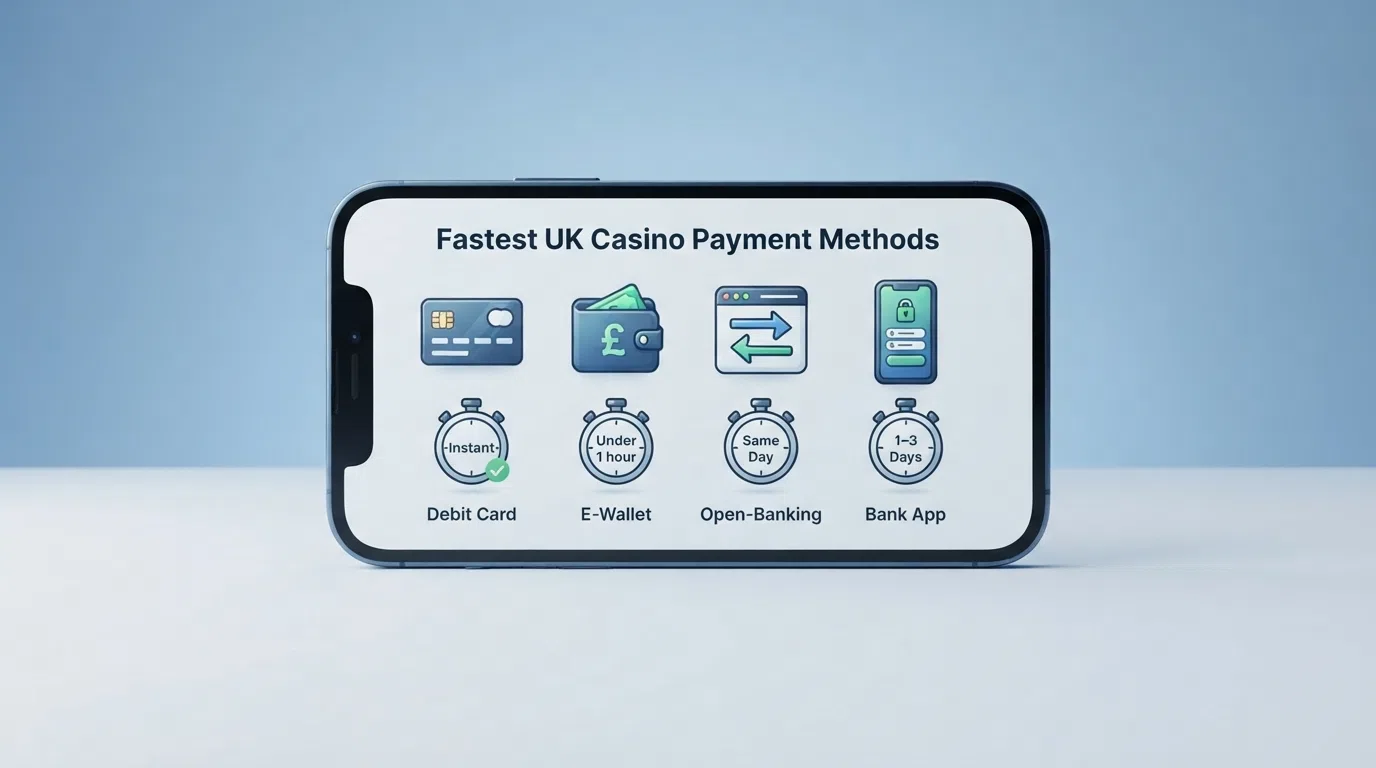
The UK regulatory filter narrows the field. Credit cards have been banned for gambling since 14 April 2020, including credit-card-funded payments routed through e-wallets. Every method that reaches a UK-licensed casino is a debit instrument or an e-money instrument, and every one of them runs through a regulated UK payment rail.
The method you deposited with is usually the method you must withdraw to. This is the standard “closed-loop” policy at UK-licensed casinos, and it has anti-money-laundering logic behind it: a player who deposits £500 via debit card and tries to withdraw to a different card is asking the operator to send the funds to a third party. Most operators refuse. The trap is that the rail you deposited with for convenience — say, Apple Pay, because the cashier made it one tap — may not be the rail you want to withdraw via.
Debit cards — Visa and Mastercard withdrawal reality
Standard Visa and Mastercard debit withdrawals take 1 to 3 business days after the operator approves the request. The default for any UK casino that has not enabled Fast Funds, and the slowest common method after a standard bank transfer.
Visa Fast Funds has shrunk that window dramatically for eligible cards at eligible casinos. At Bet365, William Hill, Ladbrokes, Coral, Betfred and BetVictor, a Visa Fast Funds withdrawal can land in minutes once approved. The eligibility check is on the card issuer’s side: most UK high-street banks support Fast Funds, but some prepaid and newer-app banks do not, and the player will only find out at the cashier. Mastercard Send is less widely supported at UK casinos than Visa Fast Funds; players who specifically want a Mastercard real-time rail should check the cashier before registering.
E-wallets — PayPal, Skrill, Neteller and the rest compared
PayPal is the dominant UK casino e-wallet, with a typical withdrawal window of 0 to 24 hours and widespread acceptance across UKGC-licensed operators. Third-party testers have recorded PayPal withdrawals at Mr Vegas clearing in 5 to 15 minutes, and William Hill clearing in around 60 minutes. The variability is operator-side, not PayPal-side.
Skrill and Neteller sit in the same 0 to 24 hour window as PayPal, with similar operator variability. The trade-off is exclusion: some welcome offers (Coral is the clearest example) exclude e-wallet deposits from the offer, and a player who deposited via Skrill to chase a free-spin welcome will find themselves on the wrong side of the terms. The exclusion exists because e-wallet routing is a known abuse vector for bonus abuse, and the offer terms are the operator’s first line of defence.
Trustly and open banking-based e-wallets settle in 15 minutes to 4 hours, direct to the player’s bank, with no separate wallet account needed. The player registers the bank, the casino initiates a Faster Payments transfer, and the funds land in the bank rather than an intermediate wallet. For a player who does not want to manage a separate e-wallet account, open banking is the cleanest path.
MuchBetter and MiFinity occupy a smaller niche. Acceptance at UKGC-licensed casinos is growing but not universal, and the speed sits in the same e-wallet band — typically sub-24 hours, occasionally sub-1-hour.
Bank transfers — why they still take days
Standard bank transfer is the slowest common method at UK-licensed casinos, taking 2 to 5 business days. The slowness is not the rail itself: most UK banks now support Faster Payments, which settles in seconds. The slowness is the operator’s choice of rail. A casino that wires payouts through a SWIFT correspondent or an older BACS routing is paying for the safety of a slower rail, and the player pays in days.
Faster Payments and Instant Bank Transfer via open banking have changed this. At Betfair, Paddy Power and William Hill, Instant Bank Transfer lands the funds in the player’s bank immediately on approval. For a player who already banks with a Faster Payments-enabled institution, the open-banking rail is the fastest path that does not require a separate e-wallet account.
Payment methods head-to-head: speed, availability and what to watch for
| Payment method | Typical speed | How it works | Availability at UK casinos | Watch for |
|---|---|---|---|---|
| Visa Fast Funds | Instant to minutes | Real-time Visa rail to eligible cards | Most major UK operators | Card issuer must support Fast Funds |
| Mastercard Send | Instant to hours | Mastercard real-time rail | Limited UK casino support | Check cashier before registering |
| Apple Pay | Instant to 2–5 days | Operator-dependent integration | Most Flutter and Entain operators | Speed varies by operator, not by rail |
| Google Pay | Rarely supported for withdrawal | Falls back to debit card or bank | Limited | Withdrawal support is the exception |
| PayPal | 0–24 hours | E-wallet to bank account | Widespread at UKGC casinos | E-wallet exclusion from some welcome offers |
| Skrill | 0–24 hours | E-wallet to bank account | Common | Often excluded from welcome offers |
| Neteller | 0–24 hours | E-wallet to bank account | Common | Often excluded from welcome offers |
| Trustly / open banking | 15 minutes to 4 hours | Direct to bank via Faster Payments | Growing | No separate wallet account needed |
| Instant Bank Transfer | Instant | Open banking rail direct to bank | Betfair, Paddy Power, William Hill | Requires Faster Payments-enabled bank |
| Standard debit card | 1–3 business days | BACS-equivalent card settlement | Universal | The default; the slowest common card route |
| Standard bank transfer | 2–5 business days | BACS or SWIFT correspondent | Universal | The slowest common method |
| Credit card | Not permitted | Banned under LCCP 6.1.2 | None | Banned since 14 April 2020 |
The single most useful habit a UK player can build is to pick a method that appears in the top half of this table before registering, and to check the cashier at the specific operator for the rail that method actually uses. A “Visa withdrawal” at one operator and a “Visa Fast Funds withdrawal” at another are not the same line in the cashier, and the difference is the difference between minutes and days.
Bitcoin casino withdrawals — the speed that costs you your UK protections
Crypto casino withdrawals are fast. Blockchain confirmation is a real technical advantage, and a Bitcoin payout that lands in 10 to 60 minutes is a payout that no UKGC rail currently matches. The trade-off is not the speed. The trade-off is everything the speed costs you.
No UKGC-licensed casino accepts cryptocurrency deposits in 2026. The UKGC does not currently authorise cryptocurrency as a payment method on licensed platforms. A British player who searches for “Bitcoin casino UK” and lands on a site that takes BTC is, by definition, on a site that does not hold a UK licence. The site is licensed somewhere — Curaçao, Anjouan, occasionally Malta or Gibraltar — and “licensed somewhere” is not “licensed for the UK.” A Curaçao or Anjouan sub-licence does not give a player any UK consumer redress. It does not put the operator inside the UKGC’s complaints process. It does not connect the site to GAMSTOP, to an ADR scheme, or to the operator-side self-exclusion tools a UKGC licensee must provide.
The site’s marketing will not lead with that. The marketing leads with “instant Bitcoin withdrawals, no verification, register in 30 seconds.” The marketing is accurate. The site is also outside the UK.
Why no UKGC-licensed casino accepts cryptocurrency in 2026
The barrier is not a single prohibition. It is a web of rules the crypto rails cannot satisfy.
The UKGC does not currently authorise cryptocurrency as a payment method on licensed platforms. The Commission’s anti-money-laundering and know-your-customer obligations require traceable fiat rails: a casino must be able to follow the money from a player’s source of funds through to a withdrawal. Crypto’s pseudonymity runs in the opposite direction. A casino that accepted BTC would have to either ignore its AML obligations or build an off-chain identity layer that defeats the privacy advantage crypto is being marketed on.
The UKGC opened an exploratory review of a potential crypto pathway at the Betting and Gaming Council’s AGM in February 2026. The review is exploratory. It signals that the Commission is willing to consider the question. It does not change what is currently authorised. A player reading “UKGC reviewing crypto” should read it as a signal that the door is being looked at, not that it has been opened.
The financial-vulnerability check the UKGC introduced in February 2025 — mandatory at a £150 net deposit threshold in a rolling 30-day period, drawing on publicly available data — is the kind of rule a crypto casino would have to replicate for UK play. The replication is technically possible; the political willingness to require it on anonymous rails is not yet established. Until it is, the licensed and unlicensed markets stay separate.
Offshore crypto casinos — what they deliver and what you lose
The typical offshore crypto casino delivers a withdrawal in 10 to 60 minutes from a hot wallet, with no pending period, no internal review queue, and no document request. The player has registered with an email address, deposited BTC, played, and is now looking at a wallet balance. The technical experience is faster than anything a UK-licensed casino offers.
The licence gap is what the player loses. A Curaçao or Anjouan registration is not a UKGC substitute. The player has no GAMSTOP — the national self-exclusion scheme that blocks access across every UKGC licensee does not reach offshore sites. The player has no ADR — the alternative dispute resolution route the UKGC requires of its licensees does not exist offshore. The player has no UKGC complaints route. The player has no obligation on the operator to pay out, because the operator is not bound by the UKGC’s payout-conduct rules.
The Commission’s enforcement against offshore operators is disruption-only. The UKGC does not have statutory ISP or DNS blocking powers; the legislation that would grant them has been proposed, not enacted. The Commission’s toolkit in the year to June 2025 was 3,140 disruption notices, 447,778 URLs referred to search engines, and 287,961 URLs removed. The strategy is to make the site hard to find. It is not to make it impossible to reach.
What a player gets on a licensed UK site that they do not get offshore: GAMSTOP exclusion that actually blocks access, a complaints route to the regulator, an ADR scheme that can compel a payout, and the structural guarantee that the operator has been vetted for solvency, AML and source-of-funds compliance. The 10 minutes of crypto speed is the price of giving those up.
Slot sites where fast withdrawals meet the games worth cashing out from
A big slot win means nothing if the cashout takes a week. Slot players care about withdrawal speed differently from table-game or sports bettors: a single high-volatility spin can multiply a stake by 5,000, and the resulting balance is often large enough to hit the operator’s per-transaction cap. A slot player picking between two equally licensed casinos will choose the one that pays out the same balance faster and in fewer transactions.
The slot sites among the featured operators that clear slot winnings fastest are the ones with no-wager free-spin welcome offers and tested sub-1-hour withdrawals: Betfred, Sky Vegas, and William Hill. All three offer 200 free spins with zero wagering on winnings, and all three have published tested withdrawal times in the 3-hour or sub-1-hour range. The no-wager pattern matters because the slot player’s session winnings are immediately withdrawable cash — there is no bonus balance to clear, and the free-spin winnings skip the wagering step entirely.
The three slots with verified RTP data in this review — Starburst, Big Bass Bonanza and Book of Dead — are all present at the featured operators, and a player who wants to know what their stake is statistically expected to return can compare the figures before they spin.
The slot sites that pay out fastest in the UK
Betfred runs 200 no-wager free spins on Starburst, with tested 3-hour withdrawals and a £5 minimum. Sky Vegas runs 200 no-wager free spins on a first eligible game, with Visa instant-eligible withdrawals in 1 to 4 hours. William Hill runs 200 no-wager free spins on selected games, with tested sub-1-hour withdrawals on Visa, PayPal, Revolut and Instant Bank Transfer.
The three operators share a structural feature: a no-wager casino welcome offer, a UKGC licence, and a payment rail wired up for fast payouts. A player who is choosing between them on speed alone would put William Hill first on the breadth of fast methods, Sky Vegas second on the simplicity of the no-wager offer, and Betfred third on the tested 3-hour Visa Fast Funds cashout. The differences are small; the pattern is the point.
Three slots with published RTP — and why that figure matters for your withdrawal
| Slot | RTP | Provider | Volatility |
|---|---|---|---|
| Starburst | 96.09% | NetEnt | Low to medium |
| Big Bass Bonanza | 96.71% | Pragmatic Play (Reel Kingdom) | Medium-high to high |
| Book of Dead | 96.21% | Play’n GO | High |
RTP dictates how much of every pound staked stays in play across a long session. A 96.09% slot returns 96.09p of every £1 in the long run; a 96.71% slot returns 96.71p. The difference between a 96% and a 97% slot is 1p per £1, which sounds trivial and adds up to a meaningful difference across a session of several hundred spins. A high-RTP slot empties a bankroll more slowly, extends the session, and delays the point at which a player runs out of stake and has to make a cashout decision.
A low-RTP slot does the opposite. The bankroll depletes faster, the player reaches a cashout moment sooner, and the casino’s withdrawal speed becomes the bottleneck. For a player who has chosen a low-RTP slot, the speed of the withdrawal is the speed at which they can recycle their stake and start again. For a player on a high-RTP slot, the same withdrawal is a longer-deferred but larger event.
The volatility figure matters differently. A low-volatility slot like Starburst returns most of its stake in small, frequent wins, with rare large payouts. A high-volatility slot like Book of Dead returns most of its stake in long dry spells punctuated by occasional large wins. The cashout pattern follows: a Starburst session ends with a small, frequent-withdrawal pattern; a Book of Dead session ends with a long wait followed by a large, single withdrawal. The latter is the session that tests the operator’s per-transaction cap and the player’s patience.
New UK casinos: can fresh brands really pay out faster?
Newly licensed UK casinos often make withdrawal speed their competitive calling card, and the strategy makes sense on its face. An established brand competes on recognition; a new entrant has to compete on something. Withdrawal speed is one of the few levers a new casino can pull, because the UKGC’s regulatory floor is the same for every licensee and the differentiation has to come from above the floor, not below it.
A fresh UKGC licence, however, does not guarantee fresh performance. The UKGC’s licensing process checks the operator’s financial,AML and player-protection readiness. It does not test the operator’s payment processing infrastructure, and it does not publish a benchmark of withdrawal speeds by licence. A new licensee can launch with the slickest payout page in the market and a payments backend that takes 48 hours to clear a request. The licence does not, and cannot, tell the player which it is.
The limited evidence base is the practical problem. New casinos have fewer third-party test results published, fewer player forum reports, and less data for an outside reader to verify a claim against. A player evaluating a new UK casino on withdrawal speed is reading the operator’s own marketing more than the affiliate tests, and the marketing is the least reliable source available.
The newest UK casino brands chasing fast-payout credibility
The pattern in 2025 and 2026 is that new UK entrants typically launch with Instant Bank Transfer and Visa Fast Funds support as table stakes — a baseline they have to meet to be taken seriously by comparison sites. The Instant Bank Transfer rail is cheap to integrate; the open-banking infrastructure is mature; the rail is the same one the established operators use. New entrants that launch without it are visibly behind before they have taken a deposit.
Verifying a new casino’s withdrawal-speed claims is a three-step check. The first step is the UKGC public register: the licence grant date tells the player how long the operator has been in the UK market. The second is the operator’s published withdrawal policy: which methods are listed, what is the published processing window, what are the minimum and maximum withdrawal amounts. The third is the payment-method roster at the cashier: a casino that lists “Visa” but not “Visa Fast Funds” is signalling that the slower standard rail is what the player should expect. A new casino’s payout claims should always be cross-checked against the cashier, not the homepage.
How new casinos use withdrawal speed as a launch strategy
The new-casino competitive position is the inverse of the established-casino position. Established operators have brand trust, decades of player data, and customer-acquisition costs that a new entrant cannot match. New entrants compete on the things a new entrant can credibly offer: speed, modern UX, fresh welcome packages, and a payments roster built around the current state of the rails.
The regulatory floor prevents a race to the bottom. Every new UKGC licensee must comply with the same LCCP conditions on verification (17.1.1), wagering caps (10× ceiling since December 2025), and the upcoming gross deposit limit (from 30 June 2026, extended to 30 September 2026). A new casino cannot offer 50× wagering to compete on headline bonus value, because the LCCP ceiling is 10×. A new casino cannot offer reverse withdrawals, because the practice is banned. A new casino cannot verify a player at withdrawal, because the rule requires verification before gambling. The regulatory floor sets the same baseline for every new entrant, and the differentiation has to come from above the floor.
The risk for players is the first-month liquidity question. A new casino that has promised instant withdrawals has committed to a payments operation it has not yet run at scale. If the operator’s first-month deposit volume outstrips its first-month withdrawal volume, the cashier performs. If withdrawals spike — a single large winner, a coordinated bonus-abuse withdrawal queue — the operations can stall. The stall does not always show up in the published policy; it shows up in the wait time. A player who values a fast withdrawal at a new brand is making a bet on the operator’s ability to handle the queue.
What UK gambling law actually says about your withdrawal — and what it doesn’t
UK regulation sets a floor for withdrawal conduct, not a speed guarantee. The LCCP and RTS are the working instruments; the Gambling Act 2005 is the statute. Between the two, the rules that govern how your money moves are specific, recent, and not always intuitive.

The 2021 to 2025 reform wave changed more about withdrawal conduct than the previous decade. The reverse-withdrawal ban took effect on 31 October 2021, alongside the auto-play ban, the 2.5-second spin speed cap, and the ban on losses disguised as wins. The 10× wagering cap took effect on 19 December 2025. The verification rule — LCCP 17.1.1 — has been in place longer, but its enforcement sharpened as the contact-centre complaint volume on withdrawal delays grew.
What the rules do not do is guarantee a payout time. The UKGC’s expectation is that large operators process within 24 to 48 hours, and the Commission’s data shows ~99% of requests clear within that window. The expectation is not a regulatory ceiling, and the Commission’s complaint volume — 2,000 a year, the number-one topic in July 2024 — is the evidence that the expectation is not always met.
The UKGC rules that directly shape how fast you get paid
Four licence conditions and one tax change shape every UK casino withdrawal in 2026.
LCCP 17.1.1 — verification before play. Operators must verify a customer’s identity before they gamble, not at the point of withdrawal. A request to withdraw cannot trigger a new identity-information requirement if that information could have been requested earlier. The rule was written to end the “withdrawal hostage” tactic, in which an operator held a cashout until the player uploaded documents. The rule is the single biggest structural reform for payout speed in the past decade, and a player who has registered, deposited, and uploaded KYC documents at sign-up has cleared the biggest withdrawal-blocker the regulator has identified.
Reverse-withdrawal ban (31 October 2021). Once a player has requested a withdrawal, it cannot be reversed. The “cancel and play again” mechanic that defined the pending period before 2021 is gone. A player who clicks “withdraw” has made a binding decision. The ban shortened the pending period at most operators to zero or near-zero, because the cashier no longer has a reason to hold a request that cannot be reversed.
10× wagering cap (19 December 2025). Wagering requirements at UK-licensed casinos cannot exceed 10× the bonus amount. The cap removed the highest-friction bonuses from the UK market. A 40× or 50× bonus, which could take weeks of play to clear, is no longer available. The 10× ceiling means a £100 bonus is cleared at £1,000 of turnover, which at a £1 stake is a single sitting. The cap is the structural reason bonus-related withdrawal holds have shrunk.
Age-banded stake caps (April and May 2025). Online slots are capped at £5 per game cycle for players aged 25 and over, and £2 for players aged 18 to 24. The cap is on stake, not on withdrawal, and it does not directly change a withdrawal time. It does, however, change the rhythm of a session: a player staking £2 per spin plays twice as many spins to reach the same turnover, which extends the time to clear a bonus and lengthens the path to a withdrawal.
Remote Gaming Duty at 40% (1 April 2026). The duty on online casino gross profits rose from 21% to 40% with effect from 1 April 2026. The change is a tax on operators, not on players, but the second-order effect is on operator margins and, with it, on the operator’s ability to invest in payments infrastructure. A duty rise of that size will be passed through in some form — to bonus generosity, to processing speed investment, to marketing spend — and the player will see the effect at the cashier.
KYC verification — why it happens before you play, not when you cash out
Pre-deposit verification covers three items: name, address, and date of birth. The operator checks these against public records and identity-document uploads at the point of registration. A player who has not completed this step is not a verified customer, and the operator must restrict the account — not just the withdrawal — until verification is complete. The restriction is a regulatory requirement, not a discretionary hold.
A second check, the financial vulnerability check, fires at a £150 net deposit threshold in a rolling 30-day period. From 28 February 2025, operators must run a publicly-available-data check on the customer at that threshold: county court judgments, individual voluntary arrangements, bankruptcy orders. The check is one-sided (the operator looks up, the customer is not asked) and it does not by itself block play. It does trigger an enhanced review if the data flags financial distress, and the enhanced review can result in deposit restrictions or account suspension. A player who has hit the £150 threshold and noticed a slowdown in withdrawals is probably seeing the vulnerability check fire; the delay is the system working as designed, not the operator stalling.
The verification flow that produces the fastest withdrawals is the one that completes at registration: upload proof of ID, proof of address, and payment-method verification before the first deposit. By the time a player is withdrawing, the KYC queue is empty and the cashier has no reason to hold the request. By contrast, the player who skips the registration uploads and waits until withdrawal to provide documents has restarted the queue at the worst possible moment.
“No-verification” casinos targeting UK players — the offshore reality
Any site advertising “no ID” or “no KYC” withdrawals to British players is operating without a UK licence. The promise is real: register with an email, deposit, play, withdraw. The reality is the licence gap.
The operator is offshore — Curaçao, Panama, Anjouan — and the UKGC’s jurisdiction stops at the GB border. The player on the offshore site has no GAMSTOP, no ADR, no Commission complaints route, and no statutory right to a payout. The operator’s promise to pay is a contractual promise from a foreign company, enforceable (if at all) in the operator’s home jurisdiction, with a UK player as the foreign claimant.
The Commission’s enforcement toolkit is disruption-only. The UKGC does not have statutory ISP or DNS blocking powers; the legislation that would grant them has been proposed, not enacted. The Commission’s toolkit, in the year to June 2025, was 3,140 disruption notices, 447,778 URLs referred to search engines, and 287,961 URLs removed. The strategy is to make the site hard to find. It is not to make it impossible to reach.
What a player on a licensed UK site gets that a player on an offshore site does not: a regulator that can compel a payout, an ADR scheme that can adjudicate a dispute, a self-exclusion register (GAMSTOP) that blocks access across every UKGC licensee, and a structural set of rules on verification, bonus terms and player protection. The trade-off is the verification itself. A player who refuses to upload documents and chooses the offshore site is not avoiding bureaucracy; they are trading every protection the UK regime offers for the convenience of not uploading.
Crypto casinos and KYC — the double gap in UK protection
Offshore crypto casinos combine the two highest-risk features a UK player can stack: unregulated status and pseudonymous payments. A Curaçao or Anjouan sub-licence is not a UKGC substitute, and the AML obligations that bind a UK licensee do not bind an offshore crypto operator. The marketing of “no-KYC” alongside near-instant withdrawals is the marketing of the absence of the protections the UK regime provides.
The double exposure is what makes the combination different from either gap alone. A player on an unlicensed fiat casino loses UK protection but has a traceable bank or card payment that supports a chargeback dispute. A player on a licensed crypto casino would have UK protection (if one existed) but no traceable rail to support a dispute. A player on an unlicensed crypto casino has neither protection nor rail. The 10-to-60-minute withdrawal that the site advertises is paid for by the absence of any recourse if the withdrawal does not arrive.
The relevant UK regulatory fact is that no UKGC-licensed casino accepts cryptocurrency deposits in 2026. The UKGC’s February 2026 exploratory review signals that the Commission is willing to look at the question, but the door is not open today. A British player using an offshore crypto site is, in regulatory terms, using an unlicensed site — and the trade-off, as above, is everything the licence provides.
When fast payouts stop being a perk — staying in control
The same withdrawal speed that makes a casino attractive can enable harmful play patterns. A fast cashout is a feature for a player who treats gambling as a paid hobby with a budget. It is a vulnerability for a player who is chasing losses and needs the cash back in their account to play again. The two patterns are not distinguishable from the cashier’s side; both are “player requests a withdrawal, operator pays it.” The safer-gambling tools exist because the cashier cannot tell the difference.
UKGC licensees are required to provide the full safer-gambling toolkit. The prevalence data — 0.4% of adults in England experience problem gambling, 1.6% experience at least moderate risk gambling, 47% of adults gambled in the past four weeks — grounds the conversation in the fact that the tools exist for a real population, not a hypothetical one. The free, 24/7 services — National Gambling Helpline 0808 8020 133, NHS gambling clinics in England, Scotland and Wales, Gamblers Anonymous — are available to any British player, regardless of where they play.
Deposit limits, reality checks and the tools every UK casino must offer
- Deposit limits. Customer-set, prompted before first deposit since October 2025, with decrease requests actioned immediately. The gross deposit limit (from 30 June 2026, extended to 30 September 2026) is based solely on money paid into the account, and only that form may be called a “deposit limit.”
- Reality checks. Pop-up session timers showing time played and net position. Mandatory at all UKGC licensees.
- Time-outs. 24-hour to 6-week cooling-off periods that lock the player out of their account. The lock is operator-level; GAMSTOP is the national-level equivalent.
- Financial vulnerability checks. Mandatory from 28 February 2025 at a £150 net deposit threshold in a rolling 30-day period, using publicly available data.
- Age-banded stake caps. £5 per game cycle for 25+, £2 for 18–24, in force since April and May 2025 respectively.
The mandatory tools are a floor, not a ceiling. A UKGC licensee can offer more — a player who wants a 24-hour reality check rather than the default 60-minute can usually set it, and a player who wants a £50 daily deposit limit rather than the default £250 can set that too. The settings live in the responsible-gambling section of the account, not on the homepage, and a player who has not visited that section is gambling with the default settings.
GAMSTOP, time-outs and self-exclusion — pulling the emergency brake
GAMSTOP is the national multi-operator self-exclusion scheme, mandatory at every UKGC-licensed online operator since 31 March 2020. The exclusion periods are six months, one year, five years, or five years with auto-renewal. The exclusion cannot be cancelled early. A player who registers with GAMSTOP is locked out of every UKGC-licensed online casino, betting site, bingo site and poker site for the chosen period; the block is not a request, and the operator cannot override it.
Operator-level self-exclusion is a separate tool. Individual casinos offer 6 to 12-month exclusions typically, and a player who excludes from one operator is not excluded from the rest. GAMSTOP is the umbrella; operator-level exclusion is the targeted version. The practical effect on withdrawals is the same: a self-excluded account must return the player’s funds. The operator cannot hold the balance hostage to the exclusion; the exclusion locks the account, the player gets the cash.
For a player who has reached the point of considering GAMSTOP, the National Gambling Helpline (0808 8020 133, 24/7, run by GamCare) is the first call. The helpline received over 52,000 calls in 2024/25, and the volume is not a sign that the service is busy — it is a sign that the service is used.
How to spot when the chase for fast withdrawals becomes a problem
The behavioural pattern is recognisable. A player who has moved from “withdraw my winnings when I have some” to “withdraw as fast as possible so I can redeposit” has crossed a line. The first pattern is housekeeping; the second is the structure of a chase. The two are visible in the cashier history: the time between a withdrawal arriving and the next deposit shrinks, the size of the withdrawals tracks the size of the deposits, and the player’s net position over a month drifts steadily negative.
The PGSI self-assessment and the GambleAware quiz are the two free, confidential screeners a UK player can use. The PGSI (Problem Gambling Severity Index) is the tool the NHS uses in its surveys; the GambleAware quiz is its public-facing version. Over 160,000 people completed the GambleAware quiz in 2024/25, and over half of completers took a meaningful action as a result. The quiz is not a diagnosis; it is a mirror. A player who answers the questions honestly will see the same pattern the cashier history shows.
The help infrastructure exists for the player who has reached the point of asking. The National Gambling Helpline (0808 8020 133) is 24/7, free, and confidential. NHS gambling harm clinics operate in England, Scotland and Wales, with treatment waiting times under two weeks from referral. Gamblers Anonymous runs peer-support meetings. The screeners, the helpline, and the clinics are not for the player who has a problem in the future; they are for the player who has one now.
How we selected and ranked the casinos on this page
The source base for this ranking is the UK Gambling Commission’s public register, the Commission’s published data and blog statements, and third-party withdrawal tests published by Bettingguide.com, OLBG, talkSPORT, Bookies.com and equivalent affiliate test logs. Every operator discussed in the ranking section holds an active UKGC operating licence; offshore casinos are identified and excluded.
The ranking criteria, in order of weight, are: tested withdrawal speed by payment method, UKGC licensing status, welcome-offer structure with emphasis on no-wager and low-wagering terms, and the breadth of fast-method support. Tested speed is the headline criterion; a casino with a sub-1-hour tested payout ranks above a casino with a 3-hour tested payout, all else equal. UKGC licensing is a hard floor: an unlicensed casino is excluded from the ranking regardless of its speed claims. Welcome-offer structure is the tiebreaker, because the offer determines whether the withdrawal is a clean cashout or a bonus-cleared withdrawal with a wait behind it.
The ranking reflects tested third-party results, not the operator’s own claim. A casino that advertises “instant withdrawal” but has not been independently tested is placed below a casino with a slower published figure that has. A casino that has been tested on a slow method only is placed below a casino tested on a fast method. Affiliate tests are best-case data, and the ranking treats them as best-case data.
The scope is explicit. Every operator in the ranking holds a current UKGC licence. The crypto section, the offshore section, and the “no-verification” section are written to identify what those sites deliver and what they cost the UK player. They are not in the ranking. A reader who wants the operator rankings should treat the ten casinos in the table as the universe this page is comparing; everything outside that table is a separate question.
Your fast-withdrawal game plan for 2026
The single most useful change a UK player can make to their cashout time is to pick the payment method first and the casino second. The method controls the speed; the casino controls the queue. A fast operator on a slow rail is slower than a slow operator on a fast rail. A player who decides they want Visa Fast Funds first, and then picks from the operators that support it, will end up with a faster cashout than a player who picks a casino first and accepts whatever rail it offers.
The second move is to open an e-wallet or verify the bank’s Faster Payments support before registering. The verification step is the long pole. Opening a PayPal account, or confirming the bank supports Faster Payments, is a one-time task that takes longer to put off than to do. A player who has the wallet open at registration can deposit and withdraw on the same rail from day one.
The third move is to complete KYC at registration, not at withdrawal. The LCCP 17.1.1 rule exists to keep verification out of the cashout path. A player who uploads those mandatory verification documents at sign-up has cleared the only structural withdrawal-blocker the regulator has identified. A player who skips the uploads and tries to verify at withdrawal is asking the operator to do the KYC work in the worst possible window, and the request will take longer than the same work would have taken at sign-up.
The fourth move is to prefer no-wager free-spin offers over deposit matches if withdrawal speed is the priority. A 10× wagering cap is at the LCCP ceiling and the offer is structurally as fast as UK bonus terms allow. A no-wager offer has no wagering at all; the winnings are cash from the moment they credit, and the cashout request is a clean cashier visit. A 100% deposit match with 10× wagering requires £1,000 of turnover on a £100 bonus before the winnings release. The no-wager offer is faster on every metric that matters to a player who is reading this page.
The fifth move is to check the operator’s UKGC licence status on the public register before depositing a penny. The register is at the UKGC’s website and is searchable by operator name. A player who checks the register is checking that the licence is active, that the licence covers the product being offered, and that the operator has not been the subject of a public enforcement action. The check takes a minute; the alternative is registering at an unlicensed site.
The sixth move is to set a deposit limit at registration and to treat it as a budget, not a target. A budget is a ceiling. A target is a floor. The mandatory deposit-limit prompt at every UKGC licensee is the place to set the ceiling, and a player who has set the ceiling has decided, in advance, what they can afford to lose. The setting is not a guarantee of behaviour, but it is the structural anchor that the rest of the safer-gambling tools build on.
Frequently Asked Questions
What creates the pending period that delays my casino cashout?
The pending period is the queue between requesting a withdrawal and the operator’s payments team acting on it. Since 31 October 2021, the UKGC has banned reverse withdrawals, so there is no longer a structural reason for the operator to hold the request. Most UKGC licensees have shortened the pending period to zero or near-zero. The delays that remain are bonus-wagering holds, KYC verification queues, and source-of-funds reviews on larger balances.
Can a UK-licensed casino legally refuse to pay out my winnings?
Yes, in specific circumstances. A casino can refuse a withdrawal if the player has not met bonus wagering requirements, has not completed KYC verification, or is the subject of a source-of-funds or anti-fraud review. The refusal must be for a reason set out in the operator’s terms, and the player has the right to escalate to the operator’s ADR scheme and, if that fails, to the UKGC’s complaints process.
What is the maximum I can withdraw from a UK online casino in one transaction?
The maximum depends on the operator. Betfred’s published ceiling is £9,999 per withdrawal. BetVictor’s is £40,000. Most UKGC-licensed operators publish per-transaction and per-day caps in their cashier terms. A player who has won more than the cap must split the withdrawal into multiple requests, and each request restarts the processing clock.
How did the reverse-withdrawal ban change fast payouts in the UK?
The reverse-withdrawal ban, in force since 31 October 2021, ended the “cancel and play again” mechanic that had defined the pending period. Before the ban, a player could request a withdrawal, change their mind, and reverse it to play again. After the ban, the request is binding. The ban shortened or removed the pending period at most UKGC-licensed operators, and it is the single biggest structural reform in UK payout conduct of the past decade.
What is the single fastest withdrawal method at UK online casinos right now?
Visa Fast Funds, Instant Bank Transfer via open banking, and Apple Pay at Betfair all settle in seconds to minutes once the operator has approved the request. The fastest of the three is operator-dependent: William Hill clears Visa in minutes; Betfair clears Apple Pay and Instant Bank Transfer instantly; Paddy Power clears Instant Bank Transfer immediately. The common factor is that the rail itself settles in real time. The constraint is the operator’s processing window, not the rail.
Can British players use Bitcoin casinos, and are the payouts really instant?
Bitcoin payouts at offshore crypto casinos are genuinely fast — typically 10 to 60 minutes from a hot wallet. The trade-off is the licence: no UKGC-licensed casino accepts cryptocurrency in 2026, and an offshore crypto casino is outside the UKGC’s jurisdiction. A player on an offshore crypto site has no GAMSTOP, no ADR, no UKGC complaints route, and no statutory right to a payout. The speed is real. The protection is not.
Apple Pay and Google Pay — instant or just fast?
Apple Pay withdrawals can clear instantly at some UK casinos and take 2 to 5 working days at others. The speed depends entirely on the operator’s backend integration. Betfair clears Apple Pay instantly; Paddy Power takes 2 to 5 working days. Both operators are on the UKGC register; the difference is what rail each has wired up behind the Apple Pay button. A player who wants Apple Pay to be fast needs to check the cashier at the specific operator, not assume.
Google Pay withdrawals are rarer at UKGC-licensed casinos. Most operators that accept Google Pay for deposits do not support it for withdrawals, and the player is sent back to a debit card or bank transfer instead. Both Apple Pay and Google Pay are debit-card-funded at their core — the underlying rail is still Visa or Mastercard — and the speed difference comes from the operator’s integration, not from a separate payments network.
Live casino withdrawals — do live-dealer games slow your cashout?
Withdrawal processing is game-agnostic. Live-dealer winnings and slot winnings follow the same pipeline at every UK-licensed casino. The cashier does not know, and does not care, whether the £200 in the account came from a blackjack hand or a free-spin feature. The processing window is the operator’s; the rail is the payment method’s; the game type is invisible to both.
The perception gap is real, though. Live-dealer sessions involve larger individual bets, faster decision cycles, and longer continuous play. A player who has been at a live roulette table for two hours has a different psychological relationship to a 4-hour withdrawal than a player who has spun 200 free spins in 10 minutes. The player at the live table wants the cash out, and the 4-hour window feels like a delay. The pipeline says it is the same as the slot pipeline. The player feels it is not.
The featured operators with the strongest live-dealer catalogues and fast withdrawals are Bet365, William Hill, Sky Vegas, Ladbrokes, Paddy Power, Coral, Betfair, 888 and BetVictor. Evolution is the dominant live-dealer provider across the set. A player who wants both Evolution’s live-dealer catalogue and a tested sub-1-hour withdrawal is looking at Bet365, William Hill, Ladbrokes, Coral and Betfair. The catalogue overlap is large; the speed difference is the differentiator.
Limits – trustedcasinos-notongamstop
Content created by the «trustedcasinos-notongamstop» team