
Top UK Online Casinos That Take Direct Bank Payments
 Available in GB
£10 gets most UK players in the door at a bank-accepting online casino. The interesting question is what happens next: how fast that money arrives, how quickly winnings come back, and which terms sit behind the welcome offer flashing on the homepage. This page ranks ten UK-licensed operators by their banking experience and explains the four rails a UK player can use to move money from a bank account to a casino and back again.

Data current as of September 9, 2026 and checked against the UK Gambling Commission’s public register, operator help pages and commercial banking-method guides.
Your Casino Deposit Rail Determines Everything — Speed, Security and the Offers You Can Claim
The UK cashier in 2026 is a bank-led space. Credit cards have been banned for gambling since 14 April 2020 under Licence Condition 6.1.2 of the LCCP, and the rule stretches to credit-card-funded e-wallets too, which closed one of the old workarounds overnight. The result is that almost every deposit at a UK-licensed casino now runs through a debit card, a bank transfer or an Open Banking rail, and those four bank-based options behave nothing like each other. The rail you pick sets your deposit speed, your withdrawal speed, your bonus eligibility and, in some cases, whether your deposit even gets accepted. A player who picks the wrong one waits three working days for a deposit that the cashier two tabs over processes in three seconds.
Four ways to pay by bank dominate the UK market: Open Banking, where the casino redirects you to your banking app for biometric confirmation; instant bank transfer, an operator-branded version of the same idea usually built on a Payment Initiation Service Provider such as TrueLayer or Trustly; direct bank transfer, the older manual flow where the casino hands you sort code and account number; and traditional bank transfer, the legacy Faster Payments or BACS route that still shows up at the slow end of the cashier. Two of those four are essentially the same plumbing with different branding. The other two are different in kind, and the difference shows in the timing.
The Four Ways to Pay by Bank at a UK Online Casino
Open Banking at a UK casino works through a Payment Initiation Service Provider, usually Trustly or TrueLayer, that sits between the casino and the player’s bank. The player picks their bank from a list, is redirected to their banking app, confirms the payment with Face ID, fingerprint or passcode, and the deposit lands in the casino account within seconds. Sky Casino calls its version “Pay by Bank” and walks the customer through the same three steps: click Deposit, choose Add method, pick Pay by Bank, then select the bank and authenticate. Betfair runs the equivalent under the label “Instant Bank Transfers” and explicitly describes the rail as Open Banking. Neither name changes the mechanism.
Instant bank transfer is the same rail under a different label, almost always when the operator has built the PISP connection into its own cashier rather than passing the player to a third-party screen. The deposit and withdrawal paths look the same to the player, the bank is the same, and the timing is the same. The distinction that matters is the brand on the button: an “Instant Bank Transfer” label is the operator telling you it has integrated the rail, while a generic “Open Banking” label is the operator telling you it has plugged in a third party.
Direct bank transfer is the older flow that survives at many UK operators as a fallback: the cashier hands you a sort code, account number and reference, you open your banking app, enter the details, and the deposit arrives the same day via Faster Payments or one to three business days later via BACS. The 2020 credit-card ban pushed this rail back into wider use for a while, and a handful of operators still show it as the default. It is also the only bank-based rail that lets a player move money without sharing their online banking credentials with anyone, which is why it has not disappeared.
Traditional bank transfer is the same mechanism with a different name and an older route. In practice the only meaningful split is between Faster Payments, which clears in hours, and BACS, which takes three working days. Casinos that still describe “bank wire” or “bank transfer” as a deposit option are almost always sending the payment through one of those two schemes. Most UK players encounter this rail when withdrawing a large balance to a bank account, where the operator’s payment provider routes the payout through BACS for amounts above the Faster Payments ceiling.
Open Banking vs Traditional Bank Transfer: Speed, Security and the Real Difference
The headline difference is time. An Open Banking deposit confirms in seconds; a Faster Payments bank transfer arrives the same day but only after the player has typed in the sort code, account number, reference and amount by hand. A BACS transfer takes three working days and gives the player nothing to look at in the meantime. The “instant” label at UK casinos refers almost exclusively to the Open Banking rail, and the marketing copy around it is not lying.
The second difference is how the payment is authenticated. Open Banking redirects the player to their own banking app, where the bank’s own biometric or passcode check decides whether the payment goes through. No casino-side password, no sort code typed into a third-party form, no card number. A direct bank transfer relies on the player’s banking app and a manual confirmation, and the authentication sits with the player throughout, which is why this rail is sometimes preferred by players who do not want to share their banking login with anyone.
The third difference is what the rail can do for the player. Open Banking can pull a deposit and push a withdrawal through the same bank connection, which is why operators with a strong Open Banking integration — Betfair is the clearest example — also offer instant withdrawals. A direct bank transfer works one way: the player sends money to the casino. Withdrawals are a separate Faster Payments or BACS transaction initiated by the casino, which means another settlement window and another queue.
The fourth difference is fraud protection. Strong Customer Authentication under PSD2 applies to both rails, but the bank-side fraud model is different. Open Banking runs through a regulated PISP and a regulated bank-to-bank rails scheme, with a clear liability framework if something goes wrong. A direct bank transfer relies on Faster Payments’ own confirmation rules and on the player entering the right reference. The exposure is not larger, but the dispute route is.
A bank-side gambling block is a quieter but important factor. UK high-street banks including Barclays, HSBC, Lloyds, NatWest and Santander offer card-level gambling blocks, and a handful also extend a block to Open Banking transactions routed through their apps. A direct bank transfer sent through Faster Payments is harder for a bank to block automatically because the bank does not know what the payment is for; the reference field is just a string. If a player has self-excluded through a bank block, the rail they used matters.
How to Pick a Banking Method That Fits the Way You Play
A speed-first player wants Open Banking. The deposit confirms while the player is still in the cashier, the withdrawal on a strong integration lands within minutes of the operator releasing it, and the wait is bounded by the operator’s internal pending period rather than by the rail. The deposit also does not need the player to type any bank details by hand, which removes a class of error and a class of fraud risk at the same time.
A high-limit player is more likely to use a direct bank transfer or a traditional bank transfer. Faster Payments has a per-transaction ceiling that varies by bank but sits well below the deposit limits at most UK online casinos, and BACS takes whatever the operator is willing to send. The trade-off is time: a £20,000 BACS withdrawal settles in three days where an Open Banking withdrawal of the same amount would split across the rail’s per-transaction ceiling and arrive in chunks. For very large balances, the slower rail is sometimes the only option.
A bank-compatibility question sits underneath both. Open Banking coverage at UK banks is wide but not universal: a player whose bank is not in the list at the cashier falls back to a direct bank transfer or a debit-card deposit. The fallback is not a failure mode, but it changes the timing and removes the biometric authentication step that makes Open Banking feel frictionless.
A security-first player will weigh two things. Open Banking never asks the player to share online banking credentials with the casino, because the authentication happens in the bank’s own app. A direct bank transfer has the same property by design, since the player is the one initiating the payment from their own bank. A debit card deposit shares the card number with the casino’s payment processor, which is the standard card-payment model but is a wider data surface than a bank-to-bank rail.
How Fast Your Money Moves: Deposits, Withdrawals and the Payment Rails That Set the Pace
Across the ten operators in this ranking, Open Banking deposits confirm in seconds and direct bank transfers arrive the same day; instant bank transfer is the same rail as Open Banking under a different label. The slow end of the spectrum is BACS, where a withdrawal takes three working days to clear and the operator’s pending period adds another one to three days on top. The single biggest factor in how long a withdrawal takes is not the rail. It is the operator’s internal review window between requesting a payout and releasing the funds to the payment provider. An operator that releases a withdrawal in two hours makes a BACS payout feel fast. An operator that holds withdrawals for 72 hours makes an Open Banking payout feel slow.
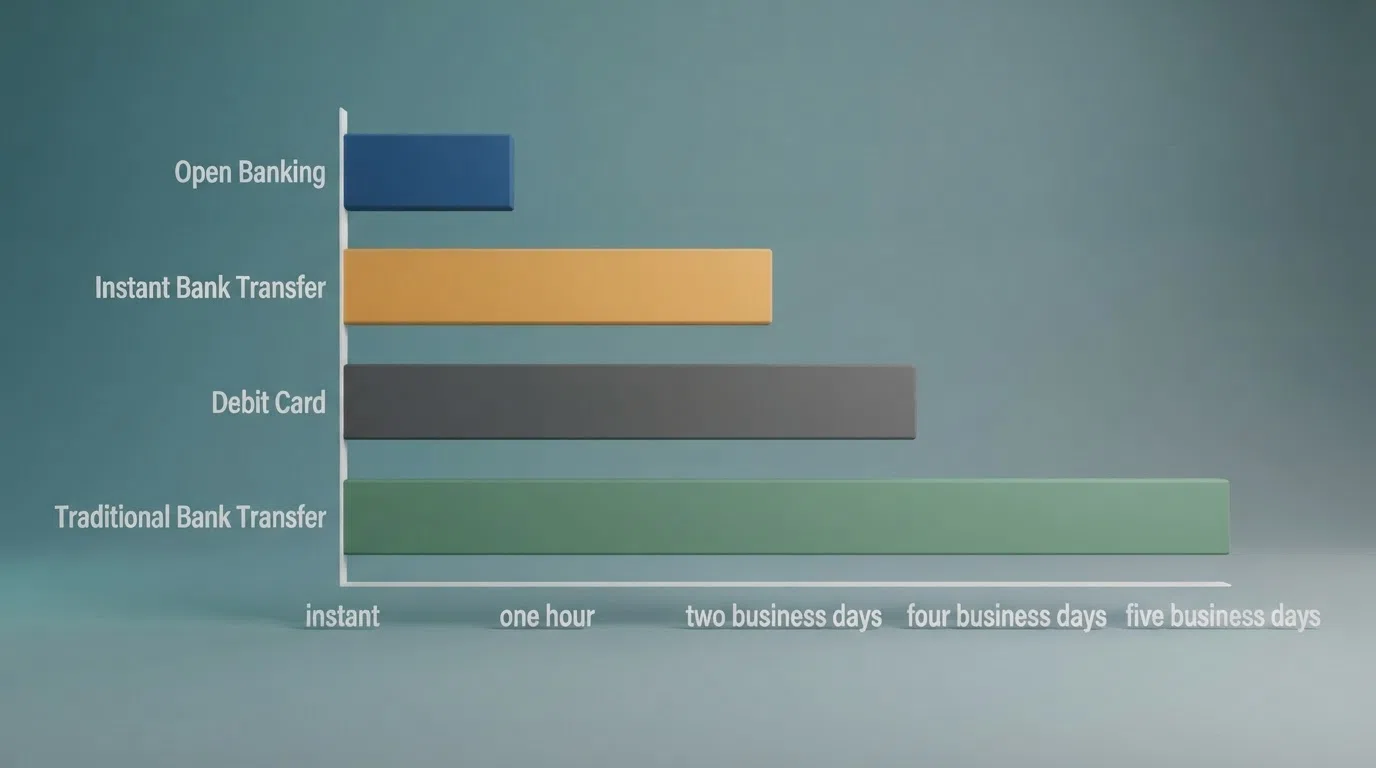
The bank-based deposit minimum at UK online casinos is almost always £10, which is also the threshold most welcome offers require to qualify. The maximum varies by operator, by payment method and by the player’s own deposit limit, which every UKGC-licensed operator must prompt the player to set before the first deposit. A bank-side block on gambling can drop the ceiling to zero, in which case the deposit simply does not go through.
Depositing by Bank: Step by Step for Open Banking, Instant Transfer and Manual Bank Transfer
The Open Banking flow at Sky Casino, Betfair and other UK operators is short. The player clicks Deposit, picks the Open Banking or “Pay by Bank” option, chooses their bank from a list, is redirected to the bank’s app, authenticates with Face ID or fingerprint, and returns to the casino with a confirmed balance. The whole thing takes under a minute, the funds are available immediately, and the player never types a sort code, account number or card number into the casino. Sky Casino’s help page sets the steps out in the same order: Deposit, Add method, Pay by Bank, select your bank, authenticate in your banking app. Currency must be £ and the bank account must be a UK account in £.
The instant bank transfer flow at Betfair, Ladbrokes, Coral and others is the same mechanism with the operator’s branding on the button. The player chooses “Instant Bank Transfer” from the cashier, the operator’s PISP integration redirects to the bank, the bank app authenticates, and the deposit confirms. Betfair describes the flow as linking a bank account to the Betfair account so that the player can deposit and withdraw instantly. The bank-linking step is the difference from a one-off Open Banking deposit: once linked, the player does not re-enter bank details for future deposits.
The direct bank transfer flow is the manual one. The cashier shows a sort code, account number and a payment reference that the player must include. The player opens their own banking app, types the details, sends the payment, and waits. Faster Payments typically clears within a few hours; BACS clears in three working days. The reference field is what reconciles the payment to the player account, so getting it wrong means a manual trace and a longer wait.
The deposit-limit prompt is the one step that all three flows share. From 31 October 2025 every UK-licensed operator must offer a financial limit before the first deposit, and the player has to engage with it, even if the limit they set is high. The limit applies to every payment method, not just the one used at that moment, and a decrease must take effect immediately.
Withdrawal Speed by Banking Method: What “Fast” and “Instant” Actually Mean
An Open Banking withdrawal on a strong integration lands within minutes. Betfair’s help page describes instant withdrawals once the bank account is linked, and the rail itself is not the bottleneck. The bottleneck is the operator’s pending period, which is the time between the player requesting a payout and the operator’s payments team releasing the funds. Pending periods at UK online casinos range from a few hours to several days, and a casino with a 24-hour pending window makes an Open Banking withdrawal feel slower than a casino with a two-hour window even though the rail is identical.
An instant bank transfer withdrawal is the same rail with the same pending caveat. The deposit side tends to be the same as Open Banking, but the withdrawal side is where the rail earns the “instant” label, because the operator is using the same PISP to push money to the player’s bank as it used to pull money from it. A handful of UK operators advertise instant withdrawals through this rail; a larger group offer “same-day” payouts, which usually means a few hours rather than a few minutes.
A traditional bank transfer withdrawal is the slowest of the four. The casino’s payment provider routes the payout through BACS for larger amounts, which takes three working days to clear in the player’s bank account. Faster Payments applies to smaller payouts and settles the same day, but the per-transaction ceiling means a large balance splits across multiple payouts and the last one can arrive a day or two after the first. The advantage of the slow rail is that the ceiling is high, and a player withdrawing a large balance can move the whole amount in one go.
A debit card withdrawal is not a bank-based rail, but it is the most common alternative in the UK cashier. Most UK banks now push debit-card gambling payouts through Faster Payments under the Gambling Commission’s push-payment reforms, which means a debit-card withdrawal at a UK operator usually clears the same day. The exception is older schemes that still take one to three working days, and operators that have not yet migrated their card payouts to the new rail.
An e-wallet withdrawal is faster on paper. PayPal, Skrill and Neteller payouts at UK operators usually confirm within hours, and the player’s e-wallet balance is available immediately on receipt. The catch is that the player then has to withdraw from the e-wallet to their bank, which puts them back on a Faster Payments or BACS timeline. The e-wallet also tends to be excluded from welcome bonuses, so the speed comes with a real cost.
Welcome Offers and Bank Deposits: Which Casinos Let You Claim the Bonus When You Pay by Bank
The credit-card ban pushed bank deposits into the default bonus-qualifying method at UK online casinos, because credit cards were the main alternative and credit cards are now banned. E-wallets remain the standard exclusion: at Ladbrokes, for example, the welcome offer’s deposit-method exclusions include Neteller, PayPal, Skrill, Paysafecard, prepaid cards and some debit cards in some sources, which means a bank transfer or a debit card is what most players will use to qualify. Coral shows a similar pattern, with bank transfer and instant bank deposits listed as eligible in some guides and e-wallets excluded.
The bank-eligible welcome offers captured this run sit on three operators. bet365 runs a 10 Days of Free Spins format with up to 500 free spins over ten daily selections, with random reveals of 5, 10, 20 or 50 free spins per selection; sources report no wagering on winnings, a £10 minimum deposit, a 30-day window to claim the offer and a 7-day validity on each selection. Ladbrokes’ offer is 100 free spins plus 300 LadBucks after depositing and staking £10 on qualifying slots, with a 10x wagering multiplier on the offer, a 48-hour window to accept the offer and 7 days to use the spins; the spin value is reported as £0.10. Coral’s offer is 100 free spins on a £10 deposit and stake, also with a 48-hour acceptance window and 7 days to use, and a £0.10 spin value; sources disagree on whether the wagering is zero or 10x and the operator’s own T&Cs should be checked before any specific figure is relied on.
The £10 minimum is a near-universal trigger. A bank transfer below £10 at any of these operators does not qualify for the welcome offer, and a deposit that lands in two parts because the player topped up mid-session counts as one deposit only if both parts clear before the offer is accepted. The 48-hour acceptance window is the one that catches players: the offer does not appear in the cashier until the qualifying deposit and stake are settled, and the 48-hour clock starts then.
Not All Bank Transfers Are Equal: 10 UK Casinos Ranked by Payment Speed and Banking Quality
The ranking rewards three things in this order: the breadth of bank-based payment methods supported, the speed of deposits and withdrawals on those methods, and the transparency of the operator’s UK Gambling Commission licence status. The ranking does not reward game-library size, brand age, or any non-banking payment method. Where two operators offer the same banking range, the tiebreaker is the clarity of the operator’s own help-page documentation of how the rail works in their cashier.
| Operator | UKGC Licence Status | Banking Methods Supported | Deposit Speed |
|---|---|---|---|
| bet365 | GB-licensed via Hillside (UK Gaming) / Hillside (UK Sports) entities | Bank transfer, Open Banking / Pay by Bank, debit card | Instant on Open Banking; same-day on bank transfer |
| William Hill | GB-licensed | Bank transfer, Open Banking, debit card | Instant on Open Banking; same-day on bank transfer |
| Sky Casino | GB-licensed under Sky Betting & Gaming | Pay by Bank (Open Banking), bank transfer, debit card | Instant on Pay by Bank |
| Ladbrokes | GB-licensed; Casino Remote active from 1 Nov 2014 (UKGC register) | Instant Bank Transfer, bank transfer, debit card | Instant on Instant Bank Transfer |
| Paddy Power | GB-licensed under Flutter Entertainment | Bank transfer, Open Banking, debit card | Instant on Open Banking; same-day on bank transfer |
| Coral | GB-licensed under Entain | Instant Bank Transfer, bank transfer, debit card | Instant on Instant Bank Transfer |
| Betfred | GB-licensed | Bank transfer, debit card | Same-day on bank transfer |
| Betfair | GB-licensed under Flutter | Instant Bank Transfer (Open Banking), bank transfer, debit card | Instant on Instant Bank Transfer |
| BetMGM UK | GB-licensed | Bank transfer, debit card | Same-day on bank transfer |
| Betway | GB-licensed | Bank transfer, debit card | Same-day on bank transfer |
The data carried into this table comes from a combination of operator help pages (Sky Casino’s “Pay by Bank” guide, Betfair’s “Instant bank transfer casino in the UK” guide), commercial bank-transfer comparison lists, and the UK Gambling Commission’s public register. The columns that did not make the table are the ones where most of the set had no captured data: per-operator deposit and withdrawal ceilings vary by player status, payment method and verification level, and a single column would have repeated one or two values down most rows.
bet365: Up to 500 Free Spins with No Wagering and Fast Bank Transfers
bet365 is the operator at the top of the ranking because the banking range is the widest in the set and the welcome offer’s headline is unusually clean. The UK Gambling Commission register shows the Hillside entities that operate bet365 — Hillside (UK Gaming) and Hillside (UK Sports) — as licensed, although the activity-date rows were not captured this run and should be confirmed on the register before any licence-specific claim is published. The banking mix is bank transfer, Open Banking and debit card, and promotional guides indicate that bank transfer and Pay by Bank deposits can qualify for the welcome offer while Paysafecard deposits are excluded. The offer itself runs for 10 days of free spins with up to 500 free spins across the period and random daily reveals of 5, 10, 20 or 50 free spins per selection. Sources report no wagering on winnings, a £10 minimum deposit, a 30-day window to claim the offer and a 7-day validity on each selection after it is revealed.
The headline “500 free spins” is the marketing’s word, and it deserves the deflation the arithmetic gives it. A 5/10/20/50 random reveal across 10 days has the player seeing a total of between 50 and 500 free spins, with the distribution weighted toward the smaller numbers. A flat cap at 500 overstates the offer in the way bonus headlines often do. For a player with a £10 bankroll who wants the cleanest possible spin experience — no wagering, no conversion math, no max-cashout terms — bet365 is the strongest pick in the ranking.
William Hill: A Banking Mainstay with Broad Payment Coverage
William Hill sits at number two because the brand is one of the longest-established in UK gambling and the banking range is broad, but the help-page specifics were not captured this run. The UK Gambling Commission register shows William Hill as GB-licensed, and the cashier is expected to include bank transfer, Open Banking and a debit-card option given the brand’s UK high-street heritage and online scale. Current welcome offer terms are available on the William Hill cashier.
For a player who values the heritage and the banking coverage, William Hill is a solid pick. Since specific help-page documentation was not captured this run, the player should verify terms directly on the site.
Sky Casino: Pay by Bank Turns Deposits Into a One-Tap Affair
Sky Casino is the clearest example of an Open Banking integration in the UK cashier, and the help page is unusually specific about how it works. The Pay by Bank flow at Sky Casino runs through Deposit, Add method, Pay by Bank, select your bank, authenticate in your banking app, and the player must use a UK £ account. Sky Betting & Gaming is GB-licensed, although specific register activity dates were not captured this run. Interested players should check the UK Gambling Commission’s public register to confirm. The current welcome offer and its bank-deposit eligibility should be verified directly on the Sky Casino cashier.
For a player who wants the shortest possible cashier flow and a help page that actually shows the steps, Sky Casino is the strongest pick in the ranking. The trade-off is that the Open Banking rail’s coverage depends on the player’s bank being in the list at the cashier, and a player whose bank is not in the list falls back to a direct bank transfer or a debit-card deposit, neither of which feels as frictionless as Pay by Bank.
Ladbrokes: Instant Bank Transfer and 100 Free Spins for a £10 Deposit
Ladbrokes is the operator with the most completely captured welcome offer and the clearest UKGC register line in the ranking. The UK Gambling Commission’s public register shows Ladbrokes Betting & Gaming Limited with a Casino Remote licence active from 1 November 2014, which is one of the few activity rows captured this run and the strongest licence evidence in the set. The cashier shows Instant Bank Transfer as a fast deposit and withdrawal method, and the welcome offer is 100 free spins plus 300 LadBucks after depositing and staking £10 on qualifying slots. The reported terms are a 10x wagering multiplier on the offer, a 48-hour window to accept and 7 days to use, with a spin value of £0.10. Snippets note that e-wallets (Neteller, PayPal, Skrill, Paysafecard, prepaid cards and some debit cards) are excluded from the offer in some sources, so a standard debit card or bank transfer is the qualifying method for most players.
For a player who wants the most completely documented welcome offer in the ranking and an Instant Bank Transfer rail, Ladbrokes is the strongest pick. The 10x wagering is the real cost, and it earns the deflation the arithmetic gives it: at £0.10 per spin, 100 free spins convert to £10 of stake-equivalent, and 10x wagering on a £10 offer means £100 of qualifying play before the offer clears.
Paddy Power: Bank Transfer from a Flutter-Owned UK High-Street Name
Paddy Power’s bank-based payment mix was not confirmed in detail this run, but the brand’s UK high-street presence and its Flutter ownership alongside Betfair make bank transfer and likely Open Banking the expected cashier set. Paddy Power is GB-licensed under Flutter Entertainment, although the specific register activity dates were not captured this run. Readers should consult the UK Gambling Commission’s public register to confirm the current licence status. For a player who already has a Paddy Power account from the high-street side, the online banking experience is expected to be on par with the Flutter sibling Betfair, though checking the cashier directly remains the best way to see the current payment options.
Coral: 100 Free Spins with Instant Banking for a £10 Deposit
Coral’s cashier shows Instant Bank Transfer as a fast deposit and withdrawal method, and the welcome offer is 100 free spins after depositing and staking £10 on selected slots. The reported terms are a 48-hour acceptance window and 7 days to use the spins, with a spin value of £0.10. There is mixed evidence on whether bank transfer was removed from the Coral cashier in 2023 with Instant Banking added in its place, and the operator’s own cashier should be checked for the current set. There is also mixed evidence on the wagering: some sources describe the spins as paying cash with no wagering, others mention 10x, and the operator’s own T&Cs should be checked before any specific figure is relied on. Coral is GB-licensed under Entain; licence status details are available on the UKGC register.
For a player who wants an Instant Bank Transfer rail and a clear £10 trigger, Coral is a reasonable pick in the middle of the ranking. The wagering uncertainty is the one thing the page will not paper over, because two contradictory figures for the same offer is exactly the kind of thing a fact-check catches on the way out.
Betfred: Bank Transfer Coverage from a UK Betting Institution
Betfred is a long-established UK operator and the banking range is expected to include bank transfer, with Open Banking and instant banking availability not confirmed this run. Betfred is GB-licensed; see the UKGC register for full licence status. Readers should check the Betfred promotions page to confirm the current welcome offer terms.
For a player who values the brand’s UK high-street heritage, Betfred is a standard choice. As the page lacks detailed help-page confirmation for the bank-deposit eligibility, players should plan to verify the offer’s payment-method eligibility at the cashier.
Betfair: Open Banking Powers Instant Deposits and Withdrawals
Betfair is the only featured operator whose own help pages explicitly document instant deposit and instant withdrawal via Open Banking. The help page describes “Instant Bank Transfers” as a method that allows customers to link a bank account to their Betfair account for instant deposit and withdrawal. Betfair is GB-licensed under Flutter. Readers are encouraged to confirm current licence details on the UK Gambling Commission’s public register. Current welcome offer terms and bank-deposit eligibility should be checked on the Betfair promotions page.
For a player who wants the clearest documentation of an Open Banking rail in the ranking and a Flutter-owned brand that pairs it with an established cashier, Betfair is the strongest pick. The combination of documented instant deposit and documented instant withdrawal is rare in the set, and it earns Betfair a top-half ranking on banking quality even though the welcome offer specifics were not captured this run.
BetMGM UK: Bank Transfer in a Growing UK Casino Library
BetMGM is a newer UK entrant. BetMGM is GB-licensed; please consult the UKGC register for status confirmation. Current welcome offer terms should be verified on the BetMGM UK promotions page.
For a player who wants a newer UK presence and is willing to confirm the banking and offer details at the cashier, BetMGM UK is a reasonable pick at the lower end of the ranking. The page’s evidence on the brand’s UK banking depth is thinner than for the operators above it, which is why the ranking places BetMGM where it does.
Betway: Bank Transfer at an Established International Brand
Betway is a globally recognised operator and the UK banking range is expected to include bank transfer. Betway is GB-licensed; see the UKGC register for confirmation. Current welcome offer terms should be verified on the Betway UK promotions page.
For a player who values the international brand and is willing to confirm the UK banking and offer details at the cashier, Betway is a reasonable pick at the lower end of the ranking. The page’s evidence on the UK banking depth is thinner than for the operators above it, and the player should plan to do the cashier verification themselves.
GB-Licensed vs Everything Else: What UK Banking-Casino Players Actually Get
A UK Gambling Commission licence is not a logo at the top of a homepage. It is a set of enforceable rules that shape what a player can and cannot do at a bank-accepting UK casino, and every rule that matters is absent the moment a player opens an account with an offshore operator that is not on the UKGC register. The four protections that matter most for bank-based payments are pre-deposit verification, GAMSTOP coverage, ADR access and the credit-card ban itself.
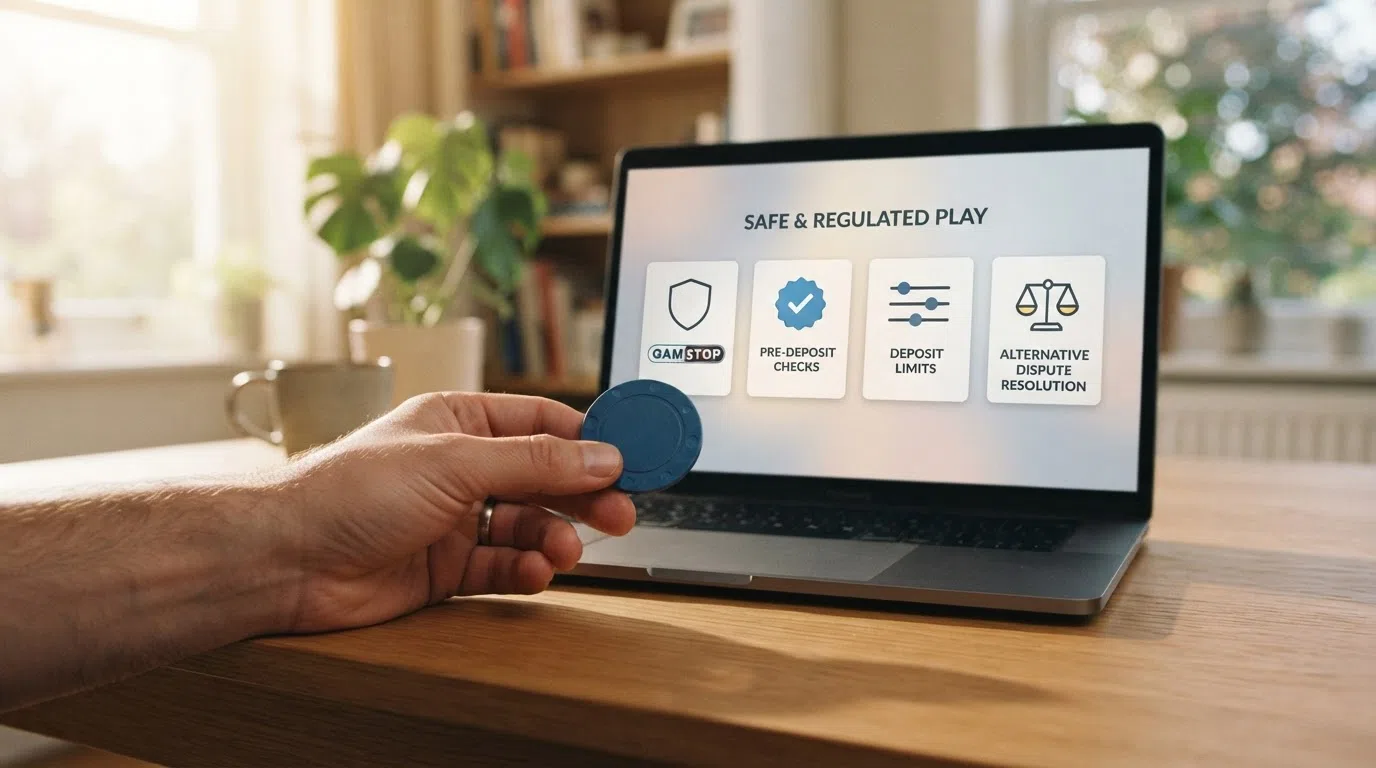
The credit-card ban under LCCP licence condition 6.1.2, in force from 14 April 2020, is the rule that pushed bank-based payments into the default position in the UK cashier. The ban covers remote betting, casino and bingo, and stretches to credit-card-funded e-wallets and money service businesses, which closed the standard workarounds. The Commission’s published rationale for the ban cited a figure of 22% of online gamblers who used credit cards being classed as problem gamblers. Whatever the reader thinks of that statistic, the effect on the cashier is what matters here: bank deposits are no longer one option among many. They are the option.
The deposit-limit rules sit on top. From 31 October 2025 every UK-licensed operator must prompt the player to set a financial limit before the first deposit, with decreases taking effect immediately. From 30 September 2026 the term “deposit limit” is standardised to mean a gross deposit limit based on amounts paid into the account, and the Commission’s RTS 12B requirements come into effect. The model is not a nationwide ceiling on deposits. The model is a player-set limit that the operator must offer and the player must engage with, on pain of the operator’s licence.
| Regulatory Requirement | Effective Date | What It Mandates or Caps | Applies To |
|---|---|---|---|
| Credit-card ban for gambling (LCCP 6.1.2) | 14 April 2020 | Prohibits accepting credit cards and credit-card-funded e-wallets for gambling | All UK-licensed operators |
| Pre-deposit identity verification | 7 May 2019 | Verifies name, address and date of birth before any deposit or gamble | All UK-licensed remote operators |
| Online slots stake cap (£5 per game cycle, ages 25+) | 9 April 2025 | Caps slot stake at £5 per game cycle for players aged 25 and over | All UK-licensed online slots |
| Online slots stake cap (£2 per game cycle, ages 18–24) | 21 May 2025 | Caps slot stake at £2 per game cycle for players aged 18 to 24 | All UK-licensed online slots |
| Deposit-limit prompt (financial limit before first deposit) | 31 October 2025 | Requires operator to offer a financial limit before the first deposit, with immediate decreases | All UK-licensed operators |
| Gross deposit limit standard (RTS 12B) | 30 September 2026 | Standardises “deposit limit” to a gross deposit limit based on deposits over a set period | All UK-licensed operators |
| GAMSTOP multi-operator self-exclusion | 31 March 2020 | Requires all remote licence-holders to be part of GAMSTOP | All UK-licensed remote operators |
| Financial vulnerability checks (LCCP SR Code 3.4.4, £150 net deposit in 30 days) | 28 February 2025 | Light-touch checks using publicly available financial data at the threshold | All UK-licensed operators |
| Bonus wagering cap (10x) and mixed-product promo ban (LCCP SR 5.1.1) | 19 December 2025 | Caps wagering requirements at 10x; bans mixed-product promotional offers | All UK-licensed operators |
| Remote Gaming Duty rate | 1 April 2026 | Operator-side tax on gross gaming yield at 40% (up from 21%) | All UK-licensed remote operators |
A UKGC licence guarantees a player a complaint route that an offshore casino cannot match. The Commission’sADR framework, GAMSTOP coverage and the operator’s own safer-gambling tools are part of the package, and a player who chooses an unlicensed offshore casino forfeits all of them. The reason to choose a UK-licensed banking casino over an offshore one is not brand preference or bonus size. It is the regulatory framework, and the framework is enforced.
GamStop, Pre-Deposit Verification and Why You Cannot Skip KYC at a UK Banking Casino
Pre-deposit verification is the rule that decides whether a player can fund an account at all. Since 7 May 2019 every UK-licensed remote operator must verify the player’s name, address and date of birth before any deposit or gamble, including bonuses and free bets. A player who fails the check cannot deposit. There is no workaround at a UK-licensed operator, and any operator that advertises “no verification” is operating outside the UKGC register and forfeiting the regulatory framework that goes with it.
GAMSTOP is the self-exclusion scheme that runs across every UK-licensed operator. Since 31 March 2020 every remote licence-holder has been part of GAMSTOP, and a player who self-excludes through GAMSTOP is excluded from every UK-licensed casino for the chosen period: 6 months, 1 year, 5 years, or 5 years with auto-renewal. The exclusion cannot be cancelled early. A casino marketed as “not on GamStop” is operating outside UKGC protection, and a player who self-excluded through GAMSTOP and then opens an account at one of those casinos has stepped outside the framework that the exclusion was designed to operate in.
Casinos marketed as “no verification” or “not on GamStop” sit outside UKGC protection. The player loses the deposit-limit prompt, the GAMSTOP coverage, the ADR route, the source-of-funds obligation, and the credit-card ban. The marketing of speed and ease is the marketing word, and the speed is real, but the protection is gone. The reader who wants a frictionless first deposit is being sold the absence of the friction that exists for a reason.
Financial vulnerability checks are the last layer. From 28 February 2025 LCCP Social Responsibility Code 3.4.4 requires light-touch checks using publicly available financial data at a £150 net-deposit threshold in a rolling 30-day period. The check is not a credit check. The operator uses publicly available data to flag patterns that suggest financial harm, and intervenes when the pattern shows up. The threshold is the trigger, not a cap.
Staying in Control: The Safer-Gambling Tools Every UK Banking Casino Must Offer
UK-licensed casinos carry a mandatory set of safer-gambling tools, and the tools are the same across the market because the rules are the same. A player moving from one UKGC-licensed operator to another will find the same deposit-limit prompt, the same reality checks, the same time-out option and the same GAMSTOP coverage. The implementation differs at the edges, and a few operators add their own layers on top, but the floor is the same.
GAMSTOP sits above the operator-level tools. A player who self-excludes through GAMSTOP is excluded from every UK-licensed operator for the chosen period, and a single registration covers the whole market. The exclusion periods are 6 months, 1 year, 5 years, or 5 years with auto-renewal, and the exclusion cannot be undone early. A player who has self-excluded and is tempted to reopen should not be looking for an offshore casino; the offshore route removes every protection that the exclusion was designed to operate in.
The help infrastructure below the operator-level tools is the same across the UK. GamCare runs the National Gambling Helpline on 0808 8020 133, with free access by call, online chat and WhatsApp, 24 hours a day. The same line routes players to blocking tools for gambling websites and apps. GamCare’s 2026 data shows that online gambling was cited in 81.5% of contacts to the helpline, the highest proportion in five years, while in-person gambling fell to 36%, the lowest since 2021. The trend line is the point: online gambling’s share of harm-related contact is rising, and the help infrastructure is sized for that rise. GambleAware provides information and signposting to treatment, and the NHS operates regional gambling harm clinics that take referrals from GamCare and from GPs.
Deposit Limits, Reality Checks and Time-Outs: The Controls Built Into Every UKGC Casino
The deposit-limit prompt is the first safer-gambling tool the player meets at a UK-licensed casino, because it is the first thing the operator has to offer before the first deposit. From 31 October 2025 the prompt must be a real offer of a financial limit, with a decrease taking effect immediately and a review path the player can return to. A player who does not want to set a limit at the prompt still has to engage with the offer, and the operator’s record of the engagement is auditable.
Reality checks are the on-screen session-duration alerts that the operator must display during play. The 31 October 2021 game-design controls require the operator to show session wins, losses and time played on a regular basis, and the reality check is the visible prompt that summarises those numbers. The auto-play ban sits alongside the reality check: slots at UK-licensed casinos no longer run on autoplay, and a 2.5-second minimum spin speed means the player has time to read the reality check between spins.
Time-outs and self-exclusion are the short-break and long-break tools at the operator level. A time-out is a short break from the operator, usually 24 hours to 6 weeks, that the player can set themselves. A self-exclusion is a longer break, usually 6 months to 5 years, that the operator must enforce and that is recorded in the operator’s records. GAMSTOP is the multi-operator version of self-exclusion, and the two systems run in parallel: a player who self-excludes through GAMSTOP is excluded from every UK-licensed operator, while a player who self-excludes at a single operator is excluded only from that operator.
The session P&L display is the last of the in-session controls. The operator must show the player how much they have won and lost during the current session, and how long the session has been running. The display updates as the session progresses, and the reality check summarises it at intervals. None of this is new. The 31 October 2021 game-design controls have been in force for years, and the technology behind them is standard across the market.
Where to Get Help: GamCare, GAMSTOP and the NHS Gambling Clinic Network
The National Gambling Helpline, run by GamCare, is the single point of entry for UK players who want help. The number is 0808 8020 133, free to call, with online chat and WhatsApp access, 24 hours a day. The same line routes players to blocking tools for gambling websites and apps, and to longer-term treatment through the NHS gambling harm clinic network. The helpline is confidential and is not a reporting line: a player who calls does not trigger a regulatory action against the operator.
GAMSTOP is the multi-operator self-exclusion scheme. Registration is free, online, and takes a few minutes; the player chooses a 6-month, 1-year, 5-year, or 5-year-with-auto-renewal exclusion, and the exclusion applies to every UK-licensed operator from the moment the registration is processed. The exclusion cannot be cancelled early. A player who self-excludes and then tries to open a new account at a UK-licensed casino will be blocked at the verification stage.
GambleAware is the information and signposting service. The website provides self-help tools, treatment directories and guidance for family members. The service does not run treatment directly, but it routes players to GamCare, the NHS clinics and the Gordon Moody Association, which runs residential treatment for severe gambling harm.
The NHS gambling harm clinic network is the regional specialist treatment service. There are clinics across England, with regional hubs that accept referrals from GPs, from GamCare and from self-referral. The clinics provide cognitive-behavioural therapy and longer-term treatment, and the waiting time at most clinics is measured in weeks rather than months. A player who reaches the threshold of needing clinical help can usually access it without paying, because the NHS funding model covers the service.
How We Selected and Ranked the Best UK Casinos for Direct Banking
The ten operators in this ranking were selected for the breadth of their bank-based payment coverage and the clarity of their UK Gambling Commission licence status. The selection starts from the UK online casino market and narrows to operators whose cashier is documented, in the operator’s own help pages or in commercial bank-transfer comparison lists, as accepting bank-based payments. The ranking rewards three things in this order: the breadth of bank-based payment methods supported, the speed of deposits and withdrawals on those methods, and the transparency of the operator’s UKGC licence status. The ranking does not reward game-library size, brand age or any non-banking payment method.
The sources consulted are the UK Gambling Commission’s public register for licence status, the operator’s own cashier and help pages for banking-method coverage, and commercial bank-transfer comparison lists for the wider set of UK-licensed operators that take bank-based deposits. The Ladbrokes register listing was captured this run and shows a Casino Remote licence active from 1 November 2014; the bet365 register search shows the Hillside entities as licensed, although the activity-date rows were not captured this run; the other operators’ specific register activity dates were not captured this run and should be confirmed on the UKGC register before any licence-specific claim is published.
The welcome-offer terms captured in this ranking are the terms that were sourced this run. bet365’s up-to-500 free spins offer, with no wagering, a £10 minimum deposit, a 30-day claim window and a 7-day validity per selection, is the strongest-documented offer in the set. Ladbrokes’ 100 free spins plus 300 LadBucks offer, with a 10x wagering multiplier, a £10 deposit and stake, a 48-hour acceptance window and 7 days to use, is the second. Coral’s 100 free spins offer, with a £10 deposit and stake, carries mixed evidence on the wagering, and the operator’s own T&Cs should be checked before any specific figure is relied on.
The ranking does not cover game-library size, brand age, non-banking payment methods, live-dealer depth, mobile-app quality, customer-service response times or any other feature that a player might rank for. A player who ranks by game library would reach a different top ten, and a player who ranks by mobile-app quality would reach a different top ten again. The page is a banking-focused ranking, and it ranks on banking.
Should You Use Bank Transfer at a UK Online Casino? The Honest Answer
Bank transfer at a UK online casino is the default and not the fallback. The 2020 credit-card ban pushed bank-based payments into the central position in the UK cashier, and Open Banking has closed the speed gap with e-wallets on the deposit side and on the withdrawal side at the operators that have integrated the rail well. The slow end of the spectrum — direct bank transfer through BACS — still has a place, especially for high-balance withdrawals where the per-transaction ceiling of Faster Payments is the constraint. The reader who wants speed wants Open Banking or an instant bank transfer. The reader who wants a high ceiling wants the slower rail.
The safety verdict is simpler. A UKGC-licensed banking casino carries the full regulatory framework: pre-deposit verification, the credit-card ban, the deposit-limit prompt, the gross-deposit-limit standard from 30 September 2026, GAMSTOP coverage, ADR access, and the safer-gambling tools. An offshore “no verification” or “not on GamStop” casino forfeits every one of those. The reader who wants frictionless sign-up is being sold the absence of the friction that exists for a reason, and the absence is the cost.
The bonus verdict is that bank deposits qualify for welcome offers at most of the featured operators, with the standard exclusions being e-wallets and prepaid cards. The bet365 offer’s headline is “up to 500 free spins”, with no wagering and a £10 minimum; the realised value depends on the random daily reveal and is usually well below the headline. The Ladbrokes offer is 100 free spins plus 300 LadBucks at 10x wagering, with a £10 deposit and stake. The Coral offer is 100 free spins, with mixed evidence on the wagering. The offers for William Hill, Sky Casino, Paddy Power, Betfred, Betfair, BetMGM and Betway were not captured this run and should be checked on the operator’s cashier before any specific term is relied on.
The one action to take before depositing is to check the operator on the UK Gambling Commission’s public register and read the payment-method terms on the cashier page. The register confirms the licence is active; the cashier page confirms the payment method the player wants to use is on the list and that the welcome offer’s deposit-method exclusions do not include it. Both checks take a few minutes, and both checks are the difference between a deposit that lands and a deposit that bounces, and between a bonus that clears and a bonus that does not.
The house always has an edge, and bank-based payment rails do not change the arithmetic. The slots at UK-licensed casinos carry a statutory maximum stake of £5 per game cycle for players aged 25 and over, and £2 per game cycle for players aged 18 to 24, under the Gambling Act 2005 (Operating Licence Conditions) (Amendment) Regulations 2025. A 100-spin session at the £5 stake on a slot with a 96.09% RTP — Starburst is the reference figure carried in the research — has an expected loss of 100 × £5 × (1 − 0.9609) = £19.55, and the same session at the £2 stake on a slot with a 96.71% RTP has an expected loss of 100 × £2 × (1 − 0.9671) = £6.58. The numbers are the average over many spins and many sessions, not a guarantee of any single outcome, and the player’s actual result will fall on either side of them.
Frequently Asked Questions
How do I deposit and withdraw at UK casinos using bank transfer or Open Banking?
To deposit by Open Banking, open the casino cashier, choose the Open Banking or Pay by Bank option, select your bank, authenticate in your banking app with Face ID or fingerprint, and the deposit confirms within seconds. To withdraw, choose the same option on the withdrawal screen and the operator pushes the funds to your linked bank account, usually within minutes once the operator’s pending period has cleared. To deposit by direct bank transfer, ask the cashier for the operator’s bank details, send the payment from your banking app with the reference provided, and the deposit arrives the same day via Faster Payments or in one to three working days via BACS.
Which UK banks support Open Banking gambling deposits and are bank-side gambling blocks applied to Pay by Bank?
Open Banking coverage at UK banks is wide but not universal. The major high-street banks — Barclays, HSBC, Lloyds, NatWest and Santander — all support Open Banking payments, and most UK challenger banks do too. A handful of UK banks extend their card-level gambling blocks to Open Banking transactions routed through their apps, which means a player with a bank block enabled will see the deposit fail at the authentication step. Direct bank transfers through Faster Payments are harder for a bank to block automatically because the bank does not know what the payment is for, and that rail is sometimes the route that survives a bank block.
How fast are withdrawals from UK casinos via Open Banking or bank transfer compared with debit card or e-wallets?
Open Banking withdrawals on a strong integration land within minutes of the operator releasing the funds, with the operator’s pending period as the main variable. Betfair’s help page describes the rail as enabling instant withdrawal once the bank account is linked. Direct bank transfer withdrawals take one to three working days via BACS for larger amounts, with Faster Payments applying to smaller amounts and settling the same day. Debit card withdrawals at UK operators now usually clear the same day through Faster Payments, after the Gambling Commission’s push-payment reforms. E-wallet withdrawals usually confirm within hours, but the player then has to withdraw from the e-wallet to a bank, which adds a Faster Payments or BACS window on top.
Are bank transfer casinos safe and how does UKGC licensing, verification and fraud prevention affect bank-based payments?
A UKGC-licensed bank transfer casino carries the full regulatory framework: pre-deposit verification since 7 May 2019, the credit-card ban since 14 April 2020, GAMSTOP coverage since 31 March 2020, the deposit-limit prompt since 31 October 2025 and the gross-deposit-limit standard from 30 September 2026. The Open Banking rail adds Strong Customer Authentication under PSD2, with biometric confirmation in the player’s own banking app and no casino-side password. A direct bank transfer relies on the player’s banking app and Faster Payments’ own confirmation rules. An offshore “no verification” or “not on GamStop” casino forfeits every one of those protections, and the marketing of frictionless sign-up is the marketing of the absence of the friction that exists for a reason.
Do bank transfer deposits qualify for UK casino welcome bonuses and what deposit requirements must be met to trigger offers?
At most featured operators bank deposits qualify for welcome offers, with the standard exclusions being e-wallets and prepaid cards. The trigger is almost always a £10 minimum deposit and stake on qualifying slots, and the offer usually has a 48-hour acceptance window once the qualifying deposit and stake are settled. The bet365 offer’s £10 minimum and 30-day claim window, the Ladbrokes offer’s £10 deposit and stake and 48-hour acceptance, and the Coral offer’s £10 deposit and stake and 48-hour acceptance, all sit on the same £10 trigger. E-wallet and Paysafecard deposits are the standard exclusions; bank transfer and debit card deposits are the standard qualifiers.
What are the minimum and maximum deposit and withdrawal limits for bank transfer at UK casinos and how do they vary by operator?
The minimum deposit at UK-licensed casinos is almost always £10, and the minimum is also the threshold most welcome offers require to qualify. The maximum varies by operator, by payment method and by the player’s own deposit limit, which the operator must offer the player before the first deposit. Open Banking and instant bank transfer withdrawals usually split across the Faster Payments per-transaction ceiling, which is why very large balances are sometimes paid out through BACS. The 30 September 2026 gross-deposit-limit standard applies to all UK-licensed operators, and a player-set limit binds across every payment method on the account.
Payments – trustedcasinos-notongamstop
Content created by the «trustedcasinos-notongamstop» team