
The UK Slots Payout Percentage Guide: What RTP Actually Pays in 2026
 Available in GB
The “best online slots payout percentage” is the figure a UK player most often quotes and least often understands. Slots on British-licensed sites typically return somewhere between 94% and 97% of every pound staked, with most clustered around 96% — a 4% house edge dressed up as a “return to player” number that sounds friendlier than it is. The standing expectation in 2026 is being quietly rewritten. Remote Gaming Duty jumped from 21% to 40% on 1 April 2026, and the average deployed RTP across the UK market has slipped roughly 0.4 to 0.6 percentage points since January as operators move slot configurations down a tier to absorb the tax. The advertised 96% on a developer’s page is not always the 96% the player gets at the cashier.

This page works through what payout percentage actually measures, which titles genuinely sit above 98%, how the post-RGD slide is reshaping the numbers, and ten GB-licensed casinos where the catalogue and the terms let an informed player keep more of the theoretical return. The figures were checked against the UK Gambling Commission’s public licence register (last refreshed 29 July 2026) and the published RTP data on each operator’s site.
Current as of September 9, 2026; verified against the UK Gambling Commission’s public licence register and the operator terms published on each casino’s own help pages.
The 96% Promise: Decoding What a Slot RTP Actually Tells You
Return to player is the long-run average of money returned as winnings divided by money staked, expressed as a percentage. A 96% RTP slot pays back £96 of every £100 wagered across the full life of the game, with the remaining £4 kept by the house. The figure is calculated by the developer’s maths model and verified by an approved test house before a slot can be offered to British players.
Three things follow from that definition, and each one matters more than the headline number. First, the RTP is measured over an enormous number of game plays — generally 10,000 or more, and considerably more for random machines where outcomes aren’t compensated by the design. A session of a few hundred spins is a rounding error against that base, which is why a player can “win” £400 on a 96% slot in an evening and still be inside the math. Helen Walton, co-founder of G Games, put the underlying mechanism bluntly: “RTP is absolute — if you reduce it from 96% to 94%, that is exactly the same as putting up the price by about 50%.” The return is not a promise to any individual session; it is the wholesale price of the entertainment across millions of spins.
Second, the UK Gambling Commission requires the %RTP to be shown on a help screen or in some other in-game area on every slot machine offered in Great Britain. The number printed on the game’s information page is the one that applies at the table the player is sitting at, not a marketing figure. The game is also certified in a specific configuration, and the live in-game screen is the authoritative record of which configuration has actually been deployed.
Third, the same slot title can be certified in more than one RTP configuration. A developer might supply a title at 96%, 94% and 92% and let the operator choose which one to run. The figure on the developer’s catalogue page is the headline; the figure on the help screen of the game the player has just loaded is the real one. Treating those as the same number is the most common error in slot comparison shopping, and the source of the bulk of “the RTP I read about isn’t what I’m getting” complaints.
The UK RTP Landscape in 2026 — Benchmarks and What Changed
The practical band for UK online slots runs from about 94% to 97%, with most titles clustered around 96%. That translates to a house edge of roughly 3% to 6%, with 4% the working figure for a “standard” 96% slot. Outside that band, the floor is set by eCOGRA’s eGAP framework, which demands a minimum theoretical return of 90%; the ceiling is held down by market pressure rather than regulation, since nothing in the UK rulebook prevents a 98% or 99% deployment.
The Autumn Budget 2025 announced that Remote Gaming Duty would double from 21% to 40% with effect from 1 April 2026. The levy lands on gross gaming yield, not stake, but it raised operator costs sharply enough to change the deployment math on slot catalogues. By mid-2026, the aggregate deployed RTP across UK-facing operators had slipped roughly 0.4 to 0.6 percentage points since the start of the year, with the decline accelerating in April as the new rate took effect. The published theoretical maximums on most main-tier configurations have not changed; the operators are simply choosing to run the lower configurations more often.
The economics of that slide are stark. A 96% RTP slot returns £96 per £100 wagered and keeps £4. A 94% slot returns £94 and keeps £6. The 2-percentage-point shift raises the operator’s gross margin per £100 from £4 to £6 — a 50% increase on the same turnover. That is the size of the lever operators are now pulling at the configuration screen. The Independent’s most recent operator payout ranking put Betway at 97.30% — the highest published operator-level average in the featured set — and most other UK brands do not publish a single aggregate figure at all. Across the rest of the market, the average UK deployed RTP now sits around 94.50%, a house edge of about 5.50%. Compared to the 96.00% theoretical average still printed on most main-tier configurations, the difference is roughly £1.50 in extra house take for every £100 wagered. Not every operator has moved. Bet365 and PlayOJO are noted as having largely maintained higher-tier deployments through the second quarter of 2026, and a few others held their ground on flagship titles.
For the player, the slide is invisible unless they check. Two different UK casinos can run the same slot at different RTPs, and the only place that confirms which is which is the help screen of the game that is already loaded.
The Highest-RTP Slots You Can Actually Play in the UK
| Slot Title | Provider | RTP | Volatility |
|---|---|---|---|
| Ugga Bugga | Playtech | 99.07% | — |
| Book of 99 | Relax Gaming | 99.00% | — |
| Mega Joker | NetEnt | 99.00% | — |
| 1429 Uncharted Seas | Thunderkick | 98.60% | — |
| Blood Suckers | NetEnt | 98.00% | — |
| Starmania | NextGen / SG Digital | 97.87% | Low |
Ugga Bugga sits at the top of the UK list at 99.07% — published by Playtech, unusual in that it uses a multi-spin structure in which the player holds symbols across rows rather than spinning fresh reels each round. Book of 99, from Relax Gaming, is the more conventional 5-reel Book-style game at 99.00% with a maximum win of 12,075x. Mega Joker from NetEnt also publishes at 99.00%, but only at maximum stake and in supermeter mode; the headline figure does not apply to lower bets, and that single mechanical detail disqualifies it for anyone not playing at the top stake. Thunderkick’s 1429 Uncharted Seas rounds out the 98% tier at 98.60%. NetEnt’s Blood Suckers is the unusual case in this group: it is fixed at 98.00%, which means there is no variable-tier question to settle. The figure has been verified at Ladbrokes among other UK sites.
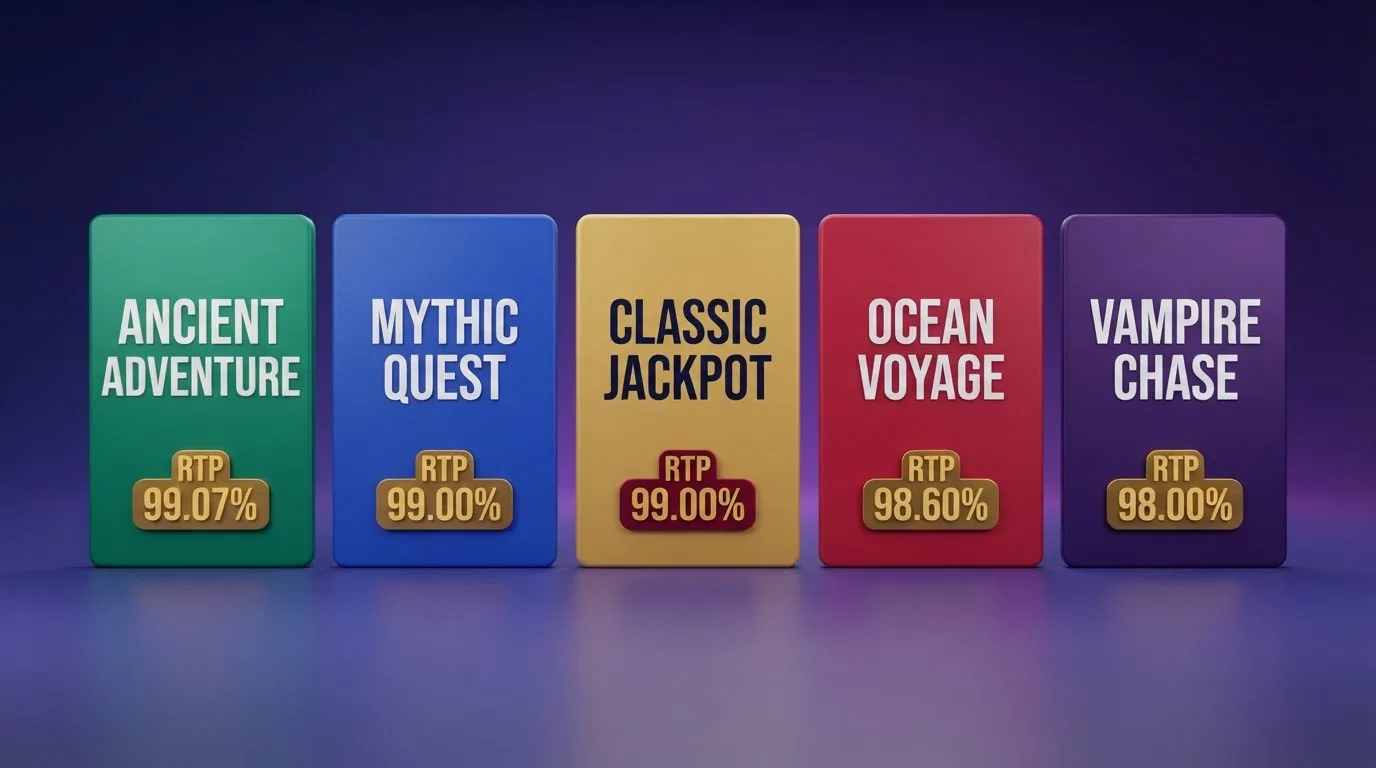
Starmania is the standout title one tier below, at 97.87% with low volatility, a 5×3 grid and 10 paylines, with a 1,000x maximum win. It is one of very few low-volatility slots that consistently clears the 97.5% bar across major UK operators, and for a player whose bankroll would not survive the variance of Ugga Bugga or Book of 99, it is the highest-RTP slot on the market that will not punish them for picking it.
Everything below the 97% line is the long tail, and the gap between the leaderboard and the average is wider than it looks. A player who picks Ugga Bugga at 99.07% over a 94% deployment of a similar theme is keeping roughly £5 of every £100 that would otherwise leave with the house. The high-RTP end of the catalogue is where the math stops being theoretical.
The Numbers Behind the Number: House Edge, Variance and What They Cost You
House edge is the mathematical inverse of RTP and the cleanest way to think about what a slot actually costs. A 96% RTP slot has a 4% house edge; a 94% slot has a 6% house edge; the average UK slot in 2026, at about 94.50% deployed, has a 5.50% house edge. Over a session of £500 in total stakes, that 1.5-point gap between a 96% theoretical slot and the current market average works out to £7.50 in additional house take. The price is fixed per unit of turnover, irrespective of how the session ends.
Volatility is a different lever and the one most players underweight. Two slots at 97% RTP can behave wildly differently in a single evening. A low-volatility title returns small wins frequently, slowly bleeding the edge across many small payouts; a high-volatility title concentrates the return into rare large hits, and a player can sit through hundreds of dead spins waiting for them. The long-run RTP is the same, but the experience of playing it is not. Starmania at 97.87% with low volatility is the textbook case: a player will see wins often enough to keep playing, and the bankroll is unlikely to evaporate before the math catches up. A high-RTP, high-volatility slot can drain a £100 bankroll in twenty minutes of dead spins and still be returning 97% over its full lifetime.
Hit frequency — the share of spins that produce any win at all — and hold percentage — the operator’s net share of turnover over a defined period — are the companion metrics that complete the picture. Most UK players never look at them because they are not printed on the help screen, but they explain why two 96% slots can feel like different games. The standard advice is to match volatility to bankroll. A short session with a small bankroll is better served by a low-volatility slot at 97% than a high-volatility slot at 98%, because the high-volatility title will not give the bankroll enough spins to realise its theoretical return.
Why Online Slots Usually Beat the Pub Fruit Machine
UK online slots cluster around the 94% to 97% band. Land-based slot machines — the Category B, C and D machines in pubs, arcades and betting shops — sit in a much tighter and lower band, capped by both regulation and the economics of running a physical cabinet. The gap is large enough to show up in cost-per-hour at equivalent stakes, and it is one of the quieter reasons the regulated online market continues to grow even with the duty changes.
The reasons are structural rather than generous. Online operators have lower fixed costs per player than a high-street arcade, the catalogue is essentially unlimited, and competitive pressure keeps the theoretical return higher than a venue with captive footfall. Land-based venues also have to clear the cost of the machine, the lease, the staff and the floor space from each spin. The RGD doubling has shifted the online math, but it has not closed the gap with the cabinets.
A direct percentage comparison is harder than it looks, because the UK Category machine RTPs are governed by separate technical standards from the online RTS, and the headline figures are quoted in different ranges. The practical point holds either way: at the same nominal stake, a player will keep more of their money online than in almost any UK pub or arcade machine. The argument is qualitative on the land-based side, because the specific ceiling differs by machine category and venue, but the direction is not in doubt.
When the Number on the Screen Isn’t What You Get
The same slot title can be certified in more than one RTP configuration, and the operator chooses which one to run. A 96% slot at one UK casino can be a 94% slot at another, and the only way the player can tell is to load the game and read the help screen. The figure on the developer’s product page is the headline; the figure on the live game’s information screen is the one being charged.
The UK Gambling Commission requires, under Remote Technical Standard 3, that operators make information available that enables an informed decision — including the %RTP — and that the figure be shown in-game. The Commission does not approve games directly; it requires operators to get every game tested by an approved test house and to submit the test report before release. Approved test houses include Gaming Laboratories International (G.L.I. UK Gaming Limited) and eCOGRA Limited, with Gaming Associates Europe Ltd and others on the register. eCOGRA’s eGAP framework sets a minimum theoretical RTP of 90% and demands regular payout reviews; the UKGC’s own testing strategy requires verification of game design, maths, artwork, theoretical RTP and simulated actual RTP.
The variable-tier system is the gap between “certified” and “live”. A title that publishes at 96% on the developer’s page might also be certified at 94% and 92%, and the operator selects the version it deploys. After the April 2026 RGD increase, several operators moved deployments down a tier to absorb the duty; the help-screen figure at the same casino may now read lower than the figure the player saw on a comparison site six months ago. The Regulatory Technical Standard’s display requirement is the player’s protection: it makes the deployed number visible, every time, on every game.
The post-RGD shift makes that visibility more important than it was. A player who reads a comparison site in January and then plays the same game in May may be playing a different configuration, and a few minutes on the help screen is the only way to know which one.
UK Online Casinos for High-RTP Slot Play — Compared
| Operator | GB Licence | Welcome Offer | Free Spins | Wagering on Free Spins | Bonus Validity |
|---|---|---|---|---|---|
| Sky Vegas | GB-licensed (Flutter) | 70 no-deposit FS + 200 FS on £10 deposit-and-spend | 270 | 0× | 7 days |
| Betway | GB-licensed (Betway Limited) | 100% up to £50 deposit match | — | 50× | 30 days |
| 32Red | GB-licensed (Kindred) | Play £30 get 320 FS on Big Bass Splash | 320 | 10× | 48h spins / 7d claim |
| 888 Casino | GB-licensed (evoke, 39028) | 100% up to £100 + 100 FS | 100 | 10× | 90 days |
| Virgin Games | GB-licensed (Gamesys / Bally’s) | 100 FS (£0.10) or £50 bingo tickets | 100 | 0× | 30 days |
| JackpotJoy | GB-licensed (Gamesys / Bally’s) | £10 deposit-and-wager for 30 FS | 30 | 0× | 30 days |
| Betfair | GB-licensed (Flutter) | 50 no-deposit FS + 100 FS on £10 deposit-and-spend | 150 | 0× | — |
| Coral | GB-licensed (Entain) | Bet £10 Get 100 FS | 100 | 10× | — |
| Ladbrokes | GB-licensed (Entain) | Bet £10 Get 100 FS | 100 | 10× | — |
| Betfred | GB-licensed (Petfre Gibraltar) | £10 stake for 200/100/50 FS at £0.05/£0.10/£0.20 | Up to 200 | 0× | 7d spins / 14d claim |
The wagering ceiling sits at 10× under LCCP Social Responsibility Code 5.1.1, in force since 19 December 2025 — which is why no offer in the featured set exceeds that multiple. The 50× figure at Betway is therefore conspicuous: it is the legacy terms carried on the deposit-match portion of the welcome package rather than the free-spins portion, and it is the heaviest burden on the list by a wide margin.
Casino Payout Percentage vs Individual Slot RTP — What the Numbers Actually Measure
A casino-level payout percentage is the average of every game on the operator’s floor, weighted by how much money players staked on each one. It is a useful number for the operator and a misleading one for the player, because the average masks per-title variance. A casino with a 97% overall payout might run its most popular slots at 94% and its high-RTP niche titles at 99%; the player who only ever plays the popular slots is paying the edge on those, not the headline 97%.
The Independent publishes a monthly operator payout ranking. Betway’s 97.30% sits at the top of the featured set, and the methodology is described in the published footnote. Most UK operators do not publish a single aggregate figure at all, and that silence is itself a signal — the operators that publish are usually confident the figure will not embarrass them. The deeper point is that the operator’s average is the wrong question for a player choosing a slot. The right question is the RTP of the specific game about to be loaded, read from the help screen.
Sky Vegas
Sky Vegas runs 70 genuinely no-deposit free spins plus 200 more on a £10 deposit-and-spend, all at 0× wagering and £0.10 per spin, valid for seven days from credit. The headline leg is the deposit-free 70: a player who registers an account and verifies it can load a game and start playing without touching a payment method, and anything won is paid as cash. The 200-spin follow-on is the larger number but it is gated on a £10 deposit and £10 spend.
The catalogue covers the providers that own the high-RTP end of the market: NetEnt (Blood Suckers, Mega Joker), Playtech (Ugga Bugga), Pragmatic Play, Blueprint, Red Tiger, Big Time Gaming and Relax Gaming (Book of 99). That mix puts most of the titles above 98% in reach on a single site, and the wagering-free structure means a high-RTP slot session is not being taxed by bonus terms. The 7-day spin validity is the tightest constraint on the list, so a player who does not intend to use the spins immediately should set a calendar note the day they register.
For a player whose first question is “which deposit-free spins on a high-RTP slot can I take right now”, Sky Vegas is the cleanest answer in the featured set.
Betway
Betway is the operator with the highest published average payout in the featured group — 97.30% in The Independent’s operator ranking — and the catalogue leans on Microgaming, NetEnt, Pragmatic Play, Evolution and Play’n GO, which covers most of the slots that have ever mattered to a UK high-RTP shopper. The headline offer is a 100% deposit match up to £50, and it carries 50× wagering on the bonus with a 30-day validity. That is the legacy multiple; the 10× UK ceiling covers free-spin winnings, not matched-deposit bonus funds, which is why the term survives.
The 50× multiple is the price. A £50 bonus requires £2,500 in slot turnover before withdrawal, and at an average 94.50% deployed RTP that is roughly £137.50 of expected house take on the way to clearing it. For a player who would rather keep their edge and play with their own money, the welcome offer is not the reason to choose Betway. The reason to choose Betway is the catalogue and the 97.30% average.
For a player who plays high-RTP slots for the long-run return and treats the welcome offer as incidental, Betway is the strongest single-site answer in the featured set.
32Red
32Red runs a play-£30-get-320-free-spins structure on Big Bass Splash at £0.10 per spin — a £32 total spin value, with 10× wagering on winnings. The spin expiry is 48 hours from claim and the claim window is 7 days from registration, so the offer rewards quick play. The qualifying spend is high relative to the spin value, and the bonus slot is fixed, which means a player who wanted to spend their play-time on Book of 99 or Ugga Bugga is being directed at a specific title.
The Kindred group catalogue behind the offer includes Microgaming, NetEnt, Pragmatic Play, Evolution and Red Tiger, so the high-RTP titles are reachable once the welcome spins are used. The payment-method restriction to debit card or instant bank transfer is consistent with the broader UK credit-card deposit ban and is not an unusual constraint. The 10× wagering sits at the regulatory ceiling rather than below it, so any winnings from the 320 spins are cleared after a 10× playthrough of the bonus amount.
For a player who likes Big Bass Splash specifically and wants a high volume of spins at the maximum wagering ceiling, 32Red is the offer on the list. For anyone whose preferred title is not in the Big Bass Splash family, the offer is harder to use well.
888 Casino
888 runs a 100% deposit match up to £100 with 100 free spins and 10× wagering, valid for 90 days from credit. The 90-day window is the longest bonus validity in the featured set, which is the structural advantage: a player who is using the offer as a slow-burn bankroll top-up rather than a quick-hit welcome bonus can spread turnover across three months.
The £100 maximum cashout is the offsetting constraint. Any bonus-derived winnings above £100 are forfeited on withdrawal, regardless of how high the cleared balance sits. A player who hits a 200x win on a high-volatility title during the bonus play will see most of it trimmed at the cashier. The licence sits with 888 UK Limited (evoke plc) under account 39028, and the Casino Remote licence has been active since 1 November 2014. The offer runs to 31 December 2026.
For a player who values a long validity window and can accept the £100 ceiling, 888 is the patient-money option. For a player whose strategy depends on letting big wins ride, the cashout cap makes the offer less useful than its headline number suggests.
Virgin Games
Virgin Games offers 100 free spins at £0.10 each or £50 in free bingo tickets — the player chooses — at 0× wagering. The qualifying requirement is a £10 deposit plus a £10 wager on slots, and the spin validity is 30 days. The Gamesys proprietary catalogue is the differentiator: titles like Double Bubble and the Gamesys-exclusive branded slots sit alongside NetEnt, Pragmatic Play, Evolution and IGT, and Virgin is one of the few UK brands where the proprietary titles are part of the core offering rather than a side catalogue.
The 0× wagering means winnings are paid as cash, and the absence of a cap is consistent with the wager-free structure. The choice of offer — spins or bingo tickets — is the design feature; a slots player should pick the spins, but the bingo-ticket alternative exists for a reason and points to a multi-product customer base.
For a player who values wager-free terms and wants access to the Gamesys catalogue, Virgin Games is the cleanest fit. For a player chasing the highest-RTP niche titles, the catalogue is broader than the high-RTP end.
JackpotJoy
JackpotJoy runs 30 free spins at 1p coin size on 10 lines — effectively £0.01 per spin and a £3 total spin value — at 0× wagering, in exchange for a £10 deposit and a £10 wager. The featured slots are Double Bubble and Fishin’ Frenzy The Big Catch 2, both Gamesys or Pragmatic house titles. The compact offer rewards a low-stakes player rather than a high-volume one.
The 30-day validity is generous given the small spin count, and the wager-free structure means whatever comes back from the spins is paid as cash. The Gamesys catalogue behind the offer is the same one Virgin Games runs, so a player comparing the two is choosing between a 100-spin offer and a 30-spin offer with the same provider mix.
For a low-stakes player who wants a low-commitment wager-free entry into the Gamesys catalogue, JackpotJoy is the right shape of offer. The headline numbers are smaller than the rest of the set by design, not by accident.
Betfair
Betfair runs 50 genuinely no-deposit free spins plus 100 more on a £10 deposit-and-spend, at 0× wagering and £0.10 per spin. The 50-spin no-deposit leg is the headline: like Sky Vegas, the spins are available without touching a payment method, and the winnings are paid as cash. The Flutter group catalogue covers NetEnt, Playtech, Pragmatic Play, Red Tiger, Blueprint and Evolution.
The 100-spin follow-on is the larger number but it carries the £10 deposit-and-spend gate, and the bonus validity is not specified in the published terms. The wager-free structure means the offer’s value is the spins themselves, not any subsequent playthrough. The Flutter catalogue is broadly the same mix as Sky Vegas, so a player choosing between the two is choosing between 70 no-deposit spins and 50 no-deposit spins plus a different brand wrapper.
For a player who wants a no-deposit wager-free entry and a Flutter-group catalogue, Betfair is a direct alternative to Sky Vegas with a smaller no-deposit leg.
Coral
Coral runs a Bet £10 Get 100 Free Spins welcome at 10× wagering on free-spin winnings, with no published maximum cashout. The Entain catalogue covers NetEnt, Playtech, Pragmatic Play, Blueprint, Red Tiger and Evolution, and the brand sits on LC International’s account 4712. The 10× wagering is at the regulatory ceiling, and the spin value is not specified in the published terms.
The absence of a no-deposit leg and the absence of a published operator-level RTP put Coral in the middle of the set: standard terms, broad catalogue, no headline differentiator. The brand familiarity is the soft factor, and the Entain catalogue is the substantive one. A player who already has a Coral account from the high street and wants the same wallet is well served; a player choosing on RTP transparency alone will find more informative options elsewhere.
For a player who values brand familiarity and the Entain catalogue, Coral is a competent standard. For a player ranking on no-deposit access or operator-level payout disclosure, the offer does not stand out.
Ladbrokes
Ladbrokes runs the same Bet £10 Get 100 Free Spins structure as Coral — 10× wagering on free-spin winnings, with no published maximum cashout. The Ladbrokes Betting & Gaming licence (account 1611, Casino Remote active from 1 November 2014) sits under Entain, and the catalogue covers NetEnt, Playtech, Pragmatic Play, Blueprint, Red Tiger and Evolution. The headline differentiator is specific: Blood Suckers, the fixed 98.00% NetEnt title, has been verified as available at Ladbrokes, which makes it one of the few operators where the high-RTP pick is confirmed on the floor rather than just on the developer’s page.
A player who has decided that Blood Suckers at 98.00% is the slot they want to play — fixed RTP, low volatility, no variable-tier question — will find it confirmed at Ladbrokes in a way they will not at most of the other featured operators.
For a player who wants a fixed-98% title confirmed on the casino floor, Ladbrokes is the verifiable pick. For a player comparing on welcome-offer generosity, the offer matches Coral and is best judged on the catalogue side.
Betfred
Betfred offers a choose-your-own-spins structure on a £10 stake: 200 spins at £0.05, 100 at £0.10, or 50 at £0.20, all at 0× wagering. The 7-day spin validity and 14-day claim window are tight, and the deposit must be by debit card. The catalogue covers NetEnt, Playtech, Pragmatic Play, Blueprint, Red Tiger and Evolution, with the Gamesys house titles absent.
The three-way choice is the structural feature. A player who values spin volume picks the £0.05 option and accepts the lower per-spin value; a player who values per-spin payout picks the £0.20 option and accepts the smaller count; the £0.10 middle is the default. The debit-card deposit restriction rules out e-wallets and paysafecard, which is a real constraint for players who do not use a card for gambling.
For a player who wants a wager-free offer with a configurable shape, Betfred is the only one of the ten offering the choice. For a player who prefers to deposit by e-wallet, the payment-method restriction disqualifies the offer.
UK Casinos That Publish Their Own Payout Rates — and What the Figures Mean
Most UK online casinos do not publish a single operator-wide payout figure. They publish per-game RTPs on the help screens, which is what the UKGC requires, and they leave the aggregation to third parties like The Independent and RTPTrack. The ones that do publish — Betway’s 97.30% in the latest Independent ranking is the standout in the featured set — are usually confident the figure will not embarrass them, and the choice to publish is itself a transparency signal.
The published number is a weighted average across every game, weighted by turnover. A 97.30% operator average can sit alongside individual slots deployed at 94%, because the average includes the high-RTP niche titles that carry less of the total stake. The number is honest at the level it claims to measure, and misleading if it is read as “the RTP of the slot I am about to load”. A player who treats the operator average as a guide to which casino has the highest-paying floor will end up reading it correctly; a player who treats it as a per-game guarantee will not.
The market average — about 94.50% deployed in 2026 — is the more useful benchmark for the question the player is actually asking. The gap between the best-published operator figure and the market average is large enough to matter at scale, and small enough to vanish against a single bad session.
How to Check a Slot’s Real RTP Before You Spin
The UKGC requires the %RTP to be available on every slot machine, on a help screen or other in-game area. The in-game information screen is the authoritative source, and it is the only source that confirms which RTP configuration the operator has actually deployed. The figure on the developer’s product page, the comparison site, the review or the slot’s promotional thumbnail can all be from a different configuration, or a different jurisdiction, or a different time.
The in-game help screen is reached through an “i”, a “?” or a menu icon inside the game window, usually on the top or bottom edge. It lists the %RTP alongside the paytable, the rules and the volatility rating. A player who has the help screen open before staking the first real-money spin is reading the same number the operator is using to price the game. That number is the one that decides what the slot costs them per £100.
The UKGC does not approve games directly. Every game offered in Great Britain must be tested by an approved test house — Gaming Laboratories International (G.L.I. UK Gaming Limited), eCOGRA Limited, Gaming Associates Europe Ltd and others on the register — and the test report must be submitted to the regulator before the game goes live. The test house reviews the maths, the game design, the artwork, the theoretical RTP and the simulated actual RTP. The test report is not a guarantee that the game is fair at any single moment, but it is the certification that the long-run return is what the published figure says it is.
Where UK Players Can Find a Slot’s Payout Percentage
Three places carry a slot’s RTP, and they can disagree. The in-game help or information screen is the authoritative record under RTS 3 — it is what the operator has deployed, and it is what the player is being charged against. The casino’s own game page or FAQ listing may carry a figure, and it usually agrees with the help screen because both come from the operator’s configuration, but it is secondary to the in-game record. Third-party databases, developer pages and review sites carry figures from the developer’s catalogue, and those figures can be from a different configuration or a different jurisdiction.
When the three disagree, the live help screen wins. When the casino page and the in-game help screen disagree — which happens when an operator has changed configurations without updating the catalogue page — the help screen is the source of truth, and the catalogue page is the bug. A player who treats the in-game help screen as the only figure that matters will not be surprised by a configuration change, and a player who treats any other source as primary will eventually be.
What to Do When the RTP Isn’t Where You Expect It
A missing or mismatched RTP almost always comes down to the variable-tier system. The slot is the same title the player read about, but the operator is running a different configuration than the one the comparison site listed. The fix is to load the help screen inside the game, read the figure there, and adjust expectations to that number rather than the headline.
If the help screen is not where it should be — the figure is missing, the screen does not load, the page is broken — that is a UKGC compliance issue rather than a player one. RTS 3 requires the information to be available, and a slot that does not surface it is failing the technical standard. A player who cannot find the RTP on a UK-licensed game should treat that as a reason to load a different title from the same provider, not as a reason to play blind.
The post-RGD shift makes this check more important than it was a year ago. A slot that was at 96% in January can be at 94% in May, and the comparison-site figure has not changed. Five seconds on the help screen is the only way to know.
What UK Regulation Actually Requires — and What It Doesn’t
The UK Gambling Commission mandates the rules of the road and the operator follows them or loses the licence. The headline rules for online slots: the %RTP must be displayed in-game; every game must be tested by an approved test house before release; the operator must monitor live RTP against theoretical values; the stake is capped by age band; the game-design features are constrained by the safer-gambling rules in RTS 14; wagering requirements are capped at 10×. None of those requirements are negotiable, and the regulator’s enforcement record on technical standards is consistent.
What the regulation does not do is set a minimum RTP for any individual slot, fix a UK-wide deposit or loss ceiling, require operators to publish an aggregate payout figure, or prevent an operator from running a 94% configuration of a slot that is also certified at 96%. The variable-tier system is legal and widespread. The market-average figure of about 94.50% deployed in 2026 is the result of operators choosing lower configurations within the rules they have been given.
The gap between “what the regulator requires” and “what the player gets” is real, and it is the gap the help-screen check exists to close.
How the UKGC Polices Slot RTP — Testing, Test Houses and What Gets Checked
The UKGC does not run a game-testing lab. It requires every operator to get each game tested by an approved test house, and the test report must be submitted before the game is offered to British players. Approved test houses include Gaming Laboratories International (G.L.I. UK Gaming Limited), eCOGRA Limited and Gaming Associates Europe Ltd, with the full list maintained on the UKGC’s public register.
The test report covers the game’s design, the maths model, the artwork and presentation, the theoretical RTP and a simulation of the actual RTP over a large number of game plays. eCOGRA’s Generally Accepted Practices framework sets a 90% floor on theoretical RTP across slots, video poker and table games, and requires payout-percentage reviews on a regular basis. The regulator’s expectation is that the operator monitors live performance against theoretical values, and that material deviations are explained.
The pipeline is pre-release certification, then ongoing monitoring, with the in-game RTP display as the player-facing record. The framework is robust against a dishonest operator; it does less against an operator who is honest about running the 94% configuration when the player expected the 96% one.
The Variable-RTP Tier System Most Players Don’t Know About
A slot is often available in multiple RTP configurations — often 96%, 94% and 92% on the same title — and the operator chooses which one to deploy. The choice is driven by economics: a 96% deployment keeps £4 of every £100 wagered; a 94% deployment keeps £6; a 92% deployment keeps £8. The headline RTP on the developer’s product page is the highest configuration, not the one the player is being offered.
The post-RGD shift from 96% to 94% configurations is the clearest recent example. A 2-percentage-point deployment cut raises the operator’s gross margin by 50% per unit of turnover, which is the size of the lever needed to absorb a near-doubling of Remote Gaming Duty. The choice to move tiers is not a regulatory failure — the configurations are all certified, and the deployed figure is displayed in-game — but it is a market-mechanics change the player needs to know about.
The defence is the same one the regulator built into the rule: read the in-game help screen. A player who knows to check the screen is not surprised by a configuration change; a player who trusts the comparison site is.
Stake Limits, Spin Speed and the Rules That Shape Every UK Slot Session
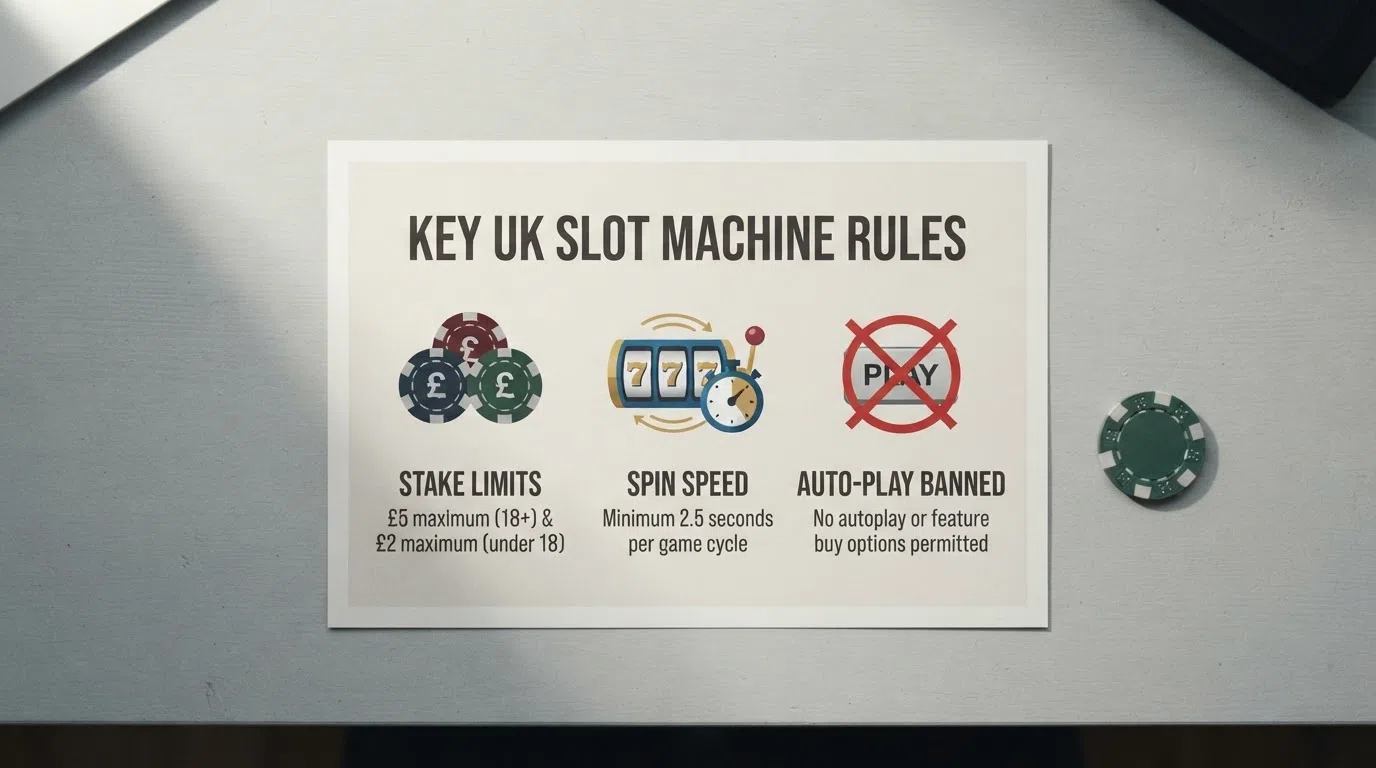
Every UK slot session runs under the same set of statutory and technical rules, and they shape what the player is actually buying. The stake cap is age-banded: £5 per game cycle for players aged 25 and over, in force from 9 April 2025; £2 per game cycle for players aged 18 to 24, in force from 21 May 2025. A game cycle is the period from initiation to when all staked money is lost or all winnings are delivered, so the cap applies to the total amount at risk within that cycle, not per spin button press. The statutory instrument is SI 2025/215.
The game-design rules, in force since 31 October 2021, are the more pervasive constraints. Auto-play is banned, so the player must press the spin button each time. Spin speed is capped at a minimum of 2.5 seconds per game cycle, which is roughly twice the speed of an unregulated slot. Turbo, quick-spin and slam-stop features are banned. Losses disguised as wins — animations that celebrate a payout smaller than the stake — are banned. Reverse withdrawals are banned. The operator must display total losses, total wins and time played during the session.
The 2.5-second rule is the one that changes the cost-per-spin math most. At 2.5 seconds per spin, a 200-spin session takes 500 seconds — about 17 minutes — and the calculation block later on this page uses that figure as the realistic session length. The session display, meanwhile, is the regulator’s transparency tool: the player can read the running loss total without leaving the game, which makes it harder to lose track of the bankroll in a long session.
When the Numbers Stop Being Fun: Safer Play and Where to Get Help
The math on this page works the same way for everyone. The 4% to 6% house edge is a wholesale price for entertainment, and the session display, the GAMSTOP self-exclusion and the financial-vulnerability check are the regulator’s answer to the fact that some players cannot afford to keep paying that price. None of those tools are a substitute for the player knowing what the slot costs them, and the section below is the working end of that knowledge.
The UK prevalence figure is 2.7% of adults aged 18+ in Great Britain scored 8 or higher on the PGSI in 2024 — the threshold for “problem gambling” — statistically stable against 2023. Forty-eight per cent of adults had gambled in the last four weeks, dropping to 28% once lottery-only players are excluded. These are not marginal numbers, and they have held steady through the stake-limit reform, the bonus-cap reform and the duty change.
The help infrastructure is real, and it is the part of the UK model that the rest of the world does not have at the same scale. The National Gambling Helpline — 0808 8020 133, run by GamCare, free, confidential, 24/7 — took over 52,000 calls in the year, and in January 2026 alone GamCare made 996 referrals to treatment and peer support, up 48% year-on-year. The NGSN reports that nine in ten people who complete treatment see improvement, and the problem-gambling rate among treatment completers fell from 86% at initial assessment to 12% at final assessment. Waiting time from referral to first appointment is under two weeks. Eighty-one and a half per cent of helpline contacts in 2026 cited online gambling — the highest share in at least five years — and that figure is the most direct read on where the harm is concentrated.
What House-Edge Awareness Actually Changes About How You Play
Treating the house edge as the price of the session rather than the cost of the slot is the practical payoff of RTP literacy. A 96% slot costs £4 per £100 wagered; a 94% slot costs £6. The player is paying one of those two numbers whether the session ends up £50 up or £50 down, and the edge is the only figure on the page that does not depend on the outcome.
The first consequence is stake sizing. A player who knows the edge is the price can decide what that price is worth in entertainment per hour. At 200 spins of £0.50 over 17 minutes, with a 96% slot, the cost of the session is about £4 in expected house take. At £5 per spin on the same slot, the cost is £40 in expected house take for the same number of spins — same edge, same math, very different price. The stake cap is the regulator’s answer to the second scenario.
The second consequence is session length. The session display is the single most important safer-gambling tool the regulator built, and a player who reads it once an hour is doing the math the operator is hoping they will not. The 2.5-second spin speed and the 8-minute-20-second 200-spin session are not accidents; they are the engineered tempo at which the math has time to feel its own weight.
GAMSTOP, GamCare and the NHS: The Help Infrastructure Every UK Player Should Know
GAMSTOP is the national self-exclusion scheme for online gambling, mandatory on every GB-licensed operator since 31 March 2020. A player can exclude for six months, one year, five years, or five years with auto-renewal. The exclusion cannot be cancelled early, and the operator is required to block the account and refuse marketing for the duration. The single step of registering with GAMSTOP closes the account access at every GB-licensed site at once, which is what makes the scheme worth using.
The National Gambling Helpline — 0808 8020 133, run by GamCare, free, confidential, 24/7 — is the front door for anyone who is not sure whether they need help. The helpline refers into the National Gambling Support Network, which routes into NHS gambling-harm clinics in England, Scotland and Wales. Treatment is free at the point of use, waiting time from referral to first appointment is under two weeks, and the published outcome data is strong: nine in ten people who complete treatment see improvement, and the problem-gambling rate among completers falls from 86% to 12% between initial and final assessment. The treatment is not a magic switch, but it is the most efficient single route in.
The 81.5% online-gambling share of helpline contacts in 2026 is the part of this that matters to a reader of this page specifically. The slots and casino products are where most of the harm is showing up, and the help infrastructure is built to take referrals from the players of those products. None of the safer-gambling tools on this page are a sign of weakness; they are the equipment the regulator gives the player for the price of admission.
How We Selected and Ranked These Casinos
Every operator in the featured set was verified as holding an active GB remote casino licence on the UK Gambling Commission’s public register, last refreshed on 29 July 2026. The register is the single source of truth for licence status in the UK market, and the cross-check ruled out any operator whose licence was suspended, surrendered or expired at the time of writing.
The ranking criteria were three. First, RTP transparency — operators that publish an aggregate payout figure, that confirm the RTP of specific high-RTP titles on the floor, or that show the deployed configuration clearly in-game ranked above those that did not. Second, high-RTP slot availability — the catalogue had to reach the titles that matter to a player choosing on payout percentage, including the 98%+ tier and the variable-configuration games. Third, welcome-offer terms — the 10× wagering ceiling, the deposit-free legs, the validity windows and the maximum cashout figures were all read against the published terms, and any operator whose published terms did not match the third-party review was deprioritised.
The data sources were the UKGC public register, the operator’s own site and terms, RTPTrack’s published deployment data, The Independent’s monthly operator payout ranking and the slot-data pages cited throughout. The ranking is editorial, based on the criteria above, and the operator write-ups name the mismatch where the welcome offer cuts against the high-RTP pitch. A brand that publishes a 97.30% operator average and attaches a 50× wagering multiple to its deposit match is a different deal from a brand that runs a wager-free no-deposit offer with no published aggregate. Both are on the list, and both are described as they are.
What to Actually Do With RTP Numbers When You Play
RTP is the most important number on a slot, and it is not a guarantee. The 96% figure is the long-run wholesale return across at least 10,000 spins; the session the player is about to run is a few hundred spins at most, and the result will diverge from the figure in either direction. The job of RTP literacy is not to predict the session but to choose the slot that costs the least per unit of stake.
The practical checklist is short. Read the in-game help screen before staking the first real-money spin, and trust the figure on it over any other source. Prefer the highest deployed RTP you can find for a given title, knowing that the same game can run at different configurations across UK sites. Treat the house edge as the price of the session and size the stake accordingly — at 200 spins of £0.50 on a 96% slot, the expected cost is about £4; at £5 a spin on a 94% slot, it is about £60. Pick the session length and the stake with the edge in mind, not the result. Use the tools the UK market gives every player: the in-session display of losses and time played, the deposit-limit prompts, the GAMSTOP self-exclusion if the math stops being entertainment. A player who runs the checklist will not change the house edge, but will stop being surprised by it.
The post-RGD landscape makes the checklist more important, not less. A slot that published at 96% in January can run at 94% in May, and the only place the player sees the deployed number is the help screen. The average UK slot in 2026 keeps £5.50 of every £100 wagered, which is roughly £1.50 more than the theoretical maximum on the same games’ main-tier configurations. That £1.50 is not a rounding error against a £100 bankroll, and over a year of regular play it is a meaningful number. Read the screen, check the configuration, size the stake to the edge and use the regulator’s tools when the math stops being fun. Everything else on the page is in service of those four steps.
Frequently Asked Questions
Does RTP differ between casinos for the same slot game?
Yes. The same slot title can be certified in more than one RTP configuration, and the operator chooses which one to deploy. A 96% slot at one UK casino can be a 94% slot at another, and the only place the player sees which is which is the help screen of the loaded game. The figure on the developer’s product page is the highest configuration, not necessarily the one being offered.
What is the difference between RTP, house edge and volatility?
RTP is the long-run percentage of stake returned to players; house edge is its inverse, the percentage the house keeps per unit of stake. A 96% RTP slot has a 4% house edge. Volatility is a separate measure of how the return is distributed across spins: a low-volatility slot returns small wins frequently, a high-volatility slot concentrates the return into rare large hits. Two slots at the same RTP can feel like very different games because of volatility.
What has changed for UK slot players since the 2025 stake limit and 2026 tax increase?
The age-banded stake cap — £5 per game cycle for players 25 and over from 9 April 2025, £2 for players 18 to 24 from 21 May 2025 — set the per-spin ceiling. The Remote Gaming Duty increase from 21% to 40% from 1 April 2026 led many operators to deploy lower RTP configurations, and the average UK deployed RTP now sits around 94.50%. The 10× wagering cap on bonuses took effect on 19 December 2025. The wagering and stake rules are in the player column; the RTP slide is in the house column.
What is the average RTP of UK online slots?
The average UK deployed RTP in 2026 is approximately 94.50%, translating to a house edge of about 5.50%. The theoretical maximum average on the main-tier configurations is 96.00%, but the gap between the theoretical and the deployed is the post-RGD shift. Individual slots range from 94% to 97% for the typical catalogue, with the top titles clearing 98% and a few reaching 99%.
Can a casino change a slot’s RTP without telling the player?
The operator can change the configuration it runs, and the change is reflected on the in-game help screen under the UKGC’s RTS 3 requirement. The change is not announced, and the player’s only way to see it is to read the help screen at the time of play. The regulator requires the displayed figure to enable an informed decision, but the player has to look.
Limits – trustedcasinos-notongamstop
Content created by the «trustedcasinos-notongamstop» team