
Best First Deposit Bonus Casinos in the UK: What the 10× Cap Did to Your Bonus
 Available in GB
A first deposit bonus in the UK is no longer the marketing object it was two years ago. Since 19 January 2026, the Gambling Commission has capped wagering requirements on casino bonuses at ten times the bonus amount. The 100% matches with 35-times playthrough that used to dominate comparison pages have been legislated out of existence. What replaced them is a market that looks, on the surface, generous — five hundred free spins here, two hundred spins there — and underneath, more standardised than any bonus catalogue the UK has previously seen.
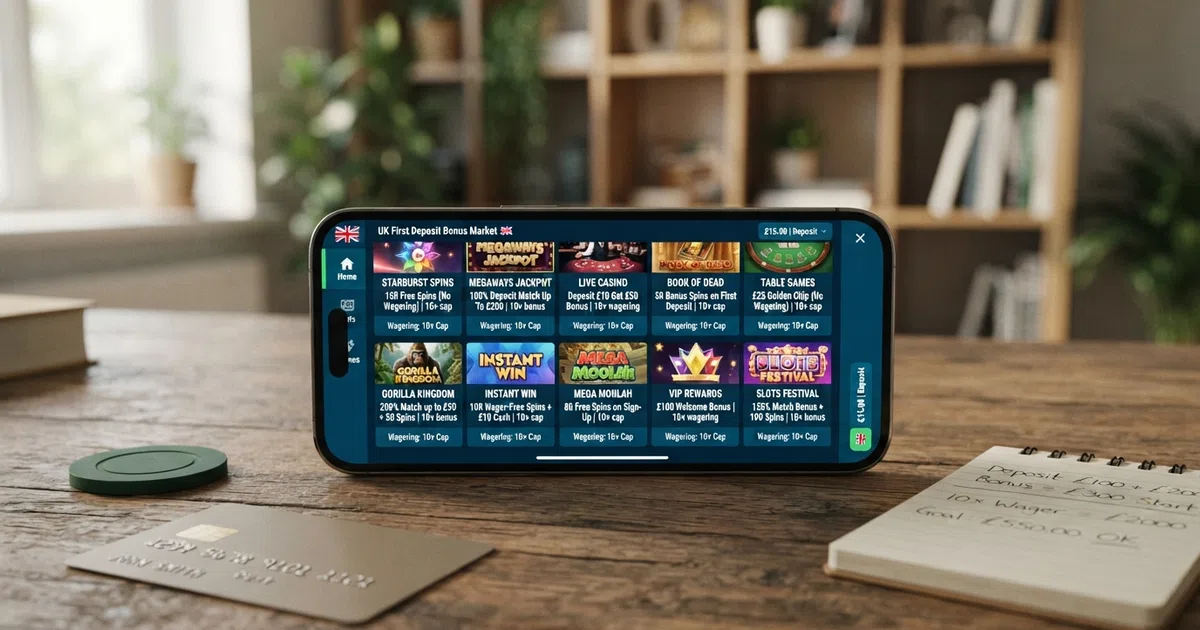
This ranking covers ten UK-licensed online casinos by what their first deposit bonus is actually worth in 2026, not by the number printed next to the offer. The calculation that drives the ranking is the one that matters: wagering-adjusted value, where a 50-spin no-wagering offer often beats a 200-spin offer carrying 10× playthrough once you account for the time and the odds. A 500% match at any wagering multiple loses to a 100% match at zero wagering, every time, because the headline percentage was never the point.
Data current as of September 9, 2026; verified against the UK Gambling Commission public register of licence holders.
What a First Deposit Bonus Gives You — and What It Doesn’t
A first deposit bonus is a contractual add-on that activates when a new customer makes their first deposit at an online casino. The operator matches a percentage of that deposit, awards a fixed number of free spins, or does both, and in return the player agrees to play under conditions: a wagering multiplier, an expiry window, a maximum cashout, a list of eligible games. The terms are not optional, and the 10× wagering cap that came into force in January 2026 is the ceiling on the worst of them, not a floor on the rest.
The bonus exists because the operator wants your business. That motivation is not hidden, and the terms reflect it: every clause, from the game-weighting rules to the withdrawal restrictions, is the price of a marketing spend the operator has already committed to. Understanding the price is what separates a player who extracts value from one who subsidises an acquisition.
What “First Deposit Bonus” Means at a UK Casino
The mechanism is straightforward. You register, you deposit, and the operator credits your account with bonus funds, free spins, or both. A 100% match means a £10 deposit produces £10 in bonus credit; a 200-spin offer at 10p per spin means the operator credits 200 game rounds at a fixed stake. The distinction matters because the two structures carry different wagering obligations. A cash match is bonus money that must be wagered before it converts to withdrawable cash; free spin winnings are either paid as cash immediately (no wagering) or carry a multiplier attached to whatever the spins return.
The opt-in requirement, codified in May 2025 under LCCP Social Responsibility Code 5.1.12, means you now tick a box for each product and each marketing channel you want to hear from. Untick everything by default and the bonus still credits when you deposit, but the operator cannot email you a “we miss you, here’s a reload” three days later. The opt-in rule cuts down cross-selling, not the welcome offer itself.
First Deposit Bonus vs Welcome Bonus vs Sign-Up Offer — Clearing Up the Labels
A welcome bonus is an umbrella term covering whatever the operator gives you across your first deposit, second deposit, and sometimes third. A sign-up offer includes everything the operator credits between registration and the conclusion of the welcome period: no-deposit free spins, a first-deposit match, follow-up reloads. The first deposit bonus is the slice of that package gated by your first deposit. The other slices may require a second or third deposit, a separate opt-in, or a different code.
Comparison pages routinely conflate these. A table that lists “welcome bonus: 100 spins + 100% match” might describe a single offer or a sequence; the wagering terms can differ between the two components. Reading the small print matters more than reading the headline.
The Four Numbers That Decide What a Bonus Is Worth
Match percentage, wagering multiplier, game weighting, and validity window. Each one changes the real cost of the bonus to the player.
The match percentage is the least informative of the four. A 100% match at zero wagering and a 200% match at 20× wagering can deliver the same expected value; the percentage is arithmetic the operator is doing, not value the player receives. Since January 2026, no UK operator can attach more than 10× wagering to a casino bonus, which compresses the spread: at 10× the maximum, the difference between a 100% match and a 200% match is closer to a rounding error than a meaningful edge.
The wagering multiplier is the primary cost driver. At 10× the bonus, a £100 match requires £1,000 of qualifying play before the bonus funds convert to cash. At 0×, the same £100 match converts the moment it lands. The cap did not eliminate wagering; it compressed the range of wagering from 20×–60× down to 0×–10×.
Game weighting determines how much of your play counts towards the wagering requirement. Slots typically contribute 100% — every £1 wagered clears £1 of bonus obligation. Live casino and table games often contribute 10%–20% or are excluded entirely. A bonus that looks like 10× on the headline becomes 50×–100× effective if the only game you want to play is blackjack.
The validity window is the clock. A bonus with 72 hours to clear (William Hill Vegas) and a bonus with 90 days (888 Casino) offer the same terms on paper but radically different real-world time pressure. The 72-hour clock is the kind of constraint that turns bonus play into a second job; the 90-day window is generous enough to clear at a comfortable pace.
Your First Deposit — Who Qualifies and What Blocks You
First-time depositors only. Every operator in the UK licensed market excludes existing customers from the welcome offer, and most require a fresh account: new email, new payment method, no prior play history at any brand within the operator’s group. The verification requirement, mandatory since May 2019, means the operator must confirm your name, address, and date of birth before your first deposit is accepted. This is not optional, and the deposit button will not appear until verification clears.
The credit card ban, in force since 14 April 2020, eliminates roughly 30% of UK adults’ preferred payment method. Debit cards remain universally accepted. E-wallets — Skrill, Neteller, and sometimes PayPal — are accepted as deposits but routinely excluded from bonus eligibility; the operator does not want the bonus claimed via a payment method that can move funds offshore without traceability. PayPal is specifically excluded at LeoVegas; the other operators either accept it as a deposit but disqualify the bonus, or treat it like any other method.
The geographic restriction is Great Britain only. Northern Ireland is outside the Commission’s remit, and players there are not protected by the LCCP. A “UK-facing” casino in the marketing sense is not the same as a GB-licensed casino in the regulatory sense; the public register is the only verification that matters.
Online vs Land-Based: Why the High-Street Offer Looks Different
The 10× wagering cap applies to remote (online) operators only. A William Hill retail shop, a Ladbrokes betting office, a Coral high-street desk: these run under different rules, licensed by local authorities, governed by separate bonus and promotional codes. The same brand name can offer 200 free spins at 10× wagering online and a free £5 bet with no wagering on the betting shop’s terminal.
The comparison matters because players who walk into a Ladbrokes on a Saturday are not subject to the LCCP’s online bonus cap. They are subject to whatever promotional structure the shop runs, which is regulated at the local-authority level and is not bound by the 10× rule. The disparity is one of the quieter consequences of the 2026 reform: the same bonus words can mean very different things depending on which door you walk through.
Where the Best First Deposit Value Sits in 2026: 10 UK Casino Offers Compared
The table below ranks the featured set by wagering-adjusted value. A no-wagering offer outranks a 10× wagering offer at the same spin count; a higher spin count outranks a lower one at the same wagering. The cashout cap, where one exists, is listed because it bounds the upside in a way the spin count does not.
| Operator | Offer Type | Free Spins | Wagering | Min Deposit | Max Cashout | Key Condition |
|---|---|---|---|---|---|---|
| PlayOJO | Spins | 50 | 0× | £10 | No cap | Big Bass Bonanza, 0× always |
| bet365 Casino | Spins | Up to 500 | 0× | £10 | No cap | Select 5–50 spins daily over 10 days, 30-day claim |
| Sky Vegas | Spins + ND | 70 + 200 | 0× | £10 | No cap | 70 no-deposit + 200 on deposit & spend |
| Paddy Power Games | Spins + ND | 60 + 200 | 0× | £10 | No cap | 60 no-deposit (50 slots + 10 Paddy’s Mansion Heist) + 200 on deposit |
| Betfair Casino | Spins | 200 | 0× | £10 | No cap | Stake £10, spins valid 7 days |
| Betfred Casino | Spins | 200 | 0× | £10 | No cap | 14-day qualifying window, spins valid 7 days |
| Ladbrokes Casino | Spins | 100 | 0× | £10 | — | Stake £10, 48h to accept, 7-day validity |
| LeoVegas | Spins | 50 | 0× | £10 | No cap | 1× deposit wager, Big Bass Splash, PayPal excluded |
| William Hill Vegas | Spins | 200 | 10× | £10 | £30 | Stake £10, 72-hour expiry on spins and wagering |
| 888 Casino | Match | 0 | 10× | £10 | £100 | 100% match, 48h to claim, 90-day wagering validity |
Eight of the ten featured operators now offer zero-wagering first deposit spins. The 10× cap has made playthrough the exception rather than the rule, and the competitive differentiation has shifted to spin volume, qualifying-window length, expiry pressure, and whether a no-deposit component is included. A player comparing these offers should not stop at the spin count: the expiry window alone separates Betfred (14 days to qualify, 7 days to use) from William Hill (deposit, stake, spin, and wager all within 72 hours).
PlayOJO — No Wagering, Ever: 50 Spins Paid as Cash
PlayOJO’s entire brand is built on the proposition that there is no wagering, ever, on anything the casino offers. The 50 free spins on Big Bass Bonanza land as cash the moment they credit. There is no playthrough, no conversion step, no maximum cashout. The £10 minimum deposit is the only threshold; once it clears, the spins are yours to use or not use.
Big Bass Bonanza (Pragmatic Play) is a high-volatility slot with a 96.71% RTP and a 2,100× maximum win. At 10p per spin, 50 spins represent £5 of stake, and the expected return before volatility is around £4.84. That figure means little in practice — a high-volatility slot delivers most of its payout in rare large hits — but it sets the floor: 50 spins at the stated RTP will return roughly what you put in, with the upside of a 2,100× payout if the bonus round lands.
SkillOnNet Ltd holds the GB licence for PlayOJO, confirmed on the public register. The 50-spin offer is the smallest in the featured set by count but the simplest in structure. A player who wants the offer with the least conditional language attached ends up here.
bet365 Casino — Up to 500 No-Wagering Spins, Scaled to Your Rhythm
bet365 is the largest operator in the UK by market share, and the first deposit offer reflects that scale: up to 500 free spins over 10 days, at 10p each, with no wagering on winnings. The catch is the selection structure. You do not receive 500 spins at once. You choose between 5, 10, 20, or 50 spins per day for 10 days, and the total you accumulate depends on how many days you log in and how many you claim.
The 30-day claim window means you have a month from registration to start the offer, and 20 days to make all 10 daily selections once you do. Spins are valid for 7 days after being awarded; unclaimed daily spins expire. The structure rewards a player who logs in consistently over 10 days, not a player who wants the full 500 immediately and walks away.
Hillside (UK Gaming) ENC, account 38721, is the licensed entity. The eligible games are Curse of the Bayou, Magic Forge, and Wrath of the Deep, selected at the qualifying game’s first load. The maximum 500 spins requires the player to claim the full 50-spin daily allocation for all 10 days; the minimum is 50 spins (the first day’s allocation, if nothing else is claimed). A bet365 player choosing this offer should set a reminder.
Sky Vegas — 70 Spins Before You Deposit, 200 After
Sky Vegas is one of two operators in the featured set offering a genuinely deposit-free component. The 70 no-deposit free spins credit on registration; the additional 200 free spins credit after a £10 deposit and £10 spend on casino games. Both lots carry 0× wagering, and there is no maximum cashout on either.
The no-deposit spins are the distinguishing feature. A player can register, claim 70 spins, and walk away with whatever those spins produce without depositing a penny. The deposit-gated 200 spins are the larger prize, and the £10 spend requirement is the condition: depositing alone does not unlock them; the player must stake the deposit on eligible games.
Bonne Terre Limited, under Flutter Entertainment, holds the GB licence. Free spins expire 7 days after credit; the deposit/spend requirement must be completed within 30 days of registration. The combined potential of 270 spins at 10p each is £27 of stake value, with the no-deposit half requiring no financial commitment at all.
William Hill Vegas — 200 Spins at 10×, With a £30 Ceiling
William Hill’s 200 free spins on Big Bass Splash carry 10× wagering on winnings and a £30 maximum cashout. The combination is the tightest in the featured set: high spin count, short expiry, and a ceiling that caps even a strong run.
Big Bass Splash (Pragmatic Play) is the same RTP and volatility profile as Big Bass Bonanza, 96.71% and high. At 10p per spin, 200 spins represent £20 of stake with an expected return of roughly £19.34 before any cashout limit. The 10× wagering on whatever the spins win means a £5 return requires £50 of additional play to convert to cash. The £30 cap means that even a 2,100× max win (worth £2,100 at 10p) pays out at £30.
William Hill Organization Limited, account 2752, active on the register since 1 January 2009. The 72-hour expiry covers both the spins and the wagering; a player who does not stake, spin, and complete the wagering inside three days loses everything. The 10× cap makes this offer legal; the £30 cap and 72-hour clock make it the least generous structure in the table on a real-value basis, despite the headline 200-spin count.
888 Casino — The Only Pure Match Bonus in the Set: 100% to £100
888 Casino is the only featured operator offering a traditional cash-match rather than free spins. The 100% match up to £100 means a £100 deposit produces £200 in playable funds (£100 cash + £100 bonus), and the £100 bonus carries 10× wagering before it converts. The 90-day wagering window is the most generous in the set; the 48-hour claim window is the shortest.
The £100 maximum cashout is the structural trade-off. Even if a player clears the wagering and builds a balance of, say, £500, the bonus terms cap withdrawals from bonus-derived winnings at £100. The match bonus structure rewards volume — a player willing to deposit £100 and play through the wagering gets the full headline — but punishes the hot run.
888 UK Limited, under evoke plc, holds the licence. There is no free spin component; the value is entirely in the matched cash. For a player who prefers table games or wants a longer wagering window to clear the requirement at a comfortable pace, 888 is the only option in the featured set that offers that structure.
Ladbrokes Casino — Stake £10, Get 100 No-Wagering Spins
Ladbrokes’ 100 free spins on selected slots carry 0× wagering. The qualifying play is a £10 stake on slots after depositing; the spins credit once the stake clears. 48 hours to accept the offer after qualification, 7 days to use the spins once credited. LC International Limited, under Entain, holds the GB licence.
The offer is clean but unremarkable: 100 spins at 10p each is £10 of stake, no wagering, no cashout cap, and a standard qualifying structure. The brand recognition is the draw, not the bonus mechanics. Ladbrokes carries a high-street presence that bet365, PlayOJO, and LeoVegas do not, and for a player who values the name, the offer is competitive within the zero-wagering cluster.
Paddy Power Games — 60 Free Spins Before You Spend a Penny
Paddy Power’s structure mirrors Sky Vegas: 60 no-deposit free spins (50 on selected slots plus 10 on Paddy’s Mansion Heist) credit on registration, and up to 200 additional free spins credit after a £10 deposit and wager. All spins are 0× wagering, with a 7-day expiry from credit. PPB Entertainment Limited, under Flutter, holds the licence.
The 60 no-deposit spins are the headline. A player who registers, claims them, and never deposits still walks away with whatever the spins produce as withdrawable cash. The 200 deposit-gated spins are the larger offer but require the same £10 deposit-and-wager structure that the other Flutter brands use.
For a player weighing Sky Vegas against Paddy Power, the distinction is in game selection (Sky Vegas runs on its own eligible games list; Paddy Power includes Paddy’s Mansion Heist) and in the no-deposit spin count (70 vs 60). The 10-spin gap is small but real.
Betfred Casino — 200 No-Wagering Spins With a 14-Day Qualifying Window
Betfred’s 200 free spins on selected titles are 0× wagering, with winnings added directly to the withdrawable balance. The 14-day qualifying window, the longest in the featured set, gives a player two weeks from registration to deposit and stake their £10. Spins are valid 7 days after credit.
Petfre (Gibraltar) Limited holds the GB licence. The 200-spin count at 10p each is £20 of stake, no wagering, no cashout cap, and the 14-day window removes the time pressure that blunts the William Hill offer. A player who cannot or does not want to claim within 72 hours has two weeks to do it.
The trade-off is game selection: the eligible titles are Betfred’s own curated set, not the Big Bass Bonanza or Big Bass Splash that other operators feature. For a player who cares more about clearing the bonus at a comfortable pace than about the specific reel, Betfred is the strongest 200-spin no-wagering option in the set.
LeoVegas — The Lightest Qualifying Play: Wager Your Deposit Just Once
LeoVegas asks for the smallest playing commitment of any featured operator: deposit £10, wager the deposit once (1×), and 50 free spins on Big Bass Splash credit. 0× wagering on the spin winnings. The deposit must be made within 7 days of registration, the 1× wager must be completed within 7 days of deposit, and the spins expire 3 days after credit.
Big Bass Splash (Pragmatic Play) — 96.71% RTP, high volatility, 2,100× max win. At 10p per spin, 50 spins is £5 of stake. The 1× deposit wager means a £10 deposit produces £10 of qualifying play before the spins credit; the spin winnings then convert to cash immediately.
LeoVegas Gaming PLC, account 39198, active on the register since 1 November 2014. PayPal is excluded from the bonus; a PayPal deposit credits the account but disqualifies the offer. The 3-day spin expiry is the tightest in the set and requires a player to use the spins quickly once they land.
Betfair Casino — Stake £10, Get 200 No-Wagering Spins From a Flutter Powerhouse
Betfair’s 200 free spins on eligible games carry 0× wagering. Stake £10 on slots after depositing, and the spins credit. 7-day expiry from credit, no stated cashout cap. PPB Entertainment Limited, under Flutter, holds the licence — the same entity that runs Paddy Power.
The offer is structurally similar to Betfred’s: 200 spins, no wagering, £10 deposit and stake. The 7-day spin expiry matches Betfred; the 14-day qualifying window does not apply (Betfair’s qualifying window is not stated separately, and a player should check current terms). The Flutter backing is the brand infrastructure: the same payments, the same KYC, the same responsible-gambling architecture as Sky Vegas and Paddy Power.
For a player choosing between the Flutter trio — Sky Vegas, Paddy Power, Betfair — the decision comes down to whether the no-deposit component (Sky Vegas and Paddy Power) or the cleaner 200-spin deposit offer (Betfair) is worth more. The arithmetic favours Sky Vegas for a player who wants to try before committing; Betfair for a player who knows the £10 is coming and wants the 200 spins without a second decision point.
Why Your 2026 First Deposit Bonus Looks Bigger Than It Really Is — and Why the 10× Cap Changed Everything
The marketing language of a first deposit bonus is designed to make the number feel like value. “100% match” sounds like free money. “500 free spins” sounds like 500 chances to win. Both descriptions are accurate on their own terms; both are misleading once the conditions are factored in. The 10× cap, in force since 19 January 2026, has not removed this gap between headline and reality. It has narrowed it.
Before the cap, a 100% match could carry 35× wagering, 50× wagering, even 60× wagering in extreme cases. A £100 bonus at 60× required £6,000 of qualifying play before the bonus converted to cash. The expected loss on that turnover, at a 96% RTP slot, was £240. The player was paying £240, in expected terms, to clear a bonus nominally worth £100. The marketing said “100% match”. The arithmetic said “60% expected loss”.
The cap changed the ceiling. At 10× the bonus, the same £100 bonus requires £1,000 of qualifying play. The expected loss at 96% RTP is £40. The player pays £40, in expected terms, to clear a bonus nominally worth £100. The arithmetic now says “40% expected loss”, and that number is still uncomfortable, but it is half of what it was at 20× and a third of what it was at 30×. The cap compressed the worst of the spread without flattening the differences that still matter.
| Offer Type | Operators Using It | Typical Wagering | Expected Cost on £10 Deposit (at 96% RTP) | Typical Cashout Cap |
|---|---|---|---|---|
| No-wagering spins | PlayOJO, bet365, Sky Vegas, Paddy Power, Betfair, Betfred, Ladbrokes, LeoVegas | 0× | £0.40 (10p × 10 spins at standard density) | None |
| Match bonus | 888 Casino | 10× | £4.00 (£10 bonus × 10× turnover × 4% house edge) | £100 |
| Spins with wagering | William Hill Vegas | 10× on winnings | ~£4.00–£8.00 (depends on spin outcome) | £30 |
The expected-cost column makes the no-wagering cluster the obvious winner. A 50-spin no-wagering offer at 10p per spin has a raw cost of around £0.40, the house edge on £5 of slot play. A £10 match bonus at 10× wagering costs £4.00, the house edge on £1,000 of play. The 10× offer is ten times more expensive, in expected terms, than the no-wagering alternative, even though the bonus face value is identical.
The cost of clearing a £500 bonus at 10× wagering is £200 (expected loss on £5,000 of play). The cost of clearing a £100 bonus at 10× is £40. The cost of clearing a £10 bonus at 10× is £4. The arithmetic scales linearly with the bonus amount, which is why match bonuses are now rare: the player who understands the math is reluctant to take a £500 match when the cost is £200, and the operator cannot advertise a £100 match without inviting the comparison. The post-cap market has shifted to free spins because spins carry a fixed stake and a bounded total cost in a way that match bonuses do not.
Welcome Bonus vs First Deposit Bonus — the Package the Operator Actually Sells
A welcome package is a sequence: a no-deposit component, a first-deposit component, sometimes a second or third. The first deposit bonus is the gateway, and the conditions usually sit on the gateway rather than the follow-up. A no-deposit free spin may have its own wagering, its own expiry, its own game list; the first-deposit match carries different terms. The two are not interchangeable.
Reload bonuses, credited on second and subsequent deposits, are a separate product line with separate terms. A “welcome bonus” table that lists a 100% match plus 100 free spins plus a 50% reload on the second deposit is describing three products, each with its own wagering multiplier. Reading the welcome page without reading each component’s terms means accepting a blended rate of return you did not calculate.
The mixed-product ban, in force since 19 January 2026, prevents an operator from conditioning a casino bonus on the player also betting on sports, buying a lottery ticket, or playing bingo. An offer that required a £10 casino deposit and a £10 sports bet to unlock the bonus is now prohibited. The ban does not prevent multi-component welcome packages within casino; it prevents the cross-product conditioning that used to be common.
The Match-Percentage Ladder: 100%, 200%, 500% — and Why the Number Means Less in 2026
A 500% match sounds five times better than 100%, but the math is the same: the percentage multiplies the deposit, and the wagering multiplies the bonus. At 10× the bonus, a £10 deposit with a 500% match produces a £50 bonus requiring £500 of play; the same £10 deposit with a 100% match produces a £10 bonus requiring £100 of play. The 500% player has five times the bonus and five times the wagering obligation. The expected cost scales with the bonus amount, not the percentage.
Why UK offers cluster around 100% now: the Remote Gaming Duty rise from 21% to 40%, effective 1 April 2026, has compressed operator margins, and a 500% match at 10× wagering eats further into those margins. The 100% match is the maximum a margin-conscious operator can offer without writing off the acquisition cost. The 200% and 500% offers that still appear in offshore marketing are absent from the UK licensed market for the same economic reason.
Free Spins on First Deposit: Counting What a Spin Is Actually Worth
500 free spins at 10p each is £50 of stake. At a 96% RTP, the expected return is £48. The raw value of the spin bundle is £48, not £500. The “500” measures the number of game rounds; the £48 measures what those rounds are statistically worth. A player who treats 500 spins as a £500 value is overstating the offer by an order of magnitude.
The 10p spin value is the industry standard for UK-licensed free spin offers. The reason is partly accounting (the operator prices the spin at the slot’s minimum stake to limit exposure) and partly regulatory (the £5/£2 per-spin stake cap applies to the player’s own money; a bonus spin is priced below that ceiling by convention). The 10p figure is the baseline; any deviation from it, up or down, is a deliberate operator decision.
No-wagering spins and wagered spins carry different real values. A no-wagering spin pays its winnings as cash: a £2 return on a 10p spin is £2 in the player’s withdrawable balance. A wagered spin at 10× multiplier pays £2 in bonus funds, which then requires £20 of qualifying play to convert. The 10× spin is worth 10% of the no-wagering spin at the moment of credit, and the gap widens if the player never clears the wagering.
The Hybrid Offer: When a First Deposit Bonus Bundles Match Cash and Free Spins
Hybrid offers combine a match bonus with free spins. The value sits in which half carries the lighter conditions. A 100% match up to £50 with 50 free spins at 0× wagering delivers two bonuses with different cost structures: the match has a 10× obligation, the spins do not. The spins are pure value; the match is a deferred-cost component.
In the post-January-2026 landscape, pure spins dominate because the arithmetic favours them. A player who can claim 200 no-wagering spins is paying the house edge on £20 of slot play, full stop. A player who claims a 100% match with 50 free spins is paying the house edge on £20 of slot play plus the house edge on £1,000 of wagering. The first is cheaper; the second has a larger face value. Which one is “better” depends on whether the player can clear the wagering at a pace that does not erode the match’s value.
How to Claim a UK First Deposit Bonus — and the Traps That Void It
The claiming flow has a fixed order, and the order matters:
- Register the account and complete identity verification (name, address, date of birth) before depositing. The deposit button does not appear until verification clears.
- Set a deposit limit when prompted. This is a regulatory requirement since 31 October 2025, not a marketing prompt you can dismiss.
- Opt in to the bonus. Some operators require a checkbox during deposit; others credit automatically. The opt-in is a regulatory requirement since 1 May 2025 for direct marketing communications, but the bonus claim itself is separate.
- Deposit using an eligible payment method. Debit cards are universally accepted. E-wallets (Skrill, Neteller) are routinely excluded. PayPal is excluded at LeoVegas specifically.
- Complete any qualifying play (stake £10 on slots, wager deposit 1×, etc.) within the qualifying window.
- Use the spins or play through the match within the bonus validity window. 72 hours at William Hill; 7 days at most others; 90 days for wagering at 888.
The traps are sharp. Deposit with Skrill, and the bonus does not credit. Deposit with PayPal at LeoVegas, and the bonus is void. Miss the 48-hour claim window at 888, and the match never activates. Fail to stake £10 on slots at Ladbrokes, and the 100 spins do not credit. The opt-in is not optional. The deposit-limit prompt is not skippable. The conditions are enforceable, and missing one means losing the offer with no recourse.
Comparing Offer Value: The Three Numbers That Matter More Than the Headline
Wagering multiplier. Maximum cashout. Spin value at the relevant RTP. The headline bonus amount is the least useful comparator. A 200-spin offer at 0× wagering with no cashout cap is worth more, in expected terms, than a 500-spin offer at 10× with a £30 cap — because the 500-spin offer’s 10× obligation erodes the winnings before the cap binds, and the cap binds before the player reaches the headline volume.
The wagering multiplier is the primary cost driver. Multiply the bonus by the multiplier, multiply the result by the house edge (typically 4% at 96% RTP), and you have the expected cost of clearing. At 0×, the cost is the house edge on the stake value (£0.40 on £10 of 10p spins). At 10×, the cost is the house edge on the bonus × 10 (£4.00 on a £10 bonus at 10× and 96% RTP). The 10× offer is ten times more expensive.
The maximum cashout is the ceiling on upside. A bonus with a £30 cap and a 2,100× max win slot delivers, at most, £30 — the cap binds before the slot’s max win does. A bonus with no cap and the same slot can, in principle, pay the full 2,100×. The probability of hitting the max win is low; the cap matters because it bounds the upside in a way the expected return does not capture.
Spin value at the relevant RTP is the baseline. A 10p spin on a 96.71% RTP slot returns 9.671p in expected value. A 10p spin on a 94% RTP slot returns 9.4p. The 2.71-percentage-point gap is small per spin but compounds across a 500-spin offer: 500 × 0.271p = £1.36 of expected return difference. The RTP matters, but the wagering and the cashout cap matter more.
Where Your First Deposit Bonus Works: Slots vs Live Casino
Game weighting determines how much of your play counts towards the wagering requirement. Slots typically contribute 100%: every £1 wagered clears £1 of bonus obligation. Live casino games (blackjack, roulette, baccarat with a live dealer) typically contribute 10%–20%, and many operators exclude live casino from bonus play entirely. Table games in RNG (non-live) form are similarly weighted low or excluded.
The weighting exists because live casino games have a lower house edge than slots. Blackjack, played with basic strategy, returns around 99.5%; a player wagering on live blackjack would clear a bonus far faster than a player wagering on slots at 96% RTP. The 10%–20% weighting offsets that advantage: a £1 live blackjack bet counts as 10p–20p towards wagering, which restores the time-cost balance the operator wants. The weighting is not punitive; it is calibrative. A player who wants to clear a bonus on live casino will take ten times as long to do it.
The RTP difference matters at the other end. Live casino’s higher RTP means the expected loss per unit of wagering is lower. A £1,000 wagering requirement cleared on slots at 96% RTP costs £40 in expected loss. The same £1,000 cleared on live blackjack at 99.5% RTP costs £5. But the 10% weighting on live blackjack means the player needs £10,000 of live play to clear £1,000 of wagering, and the £5 expected loss on that £10,000 is the same 5 basis-point rate — the weighting preserves the operator’s margin regardless of which game the player chooses.
The Slot Sites That Pair the Best Bonus With the Best Reels
A first deposit bonus attached to a strong slot library delivers more real value than a bigger bonus on a weaker catalogue. PlayOJO, bet365, and LeoVegas carry the broadest provider sets in the featured group: NetEnt, Microgaming, Pragmatic Play, Play’n GO, Evolution, Red Tiger, Blueprint, Big Time Gaming, and others. A player with a 200-spin no-wagering offer at a casino with 2,000 slots has more places to spend those spins than a player with the same offer at a casino with 400 slots.
RTP variation between titles is real. A 96.71% slot (Big Bass Bonanza, Big Bass Splash) and a 94% slot differ by 2.71 percentage points in expected return. Over 200 spins at 10p, the difference is £0.54 in expected return. Over 1,000 spins, it is £2.71. The player who knows which slots carry the higher RTP and uses the bonus spins on those titles extracts more value per spin.
Bonus Slots You Will Actually Play: Big Bass Bonanza, Big Bass Splash, and the Rest
Big Bass Bonanza and Big Bass Splash (both Pragmatic Play) are the most common bonus slots in the featured set, appearing at PlayOJO, William Hill, and LeoVegas. Both carry 96.71% RTP, high volatility, and a 2,100× maximum win. The high volatility is the operative feature for a bonus player: the slot delivers most of its payout in rare large hits rather than frequent small ones. A 50-spin bonus round on a high-volatility slot is more likely to return nothing or close to nothing than to deliver a significant payout. A 200-spin bonus round has enough volume to smooth the variance and approach the expected return.
The max win at 2,100× stake means a 10p spin can return up to £210. At 50 spins, the theoretical ceiling is £10,500 — but the probability of hitting the max win on any given spin is well under 0.01%, and the probability of hitting it at all in a 50-spin session is similarly low. The cap is a structural feature of the game, not an expected outcome.
Operators choose these titles because the brand recognition drives engagement. A player who has seen Big Bass Bonanza advertised elsewhere is likelier to play it than an unfamiliar title, and the engagement translates to more spins consumed and more house edge collected. The choice is a marketing decision, not a generosity decision.
When a Tenner Opens Every Door: Low-Deposit First Deposit Bonus Reality
Every operator in the featured set sets its first-deposit threshold at £10. The £10 floor is universal across the GB-licensed market, and the economic reasons are straightforward: a £1 or £5 deposit produces a bonus the player is unlikely to clear (the expected cost of the bonus exceeds the deposit), and the verification cost of onboarding a new player does not scale down with the deposit size. A £1 deposit carries the same KYC overhead as a £100 deposit, and the operator cannot recoup that overhead from a bonus that pays out in expected terms at a loss.
The £10 floor is also a regulatory artefact. The financial vulnerability check at £150 net deposits (rolling 30-day period) is a mandatory trigger from 28 February 2025. A £1 deposit sits well below that threshold, and the operator’s safer-gambling obligations do not bind at the same intensity. But the operational cost of processing thousands of £1 deposits, each requiring verification, exceeds the bonus revenue they generate. The £10 floor is where the unit economics begin to work.
Deposit Methods That Keep Your Bonus Alive — and the Ones That Kill It
Debit cards are universally accepted. The credit card ban, in force since 14 April 2020, extends to credit-card-funded e-wallet payments, which means a deposit made via an e-wallet that was funded by a credit card is also banned. Direct credit card deposits have been prohibited for six years; the e-wallet extension closes the indirect route.
E-wallets (Skrill, Neteller) are accepted as deposits but routinely excluded from bonus eligibility. The reason is operational: the operator cannot trace the source of e-wallet funds with the same certainty as a debit card transaction, and the bonus claim represents a marketing spend the operator wants to verify against a known payment source. Skrill and Neteller deposits will credit the account but will not trigger the bonus. PayPal is excluded at LeoVegas specifically; other operators either accept it without bonus eligibility or treat it like any other method.
The list of excluded methods varies by operator. The pattern is the same: any payment method that obscures the source of funds is excluded. A player who wants the bonus should deposit with a debit card. A player who prefers e-wallets for convenience should accept that the bonus will not credit.
Deposit Limits and Bonus Terms: The Link Most Players Miss
The deposit-limit prompt that appears before a first deposit is not a hurdle. It is a regulatory requirement, in force since 31 October 2025 under RTS 12, and it serves the same purpose as the financial vulnerability check at £150 net deposits: to keep the player’s play inside a boundary the player has set. A bonus player who sets a £50 deposit limit, deposits £10 to trigger the welcome offer, and plays through the bonus terms is operating inside the limit. A bonus player who increases the limit to chase losses has crossed the line the prompt was designed to prevent.
The bonus terms interact with the limit. A 200-spin no-wagering offer does not push the player past the £10 deposit ceiling; the spins carry their own stake value (10p each) and do not require additional deposits. A 100% match bonus at 10× wagering does: the player deposits £100, receives a £100 bonus, and the wagering turnover of £1,000 is play, not deposits, so the deposit limit is not breached. The safer-gambling architecture and the bonus architecture are designed to coexist, not to collide.
Claiming on the Go: Mobile First Deposit Bonuses in 2026
Every featured operator delivers its first deposit offer on mobile, either through a native app or a mobile browser. No operator in the set runs a mobile-exclusive first deposit bonus; the offer terms are identical across channels. A player who claims on a phone receives the same spins, the same wagering, and the same cashout cap as a player who claims on a desktop.
The mobile experience varies. LeoVegas is built mobile-first: the app is the primary product, and the desktop site is the secondary surface. PlayOJO and bet365 run responsive browser versions alongside optional apps. Sky Vegas, Paddy Power, and Betfair (the Flutter brands) offer apps with the same bonus flow as their desktop sites.
Bitcoin Casino First Deposit Bonuses: What UK Players Face
No GB-licensed casino offers a crypto deposit bonus. The Gambling Commission’s licensing framework requires fiat settlement for all regulated play, and the credit card ban (extended to credit-card-funded e-wallets) reflects a regulatory posture that disfavours untraceable payment instruments. Bitcoin, Ethereum, and other cryptocurrencies fall outside this framework. A player searching for a “Bitcoin casino first deposit bonus UK” is searching for an offshore product, not a UK-licensed one.
The offshore operators that appear in UK search results run under Curaçao or Anjouan licences. They offer deposit bonuses in Bitcoin, sometimes 1 BTC or more, with wagering terms that vary from zero to 40×. The offers look generous because the regulatory floor that constrains UK bonuses does not apply offshore. A 1 BTC welcome bonus with 10× wagering is a real offer at a real casino; the casino is just not regulated by the UKGC.
Bitcoin Bonus vs Fiat Bonus: The Terms Look Generous Because the Protection Is Missing
The typical offshore crypto offer is a multi-deposit welcome package, often 100%–200% on the first deposit, 50%–100% on the second and third, with free spins bundled in. The headline values are higher than UK-licensed offers; the protection is lower. A player at an offshore casino has no GAMSTOP coverage (the self-exclusion register does not reach unlicensed sites), no ADR route, no Commission complaints mechanism, and no guarantee of fund segregation. If the operator withholds a withdrawal, the player’s recourse is the operator’s own internal dispute process or, in some cases, the Curaçao or Anjouan licensing authority — neither of which offers the redress the UKGC provides.
The UKGC’s enforcement against offshore operators is disruption, not blocking. Between April 2024 and June 2025, the Commission issued 3,140 disruption notices and referred 447,778 URLs to search engines, of which 287,961 were removed. The Commission does not hold ISP or DNS blocking powers; the legislation to grant those powers has been proposed but not enacted. A player who reaches an offshore casino has done so despite UKGC enforcement, not because of it.
There is no confirmed penalty for a player who gambles at an unlicensed site. The enforcement targets operators, advertisers, and payment providers. The player’s loss is not a fine or a criminal record; it is the loss of protection. That protection — GAMSTOP, ADR, segregated funds, regulatory recourse — is what the UK licensed market is buying with its tighter bonus terms.
What the UK Gambling Commission Lets an Operator Offer You — and What It Blocks
The UK Gambling Commission is the single statutory regulator for gambling in Great Britain, an executive non-departmental public body sponsored by the Department for Culture, Media and Sport. The statute is the Gambling Act 2005, extended to remote operators by the Gambling (Licensing and Advertising) Act 2014, which made a GB licence compulsory for any operator serving GB customers. The day-to-day obligations sit in the Licence Conditions and Codes of Practice (LCCP) and the Remote Gambling and Software Technical Standards (RTS).
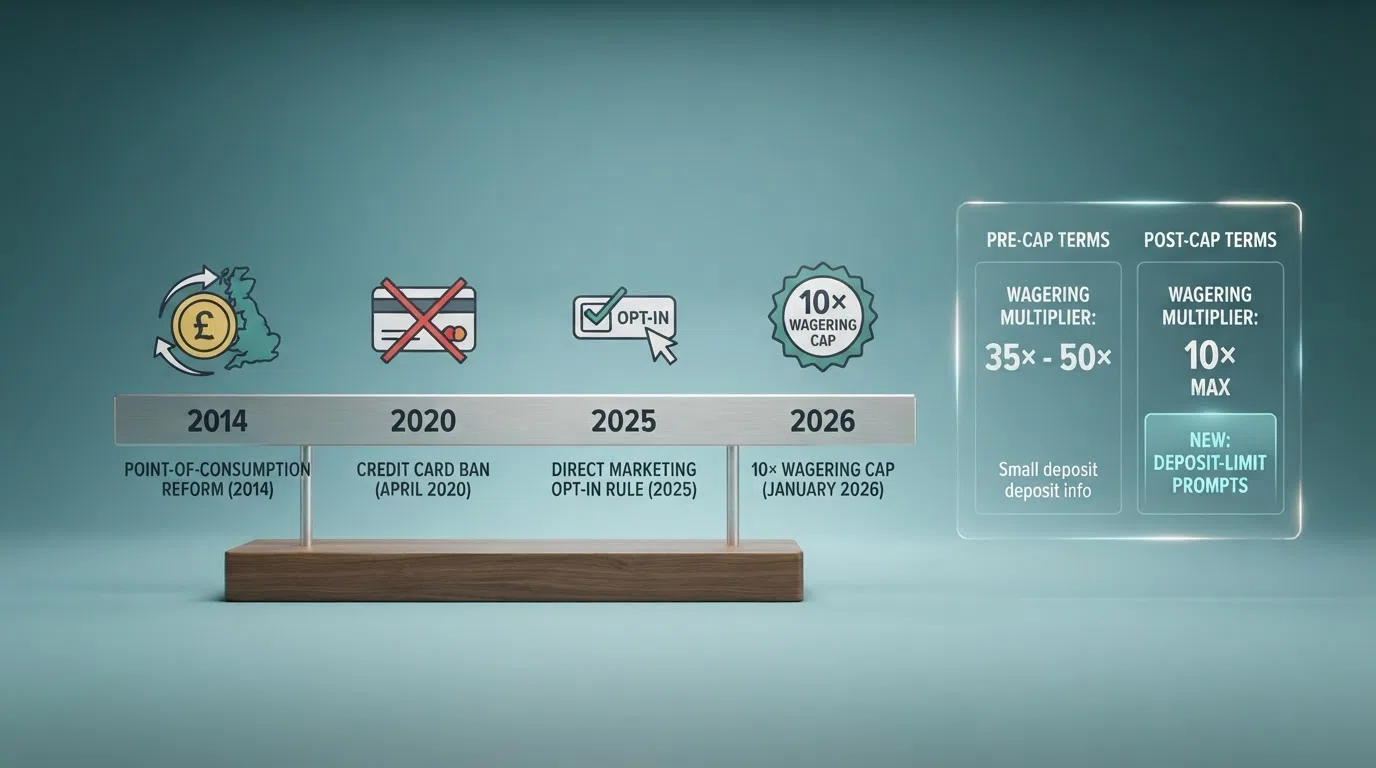
Every term on a first deposit bonus traces to a specific code provision. The 10× wagering cap is LCCP Social Responsibility Code 5.1.1, in force from 19 January 2026. The mixed-product ban is the same code, same date. The direct marketing opt-in rule is LCCP SR Code 5.1.12, in force from 1 May 2025. The credit card ban is LCCP licence condition 6.1.2, in force since 14 April 2020. The deposit-limit prompt is RTS 12, in force from 31 October 2025. The £150 financial vulnerability check is LCCP SR Code 3.4.4, in force from 28 February 2025. The provisions are not abstract; they are the clauses that shape every offer a UK player sees.
The Commission does not cap the monetary value of a bonus. A 100% match up to £1,000 is legal; a 500% match up to £100 is legal. The cap is on the wagering multiplier (10×), not on the bonus size. The cashout cap is set by the operator, not the Commission. The game eligibility is set by the operator. The expiry is set by the operator. What the Commission controls is the structure: how much play the player must do before the bonus converts.
How Wagering Requirements Actually Work — the Arithmetic the Operator Hopes You Skip
The formula is bonus × multiplier = turnover. A £10 bonus at 10× wagering requires £100 of qualifying play. A £100 bonus at 10× requires £1,000. The turnover is not deposits; it is the total amount wagered across eligible games during the validity window. A player who deposits £10, receives a £10 bonus, and wagers the £10 bonus plus their £10 deposit ten times over (£200 total wagered) has cleared the requirement.
Game weighting changes the effective multiplier. A player who wagers on live blackjack at 10% weighting needs £1,000 of live play to clear £100 of wagering. The 10× bonus is, in practice, a 100× bonus on live blackjack. The headline understates the cost; the weighting reveals it.
The stake caps interact. A player aged 25 or over can wager up to £5 per spin on slots; a player aged 18–24 is capped at £2 per spin. A £1,000 wagering requirement at £2 per spin is 500 spins; at £5 per spin, it is 200 spins. The younger player takes two and a half times as long to clear the same bonus. The 10× cap did not change the stake caps, but the caps apply to the player’s own money during bonus play, and a player who tries to speed through the wagering with a £10 spin will see the bet rejected.
Withdrawing early voids the bonus and the winnings. A player who requests a withdrawal before the wagering requirement is cleared forfeits the bonus funds and any winnings derived from them. The deposit may be returned; the bonus will not. The rule is the same at every UK-licensed operator.
What a Player Gives Up With a No-Wagering Offer — the Trade-Off Nobody Mentions
A no-wagering bonus pays winnings as cash, but it offers fewer spins or a smaller match than a wagered offer would. PlayOJO’s 50 no-wagering spins versus William Hill’s 200 spins at 10× is the clearest comparison: PlayOJO gives 50 spins, no conditions; William Hill gives 200 spins, 10× wagering, £30 cap, 72-hour expiry. The 200 spins have four times the face value. The 50 spins have one-tenth the expected cost.
The expected value calculation: 50 spins at 10p with 96.71% RTP returns, on average, £4.84 raw, with no wagering to clear. William Hill’s 200 spins at 10p returns, on average, £19.34 raw, subject to 10× wagering (which costs £7.74 in expected loss on the wagering turnover) and the £30 cap. The capped outcome of the William Hill offer depends on how often the cap binds; a strong run hits the £30 ceiling before the wagering clears, and a weak run never approaches it. The 50-spin no-wagering offer has a tighter range of outcomes: low variance, low ceiling, no hidden costs. The 200-spin 10× offer has a wider range: higher variance, higher ceiling, and a £30 cap that binds in the most favourable scenarios.
The trade-off is: fewer guaranteed pounds (PlayOJO) versus more pounds with a ceiling and a clock (William Hill). The 10× cap compressed the spread enough that the no-wagering structure became dominant; the post-cap operator can afford to offer no wagering because the cost of doing so is now close to the cost of running a wagered offer. The 21% Remote Gaming Duty that applied before April 2026 left less room; the 40% rate leaves even less, but the competitive pressure to offer zero wagering offsets the margin pressure.
The Route Inside the Licensed UK Market: How to Verify a Casino Is Real
The UKGC public register is the single source of truth. A brand name on a comparison page, an operator logo on a banner, a “UK-facing” tagline in marketing copy: none of these are verification. The public register, searchable at the Commission’s website, lists every licensed entity by name, account number, licence type, and status. A player who wants to confirm a casino is GB-licensed should search the register for the operating company name, not the brand name. PlayOJO operates under SkillOnNet Ltd; bet365 under Hillside (UK Gaming) ENC; Sky Vegas and Paddy Power under PPB Entertainment Limited and Bonne Terre Limited respectively (both Flutter); William Hill under William Hill Organization Limited; 888 under 888 UK Limited (evoke); Ladbrokes under LC International Limited (Entain); Betfred under Petfre (Gibraltar) Limited; LeoVegas under LeoVegas Gaming PLC; Betfair under PPB Entertainment Limited (Flutter).
Multiple brands on the same register entry is normal. The Flutter group operates Sky Vegas, Paddy Power, and Betfair under overlapping but distinct entities. The Entain group operates Ladbrokes, Coral, Gala, and Foxy Bingo under LC International Limited. A player who self-excludes via GAMSTOP is excluded from all brands under any operator group that shares a licence; the group structure does not create a loophole.
A GB licence has been compulsory at point of consumption since the 2014 Act. Operating without one is a criminal offence under section 33 of the Gambling Act 2005 — up to 51 weeks’ imprisonment and/or an unlimited fine. The enforcement target is the operator, not the player. The player’s loss is the protection gap, not a criminal record.
Playing Safely With a First Deposit Bonus: Limits, Self-Exclusion and the Numbers That Matter
A bonus is a marketing cost the operator spends to acquire a player’s custom. The safer-gambling tools the UK requires are the counterweight that keeps that custom inside limits the player controls. The two systems are designed to work together, and understanding how they interact is the difference between a bonus that enhances entertainment and a bonus that erodes it.
GAMSTOP self-exclusion became mandatory on every online Gambling Commission operating licence from 31 March 2020. The exclusion periods are six months, one year, five years, or five years with auto-renewal. Registration is single (one account excludes a player from every GB-licensed online site), cannot be cancelled early, and covers all brands under all operator groups. A player who registers with GAMSTOP cannot claim a first deposit bonus at any UK-licensed casino for the duration of the exclusion. The exclusion voids any active bonus and blocks new ones.
The financial vulnerability check at £150 net deposits (rolling 30-day period) is a mandatory trigger from 28 February 2025 under LCCP SR Code 3.4.4. When a player’s net deposits cross £150, the operator must conduct a check using publicly available data. The check is not a credit check; it is a vulnerability screen. A positive result triggers a proportionate response, which may include a conversation with the player, a deposit limit adjustment, or a pause on play.
The deposit-limit prompt before first deposit, mandatory from 31 October 2025, is the most visible safer-gambling intervention. A player who wants to claim a first deposit bonus must set a deposit limit before the deposit is accepted. Decreases to the limit take effect immediately; increases take effect after a cooling-off period (typically 24 hours). The standardised gross deposit limit must be offered by 30 September 2026.
The prevalence data sets the context. 47% of adults in Great Britain had gambled in the past four weeks (27% excluding lottery-only players), according to the Gambling Survey for Great Britain 2025 Year 3 data. NHS gambling referrals totalled 4,355 in 2024/25, up 91% from the previous year. The National Gambling Helpline (run by GamCare) made 996 referrals to treatment and peer-based support services in January 2026, up 48% year-on-year. The numbers are not a warning aimed at a particular player; they are the backdrop against which the safer-gambling architecture operates.
Setting Deposit Limits Before You Claim — the Prompt Is Not Optional
The deposit-limit prompt appears before the first deposit. A player who clicks through without setting a limit cannot proceed: the regulatory requirement is that the limit is set, not that the player consents to a default. The options typically include daily, weekly, and monthly limits, and the player can set all three.
A limit that accommodates the bonus deposit without exceeding what the player intends to spend is the right limit. A player who plans to deposit £10 for the welcome offer, play through the bonus, and not deposit again sets a £10 deposit limit. A player who plans to deposit £10 and potentially follow up with a second deposit of £20 sets a £30 weekly limit. The limit is a budget, not a constraint; the budget constrains the spend to what the player has decided to spend.
A decrease to the deposit limit takes effect immediately. An increase takes effect after a cooling-off period. The asymmetry is deliberate: removing access is instant, restoring access is delayed. A player who is in the moment and wants to raise the limit is asked to wait; a player who is in the moment and wants to lower the limit can do so right now. The architecture favours protection.
GAMSTOP and Your Bonus: What Self-Exclusion Does to an Active Offer
GAMSTOP registration voids any active bonus. A player who registers mid-wagering forfeits the bonus funds, the winnings derived from them, and the ability to claim any new bonus at any GB-licensed online casino for the duration of the exclusion. The exclusion is not a pause; it is a block. The player cannot undo it; the exclusion periods run their course regardless of subsequent intent.
The single-registration model means a player who self-excludes cannot open a new account at a different brand within the same operator group. The Flutter group, the Entain group, the evoke group: all blocked. The player who wants to gamble during an exclusion cannot do so at any UK-licensed online casino. The offshore route is not covered, which is one reason the Commission treats unlicensed play as a protection gap rather than a regulatory violation by the player.
How to Spot When Bonus Play Is Moving Past Entertainment
The structural features that make a first deposit bonus compelling are the same features that drive harm. The countdown timer on a 72-hour bonus creates urgency. The sunk-cost effect of “I have already wagered £600 of the £1,000” keeps a player at the reels when the rational choice is to walk away. The near-miss of a bonus round that almost lands pushes a player to “one more spin”. The free spin itself is a game design optimised for engagement, with the sound and visual feedback calibrated to keep the player spinning.
Recognising the shift from value-seeking to loss-chasing is the skill. A player who claims a 50-spin no-wagering offer, plays the spins, and stops is extracting the bonus’s value. A player who claims the same offer, wins £40 on the spins, and deposits another £100 to “play the winnings” is no longer extracting value; the bonus has become a gateway to unplanned spend. Time-tracking during bonus clearance helps: a player who intends to play for 30 minutes and finds themselves still at the reels two hours later is past the entertainment threshold.
The help resources are free, confidential, and available without registration. The National Gambling Helpline (0808 8020 133) is free, 24/7, and run by GamCare. The NHS gambling harm clinics operate in England, Scotland, and Wales. Gamblers Anonymous runs 12-step support groups. The Primary Care Gambling Service is a national service for anyone experiencing gambling-related harms. GamLearn is the Gambling Lived Experience and Recovery Network. A player who recognises the shift can reach any of these resources; the first call is the hardest, and the services are designed to make it easier.
How We Picked and Ranked These 10 UK Casinos
The ranking criteria, in order of weight: wagering multiplier, spin value, maximum cashout cap, and brand infrastructure. A 0× wagering offer outranks a 10× offer at the same spin count. A higher spin count outranks a lower one at the same wagering. An offer with no cashout cap outranks one with a cap. An offer from an operator with a strong licence, broad provider set, and reliable payments infrastructure outranks one without.
The verification source for licensing is the UKGC public register of licence holders. Every operator in the featured set was confirmed against the register before inclusion. The licence status, operating entity, and account number are drawn from the register, not from operator marketing.
The research scope is bonus terms, wagering multipliers, cashout caps, game eligibility, and expiry windows, collected from operator sites and affiliate data in 2026. The ranking adjusts for wagering: a comparison page that ranks by headline bonus value would place William Hill’s 200 spins above PlayOJO’s 50. The wagering-adjusted ranking places PlayOJO above William Hill because the 0× wagering on 50 spins is worth more than the 10× wagering on 200 spins once the cap, the clock, and the cashout ceiling are factored in.
The ranking does not measure game catalogue depth, customer support speed, or withdrawal processing time. A player who prioritises these factors should treat the ranking as a starting point, not a final answer. The ranking answers the question “where is the best first deposit bonus value?”; it does not answer “where is the best UK online casino?”.
What Your First Deposit Should Buy You in 2026
The UK first deposit bonus market has been reshaped by regulation into something simpler, safer, and more honest than it was in 2024. The 10× cap eliminated the worst of the wagering multipliers. The mixed-product ban eliminated the cross-product conditioning. The deposit-limit prompt made the safer-gambling architecture visible at the moment of bonus claim. The result is a market where a no-wagering offer with 50 spins is a more honest proposition than a 500-spin offer with 60× wagering, and a player comparing the two can see the difference without a calculator.
The decision framework is three steps. Check the register: confirm the operator is GB-licensed, with a current status, and note the operating entity. Compare wagering-adjusted value: the bonus face value is the least informative number; the wagering multiplier, the cashout cap, and the expiry window are the three that determine what the offer is worth. Set the deposit limit first: the prompt is a feature, not a hurdle, and the limit is the boundary that keeps the bonus play inside what the player intended.
The best offer is the one whose real cost the player can calculate before clicking claim. A no-wagering offer with 50 spins costs, in expected terms, the house edge on £5 of slot play. A 10× match with £100 costs, in expected terms, the house edge on £1,000 of play. Both are legal, both are licensed, both are available in the UK market. The player who understands the arithmetic picks the one that matches the budget.
Frequently Asked Questions
What is the maximum wagering requirement a UK casino can legally apply to a first deposit bonus?
The UK Gambling Commission capped wagering requirements on all casino bonus incentives at 10× the bonus amount, effective 19 January 2026 under LCCP Social Responsibility Code 5.1.1. No GB-licensed operator can legally apply a wagering multiplier above 10× to a first deposit bonus or any other casino promotion. The cap is the ceiling, not the floor; many operators offer bonuses at 0× wagering, and the competitive pressure post-cap has pushed the market toward zero-wagering spins as the dominant structure.
Which UK online casinos offer no-wagering free spins on a first deposit?
Eight of the ten featured operators in this ranking offer 0× wagering on first deposit free spins: PlayOJO (50 spins on Big Bass Bonanza), bet365 (up to 500 spins over 10 days), Sky Vegas (70 no-deposit + 200 deposit spins), Paddy Power Games (60 no-deposit + 200 deposit spins), Betfair Casino (200 spins), Betfred Casino (200 spins), Ladbrokes Casino (100 spins), and LeoVegas (50 spins on Big Bass Splash). William Hill Vegas and 888 Casino carry 10× wagering on their respective welcome offers.
Do I need a bonus code to claim a first deposit bonus at a UK casino?
No bonus code is required to claim a first deposit bonus at any featured operator in this ranking. The offers credit automatically on deposit, or after a qualifying stake, without a token. The credit card-funded e-wallet ban and the credit card ban both apply; some operators run time-limited promotional codes for reload offers, but the first deposit welcome offers in the featured set do not require them.
Are Skrill and Neteller deposits eligible for first deposit bonuses at UK casinos?
Skrill and Neteller deposits are routinely excluded from bonus eligibility at UK-licensed casinos, though they credit the player’s account. The exclusion is operational: the operator cannot verify the source of e-wallet funds with the same certainty as a debit card transaction. PayPal is specifically excluded at LeoVegas and is treated as ineligible for bonuses at several other featured operators. A debit card is the universally accepted deposit method for bonus eligibility.
What happens to my active first deposit bonus if I register with GAMSTOP?
GAMSTOP registration voids any active bonus and blocks new ones at every GB-licensed online casino for the duration of the exclusion. The exclusion periods are six months, one year, five years, or five years with auto-renewal; the exclusion cannot be cancelled early. A player who self-excludes mid-wagering forfeits the bonus funds and any winnings derived from them, and cannot open new accounts at any brand within any operator group covered by the licence.
What is the difference between a match bonus and free spins on a first deposit?
A match bonus credits a percentage of the player’s deposit as bonus funds, which must be wagered before converting to cash. 888 Casino’s 100% match up to £100 at 10× wagering is an example: a £100 deposit produces £100 in bonus funds requiring £1,000 of qualifying play. Free spins credit a fixed number of game rounds at a fixed stake, with winnings either paid as cash (no wagering) or subject to a multiplier. Match bonuses are rarer in the post-cap market because the wagering cost scales with the bonus amount; free spins are the dominant structure because the stake value is bounded.
Can You Use a First Deposit Bonus on Live Casino Tables?
Most operators exclude live casino from bonus play entirely. The few that allow it weight contributions at 10%–20%, which makes clearing a bonus on live casino impractical for any wagering multiple above 0×. A 10× bonus on live blackjack at 10% weighting requires £10 of live play for every £1 of bonus obligation cleared, which is 100× the effective wagering. The player would need 100× the expected loss to clear the same bonus.
The live dealer product is available at every featured operator — Evolution is listed as a provider across the set — but the bonus terms do not reward playing it. A player who wants to play live casino with a first deposit bonus should look for a no-wagering offer, where the weighting does not apply because there is no wagering requirement to weight.
Is a £1 First Deposit Bonus Real in the UK?
Search volume for £1 and £5 deposit casinos is significant, and the intent is clear: a player who can deposit £1 and receive a playable bonus is testing the market without commitment. The GB-licensed market does not offer this product. The low-deposit offers that exist in the UK (bingo sites, lottery sites) are not casino bonuses and carry different terms.
The offshore market does offer £1 deposit bonuses, usually at Curaçao-licensed operators. A player who deposits £1 at an offshore casino receives a bonus and plays under the offshore operator’s terms. The protection gap is the point: no GAMSTOP coverage (the player cannot self-exclude via the offshore route), no ADR (alternative dispute resolution), no Commission complaints route, no guarantee of fund segregation. A £1 deposit bonus at an unlicensed operator is a real bonus in a real casino; it is not a real bonus in a safe casino.
App vs Browser: Does How You Claim Change What You Get?
The bonus terms do not care whether the player tapped an app icon or loaded a URL. The claim flow, however, can differ. Apps may handle push notifications for bonus expiry reminders, which a browser cannot. Apps may offer biometric login (fingerprint, face), which speeds the verification step. Browser-based claims work on any device without a download, which matters for a player who wants to claim once and walk away.
Payment-method availability can differ. Apple Pay and Google Pay are easier to invoke in a mobile app or browser than on a desktop, and some operators route Apple Pay transactions through a different processing path. The bonus eligibility is the same; the deposit mechanism is not.
A player who values speed should use the app. A player who values flexibility should use the browser. The bonus is the same either way.
No-Wagering First Deposit Bonuses: Are They Real and Where Do They Sit?
No-wagering bonuses are real. They are the highest-value structure on the UK market, according to the British Gambler comparison site, and eight of the ten featured operators use them. “No wagering” does not mean “no conditions”: a no-wagering offer still requires a deposit, a qualifying stake, an expiry window, and a game list. What it does not require is playthrough on the spin winnings.
The eight zero-wagering operators in the featured set are PlayOJO, bet365, Sky Vegas, Ladbrokes, Paddy Power, Betfred, LeoVegas, and Betfair. William Hill Vegas and 888 Casino carry 10× wagering. The 10× cap made zero-wagering the competitive norm because at 10× the maximum, a zero-wagering offer is only 10 percentage points away from the cap; the competitive pressure to reduce wagering to zero is strong when the ceiling is low.
Promotions – trustedcasinos-notongamstop
Content created by the «trustedcasinos-notongamstop» team