
Non-UK Registered Casinos in 2026: The Honest Player's Guide
 Available in GB
A non-UK registered casino is an online casino that takes British players without holding a Gambling Commission licence. The label is procedural, not exotic: a UKGC licence is the only thing separating the regulated market from the offshore one, and the offshore market is large enough that two of its biggest names, MyStake and DonBet, were named in a Bloomberg investigation in June 2026 as still accessible to UK users without a VPN. The label covers Curaçao houses, Anjouan shells, MGA-licensed brands that choose not to enter Britain, and a long tail of Costa Rica registrations that sit closer to incorporation than regulation. The single trait they share is the absence of a GB licence, which is also the single trait that makes them interesting to the British players searching for them.

Current as of September 9, 2026 · Licence and operator claims checked against the Gambling Commission’s public register and each jurisdiction’s own register where accessible.
What “Non-UK Registered Casino” Actually Means
“Registered” is the operative word. In British gambling law it means a single thing: holding an operating licence from the Gambling Commission, the statutory regulator under the Gambling Act 2005. The Commission’s remit comes from the Gambling (Licensing and Advertising) Act 2014, which made a GB licence compulsory at the point of consumption — meaning any operator, wherever it is incorporated, must hold one before accepting a single bet from a player in England, Scotland or Wales. A “non-UK registered” casino is simply an operator that has not done that. It is not, despite the marketing language, an alternative regulator: it is the absence of one.
The non-UK label is shorthand for one of four offshore licensing homes. Curaçao, the largest by operator count, restructured its framework in December 2024 under the National Ordinance on Games of Chance (LOK) and now issues all licences directly through the Curaçao Gaming Authority in the format OGL/YYYY/NNN/NNNN. Anjouan, in the Union of the Comoros, has emerged as the second-most-common jurisdiction, with lower annual fees and a faster application process that have pulled in operators priced out of Curaçao or unwilling to wait. Malta (MGA) brands occasionally appear in this list, but the MGA itself does not authorise transactions with GB consumers — an MGA licence is not a route into the British market. Costa Rica completes the quartet, and is the one a player should treat with the most caution: it is a registration jurisdiction, not a regulatory one, with no formal dispute resolution and no licence number in the conventional sense.
The Commission’s own position, surfaced through a Freedom of Information disclosure, is blunt: “A licensed operator (or an operator applying for a license) based in Curaçao is not permitted to offer gambling services within the UK without a license from us.” A Curaçao licence has no standing in the British market. The same logic extends to every other offshore jurisdiction on the list.
Why British Players Look Beyond the UKGC
The most common reason a British player searches for a non-UK registered casino is GamStop — the national self-exclusion scheme that has been a mandatory condition of every UKGC online operating licence since 31 March 2020. GamStop is licence-bound. It works because every GB-licensed operator checks the central database at registration, but the database stops at the British border. A player who has self-excluded and then opened an account with an offshore casino has not bypassed a technical barrier; they have stepped outside the system that contains the barrier. No amount of will power at the offshore operator’s end can replicate what GamStop does, because the offshore operator is not a participant.
GamStop is not the only pull. The UKGC’s regulatory perimeter has tightened steadily, and each tightening has driven a category of player to look for a less restricted option. Slot stake caps now sit at £5 per game cycle for players aged 25 and over and £2 for those aged 18 to 24, imposed by SI 2025/215. Bonuses are capped at 10× wagering under the LCCP Social Responsibility Code since December 2025. Credit cards have been banned for remote gambling since April 2020, including credit-card-funded e-wallet chains. Auto-play is banned, spin speed is capped at 2.5 seconds, and operators must run a financial vulnerability check at a £150 net deposit threshold in any rolling 30-day period. None of these are bad rules. All of them compress what an operator can offer, and the gap between the regulated offer and the offshore offer widens with each one.
The offshore side answers with higher welcome figures, bonuses carrying 35× to 65× wagering, stake sizes that the UK rules would forbid, and credit card acceptance that the UK rules have banned. Whether any of that is worth the trade is the question this page exists to help a player answer.
The Non-UK Casino Landscape at a Glance
The regulated British market is not small. The Gambling Commission reported online Gross Gambling Yield of £1.55 billion in Q1 2026, a 7% year-on-year rise driven largely by slots, which were up 12%. That is the size of the market the offshore sector sits alongside — significant, growing, and tightly controlled. The offshore sector is harder to size because it does not report to a single regulator, but the Bloomberg/Coalition to End Gambling Ads investigation in June 2026 found major non-UK brands still accessible to British users without a VPN, and the UKGC’s own enforcement data shows 3,140 disruption notices issued to offshore operators between April 2024 and June 2025, with 447,778 URLs referred to search engines and 287,961 removed. The scale is real, and so is the regulator’s response to it.
The shape of the offshore market has shifted in the last two years. Curaçao’s LOK reform in December 2024 abolished the old sub-licence system — where four master licence holders issued permits under their own names — and replaced it with direct CGA oversight, which is gradually improving standards but remains a step below the UKGC and MGA. Anjouan has absorbed operators priced out of, or impatient with, Curaçao’s re-licensing. Costa Rica registrations and unverified offshore licences fill the gaps below. Within that range sit crypto-first houses like BC.Game and CoinCasino, traditional casino suites like Candyland, high-volume aggregators like MrJones, and long-running Curaçao operators like MyStake that have weathered the regulatory shifts without moving jurisdiction.
The Legal Reality: Can a UK Player Legally Use an Offshore Casino?
The legal answer is two-sided, and the two sides are not symmetric. Section 33 of the Gambling Act 2005 makes it a criminal offence to provide facilities for gambling in Great Britain without the required licence — punishable by up to 51 weeks’ imprisonment (six months in Scotland), an unlimited fine, or both. The target of that section is the operator, not the player. No UK player has been prosecuted for using an offshore casino, and the practical consequence of playing is not legal jeopardy: it is the loss of every UKGC protection that the player would otherwise sit inside.
The Gambling (Licensing and Advertising) Act 2014 closed the obvious loophole. Before 2014, a Gibraltar- or Malta-licensed operator could take British players without holding a British licence, because the licence was required at the point of supply. The 2014 Act moved the requirement to the point of consumption, so any operator taking a British player now needs a UKGC licence regardless of where the operator itself sits. An offshore operator that takes a British player is breaking the law. The British player is not. That is the entire legal position in one paragraph, and every other framing either inflates the risk to the player or downplays the risk to the operator.
The Operator Breaks the Law — the Player Does Not
Section 33 reads as a blunt instrument and works as a precision one. The criminal liability sits with the operator: the person who provides the gambling facilities without the required licence. Penalties on conviction are serious — up to 51 weeks’ imprisonment, an unlimited fine, or both — and the Commission’s enforcement activity targets that exposure. The player who places the bet has no corresponding offence under the Act. The reason is structural: the statute is drafted around the supply of facilities, not the consumption of them, and the Commission’s own compliance activity follows that drafting.
The practical cost to the player is not legal. It is regulatory. A player at an offshore casino cannot complain to the Commission, cannot access an approved alternative dispute resolution (ADR) provider, and cannot rely on the fund segregation, KYC timing, and affordability checks that a UKGC licence mandates. The Commission is not in a position to help a player recover funds from an operator it has no authority over. That is the cost — and it is real even though it never appears in a court docket.
UKGC Enforcement: 3,140 Disruption Notices and Counting
The Commission’s response to the offshore market is disruption, not blocking. The toolkit runs through cease-and-desist notices, search-engine delisting, domain registrar work, and payment-provider referrals, and the numbers between April 2024 and June 2025 give a sense of the scale: 3,140 disruption notices issued, 447,778 URLs referred, 287,961 URLs removed, and an average 32% drop in engagement across 160 disrupted sites. The Commission has proposed legislation that would grant it statutory ISP and DNS blocking powers, but those powers do not yet exist. The June 2026 Bloomberg report found that even after that enforcement activity, MyStake and DonBet remained accessible to UK users without a VPN, which is the gap the proposed blocking powers are meant to close.
The enforcement numbers are not a sign of failure. They are the shape of what the Commission can do with the powers it has, and they explain why offshore operators keep appearing and reappearing under new domains. The 32% engagement drop after disruption is meaningful — it suggests the notices work at the margins — but it is not the same as a block at the network level, and the difference is what the offshore market continues to use.
GamStop vs Non-GamStop Casinos — the Trade-Off That Costs You Real Protection
GamStop is the single most concrete boundary between the UKGC system and everything outside it. Mandatory for every GB-licensed online operator since 31 March 2020, it offers exclusion periods of six months, one year, five years, or five years with auto-renewal, none of which can be cancelled early, and it continues to flag a record for up to seven years after expiry if the player does not contact the service. It is the reason the most common reader of a non-UK casino page is an excluded player, and it is the reason that reader is the most exposed.
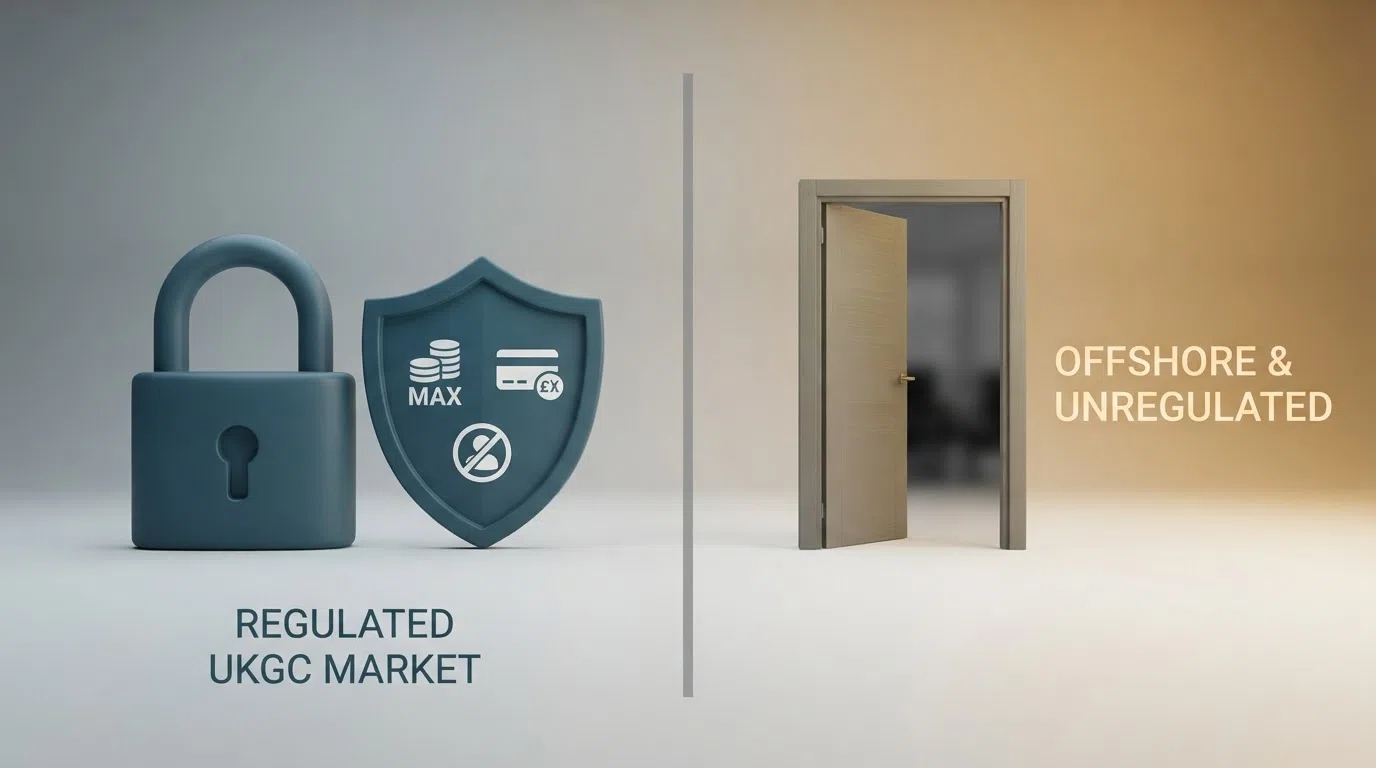
The trade-off runs in two directions. Inside the UKGC system, a player gives up the freedom to place large-stake bets, to use a credit card, to claim a bonus with 35× wagering, and to play on a site that does not check the GamStop database. Outside it, the same player gives up every statutory protection the UKGC system provides: the slot stake cap, the wagering cap, the credit card ban, the deposit-limit prompt, the £150 vulnerability check, the ADR route, and the fund segregation requirement. The two sides of the trade are not equivalent. One is a set of restrictions the player can see; the other is a set of protections the player can only miss when something goes wrong.
GamStop: What Britain’s Self-Exclusion Scheme Covers — and Where It Stops
GamStop’s mechanism is the licence condition. Every UKGC-licensed online operator must check the central database at registration and refuse entry to anyone on it. The system works because the licence is the price of doing business in Britain, and a single breach is enough to put that licence at risk. The exclusion is robust inside the system: it covers every GB-licensed site, runs for the full period the player chose, and cannot be lifted early. The follow-up is also robust: the record stays on file for up to seven years after the chosen period ends, unless the player actively contacts GamStop to close the account.
What GamStop cannot do is reach an operator outside the GB licensing system. It is not a piece of software installed on the player’s device; it is a database the operator checks. An offshore casino is not a participant, has no obligation to check, and in the majority of cases does not check. A self-excluded British player who opens an account at a non-GamStop casino is not protected by the system they entered, and the system has no mechanism to close the gap. That is the precise boundary at which the responsible-gambling conversation moves from the UKGC to the player.
The UKGC Safety Net: Seven Protections You Leave Behind
The protections that disappear the moment a player steps outside the UKGC system are not abstract. They are specific, dated, and in several cases have been tightened within the last eighteen months. The list below is what a British player at a UKGC-licensed site takes for granted, and what a non-UK registered casino is not required to provide.
- Statutory slot stake caps. £5 per game cycle for players aged 25 and over (in force 9 April 2025); £2 for players aged 18 to 24 (in force 21 May 2025), imposed by SI 2025/215. There is no equivalent cap at non-UK casinos.
- Wagering requirement cap. 10× maximum on bonus funds since 19 December 2025 under LCCP Social Responsibility Code 5.1.1. Offshore bonuses commonly run 35× to 65×.
- Credit card ban. All credit card payments, including credit-card-funded e-wallet chains, banned for remote gambling since 14 April 2020 under LCCP 6.1.2. Offshore casinos commonly accept Visa and Mastercard.
- Pre-first-deposit identity verification. Name, address and date of birth must be verified before the first deposit or first bet, in force since 7 May 2019. Many offshore operators verify only at withdrawal.
- Mandatory deposit-limit prompt. Operators must prompt the player to set a financial limit before the first deposit, in force since 31 October 2025. Non-UK casinos have no equivalent obligation.
- Financial vulnerability checks at £150 net deposit threshold. Triggered in any rolling 30-day period, using publicly available data only, in force since 28 February 2025. No equivalent check offshore.
- Auto-play ban and 2.5-second spin speed cap. Auto-play is banned; spin speed may not exceed 2.5 seconds; losses disguised as wins are banned. None of these apply offshore.
Beyond the Caps: Dispute Resolution, Fund Segregation and Mandatory KYC
The structural protections are the ones a player only notices when they break. A UKGC-licensed operator must belong to an approved ADR provider, must hold player funds in a segregated account, and must verify identity before the first deposit. None of these obligations sit in the offshore system by default. Curaçao and Anjouan do not typically enforce fund segregation, though MGA-licensed brands do, and Costa Rica-incorporated operators often have no segregation at all because the jurisdiction does not require it. The MGA route does not help a British player directly, because the MGA does not authorise transactions with GB consumers — an MGA-licensed brand can be a safer operator without becoming a UK-regulated one.
KYC timing is where the gap shows most clearly in practice. A UKGC site must verify name, address and date of birth before the first deposit. An offshore site can — and many do — defer verification to the point of withdrawal. The first deposit is frictionless; the first withdrawal is where the player discovers what verification looks like. A player who has been depositing and playing for weeks without verifying is, at the moment of withdrawal, asking the operator to do a check the operator has not been doing all along. The result is variable, and the player has no ADR route if it goes badly.
The Commission has also announced Stage 1 financial risk assessment thresholds — £5,000 net deposits in 24 hours for players aged 25 and over, and £2,500 for those under 25 — with final thresholds of £1,000/£3,000 (25+) and £750/£2,000 (under 25). The start date has not been confirmed. When the checks commence, they will add another layer that non-UK casinos will not be required to mirror, and the cost gap between the regulated and offshore offers will widen again.
Why Your 2026 Non-UK Bonus Looks Larger Than It Really Is
The arithmetic is the part the marketing does not show. A 200% welcome bonus at 40× wagering means the player must turn over the bonus amount forty times before any withdrawal is permitted — on a £100 bonus, that is £4,000 in qualifying bets before the bonus funds convert to withdrawable cash. The UKGC’s 10× cap, in force since 19 December 2025, makes that offer illegal at a British site. The offshore equivalent, with the same headline, asks for four times the play.
The gap is wider than the wagering multiple suggests. UKGC-licensed operators pay 40% Remote Gaming Duty from 1 April 2026, up from 21% under the Autumn Budget 2025, and a separate statutory levy of 1.1% for remote casino licences since 6 April 2025, with proceeds split 50% treatment, 30% prevention, 20% research. Offshore operators pay neither. The duty and levy are the reason a UK-licensed welcome package is smaller than its offshore equivalent: the operator is funding a chunk of the British treatment and prevention infrastructure with every spin. A player who moves offshore to claim a bigger bonus is, in part, moving offshore to avoid paying for the system that would protect them if something went wrong.
The wagering multiple is the visible half of the bonus cost. The duty and levy are the invisible half. Both make the same offer worth less than the headline suggests, and both are honest costs the player should price in before comparing a 200% welcome package at 40× to a 100% welcome package at 10×.
Slots, Live Dealer and Table Games — What Stays Available Outside GamStop
The game library at a non-UK casino is broadly similar to a UKGC-licensed one. The same providers — Pragmatic Play, Hacksaw Gaming, BGaming, Evolution for live dealer — appear on both sides of the line, and the same titles, including branded slots, jackpot games and live dealer tables, are usually available. Where the catalogues diverge is in the restrictions around them: no £5 or £2 stake cap offshore, no auto-play ban, no 2.5-second spin speed cap. A player who wants to stake £20 a spin on a UKGC-licensed slot cannot do so legally at a UK site; the same stake at a non-UK site is unremarkable.
Slots are the segment most affected by moving offshore. They were up 12% year-on-year in Q1 2026, the largest single contributor to the £1.55 billion online GGY, and the most exposed to the £5/£2 cap at the regulated end. Live dealer is available at most of the larger non-UK operators — Candyland carries live streams, and most Curaçao-licensed casinos integrate Evolution or Pragmatic Play Live — and the experience is broadly comparable to a UK site. Table games, video poker and specialty games round out the catalogue without significant gaps either way. The game itself is rarely the reason a player moves offshore. The terms around the game are.
Gamban, Betblocker and the Tools That Cross the Border
The self-exclusion gap is real, but it is not the end of the conversation about tools. Gamban and Betblocker are device-level blocking tools that work on any site, regardless of the operator’s licence jurisdiction. Gamban blocks gambling sites and apps at the device level, which means it works on offshore casinos in a way GamStop does not. Betblocker does the same job through a different mechanism. Both are free for UK residents.
The tools are not equivalent to GamStop. GamStop is a database operators check; Gamban and Betblocker are software the player installs. A determined player can uninstall them, while a self-excluded player cannot lift a GamStop exclusion early. The research on effectiveness is consistent, though: combining emotional support, self-exclusion and blocking tools produces better outcomes than any single strategy alone. The practical recommendation is layered — keep Gamban or Betblocker installed, maintain contact with a support service, and do not rely on a single tool to do the work of a system.
Payment Reality: Why PayPal Will Not Work and Credit Cards Will
Payment methods are the most concrete difference between a UKGC-licensed site and a non-UK casino, and the differences run in opposite directions. PayPal does not work at non-GamStop casinos. PayPal’s acceptable use policy restricts gambling transactions to operators in regulated markets, and offshore casinos outside UK licensing fall outside that policy. The result is not a PayPal decision about any individual site; it is a structural exclusion from PayPal’s gambling policy. A player who wants PayPal has to play at a UKGC-licensed site.
Credit cards run the other way. Visa and Mastercard deposits and withdrawals are commonly accepted at non-GamStop casinos — MrJones is one confirmed example — and the UKGC’s credit card ban, in force since 14 April 2020, has no equivalent offshore. E-wallet-to-credit-card chains that are blocked at the UK end work offshore. The same player who cannot use a credit card at bet365 can use one at MrJones. Cryptocurrencies are widely supported at non-GamStop casinos: CoinCasino accepts 150+ coins, the widest range in the featured set, and Bitcoin, Ethereum and stablecoins are common at most Curaçao- and Anjouan-licensed houses. Pay-by-mobile and Boku appear at some non-UK operators, though not all. The payment mix at a non-GamStop casino is wider than at a UKGC site, and the wider mix is part of the appeal.
How to Spot a Safe Non-UK Casino — and the Red Flags Most Players Miss
Verification is the only thing standing between a player and an unsafe operator, and the verification is not difficult. The first check is the licence number. A Curaçao CGA licence since December 2024 appears in the format OGL/YYYY/NNN/NNNN and can be cross-referenced against the CGA’s public register. An Anjouan licence appears on the Anjouan Gaming Authority’s site, and the operator’s claimed licence number should resolve there. An MGA licence can be checked on the MGA’s public register. A Costa Rica-registered operator typically has no licence number to check, which is itself the answer to the verification question.

The second check is the operator. A legitimate operator will publish a corporate entity name — Santeda International B.V. for DonBet, SSC Entertainment N.V. for Candyland, AXENTRA LTD for Winorio — and that name can be searched. The third check is the terms. A real operator publishes its wagering requirements, its maximum cashout, its withdrawal times, and its restricted-country list. An operator that does not, or that buries the terms in a footer link, is signalling the kind of operation it runs.
The fastest red flag is a casino that markets itself specifically to self-excluded UK players as a selling point. The marketing is not subtle: “play even if you’re on GamStop” is a direct pitch to a vulnerable population, and the operators who run it are unlikely to be running robust player-protection programmes alongside it. The same operators tend to skip KYC at registration, offer bonuses with punitive terms, and make withdrawal a process rather than a transaction. None of that is impossible to find at a non-UK casino, but it concentrates in the same places.
Reading the Licence: Curaçao, Anjouan, Malta and Costa Rica Compared
| Jurisdiction | Regulator | Player protection | Dispute resolution | Fund segregation | UK legal standing |
|---|---|---|---|---|---|
| Curaçao (post-LOK) | Curaçao Gaming Authority (CGA), direct licensing under OGL/YYYY/NNN/NNNN format | Improving since December 2024 reform; below UKGC and MGA standards | CGA-mediated; limited ADR | Not consistently enforced | UKGC FOI: “A licensed operator … based in Curaçao is not permitted to offer gambling services within the UK without a license from us” |
| Anjouan (Comoros) | Anjouan Gaming Authority | Lower annual fees (~€17,800) and faster application; formally prohibits UK-resident service, widely ignored | Limited | Typically not enforced | Same as Curaçao: no UK standing |
| Malta (MGA) | Malta Gaming Authority | Robust regulator; well-established player-protection framework | MGA-mediated ADR | Required | Does not authorise transactions with GB consumers — not a UK-market alternative |
| Costa Rica | None (registration jurisdiction) | None in the regulatory sense | No formal dispute resolution | Not required | No UK standing; no licence number to verify |
The table does not flatten to a single answer. Curaçao post-LOK is the strongest of the four offshore options, but it is still a step below the MGA, and the MGA is not a route into the British market. Anjouan is a faster, cheaper Curaçao for operators who do not want to wait for CGA re-licensing, with the same limitations. Costa Rica is the bottom of the table for a reason, and the absence of a regulator is the absence of a complaint route when something goes wrong.
Red Flags That Signal an Unsafe Offshore Casino
The warning signs are consistent across the operators that have run into problems. The list below is the practical checklist to run before depositing at any non-UK casino, and the items are not in order of severity — any one of them is enough to stop.
- No verifiable licence number, or a licence number that does not resolve on the regulator’s public register
- No KYC before play, or KYC only requested at withdrawal after significant play
- Bonus terms that are vague about wagering requirements, maximum cashout, or game weighting
- No contact details beyond a web form, or a contact email that does not respond
- Marketing that pitches “no GamStop” or “play even if self-excluded” as a feature
- No responsible-gambling tools on the site — no deposit limits, no session limits, no self-exclusion option
How New Non-GamStop Casinos Changed in 2026
The non-UK market in 2026 is not the market of 2022. Curaçao’s LOK reform in December 2024 abolished the old sub-licence system and brought all Curaçao operators under direct CGA oversight, with the new OGL/YYYY/NNN/NNNN licence format making verification easier than it was under the master/sub-licence structure. Anjouan has absorbed operators priced out of Curaçao’s re-licensing or unwilling to wait, and now sits as the second-most-common offshore jurisdiction. The UKGC’s enforcement has escalated: 3,140 disruption notices and 447,778 URLs referred in fifteen months, a pace that has not slowed. The statutory levy (April 2025) and the Remote Gaming Duty increase to 40% (April 2026) have widened the cost gap between UK-licensed and offshore operators, which is part of why the offshore offers look larger. And financial risk assessments, announced in July 2026 with thresholds of £1,000 to £3,000 (25+) and £750 to £2,000 (under 25), have not yet commenced but will, when they do, push more high-depositing players to look offshore for higher caps and weaker friction.
10 Non-UK Registered Casinos Compared: 2026 Operator Picks
The ten operators below are all non-UK registered. None holds a Gambling Commission licence. They are presented as the operators that reach British players from outside the GB licensing system, ranked by topical relevance within licence-jurisdiction groups rather than a 1–10 score. Where a licence jurisdiction or specific operator detail is not confirmed from this research, the cell shows it.
| Operator | Licence and jurisdiction |
|---|---|
| MyStake | Curaçao (CGA) |
| DonBet | Curaçao (CGA), OGL/2024/250/0115 |
| BC.Game | Anjouan (Comoros); withdrew Curaçao licence December 2025 |
| ZetCasino | Offshore — jurisdiction not confirmed |
| Winorio | Costa Rica (licence issued March 2025) |
| CoinCasino | Anjouan (Comoros) iGaming authority |
| Betpanda | Costa Rica (registration, not regulatory) |
| Candyland | Curaçao (SSC Entertainment N.V.) |
| MrJones | Offshore — jurisdiction not confirmed |
| Prestige Casino | Offshore — jurisdiction not confirmed |
How We Evaluate Non-UK Registered Casinos
The evaluation is qualitative. There is no star rating, no numeric score, and no weighting the research does not carry. The criteria are: licence jurisdiction transparency (a verifiable licence number on a public register carries weight), independent reporting (the Bloomberg/Coalition to End Gambling Ads investigation in June 2026 is the most concrete recent data point), game-library scope (provider count, title count, provably fair offerings), payment-method range (crypto support, credit card acceptance, fiat options), and responsible-gambling tools on the site. The criteria are descriptive, not ranked, and the operator write-ups below are honest about what each one does and does not confirm.
MyStake — Curaçao Veteran Named in UK Enforcement Report
MyStake is a long-running Curaçao-licensed operator that has stayed on the right side of the UKGC’s disruption activity without ever holding a UKGC licence. It was named in the Coalition to End Gambling Ads report covered by Bloomberg in June 2026 as accessible to UK users without a VPN, which is a more specific data point than most Curaçao operators carry. The domain is Mystake.com. Specific game-provider and bonus details were not confirmed from this research. For a player who wants a Curaçao operator with a public paper trail of UK-facing activity, MyStake is the operator that has been named in print; for a player who wants that paper trail to include a UKGC licence, MyStake does not have one and never has.
DonBet — Curaçao CGA Operator with a Verifiable Licence Number
DonBet operates under a Curaçao CGA licence with the number OGL/2024/250/0115, which can be checked against the CGA’s public register, and is operated by Santeda International B.V. (also trading as GTW B.V.). Like MyStake, it was named in the Bloomberg/Coalition to End Gambling Ads report in June 2026 as accessible to UK users. The domain is Donbet.com. Specific game-provider and bonus details were not confirmed from this research. The verifiable licence number is the difference between DonBet and a Curaçao operator who asks a player to take the licence on trust.
BC.Game — Anjouan Crypto Pioneer with a Bankruptcy Ruling and 38+ Providers
BC.Game migrated from Curaçao to Anjouan in 2024 and formally withdrew its Curaçao licence in December 2025 following a bankruptcy ruling over approximately $2.5 million in unpaid player claims. It has operated since 2017 and runs 38+ providers, including 75+ provably fair BC Originals (Crash, Mines, Plinko). The headline offer is a 360% monthly deposit bonus, though the exact cap was not confirmed from this research. The Anjouan licence is the regulatory home; the bankruptcy ruling is the historical context a player should know about before depositing. The combination of crypto specialisation, provably fair in-house titles, and a documented financial dispute is what defines the BC.Game profile.
ZetCasino — Offshore Operator with Limited Public Data
ZetCasino holds an offshore licence whose specific jurisdiction was not confirmed from this research. The domain is Zetcasino.com. Game-provider and bonus details were not confirmed. ZetCasino represents a category of non-UK casino that discloses less about its regulatory status than the more transparent operators in the featured set, and the absence of a verifiable licence number is itself the information a player needs.
Winorio — Costa Rica Newcomer with 10,000+ Games
Winorio holds a Costa Rica licence issued in March 2025 and is operated by AXENTRA LTD. The domain is Winorio.com, and the catalogue runs to 10,000+ titles, the largest confirmed game count in the featured set. A multi-deposit welcome package is offered across three deposits, though exact terms were not confirmed. Costa Rica is a registration jurisdiction rather than a regulatory one, which means the licence number resolves to incorporation rather than oversight. The 10,000+ catalogue is the draw, and the regulatory home is the caveat.
CoinCasino — Anjouan Crypto Specialist with 150+ Supported Coins
CoinCasino holds an Anjouan (Union of Comoros) iGaming authority licence. The domain is Coincasino.com, and the headline feature is 150+ supported cryptocurrencies, the widest crypto range in the featured set. Provably fair in-house games run alongside third-party providers, and the platform is purpose-built for crypto play. Specific bonus details were not confirmed. For a player whose primary criterion is crypto support, CoinCasino is the strongest in the set by the coin-count metric; the Anjouan jurisdiction is the same caveat that runs through every operator on that licence.
Betpanda — Costa Rica-Registered Platform with No Formal Licence Number
Betpanda is incorporated in Costa Rica as Media S.R.L., and the domain is Betpanda.io. There is no formal licence number published, which is consistent with Costa Rica’s status as a registration jurisdiction rather than a regulatory one. There is no formal dispute-resolution mechanism, which is the same point made differently. Specific game-provider and bonus details were not confirmed. The absence of a licence number is the answer to the verification question.
Candyland — Curaçao Classic with Full Casino Suite and Live Dealer
Candyland is Curaçao-licensed and operated by SSC Entertainment N.V., which also runs DaVinci’s Gold, Pantasia, This is Vegas and Paradise 8. The domain is Candylandcasino.com. The catalogue covers slots, table games, video poker, live dealer streams, jackpots and specialty games, which is the closest thing in the featured set to a full-service traditional online casino. Specific bonus details were not confirmed. The sister-brand structure is a useful signal: SSC Entertainment N.V. has multiple properties, which suggests a long-running operation rather than a single-site launch.
MrJones — 70+ Providers, 9,200 Titles and Credit Card Deposits
MrJones holds an offshore licence whose specific jurisdiction was not confirmed from this research. The domain is Mrjonescasino.com, and the catalogue runs to 70+ providers (including BGaming, Pragmatic Play and Hacksaw Gaming) and 9,200+ titles, the most confirmed provider partnerships in the featured set. MrJones accepts credit cards (Visa and Mastercard) for deposits and withdrawals, which is the feature banned at UKGC-licensed sites since 14 April 2020. Specific bonus details were not confirmed. The combination of provider breadth, title count and credit card acceptance is what defines the MrJones profile, and the credit card acceptance is a clear example of the payment gap discussed earlier.
Prestige Casino — £2,000 Welcome Package and 48-Hour Withdrawals
Prestige Casino holds an offshore licence whose specific jurisdiction was not confirmed from this research. The domain is Prestigecasino.com, and Prestige is the only operator in the featured set with confirmed welcome-bonus figures and a confirmed withdrawal timeline. The welcome package is £2,000 plus 200 Free Spins plus Wheel Spins, with a minimum deposit of £20. Payment methods include cards, e-wallets and cryptocurrencies, with GBP, EUR, USD, AUD, CAD and crypto accepted. Withdrawals are processed within 48 hours. Specific game-provider details were not confirmed. For a player who weighs an offer by its concrete terms rather than its marketing, Prestige is the most legible entry in the set, and the unverified licence jurisdiction is the trade-off.
Playing Without the Safety Net: Responsible Gambling at Offshore Casinos
The UKGC’s mandatory player-protection infrastructure does not exist outside the UKGC system. GamStop cannot reach an offshore operator, the £150 financial vulnerability check has no offshore equivalent, the 10× wagering cap does not apply, and the credit card ban does not apply. The tools that do work — Gamban and Betblocker at device level, GamCare and the NHS gambling harm clinics at the support-service level — are available regardless of where the player chooses to play. The responsible-gambling conversation at a non-UK casino is therefore a player-led one: the operator is not required to set the boundaries, so the player sets them.
The help infrastructure on the British side is well-developed. GamCare runs the National Gambling Helpline on 0808 8020 133, available 24/7 with live chat and counselling also available. NHS gambling harm clinics are commissioned by NHS England from 1 April 2026, funded by the statutory levy at approximately £100 million per year. Gamblers Anonymous runs at ga.org.uk. The prevalence data from NHS England’s 2023–24 Adult Psychiatric Morbidity Survey puts problem gambling at 0.4% of adults (PGSI 8+), at-risk or problem gambling at 5% (PGSI 1+), and 82% of National Gambling Helpline callers in 2026 cited online gambling as the source of harm, the highest rate since the end of the pandemic. The National Gambling Treatment Service treated 11,960 clients in 2024/25, an 11% increase year-on-year, with a 93% improvement rate among those completing treatment. None of this depends on the licence jurisdiction of the casino the player uses.
The GamStop Coverage Gap — What Self-Excluded Players Need to Know
The GamStop coverage gap is the ethical core of this topic. GamStop is licence-bound and reaches every GB-licensed operator automatically; it cannot reach a single offshore operator. Non-GamStop casinos explicitly market to self-excluded UK players, and the marketing is direct: “play even if you’re on GamStop” is a pitch aimed at a population the UKGC’s regime exists to protect. The operator does not check the GamStop database because it is not a participant. The exclusion the player chose at a UK site is not transferred to the offshore site, and the player has no automatic block at the point of registration.
The alternative is device-level blocking. Gamban and Betblocker are free for UK residents and block access to gambling sites and apps at the device level, which means they work on offshore sites in a way GamStop does not. The tools are not equivalent — a determined player can uninstall them, while a self-excluded player cannot lift a GamStop exclusion early — but they are the available substitute, and the research on effectiveness consistently finds that combining emotional support, self-exclusion and blocking tools produces better outcomes than any single strategy alone. The layered approach is the responsible one.
Setting Your Own Deposit and Session Limits at Offshore Casinos
UKGC-licensed sites must prompt the player to set a financial limit before the first deposit, in force since 31 October 2025. Non-UK casinos have no equivalent obligation. Some offshore operators offer voluntary deposit-limit tools in their account settings, and the presence of those tools is a useful signal about how the operator treats player protection. The absence of limit-setting tools is itself a red flag: an operator that does not let a player set a deposit limit has decided not to make it easy to control spend, and that decision tends to correlate with other decisions the player should know about.
The practical alternatives for a player at a non-UK casino are: use a separate payment method with a hard monthly cap, install Gamban or Betblocker to enforce session breaks, and remember that the £150 financial vulnerability check that triggers at UKGC sites has no offshore equivalent. The player is setting their own boundaries, and the discipline required is higher because no operator is setting it for them. A player who would not be comfortable setting their own limits should consider whether the UKGC environment is the right one to be in, regardless of the catalogue.
UK Help Services That Work Whatever Casino You Use
The support infrastructure is independent of the casino. GamCare runs the National Gambling Helpline on 0808 8020 133, available 24/7, with live chat and counselling also available. NHS England took commissioning responsibility for gambling-harm treatment from 1 April 2026, funded by the statutory levy at approximately £100 million per year, and the NHS gambling harm clinics are the clinical entry point. Gamblers Anonymous runs at ga.org.uk. GambleAware provides information and signposting at gambleaware.org. NICE guidance NG248 recommends signposting to NHS triage services for anyone showing signs of gambling harm. The prevalence data — 0.4% problem gambling (PGSI 8+), 1.6% at least moderate risk (PGSI 3+), 5% at risk (PGSI 1+) — is from NHS England’s 2023–24 Adult Psychiatric Morbidity Survey, and the 11,960 clients treated in 2024/25 with a 93% improvement rate is from the National Gambling Treatment Service via GambleAware. None of these depend on whether the player is at a UKGC-licensed site or an offshore casino. The help is the same.
How We Selected and Evaluated These Non-UK Casinos
The operator set is drawn from the featured list in the research, ten non-UK registered operators that reach British players. Licence status has been verified against the Gambling Commission’s public register, and none of the ten holds a GB licence. Jurisdiction claims have been checked against each regulator’s public-facing register where accessible — the CGA for Curaçao licences, the Anjouan Gaming Authority for Anjouan licences — and where the jurisdiction could not be confirmed from this research, that is stated. The Bloomberg/Coalition to End Gambling Ads report from June 2026 is the independent verification source for MyStake and DonBet’s accessibility to UK users. The evaluation criteria are licence transparency, track record, game-library scope, payment-method range, and responsible-gambling tools on site, and the assessment is qualitative throughout: no star ratings, no numeric scores, no percentage weightings.
What the Evidence Says About Playing at a Non-UK Registered Casino
The honest trade-off does not resolve to a draw. A non-UK registered casino offers features a UKGC site restricts — higher stakes, larger bonuses, credit card deposits, no GamStop barrier — and the appeal is real for the players who want them. The cost is also real. The player loses every statutory protection the UKGC system provides: the £5/£2 slot stake cap, the 10× wagering cap, the credit card ban, the pre-first-deposit KYC, the deposit-limit prompt, the £150 vulnerability check, the ADR route, the fund segregation requirement, and the GamStop barrier that an excluded player chose for a reason. The protection gap is not theoretical. The UKGC’s own enforcement data — 3,140 disruption notices, 447,778 URLs referred, 287,961 removed, a 32% engagement drop across 160 disrupted sites — confirms the Commission is actively fighting operators it cannot license, and the Bloomberg report confirms some of those operators are still winning. The bonus that looks larger costs more: 35× to 65× wagering against a 10× cap means more turnover before any withdrawal, and the duty and levy differential explains the gap that funds it. The self-exclusion gap is the hardest edge. A GamStop-registered player has zero protection at these sites, the operators know it, and several of them market on the basis of it.
The help infrastructure exists regardless. GamCare, the NHS gambling harm clinics, Gamblers Anonymous, Gamban and Betblocker all work whatever casino the player uses, and the responsible-gambling conversation is not dependent on the licence jurisdiction. The decision is the player’s, and it should be made with the trade-off visible. A player moving offshore to claim a larger bonus is funding the gap between the offer and the protection with the protection itself. A player moving offshore because they have self-excluded and want to keep playing is in the precise situation the system was built to prevent, and the offshore system has no equivalent answer.
Frequently Asked Questions About Non-UK Registered Casinos
What is the difference between GamStop and Gamban?
GamStop is a national self-exclusion database that every UKGC-licensed online operator must check at registration; it is licence-bound and cannot reach offshore operators. Gamban is a device-level blocking tool that prevents access to gambling sites and apps regardless of licence jurisdiction, and works on offshore casinos in a way GamStop does not. Gamban is free for UK residents but, unlike GamStop, can be uninstalled by a determined user.
Why does PayPal refuse transactions at non-GamStop casinos?
PayPal’s acceptable use policy restricts gambling transactions to operators in regulated markets. Offshore casinos outside UK licensing fall outside that policy, so PayPal does not process deposits or withdrawals at non-GamStop casinos. The restriction is structural, not a per-site decision, and applies to the entire offshore category.
Do non-UK casinos accept credit cards from UK players?
Yes. Non-GamStop casinos commonly accept Visa and Mastercard for both deposits and withdrawals, and MrJones is one confirmed example. Credit cards have been banned at UKGC-licensed remote gambling sites since 14 April 2020 under LCCP 6.1.2, including credit-card-funded e-wallet chains. The offshore acceptance is one of the payment differences that drives players across the border.
Are my gambling winnings from a non-UK casino tax-free in the UK?
Yes. UK residents pay no tax on gambling winnings regardless of where the operator is licensed. The tax on gambling in the UK is levied on the operator, not the player: Remote Gaming Duty rose from 21% to 40% from 1 April 2026 for UKGC-licensed operators, and offshore operators are not liable. The player keeps the full amount of any winnings in either case.
What is a Curaçao gaming licence and does it protect UK players?
A Curaçao gaming licence is issued by the Curaçao Gaming Authority under the National Ordinance on Games of Chance (LOK) framework that took effect on 24 December 2024, in the format OGL/YYYY/NNN/NNNN. The UKGC’s position, confirmed via FOI disclosure, is that a Curaçao licence has no standing in the British market. A Curaçao licence provides a baseline of operator oversight, but it does not provide UKGC protections, and a UK player at a Curaçao-licensed site has no access to UKGC complaints, ADR or fund segregation enforcement.
Do offshore casinos let you cap how much you deposit?
Some do, some do not. Non-UK casinos have no obligation to offer deposit-limit tools, and the absence of those tools is a red flag. Where the tools exist, they are voluntary, set by the player in account settings, and not enforced by a UKGC-style prompt. A player who wants a hard cap should also use a separate payment method with its own monthly limit, and consider installing Gamban or Betblocker to enforce session breaks.
Account – trustedcasinos-notongamstop
Content created by the «trustedcasinos-notongamstop» team