
Non UKGC Licensed Casinos: What UK Players Are Actually Signing Up For
 Available in GB
The category sits in a strange half-light. It is not a legal grey area in the strict sense: the Gambling Act 2005 is explicit about who faces criminal liability, and the answer is the operator, not the player who clicks through. What is grey is everything else: which protections travel with the licence, which evaporate at the border, and which “fully licensed” claims in a casino footer are doing any work at all. This page is a working through of those questions, anchored to the UKGC rules that take effect through 2026 and the offshore licences that the featured operators actually hold.

Data current as of September 9, 2026, verified against the UKGC public register, the MGA register, the Isle of Man GSC register and the Curaçao CGA register.
The Non-UKGC Casino, Defined: Offshore, Unregulated in the UK, and Sought-After
A non-UKGC casino is, at its simplest, a remote gambling operator that does not hold a licence from the UK Gambling Commission. That sentence sounds tautological; the substance lies in what the absence does. A UKGC licence, issued under the Gambling Act 2005, binds the operator to a particular set of conduct rules: stake limits on online slots, deposit limits, mandatory participation in GamStop, a 10x cap on bonus wagering, a credit-card ban, no cryptocurrency, fund segregation, and ADR. A non-UKGC operator is bound by none of those rules, because those rules attach to the licence. The operator’s own regulator decides what its rules are, and UK players have no automatic seat at that table.
The category has been sought-after for years, and the search landscape around it has hardened into a recognisable shape. Eight of the top ten results for the head term are listicle or guide hybrid pages, ranking offshore casinos alongside brief licensing explainers. None are academic, government or regulator pages. The commercial intent is clear, the editorial standards are variable, and the page that follows tries to do the part the listicles skip: a definition, a UKGC baseline to measure against, a map of the offshore licences, and the terminology tangle that the marketing exploits.
The Core Definition: What “Non-UKGC Licensed” Actually Means
The label is operational, not legal, and that is the first thing to get straight. A non-UKGC casino is any remote gambling operator that does not hold a UKGC licence. That covers almost the entire offshore industry, from Malta-licensed brands that meet most UK-equivalent standards down to Anjouan-licensed sites that meet almost none. The phrase does not mean “unlicensed anywhere.” A Curaçao-licensed casino is licensed; it simply is not licensed by the UKGC, and UK players therefore receive none of the protections a UKGC licence would attach to that operator.
For the operator, the practical consequence of not holding a UKGC licence is that offering remote gambling to GB consumers is a criminal offence under the Gambling Act 2005. The Commission and DCMS have said as much, plainly, in successive consultations. For the player, the consequence is different. UK players are not committing an offence by accessing a non-UKGC site; the criminal liability falls on the operator offering unlicensed services, not on the consumer who registers and deposits. That distinction is real and it matters, but it is also the limit of what “not illegal” gets you. Not illegal does not mean regulated, protected or safe. It means the state has chosen to pursue the operator rather than the player. Everything else is on the player.
The UKGC-Licensed Baseline: What a Regulated UK Casino Looks Like in 2026
The contrast only lands once the UKGC baseline is concrete, and the baseline in 2026 is denser than it has ever been. From 30 September 2026, online slots are subject to a statutory maximum stake of £5 per spin for adults aged 25 and over, and £2 per spin for adults aged 18 to 24. From 30 June 2026, every UK-licensed operator must offer customers a deposit limit based solely on the amount paid into the account; only that form of limit may be called a “deposit limit” at all, ending a long stretch in which operators could name a loss limit or a spend limit a “deposit limit” and call it compliant.
On top of that sit the affordability and bonus rules that took effect earlier in the year. The UKGC’s Financial Risk Assessment pilot triggers a check at net deposits above £1,000 in a rolling 24-hour period, or £3,000 in a rolling 90-day period, for adults aged 25 and over. For under-25s the thresholds are lower: £750 in 24 hours, or £2,000 in 90 days. From 19 January 2026, every UKGC-licensed operator is bound by a wagering-requirement cap of 10x the bonus amount, a rule that has no equivalent in any offshore jurisdiction featured in the table below. Every UKGC-licensed remote operator must participate in GamStop, the national online self-exclusion scheme, with exclusion periods of six months, one year or five years. Credit cards have been banned at UKGC operators since April 2020. Cryptocurrency is not accepted by any UKGC-licensed casino or betting operator as of 2026, and the Commission’s executive director Tim Miller announced on 26 February 2026 that the Industry Forum had been asked to examine a “sensible” crypto pathway; even on the most optimistic reading, that pathway is not open through 2027.
Behind those headline rules sit the licence conditions that are easy to forget because they are always on: ADR membership, player-funds segregation, KYC before play, AML controls, and the public register at gamblingcommission.gov.uk where every licensed operator sits. A UKGC licence in 2026 is a thicket of obligations, and the operator paid through them. The reason the comparison matters is that the non-UKGC category is, in regulatory terms, the negative space of this baseline: every one of those rules is, by definition, absent unless the offshore regulator happens to have its own version of it.
Offshore and International: Where Non-UKGC Casinos Actually Operate From
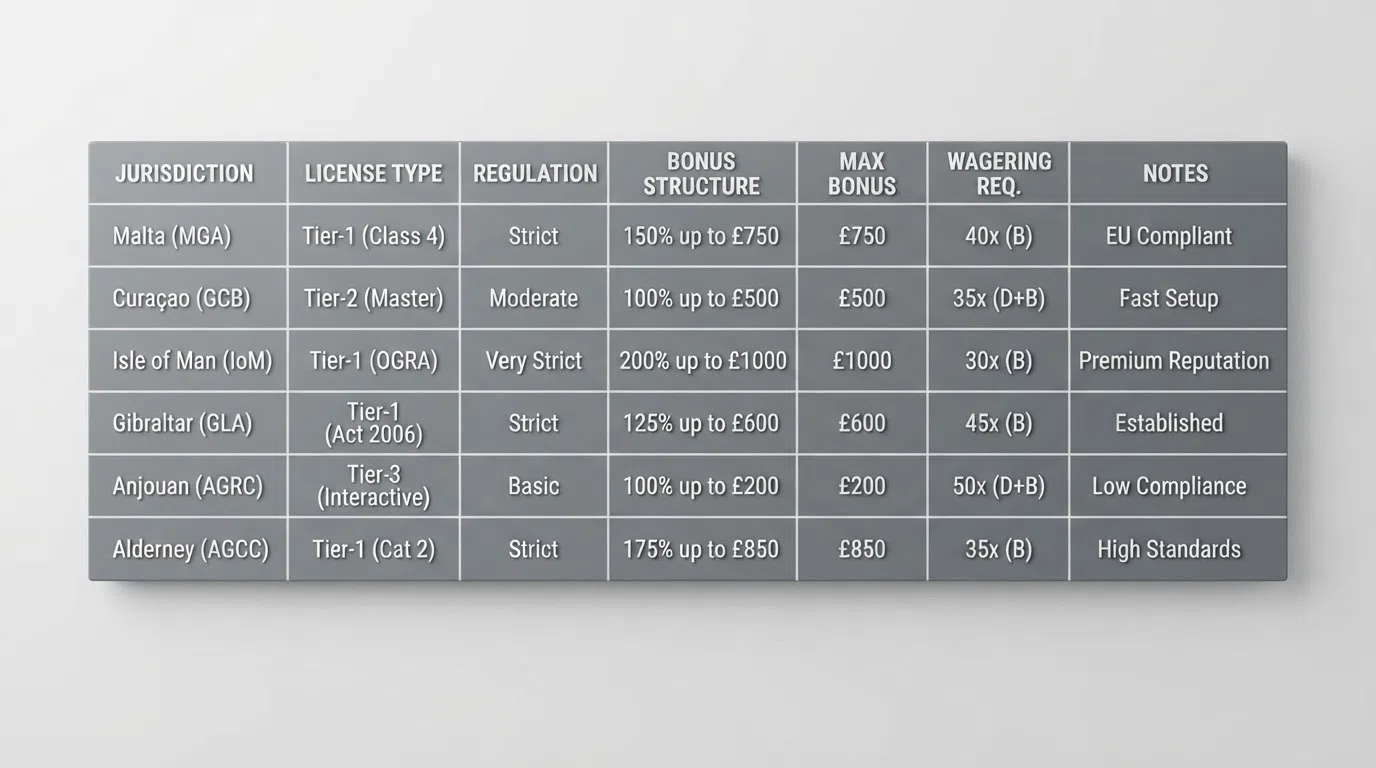
The non-UKGC world is not a single jurisdiction; it is a map of at least five. At the top sits the Malta Gaming Authority, which is consistently described in industry research as the strongest non-UK licence, with segregated player funds, mandatory dispute resolution and meaningful oversight. Below that sit Gibraltar and the Isle of Man, where the Gambling Supervision Commission requires licensees to protect 100% of player money through a bank guarantee, a trust fund, a dedicated client account, or some combination of the three. The Curaçao Gaming Authority, reorganised under the LOK framework, processed roughly 140 direct licence applications in its first intake and rejected or deferred about 38% of them, which is a more demanding signal than its reputation suggests, but enforcement capacity still trails MGA. Anjouan (in the Comoros) sits at the bottom of the named jurisdictions: lightest-touch, no fund-protection mandate comparable to the MGA or UKGC, and a licence format (ALSI-year/number) that has become a fast route to market for brands that have either never applied for stronger licences or have been pushed out of them.
The search landscape mirrors the licensing map. Directory sites and review portals dominate the search results for the head term, and a player looking for “non UKGC licensed casinos” lands, more often than not, on a listicle. The label functions less as a legal category than as a search filter, and the operators that meet it span the full range of offshore licence quality. That is the first reason the comparison matters: a category that covers an MGA-licensed brand and an Anjouan-licensed brand in the same breath is a category that needs unpicking before it is trusted.
The Terminology Trap: Licensed, Regulated, and “Outside UKGC”
The words “licensed” and “regulated” are not synonyms in this market, and a reader who treats them as such ends up overpaying for reassurance. Every featured operator on this page is licensed somewhere; that is what the footer seal claims. Whether the licence is enforced, whether player funds are segregated, whether there is a dispute body a UK player can actually reach — these are the questions the licence answers, and the answers vary by orders of magnitude across the offshore jurisdictions. A “fully licensed” claim in an Anjouan footer is doing a different amount of work from a “fully licensed” claim in an MGA footer, and the marketing does not flag the difference.
Then there is “outside UKGC,” which is the only label with a fixed meaning. Outside UKGC means: not bound by the UKGC’s stake limits, deposit-limit rules, FRA thresholds, 10x wagering cap, credit-card ban, GamStop mandate, or ADR requirement. Outside UKGC also means no UKGC advertising protections, no UKGC bonus restrictions, no UKGC-mandated RTP disclosure standards, and no UK court recourse for a gambling dispute. The phrase is precise; it is also the phrase that captures the entire trade-off the rest of the page is going to weigh.
Are Non-UKGC Casinos Legal? What UK Law Actually Says
The law is the part of this subject where the casual answer does the most damage, because the casual answer is the one that is half right. Half right is dangerous on a question a reader may act on.

What UK Law Says: The Player’s Legal Position
Under the Gambling Act 2005, offering unlicensed remote gambling to GB consumers is a criminal offence. The Commission has been clear, in successive consultations and enforcement actions, that the liability sits with the operator. A UK player who registers at a non-UKGC casino commits no offence by doing so, and the player’s winnings from such sites are not taxable under UK law. That is the “not illegal” half, and it is genuinely the law.
It is also, on its own, a thin reassurance. The same Act gives the UKGC the tools to pursue operators, and the Commission’s enforcement record against the offshore brands most visible to UK players is patchy at best. The Coalition to End Gambling Ads reported in June 2026 (via Bloomberg) that DonBet and MyStake were still accessible to UK users months after being flagged to the regulator as operating without a UKGC licence. The fact that the sites remain reachable is itself a fact about the enforcement gap, and the gap is the practical reason this page exists: the law says one thing, the search results show another, and the player is the one left to reconcile them. “Not illegal” is a true statement and a misleading one. The rest of the section is what fills the gap.
What the UKGC Provides: The Protections You Get Inside the Licensed Market
The full safety net inside the UKGC market in 2026 is unusually comprehensive, and it is worth listing once in full so the rest of the page has something to measure against. The statutory stake limits on online slots are £5 per spin for adults 25 and over, and £2 per spin for adults 18 to 24, effective 30 September 2026. The deposit-limit clarity rules took effect on 30 June 2026: any product labelled a “deposit limit” must be based solely on amounts paid into the account, and operators can no longer substitute loss limits or spend limits under that name. The Financial Risk Assessment thresholds are £1,000 in a rolling 24 hours or £3,000 in a rolling 90 days for adults 25+, and £750 in 24 hours or £2,000 in 90 days for under-25s. The 10x wagering-requirement cap on bonus offers took effect on 19 January 2026 and applies to every UKGC-licensed operator. Every UKGC-licensed remote operator must participate in GamStop, with exclusion periods of six months, one year or five years. Credit-card deposits have been banned at UKGC sites since April 2020. No UKGC-licensed operator accepts cryptocurrency as of 2026, and none will through at least 2027. ADR is mandatory. Player funds are segregated. KYC is completed before play. The list is the answer to “what am I giving up,” and it is longer than the question implies.
What You Give Up: Every Protection That Disappears Outside UKGC Regulation
Once the page is outside UKGC regulation, the protections above are absent by default, and the fact that some of them exist at MGA-licensed sites is the only thing that keeps the category from being uniformly bare. The full list, for reference, runs: no GamStop coverage; no UKGC-mandated ADR for disputes; no guaranteed player-fund segregation (it depends entirely on the offshore regulator and is uncertain at Curaçao- and Anjouan-licensed sites); no UKGC advertising or bonus restrictions; no Financial Risk Assessments and no affordability checks; no guaranteed RTP disclosure standards; no recourse to UK courts for gambling disputes; and no statutory stake or deposit limits. None of these are negotiable. They are the structural condition of the offshore market, and the operator’s own terms will not recreate them.
A practical note that follows from that list: the protections are not stripped in sequence, one by one; they are stripped all at once, the moment the player signs up at a non-UKGC site. A reader who treats the trade-off as a series of small concessions is missing the scale of it. The single concession is the licence, and everything else cascades from that.
The Alternative Licensing Landscape: What Each Offshore Regulator Actually Enforces
The non-UKGC market looks uniform from the outside and tiered from the inside. The tiers are not invented; they are derived from what each regulator requires and what it enforces. The MGA sits at the top: segregated player funds, mandatory ADR through MADRE, real oversight, and a public register at mga.org.mt where a licence can be verified by number. As one industry research summary put it, “A Malta licence is the strongest of the non UK options, with segregated funds, mandatory dispute resolution and real oversight, so an MGA site is far closer to UK protection than a Curacao one.” Gibraltar carries similar rigour. The Isle of Man GSC requires 100% player-money protection via a bank guarantee, a trust fund, a dedicated client account or a combination, and its register at isleofmangsc.com is searchable. Curaçao under the LOK framework rejected or deferred about 38% of roughly 140 direct licence applications, which is a more demanding intake than the jurisdiction’s reputation suggests, but enforcement capacity still trails the MGA and fund segregation is not guaranteed. Anjouan is the lightest-touch of the named jurisdictions and has no fund-protection mandate comparable to MGA or UKGC. The tiers, in this order, are MGA, then Gibraltar and Isle of Man as a second tier, then Curaçao, then Anjouan. A reader who internalises the order has already made the most important decision on the page.
How to Verify a Casino Licence Yourself — Without Clicking the Footer Seal
The footer seal is a piece of graphic design. It can be copied, the image can be re-hosted, and the link can point anywhere. The only reliable check is a direct lookup on the regulator’s own register, and the check takes about five minutes once you know the formats. MGA licence numbers follow MGA/B2C/number/year. Gibraltar uses an RGL number. Curaçao’s LOK format is OGL/year/number, and the register lives at cert.cga.cw. Anjouan uses ALSI-year/number. The procedure is the same in every case: visit the regulator’s URL directly (do not click the link in the footer), enter the number, and confirm three things — that the licence is Active, that the operator name on the register matches the casino you are looking at, and that the URL on the register matches the domain you are actually using. Independent testing seals from eCOGRA, Gaming Laboratories International, or iTech Labs are useful as additional confidence but are not a substitute for a verified licence. The whole exercise is unglamorous and effective, which is why the affiliate pages skip it.
Payment Methods: What Non-UKGC Casinos Offer That UKGC Sites Cannot
The payment-method gap is the most concrete difference between the two markets. Cryptocurrency — Bitcoin, Ethereum, Tether, Litecoin and others — is standard at non-UKGC sites and unavailable at any UKGC-licensed operator through at least 2027. The UKGC executive director’s February 2026 announcement that the Industry Forum would examine a “sensible” crypto pathway is a directional signal, not a current product. The Commission itself has been explicit: “As of 2026, no UKGC-licensed casino or betting operator accepts cryptocurrency as a deposit or withdrawal method.” Until that changes, crypto is an offshore-only option, and the choice between a non-UKGC site and a UKGC site is, for a player who wants to deposit in Bitcoin, not really a choice.
Credit cards travel the same direction. Banned at UKGC operators since April 2020, still accepted at most non-UKGC sites, though UK-issued cards do see higher decline rates offshore. The combined picture is that the offshore market offers a wider payments menu (crypto, credit cards, e-wallets) and a thinner protections menu, while the UKGC market offers the inverse. The page’s task is to keep both menus visible at once.
The Best Non-UKGC Casinos for 2026: The 10 Featured Operators Ranked
The table below compares the ten operators covered in detail further down. The numbers come from the operators’ own terms and from independent reviews where research has them. Cells where research has no specific figure carry an em dash. Wagering requirements are stated on the bonus only unless the operator’s own terms say otherwise.
| Operator | Licence | Welcome Bonus | Free Spins | Wagering |
|---|---|---|---|---|
| MyStake | Curaçao GCB | 150% up to £750 (1st deposit) | 30 no-deposit | 30x (deposit + bonus) |
| DonBet | Curaçao | 150% up to £750 | 50 | 30x (deposit + bonus) |
| GoldenBet | Curaçao | 100% up to £500 | — | 30x |
| Rolletto | Curaçao | Up to £5,500 across 3 deposits | 200 | 30x (bonus) |
| BitStarz | Curaçao GCB | Up to 5 BTC + 180 FS across 4 deposits | 180 | 40x (bonus) |
| BC.Game | Anjouan | Up to $4,000 + 400 FS across 4 deposits | 400 | 40x (deposit + bonus) |
| Cloudbet | Curaçao / Anjouan | 100% up to $2,500 | 200 | 0x |
| Velobet | Curaçao | 150% up to £500 / 100% up to £1,000 | 70 | 30x (bonus) |
| Stake | Curaçao | No welcome bonus | — | 40x (reload) |
| FatPirate | Curaçao | 100% up to £500 | 200 | 40x |
Comparison of Licence Jurisdictions and Enforcement Strength
| Operator | Primary Licence Jurisdiction | Enforcement Strength |
|---|---|---|
| MyStake | Curaçao | Moderate |
| DonBet | Curaçao | Moderate |
| GoldenBet | Curaçao | Moderate |
| Rolletto | Curaçao | Moderate |
| BitStarz | Curaçao | Moderate |
| BC.Game | Anjouan | Low |
| Cloudbet | Curaçao / Anjouan | Low-Moderate |
| Velobet | Curaçao | Moderate |
| Stake | Curaçao | Moderate |
| FatPirate | Curaçao | Moderate |
The enforcement strength rankings above reflect the practical capacity of each jurisdiction: Curaçao, under the LOK framework, is building enforcement capacity but still trails the MGA, while Anjouan remains a lightest-touch jurisdiction with no mandatory fund-protection equivalent to Tier-1 regulators.
MyStake Casino: The No-Deposit Free-Spins Entry Point
MyStake holds a Curaçao GCB licence and structures its welcome package around a 150% match up to £750 on the first deposit, extending to 300% up to £1,500 across three deposits. The unusual element is the 30 no-deposit free spins that come with the offer: a player does not need to deposit to claim them, though winnings from those spins remain subject to the bonus terms. Wagering is 30x on the deposit and bonus combined, and bonus winnings are capped at 10x the bonus amount. The minimum deposit is £20 and crypto payouts are processed in 24 to 48 hours. The no-deposit element is the differentiator in a market where most competitors gate everything behind a first deposit. The 30x wagering on deposit plus bonus, applied to the headline match, is the price of it. A player chasing the free spins without intending to clear the deposit bonus will be better served elsewhere; a player clearing the whole package should expect to wager the deposit and bonus amount thirty times over before any withdrawal is possible.
DonBet Casino: The 2023 Launch With a Straightforward Welcome Offer
DonBet is the youngest operator in the set, having launched in 2023, and its welcome offer is the cleanest in the comparison: 150% up to £750 plus 50 free spins on the first deposit, with 30x wagering on deposit and bonus combined. The minimum deposit is £20, and crypto payouts run 24 to 48 hours. There is no no-deposit component and no multi-deposit package. The simplicity is the point. A player who wants the most direct read of “what does this bonus cost” gets it from DonBet: one match, one wagering figure, one expiry. The trade-off against MyStake is the missing no-deposit free spins, and the trade-off against the older operators in the set is the shorter track record. DonBet has been visible to UK players for the shortest time, and that is exactly the data point a reader should weigh.
Rolletto Casino: The Biggest Welcome Package in the Set
Rolletto’s headline is the largest in the comparison: up to £5,500 plus 200 free spins across three deposits on the casino track (100% up to £1,000 plus 200 free spins on the first deposit), with 30x wagering on the bonus amount and a 10x maximum cashout on bonus winnings. The operator also runs parallel crypto and sports tracks: a 160% crypto bonus up to €1,000 at 35x wagering, and a 150% sports bonus up to £1,000 at 15x wagering. The minimum deposit is £20 and crypto payouts are the fastest in the set at 30 minutes. The number to stare at is the £5,500 ceiling. At 30x on the bonus amount, the total wagering required to clear the full package runs into five figures, and the 10x cap on bonus winnings means that, however the sessions go, the withdrawal from bonus play is bounded. Rolletto is built for a player who wants a high ceiling and is prepared to do the volume; the offer rewards that preparation and quietly penalises anything less.
Velobet Casino: Tiered Bonuses Across Three Separate Tracks
Velobet splits its welcome offer by deposit size, product track and currency, and the result is the most conditional offer in the set. On the casino track, a deposit under £500 receives a 150% match up to £500 plus 70 free spins; a deposit of £500 or more receives a 100% match up to £1,000 plus 70 free spins. Wagering is 30x on the bonus amount, and free-spin winnings carry a £100 maximum cashout. The crypto track is 160% up to €1,000 at 35x wagering, and the sports track is 150% up to £1,000 at 15x wagering. The operator is Curaçao-licensed and run by Santeda International B.V. The conditional structure is the trap: a player who reads the headline figure without reading the deposit tier will misjudge the offer. The casino track is the right starting point for most readers, and the £100 cap on free-spin winnings is the figure that decides whether the spins are worth playing.
GoldenBet Casino: Sports and Casino Under One Curaçao Licence
GoldenBet launched in 2021 under a Curaçao licence and offers a 100% welcome bonus up to £500 at 30x wagering, with a £20 minimum deposit and 24 to 48 hour payouts. What separates it from the rest of the set is the inclusion of a full sportsbook alongside the casino product. For a player who wants to move between slots and sports betting under one account, the offer is genuinely broader; for a player who only plays casino, the bonus ceiling is below the cluster average and the wagering is the same as everyone else’s. The verdict depends entirely on which product the player is actually going to use.
FatPirate Casino: The Low-Minimum-Deposit Option
FatPirate is the lowest entry point in the set. The welcome offer is 100% up to £500 plus 200 free spins at 40x wagering, and the minimum deposit is £10, the only operator in the featured set to drop that low. The Curaçao licence and 24 to 48 hour payouts are in line with the cluster. The 40x wagering is the trade-off against the lower minimum: a player clearing a small deposit at FatPirate pays for the entry point in extra turnover. For a player who wants to test a Curaçao site without committing much capital, the offer makes sense; for a player planning a larger first deposit, the same 100% up to £500 ceiling is available at competitors with 30x wagering, and that 10x gap is most of the difference.
BitStarz Casino: The Crypto-First Veteran With a 5 BTC Welcome
BitStarz holds a Curaçao GCB licence (no published number) and has built its offer around a four-deposit welcome package denominated in Bitcoin, totalling up to 5 BTC plus 180 free spins, with 100% up to 1 BTC plus 180 free spins on the first deposit. Wagering is 40x on the bonus amount, the maximum bet during wagering is $5 or 5 mBTC, and the bonus expires 14 days after issue. Crypto payouts complete in under 10 minutes; fiat payouts take one to five days. The package is the most genuinely crypto-native in the set: the bonus is denominated in Bitcoin, the wagering is denominated in Bitcoin, and a fiat player who wants to compare it to the GBP offers above has to do the conversion. For a player already holding crypto, BitStarz is the offer that speaks the same language. For a player funding in pounds, the comparison is harder and the 40x wagering is steeper than the cluster average.
BC.Game: The Anjouan Licence With a $4,000 Welcome Package
BC.Game is the operator in the set with the most regulatory history. Its UKGC licence was revoked in December 2024, and it now operates under an Anjouan (Comoros) licence. The welcome package runs up to $4,000 plus 400 free spins across four deposits, with 40x wagering on deposit and bonus combined, and a separate 40x on free-spin winnings. The minimum deposit is $5 (the lowest in the set), crypto payouts complete in under 10 minutes, and fiat payouts take one to five days. The most unusual term is the $10 maximum withdrawal per batch of free-spin winnings, which is the strictest free-spin cap in the comparison and the term that decides whether the 400 free spins are worth chasing. The UKGC revocation matters for a specific reason: BC.Game has previously been inside the UKGC system and is now outside it, which makes it a clean case study in what changes when a brand moves jurisdictions. The answer is most of the protections.
Cloudbet: The Only Zero-Wagering Welcome Bonus
Cloudbet holds dual Curaçao and Anjouan licensing, is crypto-only, and runs the only zero-wagering welcome offer in the comparison: 100% up to $2,500 plus 200 free spins, with no wagering requirement at all. The minimum deposit is 0.001 BTC, payouts are instant, and there is no fiat on-ramp. The zero-wagering term is not a marketing trick; it is the genuine differentiator, and it means the bonus is paid in cash, not in bonus funds, and is withdrawable as soon as the casino’s standard processing time allows. The trade-off is the crypto-only constraint. A player who is not already holding Bitcoin or another supported cryptocurrency will need to acquire some before they can deposit, and that is a friction the GBP-funded operators in the set do not impose. For a crypto-native player, the offer is unmatched; for a fiat player, it is not an option.
Stake Casino: Surrendered Its UKGC Licence — Now a Crypto-Only Offshore Operator
Stake surrendered its UKGC licence in March 2025 and now operates under a Curaçao licence only, accepting UK players offshore. There is no traditional welcome bonus; the offer is daily races and reload promotions, with 40x wagering on reload bonuses. The minimum deposit is the crypto equivalent of $10, and crypto payouts are instant. The reason Stake is in the set is not the bonus — it is the brand recognition. A player who already knows Stake from its pre-2025 UK presence is, in 2026, looking at the same brand under a different licence, with the same games, the same crypto payments, and a fundamentally different relationship with the UKGC. The promotional structure rewards activity rather than signup, which suits a returning player and offers nothing to a first-time visitor looking for a matched deposit.
The GamStop Paradox: Why a “UKGC Casino Not on GamStop” Cannot Exist
A search for “UKGC casino not on GamStop” returns around 36 related queries in this cluster, and the volume itself is the signal. The searches are not idle; they are players who have either chosen to leave the UKGC system or are confused about whether such a thing is possible. The page that skips the answer to that confusion is the page that lets confusion persist.
What GamStop Is and How It Connects to UKGC Licensing
GamStop is the national online self-exclusion scheme, and every UKGC-licensed remote operator must participate. The exclusion periods are six months, one year, or five years. Once a person has registered, they cannot open an account at any participating operator for the duration of the chosen period, and the participating operators are required to take reasonable steps to prevent the registered person from accessing their existing accounts during that time. GamStop participation is not an optional add-on that a UKGC-licensed brand can decline; it is a hard condition of holding a UKGC remote licence. The mechanism is built into the licence itself.
The “UKGC Casino Not on GamStop” Search: What Players Are Actually Looking For
The 36-key cluster around “UKGC casino not on GamStop” splits into two intents that read as one. The first intent is a player who has registered with GamStop and is looking for a way to gamble again. The second is a player who has heard the term “non-UKGC” and assumes it means “UKGC but exempt from GamStop.” Both intents lead to the same factual answer, and the page has a duty to give it cleanly.
For the first intent, the answer is direct: a non-UKGC casino does not participate in GamStop, will not check the GamStop register, and will accept a self-excluded UK player without asking. The rest of this page does not help that reader make that choice. For the second intent, the answer is the terminological one: there is no “UKGC but exempt from GamStop” category, because no such exemption exists. A site that claims UKGC licensing while being absent from GamStop is either lying about its licence or operating in breach of it. The UKGC maintains a public register of licensed operators at gamblingcommission.gov.uk, and any UKGC claim can be checked there in under a minute.
Can a UKGC Casino Operate Without GamStop? The Hard Answer
No. GamStop participation is a mandatory condition of a UKGC remote operating licence, with no exemption process and no opt-out. A site that claims to be UKGC-licensed and is not on GamStop is making a false claim about its licence. The practical test is the public register: the operator’s name, the licence number, and the trading name on the register should match the casino being checked. If they do not, the site is either not UKGC-licensed or is operating in breach, and the difference is academic to the player.
The Self-Exclusion Gap: What Happens When You Play at a Non-UKGC Casino
A player registered with GamStop can open an account at a non-UKGC casino in minutes. The non-UKGC operator has no obligation to consult GamStop, no obligation to ask, and no obligation to refuse. Some non-UKGC operators offer their own self-exclusion tools, but those tools are site-specific, have no reach beyond that one site, and exist because the operator chose to offer them, not because any regulator required it. A player who self-excludes from one non-UKGC site can open an account at another in the same afternoon, and the protection is only as wide as the sites the player remembers to exclude from. The National Gambling Helpline (0808 8020 133) is available regardless of where a player gambles, and the section on the UK help infrastructure covers what that line can and cannot do.
Beyond GamStop: SENSE, ADR and the Wider Protection Gap
GamStop is the headline, but the protection gap is wider. SENSE is the land-based self-exclusion scheme that covers UK casinos and bingo halls; it has no presence online and no relationship with non-UKGC operators. ADR (Alternative Dispute Resolution) is mandatory at every UKGC-licensed site, and absent at most non-UKGC sites; a dispute with a Curaçao- or Anjouan-licensed operator is handled under that regulator’s framework, and the practical accessibility of that framework to a UK player is variable at best. Player-fund segregation is mandatory at UKGC-licensed sites, guaranteed at MGA-licensed sites, and uncertain or absent at Curaçao- and Anjouan-licensed sites. The cumulative effect is that the offshore category strips the self-exclusion coverage, the dispute body, and the fund protection in one move. None of the three is recreated by the operator’s own terms, and none is enforced by any UK body once the player is at a non-UKGC site.
New Non-UKGC Casino Launches Worth Watching in 2026
The new launch list in 2026 is unusually busy, for two reasons. The Curaçao Gaming Authority processed roughly 140 direct licence applications under the LOK framework and rejected or deferred about 38% of them, which is the first material change in the Curaçao licensing landscape in years and the reason new Curaçao brands keep appearing. The second is the wave of regulatory-status changes among operators that were once UKGC-licensed: BC.Game’s UKGC licence was revoked in December 2024, and Stake surrendered its UKGC licence in March 2025. Both are now offshore-only and visible to UK players as “new” non-UKGC options, even though neither is a new brand.
The Newest Non-UKGC Casino Brands in 2026
DonBet, at a 2023 launch, is the youngest Curaçao brand in the featured set. BC.Game (now Anjouan, after the December 2024 UKGC revocation) and Stake (Curaçao only, after the March 2025 UKGC surrender) function as newly offshore brands to a UK audience, even though the operators themselves are not new. The ~140 LOK applications at the Curaçao CGA signal a pipeline of new entrants that will become visible to UK players in the coming months; the rejection and deferral rate suggests the new regulator is taking a more rigorous line than its predecessor, but it is too early to say what that line looks like in enforcement.
New vs Established: What Changes When a Casino Is Freshly Launched
A new non-UKGC casino has no payout history that a player can research. That is the only fact that matters about “newness” in this market, and it is the fact the marketing never advertises. An established non-UKGC casino has years of player-forum threads, named complaints, regulator actions, and payout disputes that can be searched; a new one has none, and the absence of complaints is not a positive signal — it is an absence of data. The LOK framework at Curaçao is too new to have an enforcement record of its own, which means that even the LOK-licensed brands in this cycle are operating in a regulatory environment whose future behaviour is itself unproven.
What to Check Before Joining a Brand-New Non-UKGC Site
A new casino demands more verification, not less, and the steps run in order: verify the licence number directly on the regulator’s register; do not rely on the footer seal, because the seal proves nothing the register does not. Confirm that the operator name and the domain on the register match the casino you are looking at, and confirm that the licence status reads Active. Search independent player forums for unresolved payout complaints, and look for complaints that name specific transactions, not just generic frustration. Confirm the corporate entity behind the operator and the jurisdiction it claims to operate from. Test the live chat with a specific question before depositing, and note the response speed and the substance of the answer; a casino that cannot answer a pre-deposit question will not answer a withdrawal question. None of these checks is exotic. All of them are easy to skip, and all of them are the difference between a known quantity and a guess.
Don’t Deposit Blind: How to Evaluate a Non-UKGC Casino
The results for the head term are dominated by affiliate-driven directory and review pages, and the player who treats those pages as neutral is the player who ends up surprised. The pages are not lying; they are running a model in which the casino pays for placement and the reader is the product. That model is not a scandal, but it is a model, and a reader needs to read it as one.
Reading Non-UKGC Casino Reviews: What Signals Actually Matter
A review that lists only positives and no caveats about the licence is not a review; it is an advertorial that has learned to use paragraphs. The signals that matter are specific. Does the review cite a specific licence number, or does it only say “fully licensed”? Does it name the corporate entity behind the operator, or does it refer to the casino as a single opaque brand? Does it mention a specific payout timeline backed by a player report, or does it gesture at “fast withdrawals” without evidence? A review that answers those three questions with specifics is doing the work; a review that does not is selling something.
The Evaluation Framework: Licence, Payout Record, Game Library and Support
Four criteria do more work than any star rating. First, the licence: verify it yourself on the regulator’s register, do not trust the footer seal, and remember that an MGA licence and a Curaçao licence are not equivalent. Second, the payout record: search independent player forums for unresolved withdrawal complaints and look for the same names appearing more than once. Third, the game library: check the provider list, and the providers that signal genuine supplier relationships are NetEnt, Pragmatic Play, Evolution and Play’n GO; a casino that claims thousands of games from no named suppliers is not telling the whole story. Fourth, support: test the live chat with a specific question before depositing, and note both the response time and the answer quality; a casino that cannot answer a pre-deposit question will not answer a withdrawal one.
UKGC-Licensed vs Non-UKGC Reviews: How the Signals Differ
A UKGC-licensed casino review checks for GamStop coverage, ADR membership, and FRA compliance, because those are the licence conditions a UKGC operator must meet. None of them exist at a non-UKGC site. A non-UKGC review has to start from a different checklist: verify the licence directly, check the regulator’s enforcement record, search for payout disputes on independent forums, and treat the absence of UKGC-mandated protections as the baseline rather than a missing feature. The player carries the verification burden that the regulator would otherwise carry, and the only sensible response is to carry it deliberately. The shift from “what does the licence guarantee me” to “what does the licence fail to guarantee me” is the entire review framework for the offshore market.
Staying Safe: Responsible Gambling Outside the UKGC Framework
The responsible-gambling infrastructure in the UK is real, well-funded and stretched. It is also almost entirely pointed at UKGC-licensed operators, which is the structural reason the offshore category carries a different duty of care.
The UK’s Responsible-Gambling Infrastructure: What Exists and Who It Covers
The National Gambling Helpline (GamCare) is available on 0808 8020 133, twenty-four hours a day, free and confidential, with a live-chat option alongside. In January 2026 the helpline made 996 referrals to treatment and peer-based support services, up 48% year on year from 674 in January 2025. The National Gambling Support Network (NGSN) treated 11,960 clients between April 2024 and March 2025, an 11% increase on the prior year, and 82% of those clients showed improvement in PGSI score; the share classified as “problem gambling” fell from 87% at initial assessment to 27% at final assessment. The numbers are the proof that the treatment side of the system works for the people who reach it. The complication is reach: GamStop, the national online self-exclusion scheme, blocks access at every UKGC-licensed remote operator for six months, one year or five years, and that reach stops at the UKGC border. A non-UKGC casino is not on GamStop and does not check the register. The GamStop reach is real, and the gap in it is the gap this page has been describing throughout.
The prevalence data explains why the duty of care is on the page. According to GambleAware’s Annual Treatment and Support Survey, 13.1% of adults who gamble — roughly 6.8 million GB adults — are classified as experiencing any level of gambling problems (PGSI 1+). The share of National Gambling Helpline contacts citing online gambling reached 81.5% in 2026, the highest proportion in five years and up from 72.9% in 2021. The direction of travel is consistent across the dataset: more contact, more online contact, more pressure on the system. The infrastructure exists; the question is whether the offshore category routes players into it or around it.
What Responsible-Gambling Tools Non-UKGC Casinos Actually Offer
Some non-UKGC casinos offer deposit limits, session timers, and site-specific self-exclusion. Where they exist, the tools work; where they do not, there is nothing. The structural gap is that no offshore tool reaches across operators. A player can self-exclude from a single Curaçao-licensed site and open an account at a different one the same afternoon, and there is no cross-operator self-exclusion outside the UKGC framework. ADR for gambling-harm disputes is not mandatory at most non-UKGC sites, and affordability checks are absent. The National Gambling Helpline is available regardless of where a player gambles, and that is the number worth keeping to hand: 0808 8020 133, twenty-four hours a day, free and confidential. The tools at the casino are optional. The line is not.
How We Evaluated These Non-UKGC Casinos
The findings behind this page are the search results that dominate the head term, the operators’ own published terms, the public registers of the UKGC, MGA, Isle of Man GSC and Curaçao CGA, and independent player-forum reports where they exist. The evaluation criteria were licence jurisdiction and the enforcement record of that jurisdiction; welcome-bonus terms (amount, free-spin count, wagering multiple, winnings cap, expiry); and operator track record, including any regulatory-status changes such as UKGC revocations or surrenders. Operators were excluded from the ranking on marketing claims, affiliate ratings, and unverified user reviews; the table is built from specific terms and specific numbers, and where research had no figure the cell carries an em dash rather than a guess.
Offshore Casino Play: The Trade-Off in Numbers — and the One Check You Must Do
The trade-off, stated plainly: a non-UKGC casino offers bigger bonuses, crypto acceptance, and none of the affordability friction that has tightened at UKGC sites through 2026. It also offers no GamStop coverage, no UKGC-mandated ADR, no guaranteed fund segregation, and no UK court recourse for a gambling dispute. The bonuses are the draw, and the bonuses are the trade’s mechanism. A £750 welcome match at 30x wagering on deposit and bonus combined, applied to a £750 deposit, requires £45,000 of wagering before the bonus funds become withdrawable; the UKGC’s 10x cap, applied to the same £750 bonus, would have required £7,500. The gap is not a rounding error, and it is the gap that lives between the marketing number and the cost. A player who reads the wagering figure before they read the bonus amount has already made the only decision that matters.
The non-UKGC route suits a specific reader: a player who is not self-excluded, who understands that the offshore protections are thinner, who has verified the licence on the regulator’s own register, who has checked the operator’s track record on independent forums, and who has decided that the bonus terms and payment options are worth the missing UKGC framework. It does not suit a player who wants GamStop coverage, who needs the dispute resolution that ADR provides, or who expects the same fund segregation they would have at a UKGC site. Those readers should stay in the UKGC market. Both routes are real; neither is a workaround for the other.
The one check that is not negotiable, before any deposit at any non-UKGC casino: verify the licence number directly on the regulator’s register. Visit the regulator’s URL yourself; do not click the link in the footer. Confirm the licence is Active, that the operator name matches, and that the URL in the register matches the domain you are actually using. Five minutes of work that beats any review, any star rating, and any “fully licensed” claim. Everything else on the page is context for that check.
Frequently Asked Questions
What payment methods can I use at non-UKGC casinos that are not available at UKGC-licensed sites?
Cryptocurrency — Bitcoin, Ethereum, Tether and Litecoin among others — is standard at non-UKGC casinos and unavailable at any UKGC-licensed operator as of 2026; the UKGC Industry Forum is examining a crypto pathway but it will not be open through at least 2027. Credit cards are also accepted at most non-UKGC sites, having been banned at UKGC operators since April 2020. The combined offshore menu is wider; the UKGC menu trades that width for affordability checks and fund segregation.
How do welcome bonuses at non-UKGC casinos actually compare to UKGC-licensed casino bonuses?
Non-UKGC welcome packages are larger in headline terms — Rolletto’s up to £5,500 across three deposits, BC.Game’s up to $4,000 plus 400 free spins — but the wagering requirements are 30x or 40x on the bonus (and on the deposit at several operators). The UKGC’s 10x wagering cap, effective 19 January 2026, makes that comparison a strict one: the same bonus amount at a UKGC site costs roughly a third to a quarter of the wagering to clear. Cloudbet is the lone zero-wagering offer in the offshore set; the rest of the field sits two to four times above the UKGC cap.
Which offshore licence offers the strongest player protection — MGA, Gibraltar, Isle of Man or Curacao?
The Malta Gaming Authority offers the strongest non-UK protection, with segregated player funds, mandatory dispute resolution through MADRE, and meaningful oversight, putting an MGA-licensed site closer to UKGC standards than any other offshore option. Gibraltar and the Isle of Man sit in a similar tier; the Isle of Man GSC requires 100% player-money protection via a bank guarantee, trust fund, dedicated client account, or a combination. Curaçao, under the new LOK framework, has rejected or deferred about 38% of around 140 direct licence applications, but enforcement capacity still trails MGA and fund segregation is not guaranteed. Anjouan is the lightest-touch of the named jurisdictions.
Can a non-UKGC casino be held accountable if it refuses to pay out my winnings?
Accountability depends on the offshore regulator. MGA-licensed operators are answerable to MADRE for dispute resolution, and Isle of Man GSC licensees sit under a similar framework. Curaçao- and Anjouan-licensed operators have weaker dispute mechanisms, and the dispute is handled under the offshore regulator’s jurisdiction rather than under UK law. There is no UK court recourse for a gambling dispute with a non-UKGC site. Verifying the licence on the regulator’s own register, and choosing MGA or Isle of Man over Curaçao or Anjouan, is the only pre-deposit action that materially affects how a future dispute would be handled.
What responsible-gambling tools do non-UKGC casinos offer, and how do they compare to UKGC requirements?
Some non-UKGC casinos offer deposit limits, session timers, and site-specific self-exclusion; the tools are optional, vary by operator, and have no cross-operator reach. Compared to UKGC requirements, the offshore category lacks mandatory GamStop participation, mandatory ADR, mandatory fund segregation, affordability checks and Financial Risk Assessments. A player who self-excludes from one non-UKGC site can open an account at another the same afternoon. The National Gambling Helpline (0808 8020 133) is available regardless of where a player gambles, twenty-four hours a day, free and confidential.
Licence – trustedcasinos-notongamstop
Content created by the «trustedcasinos-notongamstop» team