
Best Bingo Sites UK No Wagering in 2026: What the New 10× Wagering Cap Actually Changed
 Available in GB
A no-wagering bingo bonus is the closest thing to a free lunch the UK online bingo market has ever sold. You claim it, you play it, and whatever you win lands in your cash balance with no playthrough hurdle to clear. After 19 January 2026 the rest of the market caught up — sort of. The UK Gambling Commission capped every promotional wagering requirement at ten times the bonus amount, which is a generous ceiling compared with the 40-times and higher terms that defined the last decade. Ten times is still ten times, though. A ten-times bonus is not the same product as a zero-times one, and the arithmetic is unforgiving either way: at a typical 96.7% return-to-player, every £100 you turn over at a wagered bonus keeps about £3 in the house’s pocket. A zero-wagering bonus keeps nothing on top of what the game already takes, and that is the difference this guide is built around.
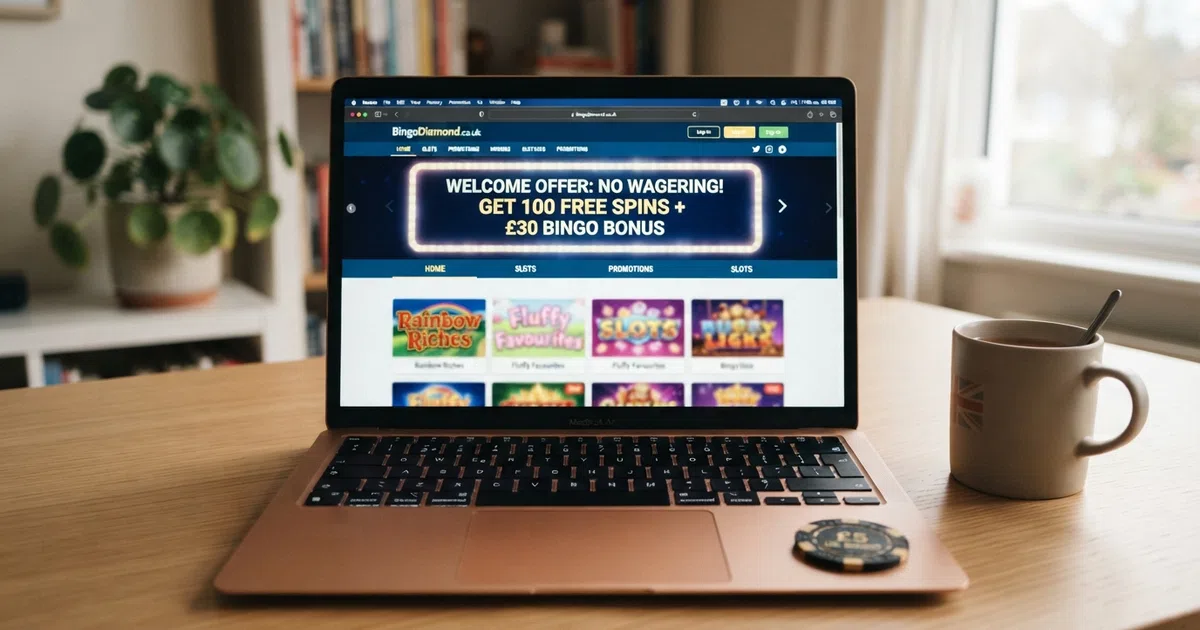
This page ranks the ten UK-licensed bingo sites whose welcome offers carry zero wagering, checks each one against the UK Gambling Commission’s public register, and runs the numbers on what “no wagering” actually saves a player over the new ten-times legal maximum. The featured set is the ten operators the research backs with verified UKGC licence numbers and confirmed bonus terms; one of them — Bet365 Bingo — has offer details not fully confirmed in the public record, and that is flagged in its entry rather than papered over.
Current as of September 9, 2026. Licence claims verified against the UK Gambling Commission’s public register.
What “Zero Wagering” Changed for UK Bingo Players in 2026
The phrase “no wagering” has been floating around UK bingo affiliate pages for years, but the regulatory floor it sits on is brand new. Before 19 January 2026, the term was a marketing label — a brand promise with no statutory weight. As of that date, the UK Gambling Commission’s Social Responsibility Code 5.1.1 set a hard ceiling: no bonus wagering requirement at a UK-licensed site can exceed ten times the bonus amount, and every promotion must display five material terms up front before a player claims. The new rule did not invent zero-wagering offers. It just stopped pretending that a 40-times bonus was anything other than what it was.
A no-wagering bonus, in the strict UKGC-compliant sense, is one on which there is no playthrough requirement at all. Winnings from free spins, free bingo tickets or matched bonus funds land in the withdrawable cash balance the moment they are credited, exactly as OLBG defines it: “No Wagering Bingo means there are zero wagering requirements attached to your bonus. Winnings are credited as withdrawable cash.” That is a different product from a ten-times bonus, where the same £20 in bonus credit has to be turned over as £200 in real bets before any winnings become withdrawable. The ten-times cap is a ceiling; zero is the floor; and the gap between them is where the real money sits.
The reform did not just cap wagering. It also banned mixed-product incentives — a single promotion may no longer combine more than one type of gambling product (betting, casino, bingo, lottery) under the same headline. For bingo players that matters: the old “deposit £10, get £10 bingo bonus plus 50 casino spins” bundle is gone. An operator can offer one or the other, not both wrapped in one offer. The UKGC’s stated rationale was that capping the requirement “decreases the likelihood of harm, reduces complexity, and improves transparency while maintaining consumer choice.” That last clause is doing real work — “maintaining consumer choice” is regulator-speak for “we are not banning wagered bonuses, just making sure no one mistakes one for the other.”
The practical upshot for a UK bingo player in 2026 is a market split into three tiers. At the top, a handful of brands — PlayOJO, MrQ, Jackpotjoy, Heart Bingo, Double Bubble Bingo, Tombola, Bet365 Bingo, Gala Bingo, Mecca Bingo and Buzz Bingo — built their welcome offers around zero wagering. The middle of the market is a wave of post-reform offers rewritten down to ten times. Below that sits the long tail of legacy wagered bonuses that survived the cull at twenty, thirty, even forty times on the matched portion — most of which are now non-compliant and quietly being replaced. A player looking for the bottom-line cost of a bonus no longer has to wade through a thicket of small print to find it; ten times is the worst the law now allows, and zero is what a serious no-wagering comparison should be ranking.
Bingo and slots: how UK bingo sites blend the two
The mixed-product ban reshaped the welcome offers on every UK bingo site, but the underlying platform is still a hybrid. The licence a UK-licensed bingo operator holds is typically a remote bingo operating licence from the UKGC, and that licence does not require the platform to be bingo-only. Most of the operators on this list run a full slot catalogue alongside their bingo rooms, drawing on providers like Pragmatic Play, NetEnt, Playtech, Gamesys’ in-house studios and Blueprint Gaming. The casino side is not bolted on; it is the same account, the same wallet, the same deposit, and for years the same promotion.
What the new rule stopped is the cross-sell. A site can still host both products, and a player can move between the bingo rooms and the slots with the same balance, but the welcome offer that introduces the player to the platform can no longer be one offer that pays out in both. Jackpotjoy’s welcome package is a clean illustration: a new player picks either 30 free spins on Double Bubble or up to £50 in free bingo tickets, not both. The choice is real, and the two arms of it are separately regulated, separately credited and separately wagered at zero. The same pattern shows up at Mecca — a £20 bingo bonus with five-times wagering on one path, or 50 free spins on King Kong Cash Even Bigger Bananas on the other. The player picks, the operator pays, and the regulator gets a clear audit trail on which product was promoted and how.
Slingo sits at the seam between the two products. It is a bingo-slots hybrid that uses a slot-style reel as its number-draw mechanism, played on a bingo-card grid. Slingo is technically a slot under UKGC classification, which is why a Slingo title can sometimes appear inside a casino welcome offer at a bingo-led site without tripping the mixed-product rule. Most of the featured brands carry a Slingo catalogue in their slot library, and a few lean on it as a bridging product for players who arrive for the bingo and stay for the reels. The classification is the reason a player can claim a free-spins welcome offer at a bingo site and find Slingo titles contributing to wagering where any wagering exists. Where there is no wagering, the distinction is academic — the spin either pays cash or it does not.
Casino-style bingo platforms vs dedicated bingo sites
The ten featured operators fall into two distinct shapes. On one side sit the dedicated bingo brands — Tombola is the cleanest example, with an entirely proprietary game library and a platform built around the bingo hall rather than the slot floor. On the other sit the casino-bingo hybrids: Jackpotjoy, Heart Bingo, Gala, Mecca and Buzz, all of which run a substantial slot and live-casino catalogue alongside the bingo rooms, and most of which are owned by the major UK gaming groups (Entain, Rank, Gamesys) that run full casino platforms as well. PlayOJO and MrQ sit slightly outside both buckets — PlayOJO is a SkillOnNet casino brand that added a bingo room, MrQ is a proprietary bingo-first brand that runs slots on the side.
The split matters for what the welcome offer actually delivers. A dedicated bingo brand like Tombola can offer a matched deposit bonus on bingo credit because the credit has nowhere else to go; the matched portion is playable only in Tombola’s own bingo rooms, and the one-times wagering on the matched bonus is a small structural cost rather than a meaningful friction. A casino-bingo hybrid has to choose which product the welcome offer promotes, which is why Jackpotjoy offers the bingo-tickets-or-free-spins fork and Mecca offers a bingo-bonus-or-free-spins fork. The brand is hybrid; the offer has to pick a lane.
Practically, a player who wants a pure bingo experience with a small slot library to fill the gaps between sessions will find the dedicated end of the market more focused. A player who wants bingo nights and slot sessions on the same wallet, and is happy to move between the two, will find the hybrids easier to live with — one deposit, one balance, one set of responsible-gaming tools. The zero-wagering offers on the list work on both shapes; the difference is in what surrounds the welcome.
The Top No-Wagering Bingo Operators in the UK: 2026
The table below ranks the ten UKGC-licensed operators whose welcome offers are verified zero-wagering. Where a field could not be confirmed from the public record, the cell is left empty rather than filled with a guess. Bet365 Bingo is a special case: the brand is licensed (UKGC 55148) and the zero-wagering status of the welcome offer is confirmed, but the headline offer (100 tickets plus 50 free spins on a £10 deposit) is reported by affiliate listings rather than directly on the operator’s UK bingo promotions page, so specific bonus details that the other nine carry are not confirmed for Bet365 and are marked accordingly.
| Operator | UKGC Licence | Welcome Offer | Wagering | Bonus Validity |
|---|---|---|---|---|
| PlayOJO | 39326 (SkillOnNet Ltd) | 50 free spins on Big Bass Bonanza | 0× | No expiry stated |
| MrQ | 60629 (Lindar Media Ltd) | 100 free spins on Big Bass Splash | 0× | 48 hours from crediting |
| Jackpotjoy | 38905 (Gamesys Operations Ltd) | 30 free spins on Double Bubble or up to £50 in free bingo tickets | 0× | 7 days |
| Heart Bingo | 38905 (Gamesys Operations Ltd) | 500 free bingo tickets (up to £50) plus 100 free spins on Make Me a Millionaire | 0× | 7 days on both |
| Double Bubble Bingo | 38905 (Gamesys Operations Ltd) | 30 free spins on Double Bubble Cash Wall | 0× | 30 days |
| Tombola | 38613 (Tombola International Plc) | 100% deposit match up to £50 plus up to 50 free plays | 0× on free plays, 1× on matched bonus | 7 days |
| Bet365 Bingo | 55148 (Hillside UK Gaming ENC) | 100 bingo tickets plus 50 free spins | 0× | — |
| Gala Bingo | 57408 (Entain) | 100 free spins on selected slots | 0× | 7 days |
| Mecca Bingo | 57924 (Rank Interactive) | £20 bingo bonus (5×) or 50 free spins on King Kong Cash Even Bigger Bananas | 5× on bingo bonus, 0× on spins | 28 days on bingo bonus |
| Buzz Bingo | 57594 (Buzz Bingo Digital Ltd) | £30 online bingo bonus (4×) plus £10 club voucher, or up to 200 slot spins | 4× on bingo bonus | 14-day qualifying period |
PlayOJO
PlayOJO is the operator most closely associated with the no-wagering proposition in the UK. Its welcome offer is fifty free spins on Big Bass Bonanza at £0.10 per spin, claimed on a first deposit of £10 or more, with no wagering and no maximum cashout. Operated by SkillOnNet Ltd under UKGC licence 39326, the brand has been active in the UK since 2014 and built its identity on the “no wagering, no max win, no small print” line that the rest of the market is now scrambling to match.
The offer’s strength is what it does not carry. There is no playthrough on spin winnings. There is no cap on what those winnings can be withdrawn at. There is no game-weighting structure hiding behind the headline. The fifty spins at the slot’s standard return-to-player on Big Bass Bonanza have a real expected cash value of around £4.84, but the variance on a 50-spin sample is enormous — a player can land a 5,000-times-line win on the bonus round and walk away with hundreds, or walk away with the £5 deposit and no bonus payout at all. The expected value is the average; the cash value is the actual session result. What PlayOJO sells is the right to keep whichever one of those you get.
The only material gap is the lack of a stated expiry on the free spins — research did not return an explicit validity window for the PlayOJO offer, which is unusual for a market where most operators name a clock. A player should confirm the expiry on the promotions page before claiming, because a no-expiry offer at a UKGC-licensed site is rare and the actual T&Cs may differ from the headline. The casino-style platform runs a full slot catalogue from thirty-plus providers including NetEnt, Pragmatic Play, Evolution and Microgaming, and the bingo room is a smaller part of the overall product. For a bingo player this is a hybrid site that happens to lead with slots; if the bingo room is the main reason for joining, a more bingo-led brand may suit better.
For a slots-first player who values the absence of any cap on winnings, PlayOJO is the cleanest zero-wagering offer on the UK market and a sensible first choice.
MrQ
MrQ is the most aggressive no-wagering bingo site in the featured set. Its welcome offer is one hundred free spins on Big Bass Splash at £0.10 per spin, claimed on a first deposit of £10, with all winnings paid as cash and no cap on what is withdrawable. Operated by Lindar Media Ltd under UKGC licence 60629, the brand’s entire promotional philosophy is wager-free — the tagline is not a marketing line, it is the structure of every offer on the site.
The headline number is the spin count: 100 free spins is the largest free-spin welcome in the featured set, and at the same £0.10-per-spin valuation as everyone else it doubles PlayOJO’s offer. At a 96.71% default RTP on Big Bass Splash, the expected cash value of the 100 spins is around £9.67, against a £10 deposit — close to a one-for-one match on the deposit in expected-value terms, before any of the player’s own cash is staked. That figure is the average; the variance is wide. The one constraint is the forty-eight-hour expiry from crediting. A player who does not use the spins within two days of the deposit loses them, and a £10 deposit on its own is not enough to make the offer worthwhile.
The tight window is the single biggest practical drawback. Forty-eight hours is the shortest validity in the table and a quarter of the thirty-day window Double Bubble Bingo offers on its spins. For a player who deposits on a Sunday evening and does not log in until Wednesday, the spins are already gone. The workaround is to deposit, claim the offer and play the spins in the same session — the wagering is zero, so there is no strategic reason to delay.
The platform is bingo-first, with proprietary bingo rooms forming the core product and a Pragmatic Play / NetEnt slot library on the side. For a bingo player who also plays the occasional slot, MrQ’s 100 free spins and zero-wagering welcome make it the strongest match on the set for spin volume.
Jackpotjoy
Jackpotjoy is a hybrid operator that asks the player to choose the welcome offer shape. The two options are thirty free spins on Double Bubble at £0.10 per spin (1p coin size, 10 lines) or up to £50 in free bingo tickets, both triggered by a £10 deposit and a £10 wager, both paid as withdrawable cash with zero wagering. Operated by Gamesys Operations Limited under UKGC licence 38905, the brand has been active since 1 November 2014 and runs a Gamesys-proprietary platform with Evolution, NetEnt and Pragmatic Play on the side.
The fork is the practical decision. Thirty free spins at £0.10 is roughly £3 in expected value at a typical slot return rate — modest, but the variance on a small sample is what makes any spin offer interesting, and Double Bubble is a long-running Gamesys title. The bingo-tickets arm is structurally different: up to £50 in free tickets, paid as cash winnings if the player hits. A bingo player who lands a £50 win on a free ticket keeps the full £50. The choice matters because a player who would have preferred the other arm cannot have it on this offer.
Seven-day validity is the standard Gamesys T&Cs window. The platform runs one of the deeper bingo room catalogues in the featured set, with multiple 90-ball and 75-ball rooms, a community chat layer and a slot library on the same wallet. The proprietary Double Bubble and other Gamesys slots are the main reason Jackpotjoy appears on multiple entries in the table — the brand is the parent, and the slot is the offer’s centrepiece. Jackpotjoy remains a top-tier choice for players who prioritise a reliable platform and clear, transparent terms.
Heart Bingo
Heart Bingo is the volume leader for bingo tickets. The welcome offer is 500 free bingo tickets (worth up to £50 at 10p per ticket) plus 100 free spins on Make Me a Millionaire, claimed on a first deposit of £10 or more, with winnings from both credited as cash and a 7-day expiry on each. Operated under the same UKGC licence 38905 as Jackpotjoy and Double Bubble Bingo, the brand sits inside the Gamesys portfolio and runs Gamesys-proprietary games with Evolution and NetEnt on the side.
The 500-ticket number is the headline. At 10p per ticket, the face value of the bingo portion is up to £50 — the largest bonus figure on any welcome offer in the table, and one of the few where the bingo-ticket value is the dominant component rather than the slot side. The slot portion is 100 spins at £0.10 each on Make Me a Millionaire, a Gamesys proprietary title. The combination gives a player a high-volume bingo introduction and a separate slot experience on the same wallet.
The 7-day expiry on both halves is the friction. A player who does not use the tickets in the first week loses them; the same applies to the spins. The wagering is zero, so there is no benefit to delaying play. The structural question is whether 500 tickets at 10p each on a single bingo room is more or less useful than 100 spins on a slot — and that depends on whether the player is at Heart Bingo for the bingo or the slots. The platform supports both, but the welcome offer’s centre of gravity is the bingo room.
For a bingo-first player who wants the largest ticket volume on the list, Heart Bingo is the right choice. The slot arm is a bonus, not the main event.
Double Bubble Bingo
Double Bubble Bingo runs the longest bonus validity window in the featured set. The welcome offer is 30 free spins on Double Bubble Cash Wall at £0.10 per spin (1p coin size, 10 lines), triggered by a £10 deposit and a £10 wager on slots, with winnings paid as cash and a 30-day validity from crediting. Operated by Gamesys Operations Limited under UKGC licence 38905, the brand is a single-title-focused site built around the Double Bubble slot and its bingo derivatives.
The 30-day window is the offer’s defining feature. Every other featured operator in the table names a clock of a week or less; Double Bubble Bingo’s 30 days is more than four times the standard Gamesys 7-day window. For a player who does not want to be forced to play in the first weekend after depositing, the offer keeps its value through the month. The trade-off is the spin count — 30 spins is the smallest free-spin welcome alongside Jackpotjoy’s spins arm, and at a 96% return rate the expected cash value is roughly £2.88. Variance is wide on a 30-spin sample.
The platform is slot-anchored, with Double Bubble and other Gamesys titles in the main catalogue and a smaller bingo room offering. For a player who wants a slot-first site with a clean zero-wagering welcome and the time to use it, Double Bubble Bingo is the right pick; for a bingo-first player, the spin count is light and the bingo room is not the centre of gravity.
Tombola
Tombola is the only true bingo-only platform in the featured set. The welcome offer is a 100% deposit match up to £50, plus 1 free play per £1 deposited up to a maximum of 50 free plays at £0.10 each, claimed on the first deposit, with zero wagering on the free plays and 1× wagering on the matched bonus. The bonus carries a 7-day expiry. Operated by Tombola (International) Plc under UKGC licence 38613, the brand has been active since 1 November 2014 and runs an entirely proprietary game library — every game on the platform is built in-house, with no third-party slot providers.
The matched bonus is the structural anomaly. A 100% match up to £50 at 1× wagering means a player who deposits £50 has to stake the £50 matched bonus once before any winnings are withdrawable. At a typical 80%–85% return-to-player on a Tombola bingo game, that one-times turnover keeps about £7.50 to £10 in the house on a 50-bonus deposit. Compare that to a strict zero-wagering offer like PlayOJO’s, where the bonus funds never have to be turned over at all, and the difference is the cost of the matched structure. The free-plays arm of the offer is a cleaner zero-wagering product: up to 50 plays at £0.10, paid as cash if they win, with no playthrough.
The platform is the most distinctive in the table. No third-party providers, no Pragmatic Play or NetEnt slots, no Evolution live casino. The games are all Tombola’s, and the bingo rooms are the only real product. For a player who wants a pure bingo experience with no slot distraction, Tombola is the only operator on the list that delivers it; for a player who wants both, the absence of a slot catalogue is a real gap.
For a bingo purist who values the in-house platform over the spin volume, Tombola is the right home. The 1× on the matched bonus is the price of admission.
Bet365 Bingo
Bet365 Bingo is the sportsbook giant’s bingo vertical. The welcome offer is 100 bingo tickets plus 50 free spins on a £10 first deposit, with zero wagering. Operated by Hillside (UK Gaming) ENC under UKGC licence 55148, the brand sits inside the bet365 group and runs a Playtech- and Pragmatic-Play-powered platform. The UKGC licence is verified; the zero-wagering status of the welcome is confirmed; but several specific details that the other nine entries in the table carry — the exact slot title for the 50 free spins, the per-spin value, the bonus validity window — are not confirmed from the public record on Bet365’s UK bingo promotions page. The headline structure is right; the cell-level detail is not.
The bet365 name carries weight on its own. It is the largest UK-facing gambling brand by some measures, with the most comprehensive sportsbook, the deepest live-casino platform and a long-established reputation for prompt payouts. The bingo vertical is a smaller part of the overall operation than the sportsbook, but it runs on the same account, the same wallet and the same responsible-gaming tooling. A player who already has a bet365 account has a low-friction route into the bingo rooms; a player who does not has to register a sportsbook-style account to play bingo, which is a different onboarding flow from the bingo-first brands.
For a player who values the bet365 group infrastructure and is comfortable with the unconfirmed bonus details, Bet365 Bingo is a reasonable pick. For a player who requires absolute certainty on every bonus term, however, one of the other nine verified operators may be a safer bet.
Gala Bingo
Gala Bingo is the Entain-owned high-street legacy brand. The welcome offer is 100 free spins on selected slots at £0.10 per spin, triggered by a £10 deposit and a £10 spend on slots, with winnings paid as cash and zero wagering. The bonus carries a 7-day expiry from deposit. Operated under UKGC licence 57408 in the Entain group, the brand runs a Playtech-, Pragmatic-Play- and Evolution-powered platform with one of the larger slot libraries in the featured set.
The 100 free spins at £0.10 is the second-largest free-spin welcome alongside MrQ, and the larger slot catalogue is the practical differentiator — a Gala player has more choice about which games the spins land on than a Heart Bingo or Jackpotjoy player, where the spin title is fixed. The trade-off is that “selected slots” is not “all slots,” and the actual games the spins are valid on are not named in the headline. A player who has a specific slot in mind should confirm the eligible-games list on Gala’s promotions page before depositing.
The platform is hybrid in the same way Jackpotjoy and Heart Bingo are: bingo rooms, a large slot catalogue, live casino, the same wallet across all of it. The Entain group runs a tight responsible-gaming stack — GAMSTOP integration, deposit limits, time-outs, reality checks — and the 7-day window is the standard. For a player who wants a high-street bingo brand with a large slot catalogue and a competitive free-spin welcome, Gala is a strong fit. The 100 free spins at £0.10 are the centrepiece; the bingo room is the broader context.
Mecca Bingo
Mecca Bingo is the Rank Group brand that offers a forked welcome. The two arms are a £20 bingo bonus (5× wagering) after spending £5 on bingo, or 50 free spins on King Kong Cash Even Bigger Bananas after spending £5 on slots — both triggered by the first deposit, with the bingo bonus carrying a 28-day validity and the free spins paid as cash with zero wagering. Operated by Rank Interactive under UKGC licence 57924, the brand runs a Playtech-, Pragmatic-Play- and Blueprint-powered platform and is one of the longest-established bingo names on the UK high street.
The fork is the deciding choice. The bingo arm carries 5× wagering — meaning a player who claims the £20 bonus has to stake £100 in real bingo bets before the bonus funds (and any winnings on them) become withdrawable. At a typical 80% return on a bingo game, that one-hundred-pound turnover keeps about £20 in the house. Compare that to the spins arm, which is zero-wagering: whatever the 50 spins on King Kong Cash Even Bigger Bananas pay is withdrawable as cash the moment it lands. The two arms are not equivalent products; the spins arm is the strictly better deal for a player who values keeping winnings.
The 28-day validity on the bingo bonus is generous — the longest in the table for a wagered bonus — and gives a player the time to clear the 5× playthrough without rushing. The slot title, King Kong Cash Even Bigger Bananas, is a Blueprint Gaming release; the per-spin value and exact RTP for this title are not confirmed from the public record on Mecca’s bingo promotions page, which leaves a small hole in the expected-value calculation. The platform supports both bingo and slots on the same wallet.
For a player who wants Mecca’s high-street bingo heritage and is happy to take the spins arm, the offer is a clean zero-wagering product. The bingo arm is there for a player who prefers the bingo rooms and accepts the 5× cost.
Buzz Bingo
Buzz Bingo is the online-and-club hybrid with the highest potential spin count in the featured set. The welcome offer is a £30 online bingo bonus (4× wagering) plus a £10 club voucher, or up to 200 slot spins on selected King Kong or Fishin’ Frenzy games, triggered by a £10 first deposit and a £10 stake. The offer carries a 14-day qualifying period. Operated by Buzz Bingo Digital Limited under UKGC licence 57594, the brand runs a Playtech- and Pragmatic-Play-powered platform and is the only operator on the list with a physical-club network that the welcome offer directly engages.
The 200-spin ceiling is the largest spin potential in the table. At a typical £0.10 per spin, the headline value of 200 spins is £20 — a smaller face value than a 100-spin welcome at the same per-spin rate, but the spread is wider. The wagering on the slot arm is not confirmed from the public record on Buzz’s promotions page, which leaves a small hole in the comparison. The bingo arm is 4× wagered: a player who claims the £30 bonus has to stake £120 in real bingo bets before the bonus funds and any winnings on them are withdrawable.
The £10 club voucher is the structural differentiator. Buzz’s physical clubs in the UK are real rooms with real callers, and the voucher gives an online player a reason to visit them. For a player who lives near a Buzz club and would use the voucher, the welcome offer’s value is meaningfully higher than its pure cash equivalent. For a player who only plays online, the voucher is wasted and the offer looks thinner than the spin count suggests.
For a player who values the club network and lives near one, Buzz is the strongest fit. The 200-spin ceiling is generous; the 4× on the bingo arm is the price of the ticket.
New bingo sites: what a 2026 launch brings to the table
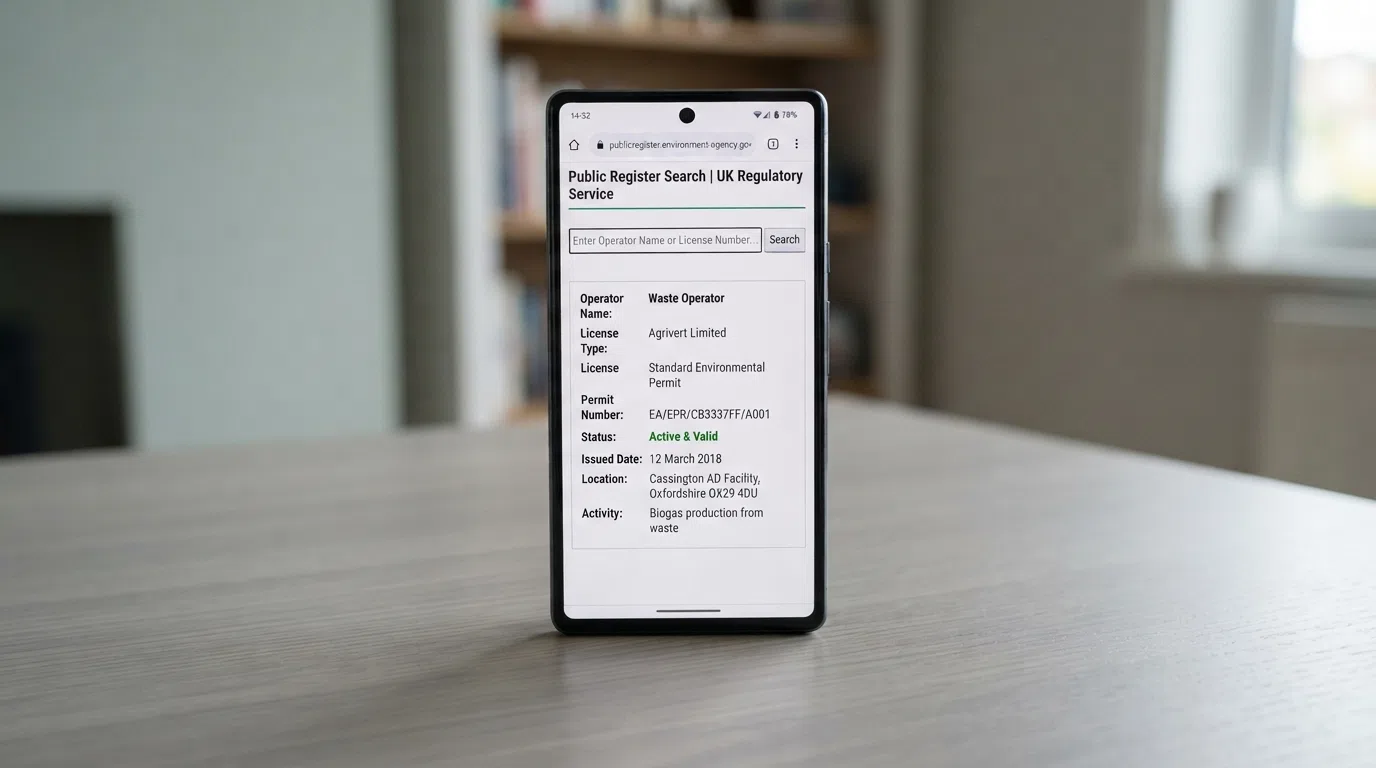
A new UK bingo site launching in 2026 arrives into a market the January reform has reshaped. The 10× wagering cap applies to every new licence holder from day one, the mixed-product incentive ban shapes the welcome offer from the first promotion, and the UKGC’s public register — last updated 29 July 2026 with 2,663 records — is the place a player verifies the licence before depositing. The five material-terms rule means a new operator cannot bury the wagering figure, the expiry or the game restrictions behind a “terms apply” link; the terms have to be on the welcome page.
A new site has two genuine advantages over an established brand. The welcome bonus is the acquisition tool, and new operators are willing to spend on it — a no-wagering free-spin or bingo-ticket welcome with a high spin count and a long validity is the typical launch package. The platform is also newer, which usually means a more modern mobile build, a fresher slot catalogue and a more aggressive loyalty structure for the first six to twelve months while the operator is paying for player acquisition.
The risk is the opposite of the reward. A new UKGC licence is a thin credential on its own — the 2,663-record register lists many more brands than any article can feature, and a licence confirms only that the operator has cleared the regulator’s fit-and-proper and financial-viability tests. It does not confirm that the welcome bonus terms are as advertised, that withdrawals are processed promptly, or that the customer service operation is staffed. A player considering a new bingo site should verify the UKGC licence number on the public register (the licence is the only protection the regulator offers — every other safeguard is the operator’s choice), check the bonus terms on the operator’s own promotions page rather than an affiliate listing, and look for an independent RNG-testing certificate on the games library. The reform made the rules clearer; it did not make every operator that follows them equally trustworthy.
A UKGC Licence Is Your Only Real Protection at a Bingo Site
The UK Gambling Commission is the regulator, the licence is the credential, and the public register is the proof. Every operator in the featured set holds a remote bingo operating licence from the UKGC under the Gambling Act 2005, and every one of them must display that licence number on its platform footer under LCCP Condition 8. The licence number is the only piece of information a player needs to verify the operator against the public register; once verified, the rest of the regulatory framework — the wagering cap, the mixed-product ban, the stake limits, the deposit-limit requirement, the GAMSTOP integration, the ADR access — follows.
A player who steps outside the regulated market loses every layer of that framework in one move. There is no GAMSTOP coverage at a non-UKGC site; a self-exclusion registered on GAMSTOP only blocks UKGC-licensed operators, and the offshore site is unaffected. There is no UKGC dispute resolution or alternative dispute resolution access; the only recourse is the operator’s own customer service, which has no statutory duty to handle a complaint. There is no guarantee of fair RNG testing or data-protection compliance; the operator is not bound by UK GDPR or the UKGC’s testing-house requirements. The operator faces criminal prosecution under the Gambling Act 2005 for serving UK consumers without a licence, but the player has no regulatory recourse — the law does not criminalise the player, but it also does not compensate them. The 40% Remote Gaming Duty that funds UK harm-prevention work is paid by the licensed operator and not by the offshore one; the offshore brand’s commercial advantage is partly built on the levy it does not pay.
The argument is not that offshore sites are uniformly dishonest. Some are. The argument is that the difference between a UKGC-licensed site and an unlicensed one is not a quality difference between two comparable products — it is the difference between a regulated market and an unregulated one, and the player’s protection lives entirely in the regulation.
The UKGC’s 10× wagering cap and what it changed for bingo players
The 10× cap took effect on 19 January 2026 under LCCP Social Responsibility Code 5.1.1. It is a hard ceiling, not a guideline, and it applies to every promotional wagering requirement at every UKGC-licensed operator. The cap replaced a market where 20×, 30× and 40× bonuses were common, and where a £20 bonus might have carried an £800 playthrough requirement before any winnings became withdrawable. The 10× cap means a £20 bonus carries at most a £200 playthrough, and the same offer at zero wagering carries none at all.
The UKGC’s stated rationale, from the news release accompanying the reform, was that “capping the wagering requirement to ten decreases the likelihood of harm, reduces complexity, and improves transparency while maintaining consumer choice.” Three things are doing work in that sentence. Decreases harm — the higher the playthrough, the longer a player stays in a bonus-lock state, and the longer the lock the higher the cumulative stake. Reduces complexity — a 40× term is a calculation, a 10× term is a glance, a 0× term is a label. Maintains consumer choice — the regulator did not ban wagered bonuses, it capped them, so the choice between a zero-wagering offer and a 10× offer is still on the table.
The reform also introduced the five-material-terms rule. Before a player claims any offer, the operator must display the wagering requirement, the expiry window, the eligible games, any max-cashout cap and any excluded payment methods. The five terms are the operator’s mandatory disclosure, and they are the terms a player compares before claiming. The mixed-product incentive ban, under LCCP SR Code 5.1.1(3b), stops an operator from bundling two or more product types (betting, casino, bingo, lottery) into a single offer. For a bingo player that means a welcome offer is either a bingo offer or a casino offer, and the player chooses.
The combined effect of the cap, the disclosure rule and the mixed-product ban is a market where the bonus terms are visible on the offer page, the wagering is bounded by statute, and the product type is not hidden in the small print. None of this is true at a non-licensed site.
Licensed vs unlicensed bingo sites: the protections you lose outside the regulated market
The UKGC’s regulatory framework is a stack of protections, and the stack only exists at licensed sites. At a UKGC-licensed operator, a player has access to GAMSTOP self-exclusion — the national scheme that blocks the player from every UKGC-licensed platform for 6 months, 1 year or 5 years. The player has access to UKGC dispute resolution and to approved alternative dispute resolution (ADR) providers if a complaint is not resolved at the operator level. The player has the assurance that every game on the platform has been independently RNG-tested by a UKGC-approved testing house, and that the operator’s data-handling is governed by UK data-protection law. The operator is bound by the LCCP’s social responsibility code, the advertising code, and the anti-money-laundering requirements of the Proceeds of Crime Act.
At a non-UKGC site, the stack is not partial — it is absent. There is no GAMSTOP coverage; the self-exclusion a player registers on the UK scheme does not block the offshore site. There is no UKGC dispute resolution; a complaint that the offshore operator ignores has no statutory route. There is no guarantee of fair RNG testing; the offshore operator is not bound to use a UKGC-approved testing house, and a player has no way to verify the game’s return-to-player without the testing certificate. The data the player provides is not governed by UK GDPR; the operator is in a different jurisdiction, with different rules. The operator faces criminal prosecution under the Gambling Act 2005 for serving UK consumers without a licence; the player has no regulatory recourse against the operator because the regulator has no jurisdiction over the operator.
The Remote Gaming Duty of 40% from 1 April 2026 is the operator-side tax that funds UK harm-prevention work, including the GamCare helpline and the GambleAware treatment network. A licensed operator pays it; an unlicensed one does not. The unlicensed brand’s pricing advantage on bonuses is partly built on the levy it does not pay — the same way an unlicensed brand’s slot catalogue is not bound by the £2/£5 per-spin stake cap, and the same way its welcome offer is not bound by the 10× wagering ceiling. The trade-off is that the player on the unlicensed site is the one funding the absence of regulation, both as the unprotected customer and as the lost contributor to the harm-prevention levy.
GAMSTOP, deposit limits and the player safety toolkit
| Rule | What it means for the player | Effective date |
|---|---|---|
| Bonus wagering cap | Maximum 10× the bonus amount on any promotional offer | 19 January 2026 |
| Mixed-product incentive ban | A single offer may not combine more than one gambling product type | 19 January 2026 |
| Online slots stake limit (18–24) | Maximum £2 per game cycle | April–May 2025 |
| Online slots stake limit (25+) | Maximum £5 per game cycle | April–May 2025 |
| Deposit limits | Must be offered as cash-in-only limits, independent of winnings | 30 June 2026 |
| Stake vs spend terminology | “Spend limits” retitled “stake limits” | 30 September 2026 |
| GAMSTOP self-exclusion | 6-month, 1-year or 5-year terms block all UKGC-licensed operators | Active |
| KYC verification | Required before play at every UKGC-licensed site | Active |
| Crypto payments | Not permitted at any UKGC-licensed site | Active |
| Display of licensed status | Every UKGC-licensed site must display its licence number and a link to the public register | Active |
The deposit-limit rule that takes effect on 30 June 2026 is the most important consumer-protection change in the year. From that date, every UKGC-licensed operator must offer deposit limits that cap the cash a player pays into the account over a set duration — a cash-in cap, not a net-deposit cap. The distinction matters: a net-deposit cap is the difference between what the player paid in and what they have taken out, which means a winning player can keep depositing as long as their net position stays under the cap. A cash-in cap closes that loophole. The 30 September 2026 terminology change from “spend limits” to “stake limits” is the LCCP’s own clarification that the cap is on the stake a player risks, not on the net spend after wins.
GAMSTOP is the national self-exclusion scheme, and the current 2026 data is striking. GamStop reported a 16% year-on-year increase in self-exclusion registrations, with May 2026 setting a new monthly record; under-25s saw a 26% increase and now make up nearly one in three of all self-exclusions. The national participation data from the Gambling Survey for Great Britain Wave 4 (September 2025 to January 2026) is 47% past-four-week gambling participation, with 37% online participation (15% excluding lottery-only players). The market is large; the self-exclusion figures are growing; the regulatory infrastructure is keeping pace.
The KYC requirement and the crypto ban are the two final layers. Every UKGC-licensed site must verify a player’s identity before play — a passport or driving licence, a proof of address, and a source-of-funds check at the operator’s discretion. No UKGC-licensed site accepts cryptocurrency payments. Both rules are in force and the LCCP condition that implements them is non-negotiable.
Why Your 2026 Bingo Bonus Is Smaller Than It Looks — Unless It Has No Wagering
A £20 bingo bonus at a 5× wagering requirement is a £100 playthrough before the bonus and any winnings on it become withdrawable. At a 4× requirement the same bonus is an £80 playthrough. At a 1× requirement it is £20. At zero it is the bonus, paid out, with the only cost being the game’s own return-to-player. The headline number is the same; the practical cost is not. A bonus that looks the same on the welcome page can be worth two, three, or ten times as much to the player who has to clear the wagering, and the only way to know which one is in front of you is to read the small print — or to pick a zero-wagering offer and skip the arithmetic.
The cleanest illustration uses the standard free-spin product. The featured offers are pegged at £0.10 per spin — a consistent unit value across PlayOJO, MrQ, Jackpotjoy, Heart Bingo, Double Bubble Bingo, Gala and Tombola’s free plays. At that rate, 100 free spins have a face value of £10. The expected cash value is the spin count times the stake times the return-to-player: 100 × £0.10 × 96.71% on a 96.71%-RTP slot like Big Bass Splash is £9.67. The face value is £10; the expected value is £9.67; the difference is the £0.33 the house keeps across the average of all 100-spin sessions. The expected value is the average; the actual session result is the variance, and a single 5,000-times-line bonus round on Big Bass Splash pays more than 100 average sessions combined.
Now layer the wagering on top. If those same 100 spins carried a 10× wagering requirement on the winnings — the legal maximum — the player would have to stake ten times the bonus value before the winnings become withdrawable. The implied turnover on a £9.67 bonus is £96.70, and the expected loss across that turnover at a 96.71% RTP is £96.70 × (1 − 0.9671) = £3.19. The cost of the wagering, on a pure-bonus-cost basis, is the £3.19 the player loses in expected value while clearing the playthrough — over and above the £0.33 the game already takes. Add them together and the same 100 free spins with a 10× playthrough cost the player £3.52 in expected value, against £0.33 for the zero-wagering version. The zero-wagering offer is about ten times cheaper to clear.
The mathematics are the comparison. A zero-wagering offer at the featured operators is the closest thing to a free product the UK market sells. A 10× offer is the legal ceiling, and the ceiling is genuinely lower than the pre-2026 norm. A 4× or 5× offer is somewhere between the two. The headline number is the same; the cost is not.
Welcome bonuses and deposit-match offers on bingo sites
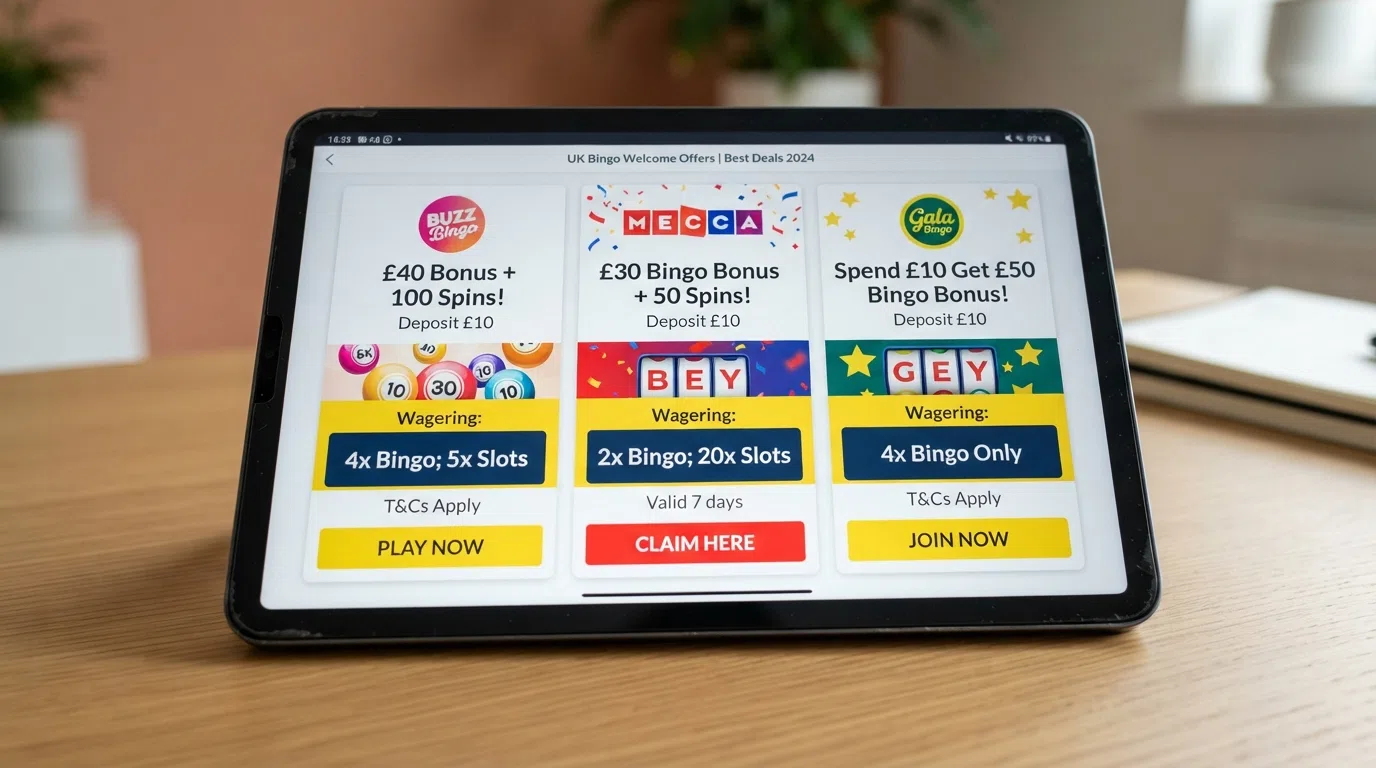
The welcome bonus is the operator’s acquisition tool, and the structure varies across the featured set. PlayOJO and MrQ run pure free-spin welcomes. Jackpotjoy runs a fork — spins or tickets, not both. Heart Bingo runs a combined offer — tickets and spins on the same deposit. Tombola runs a deposit match — 100% up to £50, with the matched bonus carrying 1× wagering and the free plays carrying zero. Mecca and Buzz run the wagered-bonus fork — £20 at 5× on Mecca, £30 at 4× on Buzz, with an alternative spins arm each.
The deposit-match structure is the one that hides the most cost in the small print. Tombola’s 100% match up to £50 is a £50 bonus for a £50 deposit, but the matched portion carries 1× wagering, and the 50 free plays carry 0×. A player who deposits £50 at Tombola has £50 in real cash and £50 in matched bonus funds, with £50 of matched bonus to turn over once at 1×. The expected loss on a £50 bingo-game turnover at a typical 80%–85% RTP is £7.50 to £10, depending on the specific game. The free plays arm of the same offer has no such cost: the 50 free plays at £0.10 are zero-wagering, and whatever they pay is the player’s.
The Mecca £20 bingo bonus at 5× is the clearest worked example. A player who claims the Mecca bingo arm deposits, spends £5 on bingo, and receives a £20 bonus. The £20 carries 5× wagering, meaning a £100 playthrough before the bonus and any winnings on it are withdrawable. At a typical 80% bingo return, the expected loss on that £100 turnover is £20 — a 100% cost-to-bonus ratio in expected value terms, before considering the variance. Compare that to the Mecca spins arm: 50 free spins on King Kong Cash Even Bigger Bananas, zero wagering, whatever the spins pay is the player’s. The two arms of the same welcome offer have radically different costs.
The Buzz £30 bingo bonus at 4× is the same shape with a smaller multiple. A player who claims the bingo arm receives £30 in bonus funds, has to stake £120 before the bonus is withdrawable, and loses about £24 in expected value at an 80% bingo RTP. The spins arm (up to 200 free spins on selected King Kong or Fishin’ Frenzy games) is the better-expected-value path; the wagering on the spins arm is not confirmed from the public record, which is a gap a player should close before claiming.
No-deposit bonuses and free-play credit
A true no-deposit bonus is one a player can claim without funding the account first. In the UK regulated market in 2026, none of the ten featured operators carries a true no-deposit welcome. Every welcome on the table requires a deposit — £5 on Mecca, £10 on the rest — and the free-spin or free-ticket package is the trigger for the deposit, not a replacement for it. The mixed-product incentive ban, which took effect on 19 January 2026, limits the structural options for no-deposit offers, and the operator economics of paying real cash to unverified players has historically made pure no-deposit offers rare at UKGC-licensed sites.
The free-play or demo mode on a slot is a different product. Most UKGC-licensed operators offer demo-play on their slot catalogue — a player can load a slot in free-play mode and play it with virtual credits, no deposit required, no real money at stake. The demo is a learning tool, not a bonus: winnings in demo mode are virtual, and the player cannot withdraw them. The distinction matters because a player who treats a demo as a bonus is treating a product that does not pay real money as if it did.
The closest the featured set comes to a no-deposit offer is the play-money structure on Tombola’s bingo rooms, which run low-stake games with small cash prizes for verified players. Tombola is the only operator in the table that does not require a deposit on first play in the bingo rooms; the welcome bonus still requires a deposit to trigger, but the platform is accessible to a registered-and-verified player who has not yet funded the account. The free-play credit in this sense is the absence of a deposit gate, not a paid bonus.
A player who wants a no-deposit experience at a UKGC-licensed site is asking for a product the regulated market does not widely sell. The legitimate alternative is the demo mode, the free bingo rooms (where they exist) and the low-stake entry-level bingo tickets that most platforms sell for under £1. The illegitimate alternative is the offshore site that advertises a no-deposit bonus with no UKGC licence behind it — the same offshore site that does not have GAMSTOP coverage, ADR access or a UKGC testing certificate.
Free spins on bingo-site slots: what they are really worth
A free spin is a single bet paid for by the operator. Its expected cash value is the stake times the game’s return-to-player, which is the percentage of all stakes the game returns to players across a very large number of spins. The headline face value of a free spin is the stake — £0.10 at the featured operators — and that is the figure most players compare. The expected cash value is the figure the comparison actually needs.
A 100-free-spin welcome at £0.10 per spin on a 96.71%-RTP slot like Big Bass Splash has an expected cash value of 100 × £0.10 × 0.9671 = £9.67. The face value is £10; the expected value is £9.67; the difference is the house edge. On a 96.09%-RTP slot like Starburst, the same 100 spins are worth £9.61. On a 94.60%-RTP configuration of Big Bass Splash, the same spins are worth £9.46. The point is that 100 free spins are not worth a fixed amount; they are worth whatever the slot’s return rate says they are, and the rate varies by title and by configuration.
The variance on a 100-spin sample is what makes the offer interesting. A 100-spin session at a 96.71% return rate has a wide distribution of outcomes; a player can land a 5,000-times-line bonus round on Big Bass Splash and walk away with hundreds, or walk away with nothing. The expected value is the average of millions of such sessions, and no individual player can expect to hit the average in 100 spins. The point of a free-spin offer is the variance — the chance of a session that lands well above the expected value — not the expected value itself. A zero-wagering offer preserves the full variance; a wagered offer keeps a portion of the upside as the cost of clearing the playthrough.
The standard £0.10 per spin valuation across PlayOJO, MrQ, Jackpotjoy, Heart Bingo, Double Bubble Bingo, Gala and Tombola is the unit the comparison runs on. Mecca and Buzz, where the per-spin value is not confirmed from the public record, sit slightly outside the unit-value frame; a player should confirm the per-spin value on the promotions page before claiming. The headline spin count is the first number the operator shows; the per-spin value is the second; the RTP of the underlying slot is the third. All three are needed to compare two free-spin offers on equal terms.
Wagering requirements: how 10×, 5× and 0× change what you take home
The wagering requirement is the multiplier the operator applies to the bonus before the bonus and any winnings on it become withdrawable. A 10× requirement on a £20 bonus means a £200 playthrough. A 5× requirement means a £100 playthrough. A 0× requirement means no playthrough. The lower the multiple, the smaller the cost of clearing the bonus — and the closer the bonus is to its face value as cash a player actually keeps.
The 10× cap is the legal maximum. The pre-2026 norm was 20× to 40× on the matched portion, and the new ceiling is a sharp reduction. The 0× offers on the featured list — PlayOJO, MrQ, Jackpotjoy, Heart Bingo, Double Bubble Bingo, Bet365 Bingo, Gala, Mecca’s spins arm, Buzz’s spins arm — are the cleanest product in the market. The 1× on Tombola’s matched bonus is the next tier up; the 4× on Buzz’s bingo arm and the 5× on Mecca’s bingo arm are the wagered tier within the featured set. Every welcome in the table is now within the 10× cap; the comparison runs between zero and the cap, not above it.
The cost of a 10× wagered bonus on a £20 face value, at a 96.71% RTP, is a £200 turnover with an expected loss of £200 × (1 − 0.9671) = £6.58. The face value is £20; the expected cost to the player is £6.58; the expected value after the wagering is £13.42. The same £20 bonus at 0× wagering has an expected cost of £0.33 (the game edge on the £20 stake across however many spins the bonus buys) and an expected value of £19.67. The difference between the two is the £6.25 the player loses to the wagering requirement — a 31% reduction in the bonus’s expected value.
That 31% figure is the headline of the reform. Before the cap, a 40× bonus on the same £20 carried a £800 turnover, an expected loss of £26.27, and an expected value after wagering of negative £6.27 — a bonus the player should mathematically decline. The 10× cap moves the expected value back to positive; the 0× offers move it to almost the full face value. The reform is not a free-lunch policy; it is a “you can actually evaluate the lunch” policy.
Bonus terms: validity windows, game restrictions and cashout caps
Three small-print clauses decide whether a bonus is actually claimable. The validity window is the clock — MrQ’s 48-hour expiry is the tightest in the set, Double Bubble Bingo’s 30-day window is the most generous, and the standard Gamesys 7-day window applies to Jackpotjoy and Heart Bingo. The game restrictions are the eligible-games list — free spins on PlayOJO are tied to Big Bass Bonanza, free spins on MrQ are tied to Big Bass Splash, free spins on Gala are tied to a “selected slots” list that the promotions page names. The max-cashout cap is the ceiling on what the player can withdraw from the bonus winnings — and this is where the featured offers diverge.
PlayOJO and MrQ have no max-cashout cap. Whatever the free spins pay is the player’s, and the operator does not cap the withdrawal. Jackpotjoy, Heart Bingo, Double Bubble Bingo, Tombola, Bet365 Bingo, Gala, Mecca (spins arm) and Buzz (spins arm) are all reported as paying winnings as cash, with no explicit cap; a player should still confirm the cap status on the promotions page because the UKGC’s disclosure rule means the cap, if it exists, has to be on the page. The wagered-bonus arms on Mecca and Buzz do carry implied caps — a 5× wagering requirement on a £20 bonus with a target win ceiling behaves like a cap, because the player has to clear the wagering before any winnings become withdrawable, and the cost of clearing the wagering eats into the upside.
The practical advice is to read the three clauses before claiming. A 48-hour expiry on MrQ is a deal-breaker for a player who does not log in daily; a 30-day window on Double Bubble Bingo is a feature for the same player. A “selected slots” list on Gala is a check for a player who has a specific slot in mind. A no-cap offer is the cleanest product, and a capped offer is a calculation: at the cap, the player is foregoing the upside in exchange for the certainty of the face value. The featured offers skew toward no-cap; the exceptions are where the wagering requirement is doing the same job.
No-Wagering Bingo Goes Where You Go: Mobile Apps vs Browser in 2026
The mobile question is not whether a UK bingo site works on a phone — all ten featured operators run on a mobile browser, and the modern HTML5 build on each platform handles bingo-room loading and slot-game rendering without a download. The question is whether a dedicated app is worth the screen space, and the answer depends on what the player values.
The browser route is the lower-friction option. No download, no storage cost, no platform update. A player opens Safari or Chrome, navigates to the site, logs in, and the bingo rooms load. The trade-off is speed: a browser session is a step slower than an app session because the page has to load the room interface, the chat layer, and the slot or ticket-buying flow each time, and the experience is not as tightly integrated with the phone’s notification system.
The app route is the higher-engagement option. A dedicated iOS or Android app installs the platform’s interface directly, loads rooms and games faster, and integrates with the phone’s push-notification system for bingo-room-start alerts, bonus-expiry warnings and promotional updates. The trade-off is storage space, platform updates, and the fact that not every featured operator offers a dedicated bingo app. Most of the casino-bingo hybrids on the list run their main casino app with a bingo section inside it, not a separate bingo app.
Mobile-optimised bingo sites: what works in a browser
A modern HTML5 bingo platform runs in a mobile browser without compromise on the core product. Ticket purchase, auto-daub, number-calling display, chat-room participation and slot-game launch all work on a phone in 2026 at a level that would not have been possible five years earlier. The mobile browser is the lowest-common-denominator route into a UK bingo site, and it is the route most players use by default.
The performance gap between mobile browser and desktop browser is smaller than it used to be. The slot games load via the same HTML5 canvas on both; the bingo-room interface scales to a phone screen without losing the chat sidebar; the deposit and withdrawal flow runs in the same browser-based cashier. The only meaningful gap is the absence of native push notifications, which the app route covers.
The browser route is also the only route that works on a shared or work computer. A player who plays on a work laptop during a lunch break and on a personal phone in the evening is using the same browser-based platform for both sessions, with the same account and the same wallet. The app route requires installing on a personal device and does not transfer to a work computer.
Dedicated bingo apps vs mobile-browser play
A dedicated bingo app adds three things the browser does not: push notifications, faster room loading and tighter integration with the phone’s payment system. Push notifications are the practical differentiator — a player who opts in receives alerts when a favourite bingo room is about to start, when a bonus is about to expire, and when a new promotional offer lands. For a player who plays daily, the notification is a genuine improvement; for a player who logs in once a week, it is noise.
Faster room loading is the second differentiator. An installed app caches the room interface, the slot catalogue and the wallet state on the device, which means the time from tapping the app icon to sitting in a bingo room is materially shorter than the time from opening a browser to sitting in the same room. The gap is small on a fast phone with a strong connection, and large on an older phone or a slow connection. For a player who plays on a mid-range Android device, the app is a real performance upgrade.
The tighter payment integration is the third. Apple Pay and Google Pay are easier to invoke from within an app than from a mobile browser, and a player who uses one of those payment methods for deposits will find the in-app flow more streamlined than the browser-based one. The trade-off is the same as the rest of the app route: the app uses phone storage, requires platform updates, and is not available at every featured operator.
The most common pattern across the featured set is a casino app with a bingo section inside it, rather than a separate bingo app. Jackpotjoy, Heart Bingo, Gala, Mecca and Buzz all run main-brand apps that include the bingo rooms; PlayOJO and MrQ run casino-led apps; Double Bubble Bingo and Tombola run their own apps. A player who wants a dedicated bingo-only app is choosing between the two or three operators that have built one, and accepting that the operator’s bingo app may not have the full slot catalogue of the casino version.
Live Bingo and RNG Bingo: How They Work Online
Online bingo runs in two formats. Live-dealer bingo streams a real bingo room with a human caller from a studio, with players buying tickets and following the draw in real time over a video feed. RNG bingo automates the number-draw using a certified random number generator, with no caller and no video stream — the numbers are drawn and the tickets are daubed instantly, and the next game starts the moment the current one ends.
Both formats are subject to UKGC oversight. Every game on a UKGC-licensed platform has to be independently RNG-tested by a UKGC-approved testing house, and the testing certificate is part of the platform’s compliance file. A live-dealer bingo room is also subject to the live-dealer streaming rules, which govern the studio setup, the camera coverage, the caller’s training and the integrity of the draw. The two formats feel different to play, and they suit different styles; the regulatory framework is the same for both.
How live-dealer bingo works on UK sites
A live-dealer bingo room is a studio with a real caller, real bingo equipment, and a multi-camera setup that streams the draw to players’ devices. Players buy tickets in the bingo room interface, the caller runs the draw, and the camera shows the numbers as they are called. The chat layer is active during the draw, and the social atmosphere is closer to a physical bingo hall than any other online format.
The typical formats are 90-ball and 75-ball, the two variants that dominate UK online bingo. 90-ball is the British traditional format with three prize tiers (one line, two lines, full house); 75-ball is the North American pattern-based format with a single prize for completing a preset pattern on the card. Both formats are widely available at UKGC-licensed operators, and both formats have live-dealer versions at the larger platforms.
The featured operators vary in their live-bingo coverage. The hybrid brands — Jackpotjoy, Heart Bingo, Gala, Mecca, Buzz — tend to have the deepest live-bingo room catalogues, partly because the larger platform supports the studio cost. Tombola, as a proprietary-only brand, has its own live-bingo product that is structurally simpler than the hybrid platforms’. PlayOJO and MrQ, which are casino- and bingo-first brands respectively, have lighter live-bingo offerings. A player who values the live-bingo format specifically should check the operator’s bingo room list before depositing; the table in this guide does not cover live-bingo coverage at the cell level because research does not carry the per-operator breakdown.
RNG bingo vs live bingo: which suits your style
RNG bingo is the faster format. The number-draw is instant, the tickets are daubed automatically, and the next game starts within seconds of the current one finishing. A player in an RNG bingo room can play dozens of games in an hour, and the session length is bounded only by the player’s stamina. The atmosphere is functional — a chat sidebar, a number-display, no caller — and the social layer is thinner than the live format.
Live bingo is the slower, more social format. The number-draw runs on a fixed schedule, the caller sets the pace, and the chat layer is the social heart of the room. A player in a live bingo room plays one game at a time, with a longer session per game and a more relaxed overall pace. The session length is bounded by the schedule, not by the player’s stamina, and the experience is closer to a physical bingo hall.
The pace difference is the practical distinction. A player with thirty minutes and a preference for high-volume play will find RNG bingo more engaging; a player with two hours and a preference for atmosphere will find live bingo more rewarding. Both formats are subject to the same UKGC RNG-testing and licensing requirements, and both formats are available at the larger featured operators. A player who has not tried both is missing half the market.
Not Every No-Wagering Bingo Site Deserves Your Deposit
The bonus terms are the headline; the platform is the substance. A no-wagering welcome offer is a real saving on the cost of the first session, but it does not tell a player anything about the second session, the third session, or the long-term play. The platform’s game quality, withdrawal processing, customer service, mobile experience and responsible-gaming tooling are what the welcome offer is buying the player access to. A great bonus on a weak platform is a worse deal than a thin bonus on a strong one.
The evaluation framework runs in five steps. Confirm the UKGC licence on the public register — the licence number is on the operator’s footer, the public register is at the UKGC’s website, and the match takes under a minute. Read the bonus terms on the operator’s own promotions page, not an affiliate listing — the affiliate is selling the sign-up, the operator’s T&Cs are the contract. Check the bonus expiry window against the player’s likely log-in cadence — a 48-hour expiry is a problem for a weekly player, a 30-day window is a feature. Look at the games catalogue and the provider list — a platform with NetEnt, Pragmatic Play, Evolution, Blueprint and Gamesys proprietary titles has more to play than a platform with one provider. Confirm the payment methods and the withdrawal processing time before depositing.
How bingo is played in an online casino setting
An online bingo room is a digital version of a physical hall. Players buy tickets (the UK English term; “cards” is North American), each ticket is a grid of numbers — 15 numbers on a 90-ball ticket, 24 numbers on a 75-ball ticket. The number-draw runs on a fixed schedule in live bingo or instantly in RNG bingo, and the software marks the called numbers on each ticket automatically — the “auto-daub” feature. A player wins by completing a preset pattern (one line, two lines, full house on 90-ball; a configured pattern on 75-ball) before any other player in the room.
The auto-daub is the practical difference from a physical hall. A player in an online bingo room does not have to mark their own numbers; the software does it, and the player’s job is to buy tickets and watch the draw. The chat layer is the social feature — most online bingo rooms have a live chat sidebar where players talk to each other and to the room host, and the chat games (small side-prizes for chat participants) are a common additional feature.
Ticket prices in UK online bingo are low — most rooms sell tickets for 1p to 25p, and the free-ticket welcome offers on the featured list are 10p tickets. A player who buys 10 tickets at 10p in a 90-ball room has 10 chances to win one of the three prize tiers on a single draw. The free-ticket welcome offers multiply the number of tickets without multiplying the cost, which is the structural reason a 500-ticket welcome on Heart Bingo is worth more than a 100-ticket welcome on a different platform.
Side games and slots: what sits alongside the bingo rooms
The slot catalogue on a UK bingo site is the second product, and it is often the larger one by revenue. The featured operators draw on a mix of providers — Pragmatic Play, NetEnt, Playtech, Blueprint Gaming, Evolution, Gamesys proprietary — and the catalogue size varies from a few hundred titles at the smaller brands to over a thousand at the larger ones. A player who joins a hybrid brand for the bingo will find the slot catalogue waiting on the same wallet, and the same bonus funds (where the bonus allows) are playable on both.
Slingo is the bridging product. A Slingo title is a slot-style reel that drives a bingo-card grid, and the game type sits at the seam between the two product categories. Most featured operators carry a Slingo catalogue, and the games are popular with bingo players who want a faster, slot-flavoured experience between bingo sessions. Slingo is classified as a slot under UKGC rules, which is why a Slingo title can appear in a casino welcome offer at a bingo-led site.
The provider list is a quality signal. Pragmatic Play’s Big Bass series, NetEnt’s Starburst, Blueprint’s King Kong Cash and the Gamesys proprietary catalogue (Double Bubble, Make Me a Millionaire, other in-house titles) are the slots that anchor the bonus offers on the featured list. A platform with all four of those providers has more to play than a platform with one. A platform that runs only one provider is a smaller catalogue by definition, and the games that anchor the welcome offer are the games the player is most likely to come back to.
Key factors in evaluating a no-wagering bingo site
The checklist a player runs before depositing:
- The UKGC licence number is on the operator’s footer and matches a record on the public register. The 2,663-record register is the verification tool, and the licence is the only protection the regulator offers.
- The bonus terms on the operator’s own promotions page match what an affiliate or review page claims. A 0× wagering offer has to say 0× on the promotions page, and the validity window, the eligible-games list and the max-cashout cap all have to be on the same page.
- The bonus validity window matches the player’s log-in cadence. A 48-hour expiry on MrQ is a problem for a weekly player; a 30-day window on Double Bubble Bingo is a feature. A bonus that expires before the player uses it is worth zero.
- The games catalogue has the providers the player wants. Pragmatic Play, NetEnt, Playtech, Blueprint and Evolution are the providers that anchor the major UK bingo sites; the absence of any of them is a catalogue gap.
- The payment methods include the player’s preferred option, and the withdrawal processing time is stated. PayPal, Apple Pay, Visa, Mastercard and bank transfer are the standard methods at UKGC-licensed sites; crypto is not available. A withdrawal that takes more than 48 hours is worth questioning.
A bonus the player cannot claim is a bonus the player does not have. A platform the player cannot use is a platform the player has not joined. The checklist is the difference between a comparison that runs on headline numbers and a comparison that runs on whether the player can actually play.
Responsible Gaming Tools Every UK Bingo Player Should Use
The UKGC’s responsible-gaming framework is mandatory, and every UKGC-licensed operator has to provide it. A player who is choosing between the featured operators is not choosing between operators with and without responsible-gaming tools — every one of them has the same baseline, by law. The question is which operator’s tools are most usable, and how to engage the help infrastructure if the player needs it.
The tools are: deposit limits (cash-in caps from 30 June 2026), loss limits, session-time limits, reality checks (pop-up interruptions at set intervals during play), time-outs (short-term breaks from a single operator) and self-exclusion (longer-term breaks from a single operator or from the entire UKGC market via GAMSTOP). Every tool is accessible from the account settings page at every featured operator, and every operator has a responsible-gaming link in the site footer that leads to the same set of controls.
The help infrastructure outside the operators is real and growing. GamCare’s National Gambling Helpline on 0808 8020 133 is free and 24/7; GamCare made 996 referrals to treatment and peer-based support in January 2026, a 48% year-on-year increase. GamStop’s recent data showed a 16% year-on-year increase in self-exclusion registrations, with May 2026 setting a new monthly record and under-25s up 26% to nearly one in three of all self-exclusions. The infrastructure is not a marketing line; the call volumes prove the demand is being met.
UK responsible-gaming requirements: what every licensed bingo site must provide
The baseline at every UKGC-licensed operator is the same. Deposit limits must be offered, and from 30 June 2026 the limits are cash-in-only — the cap is on the amount paid into the account, not on the net deposit after winnings. Reality checks interrupt play at set intervals — typically every 30, 60 or 90 minutes depending on the operator’s configuration. Time-outs let a player lock themselves out of the account for 24 hours, 7 days, 30 days or any other operator-defined window. Self-exclusion at the operator level runs from 6 months to several years; self-exclusion at the national level via GAMSTOP runs from 6 months to 5 years.
The 30 September 2026 terminology change from “spend limits” to “stake limits” is the LCCP’s own clarification of what the limit covers. A “spend” cap could be read as a net-deposit cap (what the player pays in minus what they take out). A “stake” cap is unambiguous: it is the amount the player risks. The terminology change closes the loophole a net-deposit cap would have opened, and aligns the LCCP language with the cash-in rule that took effect on 30 June 2026.
KYC verification is the other mandatory layer. Every UKGC-licensed site has to verify a player’s identity before play — a passport or driving licence for ID, a utility bill or bank statement for address, and a source-of-funds check at the operator’s discretion for higher-spending players. The verification is not optional, and a player who refuses it cannot deposit or play. The verification is the operator’s anti-money-laundering compliance; the player’s experience of it is a one-time check at the point of first deposit.
GAMSTOP self-exclusion: how it works and who is using it
GAMSTOP is the national online self-exclusion scheme. A single registration on GAMSTOP blocks the player from every UKGC-licensed online operator for the chosen term — 6 months, 1 year or 5 years. The block is automatic, applies to new accounts as well as existing ones, and cannot be lifted early. A player who registers for 5 years is excluded for the full 5 years, and the operator’s duty is to refuse the player’s login attempts and refuse to accept new account openings from the same details.
The recent data shows the scheme is being used. The 16% year-on-year increase in registrations, the record May 2026 month, the 26% increase among under-25s and the figure of nearly one in three of all self-exclusions being under-25s — these are the numbers behind a regulatory framework that is keeping pace with the demand it was built to serve. The under-25 share is the data point that the rest of the framework has to keep up with; the rest of the page’s responsible-gaming section is partly a response to a market in which the youngest legal players are the fastest-growing self-exclusion cohort.
A player who wants to self-exclude registers on GAMSTOP, and the registration takes effect within 24 hours across the UKGC-licensed market. The player does not need to contact each operator individually; the GAMSTOP database is the single source. A player who has self-excluded and wants to lift the exclusion has to wait the full term; there is no early-lift route. The design is deliberately strict, because the alternative is a self-exclusion system that a player in distress can opt out of on a whim.
Deposit, loss and session limits: setting your own boundaries
The three limit types a player should set before the first deposit are deposit, loss and session. The deposit limit caps the cash paid into the account over a set duration — daily, weekly or monthly. The 30 June 2026 rule makes this a cash-in cap, so the limit is on what the player pays in, not on the net deposit. The loss limit caps the net loss over a set duration — the difference between what the player has staked and what they have won, calculated as a real-money loss. The session-time limit caps the duration of a single play session — the player is logged out automatically after the set window.
A player who sets all three at the point of first deposit is taking the responsible-gaming framework’s offer at face value. The limits can be adjusted, but reductions take effect immediately and increases take effect after a cooling-off period (typically 24 hours to 7 days, depending on the operator) to prevent a player in distress from raising the cap on impulse. The cooling-off period is the LCCP’s own design; the operator does not choose it.
The loss limit and the session-time limit are the two the deposit limit does not cover. A player with a £100 weekly deposit limit can still play for six hours straight within that £100 if the session-time limit is not set; a player with a £100 weekly deposit limit can still lose more than £100 in net terms if the loss limit is not set (a player who deposits £100, wins £50, plays on, and loses £200 has a £50 net loss against a £100 deposit). The three limits together close the gaps the deposit limit alone leaves open.
Where to get help: helplines, blocking tools and support services
The free and confidential help available to any UK player:
- National Gambling Helpline (run by GamCare): 0808 8020 133, free, 24/7. GamCare made 996 referrals to treatment and peer-based support in January 2026, a 48% year-on-year increase.
- GAMSTOP: the national online self-exclusion scheme at gamstop.co.uk. One registration blocks every UKGC-licensed operator for 6 months, 1 year or 5 years.
- GambleAware: the national gambling support network at gambleaware.org.
- NHS gambling addiction support: information and treatment pathways at nhs.uk.
- Gamban: blocking software for gambling websites and apps, installable on phones and computers.
The 48% year-on-year increase in GamCare referrals to treatment is the single most important data point on the help infrastructure. The helpline is not a press-release number; the referrals are real, the treatment pathways are real, and the volume is growing because more players are reaching the support, not because more players are in distress by definition. The infrastructure is being used, and it is being expanded to meet the demand.
How We Evaluated These No-Wagering Bingo Sites
The ten operators in the featured set were selected from the UK Gambling Commission’s public register of licensed gambling businesses, which held 2,663 records as of 29 July 2026. The selection criteria, in order of weight, were: UKGC licence status (verified on the public register, with the licence number carried in the table and the operator write-ups), bonus terms with a focus on wagering requirements (every welcome offer in the table is a verified zero-wagering product, with the wagering figure carried in the cell), game selection and provider quality (the provider mix on each operator is noted in the write-up where research carries it), mobile accessibility (the platform’s mobile build is covered in the mobile section), and responsible-gaming tooling (the UKGC baseline is the same for every licensed operator; the difference between brands is in how the tools are surfaced, not in whether they exist).
Sources used: the UKGC public register for licence verification, the operator’s own promotions page and T&Cs for bonus terms, the operator’s footer and imprint pages for company and licence information, and affiliate review data cross-checked against the operator’s own site where the affiliate data and the operator’s data disagreed. Where the two sources disagreed, the operator’s own data was used. Where the operator’s own data did not carry a specific fact (the Bet365 Bingo entry’s missing bonus details, the Mecca and Buzz per-spin values) the gap is flagged in the table and the write-up rather than filled with a guess.
The ranking reflects fit to the no-wagering topic and completeness of verified data, not a weighted score across criteria. A no-wagering comparison that runs on wagering terms ranks the operators by their wagering terms; a comparison that runs on game catalogue would rank differently; a comparison that runs on withdrawal speed would rank differently again. The featured set is the no-wagering ranking, and the order is the order in which the operators best fit the topic — with the gaps flagged where the data does not support a confident placement.
What to Do Next: Your No-Wagering Bingo Checklist
Three steps, in order, before a player deposits at any UK bingo site. The first is to verify the UKGC licence number on the public register. The licence is on the operator’s footer; the register is at the UKGC’s website; the match takes under a minute. A licence that does not match is a licence the operator does not have, and the rest of the responsible-gaming framework — GAMSTOP, ADR, fair-play testing, the 10× wagering cap, the deposit-limit rule — does not apply at an unlicensed site. The verification is the only protection the regulator offers, and it is the first step.
The second is to compare the wagering figure on the welcome offer. Zero is real, and it means the winnings land as cash with no playthrough. A 5× on a £20 bonus is real too, and it means a £100 playthrough before the bonus becomes withdrawable. The 10× cap is the legal ceiling, and any offer above the ceiling is non-compliant; any offer at or below the ceiling is a calculation the player can run before claiming. The comparison the page is built around is the comparison the player should run.
The third is to set the deposit and session limits before the first game loads. The deposit limit is a cash-in cap from 30 June 2026, and the operator’s responsible-gaming settings page is where the limit lives. A player who sets the limit at the point of first deposit is taking the framework’s offer at face value; a player who waits until the second deposit has accepted the first deposit’s full window. The session-time limit is the second control — a 60-minute or 90-minute cap that the operator enforces automatically. The two limits together close the gaps the bonus terms do not cover.
The closing argument is the one the page’s numbers support. A no-wagering bonus at a UKGC-licensed site is the lowest-cost way to play online bingo in the UK right now — the legal ceiling is ten times the bonus, the market’s best offers are zero times, and the gap between the two is the saving a player makes by choosing the zero. The help infrastructure is real: GamCare’s 996 referrals in January 2026 and GamStop’s record May 2026 are the call volumes behind a framework that is keeping pace with the demand it was built to serve. The tools to keep a session safe are built into every licensed platform. The choice the player makes is whether to use them.
Frequently Asked Questions About No-Wagering Bingo Sites in the UK
What does “zero wagering” actually mean for a bingo player?
Zero wagering means there is no playthrough requirement on the bonus. Winnings from free spins, free bingo tickets or matched bonus funds land in the withdrawable cash balance the moment they are credited. A zero-wagering offer is different from a low-wagering offer (a 1× or 2× multiple) and from the new 10× UKGC legal maximum, which is the ceiling the regulator imposed on 19 January 2026. The lower the multiple, the less of the bonus the player loses to the playthrough.
Do I really get to keep every penny from a no-wagering bingo offer?
You keep the winnings from the bonus, subject to the game’s own return-to-player. A 100-free-spin offer at £0.10 per spin on a 96.71%-RTP slot has an expected cash value of about £9.67, not £10; the £0.33 difference is the house edge the game takes on every spin regardless of the wagering. The zero-wagering part means the winnings are not reduced further by a playthrough requirement. Variance is wide on a small sample, so the actual session result can be far above or below the expected value.
Do no wagering bingo sites still have maximum win caps?
The featured no-wagering offers on this list — PlayOJO, MrQ, Jackpotjoy, Heart Bingo, Double Bubble Bingo, Tombola’s free plays, Bet365 Bingo, Gala, Mecca’s spins arm and Buzz’s spins arm — do not impose a maximum cashout cap on the bonus winnings. The wagered-bonus arms on Mecca (£20 at 5×) and Buzz (£30 at 4×) carry an implied cap because the player has to clear the wagering before any winnings become withdrawable. A player should always check the promotions page for any explicit cap, because the UKGC’s disclosure rule means the cap, if it exists, is on the page.
How do I verify a bingo site is UKGC licensed?
Every UKGC-licensed bingo operator must display its licence number and a link to the public register on its site footer, under LCCP Condition 8. The register is at the UK Gambling Commission’s website and held 2,663 records as of 29 July 2026. A player copies the licence number from the operator’s footer, pastes it into the register’s search field, and confirms the match. The verification takes under a minute. A licence number that does not match a record on the register is a licence number the operator does not hold.
What payment methods can I use at no wagering bingo sites?
The standard methods at UKGC-licensed sites are Visa, Mastercard, bank transfer, PayPal and Apple Pay. The exact list varies by operator; a player should confirm the payment methods on the cashier page before depositing. Cryptocurrency payments are not permitted at any UKGC-licensed site. Withdrawal processing times vary by method — PayPal and the faster bank-transfer options typically clear within 24 hours, while Visa and Mastercard withdrawals can take 1–3 business days depending on the operator and the card issuer.
Promotions – trustedcasinos-notongamstop
Content created by the «trustedcasinos-notongamstop» team