
The Best Low Volatility Slots UK Players Can Spin in 2026
 Available in GB
Low volatility slots are the slot category the marketing pages like to dress up as the responsible choice. The pitch is that frequent small wins feel steadier, so the balance lasts longer, so the player loses less. The maths says otherwise: the house edge does not shrink because the wins arrive more often. It stays exactly where it is, and the longer session it produces is itself a cost. A slot that pays back 96 pence for every pound wagered still pays back 96 pence for every pound wagered, whether the pounds arrive in ten cliff-face drops or in three hundred small steps. Understanding that one line is what separates a useful ranking from a list of titles that sound comforting.

This page is a working guide for players in Great Britain who want a ranked set of low-volatility slots they can actually play at UK-licensed casinos, with the numbers that matter (RTP, max win, provider, wagering terms) and the regulatory framework that wraps every spin. It draws on the Gambling Commission’s public register, the per-title specifications published by the studios and the catalogues of the ten UKGC-licensed operators that carry the widest low-volatility range. The verdict at the close is mine, not the operators’, and the picks are organised by what the figures actually argue for rather than by the welcome bonus with the loudest headline.
*Current as of September 9, 2026. Licence status verified against the Gambling Commission’s public register of licence holders.*
What Low Volatility Actually Means, and Why It Will Not Beat the House Advantage
A low-volatility slot is a slot whose prize distribution is compressed. It pays often, it pays small, and it pays in a narrow band centred on the stake. The mechanism behind that pattern is the hit frequency, the share of spins that return any payout at all, and the payout shape, the size of those payouts relative to the bet. A low-volatility game runs a hit frequency above 30%, often closer to 40%, with most winning spins returning between one and five times the stake. Bonus features, where they exist, trigger roughly every 80 to 150 spins rather than every 300 or 600. The game feels busy; the balance moves in small steps.
That definition is the engineering. The marketing version is a different claim: that this rhythm is safer, easier on the bankroll, more sustainable. It is true that the bankroll graph looks flatter than a high-volatility slot’s. It is not true that the slot costs less to play. The house edge is set by the return to player, and the RTP is a property of the game’s mathematics, not its payout shape. A 96% RTP slot returns 96% over a statistically meaningful number of spins whether it pays in 800 small chunks or in 8 large ones. A longer session at a negative-expectation game, which a flatter balance encourages, multiplies the total loss rather than softening it. This is the trade-off the marketing never names: the same edge, the same maths, applied to more spins.
There is a real reason to choose low volatility, but it is not safety. It is the texture of the session. Players who dislike long dry spells, who want to feel the game responding to their bets, who are working through a bonus playthrough or simply want a quieter ride, will get what they want from this category. What they will not get is a better price per spin. The 2% to 4% house edge is unchanged; only the timing of the losses shifts.
Hit Frequency and Small Wins: How Low-Volatility Play Feels
A 30% hit frequency means roughly three spins in ten return something. On a £1 slot, that “something” is most likely a £1 to £5 payout, with a smaller tail stretching toward the bonus-feature tier. The session reads as a stream of near-misses and small wins punctuated by the occasional bonus trigger. The balance graph moves in a saw-tooth of dips and recoveries, with each recovery landing the balance close to where the dip started. The eye sees activity; the wallet feels it more slowly than on a high-volatility game.
Compare that with high volatility, where a 20% or lower hit frequency meets a payout distribution stretched toward 50×, 100× or more. The balance moves in cliffs: long flat stretches, then one or two large recoveries, then another flat stretch. Over the same number of spins, the two games return almost identical amounts to the player on average. The difference is the journey. A player on a high-volatility slot may watch the balance halve and double in a hundred spins; a player on a low-volatility slot will see the same net movement spread across three times as many decisions.
That difference is the whole reason the category exists. It is a presentation choice, not a value choice. The slot still takes 4% of every pound; the pounds simply arrive in different parcels. The “safer” framing collapses once you notice that a longer session is itself an exposure.
Low vs. High Volatility: Same House Edge, Different Ride
Strip the volatility label off and the games are mathematically similar. A 96% RTP slot returns 96p per pound in the long run regardless of how the wins are distributed. A 97% slot returns 97p. The 1% gap is the player’s only real edge, and it is identical at both ends of the volatility spectrum. The ride is the only thing that changes: how many spins the player gets per pound, how the balance behaves between wins, how a session feels from the chair.
What changes for the player is fit. A short session with a fixed budget, a desire to feel the game respond, a bonus playthrough that punishes busts, all of these suit low volatility. A patient player hunting a feature buy or a large multiplier, with a budget sized to absorb a long quiet stretch, suits high volatility. Neither profile gets a better price. They get different journeys to the same destination.
Extended session length is the cost the marketing language papers over. A flatter balance invites another spin, and another, and the session stretches. The expected loss over time is the product of stake size, session length and house edge, and low volatility pushes the session-length term upward. The arithmetic is simple. The implication, that a longer session at the same edge costs more, is the one line a low-volatility ranking should print first.
Low-to-Medium: The Grey Zone Worth Knowing
Volatility labels are not standardised. Studios, review sites and operators all assign their own classifications, and the boundaries between “low,” “low-medium” and “medium” are drawn differently in different places. Two titles in the ranking sit in this grey zone. 1429 Uncharted Seas (Thunderkick, 98.50% RTP) is classified as low by some sources and medium by others. Starburst (NetEnt, 96.09% RTP) sits at low-to-medium on NetEnt’s own page and is often treated as the canonical low-volatility slot regardless. The classifications are useful shorthand, but they are not physics. Where the rating disagrees, the RTP and the paytable are the firmer evidence.
The practical consequence is that a player filtering for “low volatility” exclusively will miss titles that share the frequent-payout pattern of low-volatility play with slightly larger top-end prizes. Starburst’s low-to-mid classification is precisely why it has stayed a default slot in casino lobbies for over a decade. The 96.09% RTP is below the high-RTP tier, but the session feel is close to a true low-volatility game, and the max win of 500× to 800× is a meaningful step up from the 180× cap on Ancient Egypt Classic. Players who want the rhythm of low volatility with a slightly larger ceiling are usually best served by the grey-zone titles.
The Best Low Volatility Slots UK Players Can Play in 2026
The ten operators below are all verified as active on the Gambling Commission’s public register of GB licence holders, and each carries a low-volatility catalogue deep enough to support the ranking. The table ranks by a combination of library depth, bonus terms, demo-mode availability and the strength of the low-volatility range. Per-operator write-ups follow, with the catalogue detail that the table cannot carry.

| Operator | GB Licence | Welcome Offer | Free Spins | Wagering on Winnings | Slot Count | Demo Mode |
|---|---|---|---|---|---|---|
| Bet365 Games | UKGC verified | Up to 500 free spins (10 daily picks) | Up to 500 at £0.10 | 0× | 1,000+ | Yes |
| Sky Vegas | UKGC verified | 50 no-deposit spins + 200 after £10 spend | Up to 250 at £0.10 | 0× | 600+ | Yes |
| William Hill Vegas | UKGC verified (account 39225) | 200 free spins on Big Bass Splash | 200 at £0.10 | 10× | 1,500+ | Yes |
| Betway Casino | UKGC verified | £50 bonus (10×) or 150 free spins (0×) | 150 or £50 bonus | 0× or 10× | 500+ | Yes |
| Paddy Power Games | UKGC verified | 60 no-deposit spins + 100 after £10 bet | Up to 160 at £0.10 | 0× | 500+ | Yes |
| Ladbrokes Casino | UKGC verified | £50 bonus spins | £50 worth | 10× | 2,000+ | Yes |
| Coral Casino | UKGC verified | £50 free spins | £50 worth | 10× | 1,800+ | Yes |
| Betfair Casino | UKGC verified | Varies by promotion | Varies | 0–10× | 400+ | Yes |
| Betfred Casino | UKGC verified | Stake £10, get 200 free spins | 200 | 0× | 500+ | Yes |
| Virgin Games | UKGC verified | Varies by promotion | Varies | 0–10× | 400+ | Yes |
Welcome offers change frequently; the columns show the offer current at the time of writing. The wagering figures are on free-spin winnings where applicable. Several operators run 10× at the UKGC cap, which is the maximum any UK-licensed casino may now charge.
Bet365 Games: 500 Free Spins With Zero Wagering
Bet365’s welcome offer runs to up to 500 free spins across 10 daily picks of 5, 10, 20 or 50 spins, each at £0.10, on Book of Horus, Curse of the Bayou, Magic Forge and Wrath of the Deep. The headline number is the wagering: 0×. Whatever those spins win is paid as cash. The minimum trigger is a £10 lifetime deposit, the offer is valid for 7 days and spins must be claimed within 30 days. The welcome shape is the strongest on this list for a player who cares about free-spin volume and who would rather not play a bonus balance through a wagering requirement.
The catalogue backs the offer. Bet365 carries 1,000+ slots, with the full NetEnt and Playtech ranges, and demo mode is available to registered users. That combination matters for the high-RTP low-volatility picks: Blood Suckers (98.00%) and Starburst (96.09%) are both on the platform, and the demo-mode availability means a player can test the hit frequency on either before committing a real-money balance. The seven-day validity is the main constraint. Spins expire a week after credit, and the daily-pick structure means the player needs to log in for 10 consecutive days to claim the full 500. Miss a day and the offer shrinks. The ten-day log-in commitment is the primary hurdle. Players who prefer a straightforward, one-off bonus trigger should look to the simpler welcome structures elsewhere.
Sky Vegas: 50 No-Deposit Spins and 0× Wagering
Sky Vegas runs the no-deposit entry point that most other operators avoid: 50 free spins credited on registration, with no deposit required, plus 200 more after the player deposits and stakes £10. Every free-spin winning carries 0× wagering. The 7-day validity and 30-day window to place the qualifying £10 stake are the conditions. Spins are £0.10 each.
The catalogue is 600+ slots, with NetEnt, Playtech and Pragmatic Play ranges covered, and demo mode available to registered users. The two strongest low-volatility titles for the Sky Vegas catalogue are Blood Suckers (98.00% RTP, on NetEnt) and Ancient Egypt Classic (98.03% RTP, on Pragmatic Play). For a player who wants to test the welcome offer without committing a deposit up front, the 50 no-deposit spins are the cleanest version of that on the list. The £10 qualifying stake for the second batch is the only meaningful hurdle.
William Hill Vegas: 200 Free Spins, But Watch the Cap
William Hill Vegas offers 200 free spins at £0.10 each on Big Bass Splash after a £10 deposit and stake. The wagering is 10× on winnings, which sits at the UKGC cap and is the maximum any UK operator may now charge. The bigger constraint is the maximum-cashout cap: free-spin winnings are limited to £30. Even on a good Big Bass Splash run, anything above £30 is forfeited. The offer runs until 31/12/26, and spins expire 72 hours after credit.
The catalogue is the second-largest in the featured set, at 1,500+ slots, with NetEnt, Playtech, Blueprint and others. That depth is the case for the brand: a player who wants the William Hill range of titles, including the full NetEnt low-volatility catalogue, will find them. The welcome offer, by contrast, is the one to read closely. The combination of 10× wagering, a 72-hour expiry and a £30 cashout cap means the headline 200 spins is worth less than its face value. A player optimising on the welcome terms should look at the 0× offers; a player optimising on library depth and operator reputation will find more value at William Hill.
Betway Casino: Choose Your Bonus, Not Your Lock-In
Betway’s welcome is the only one of the ten that offers a genuine choice. New UK players can pick a £50 welcome bonus, a 100% match on a minimum £10 deposit, at 10× wagering, or 150 free spins with 0× wagering. The two tracks suit different players: the bonus track for someone who plans a longer session and is comfortable with playthrough, the free-spin track for someone who wants the cash-out path clean.
The catalogue is 500+ slots, with NetEnt, Games Global and Pragmatic Play, plus demo mode for registered users. The 150 free spins are split across 3 days at 50 per day, so the player has a clear rhythm. Blood Suckers (98.00% RTP), Dazzle Me (96.90% RTP) and Twin Spin (96.56% RTP) are all on the platform. The Betway choice is the right design for the post-10×-cap era: a player who prefers cash over a bonus can take it, and the offer does not lock either profile into a track that does not suit their play.
Paddy Power Games: 60 Free Spins Before You Deposit a Penny
Paddy Power offers 60 no-deposit free spins on registration, plus 100 additional free spins after a £10 deposit and bet, all at £0.10 per spin with 0× wagering. The 7-day expiry covers both batches. The structure is the same as Sky Vegas’s, with the no-deposit entry point scaled up by 10 spins. The operator’s appeal rests on the no-deposit entry, which lowers the barrier to entry compared to the deposit-first models at many other casinos.
Ladbrokes Casino: The Largest Slot Library in the List
Ladbrokes’ 2,000+ slot catalogue is the largest in the featured set, and the welcome offer is £50 in bonus spins with 10× wagering at the UKGC cap, 7-day validity, on a minimum £10 deposit. The wagering sits at the maximum any UK operator can now charge, which is the trade the operator makes for the catalogue depth. For a player who values library size over bonus terms, the depth is the case. Blood Suckers (98.00% RTP, NetEnt), Starburst (96.09% RTP, NetEnt) and Mega Joker (up to 99% RTP in Supermeter mode, NetEnt) are all on the platform, and the 2,000+ slot count means the low-volatility titles that do not appear in the table are also typically present.
Coral Casino: 1,800+ Slots Under One UKGC Licence
Coral is Ladbrokes’ sister brand under the same group, and the catalogue is near-identical at 1,800+ slots. The welcome offer is £50 in free spins with 10× wagering, 7-day validity, on a minimum £10 deposit. The NetEnt, Playtech, Pragmatic Play and Games Global ranges are all covered, and demo mode is available to registered users. Starmania (97.87% RTP, NextGen / SG Digital) is on the platform, and the deep catalogue means the wider low-volatility range is present. With a near-identical catalogue and consistent bonus terms, Coral serves as a reliable equivalent for those familiar with the Ladbrokes experience.
Betfred Casino: 200 Free Spins, Stake-Triggered, No Wagering
Betfred’s offer is a clean stake-and-receive: stake £10 to unlock 200 free spins with 0× wagering, 7-day validity. The trigger is the simplest of the list. There is no daily-pick structure (so no 10-day log-in requirement), no two-batch offer, no cashout cap. The 500+ slot catalogue covers NetEnt, Playtech, IGT and others, and Jack Hammer (97.00% RTP, NetEnt) and Starburst (96.09% RTP, NetEnt) are on the platform. By combining the qualifying stake and bonus credit into a single transaction, Betfred avoids the multi-stage claim process found at other sites.
Betfair Casino: A Flexible Offer on a Compact Library
Betfair’s welcome offer varies by promotion; the typical shape is free spins or a bonus, with 0–10× wagering depending on the running offer. The 400+ slot catalogue is the smallest in the featured set, but it covers the NetEnt and Playtech low-volatility essentials. Dazzle Me (96.90% RTP, NetEnt) and Twin Spin (96.56% RTP, NetEnt) are both on the platform. The case for Betfair is the Betfair exchange ecosystem and the consolidated wallet, not the slot depth. For a player who already uses Betfair’s sportsbook, the casino is a familiar extension. For a player choosing on catalogue, the smaller library is the trade.
Virgin Games: A Curated Catalogue With Variable Welcome Terms
Virgin Games runs a 400+ slot catalogue with a similar offer structure to Betfair: the welcome terms vary by promotion, typically free spins on selected slots, 0–10× wagering, 7-day typical validity. The catalogue is curated, with NetEnt, Pragmatic Play and Games Global titles, and the focus is on quality over volume. Starburst (96.09% RTP, NetEnt) and Ancient Egypt Classic (98.03% RTP, Pragmatic Play) are on the platform. For a player who prefers a smaller, well-curated range and is comfortable with promotion-specific terms, Virgin Games fits. The variable offer is the main constraint, since the player has to check the current promotion at sign-up.
Low Volatility Slots by Studio: Pragmatic Play and IGT
Two studios are worth a separate call-out. Pragmatic Play’s low-volatility range is led by Ancient Egypt Classic, at 98.03% RTP and a 180× max win, the studio’s highest-RTP title. The catalogue around it is deep, with the studio’s signature hit-frequency design. IGT’s range leans on the studio’s land-based legacy: titles that originally appeared on casino floors and were ported to online, with low-volatility math and modest max-win caps. The IGT titles are less commonly offered at the higher end of the welcome-offer ladder, but the 500+ catalogues at Bet365, Ladbrokes and Betfred all carry the studio.
The studio-level signal is real. A studio whose design philosophy centres on frequent small wins will produce more low-volatility titles than a studio that targets feature-buy mechanics and large multipliers. NetEnt’s fixed-RTP low-volatility catalogue (Blood Suckers, Starburst, Jack Hammer, Dazzle Me, Twin Spin) is the most consistent range in the UK market. Pragmatic Play’s range is broader but more varied in RTP. IGT’s low-volatility range is narrower but reaches a player who already knows the land-based titles.
High-RTP Low-Volatility Slots: The Numbers That Narrow the Edge
The lowest house edge in the UK market sits at the intersection of two numbers: high RTP and low volatility. The titles in the table below are the slots where both align. The fixed-RTP configurations are the firmer values, since the deployed math is identical at every UKGC casino carrying the studio’s catalogue. The configurable-RTP titles are noted as such; the figures shown are the highest published configuration.
| Slot Title | Provider | RTP | Volatility | Max Win |
|---|---|---|---|---|
| 1429 Uncharted Seas | Thunderkick | 98.50% | Low/Medium | 670× |
| Ancient Egypt Classic | Pragmatic Play | 98.03% | Low | 180× |
| Blood Suckers | NetEnt | 98.00% | Low | 900× |
| Mega Joker | NetEnt | Up to 99% (Supermeter) | Low | 2,000× |
| Starmania | NextGen / SG Digital | 97.87% | Low | 2,400× |
| Jack Hammer | NetEnt | 97.00% | Low | 1,000× |
| Dazzle Me | NetEnt | 96.90% | Low | 795× |
| Jimi Hendrix | NetEnt | 96.90% | Low | 400× |
| Twin Spin | NetEnt | 96.56% | Low | 270× |
| Aloha: Cluster Pays | NetEnt | 96.42% | Low | 2,000× |
| Starburst | NetEnt | 96.09% | Low/Mid | 500–800× |
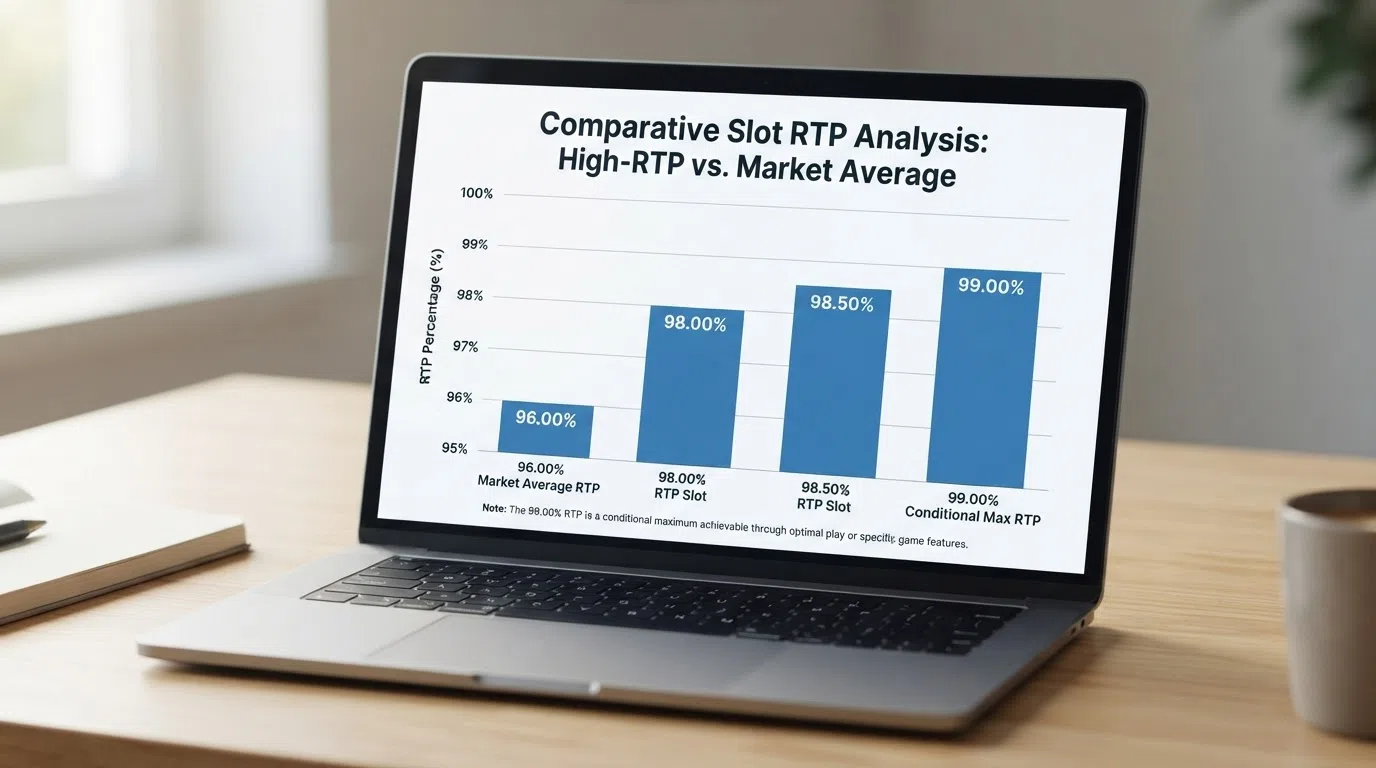
A 2% swing in RTP, from 96% (the market average) to 98%, halves the house edge. Across thousands of spins, that difference compounds into a meaningful gap. The 98%+ tier is the strongest set of odds the UK market offers on a low-volatility game, and the four titles in that band are the natural starting point for any ranking.
The 98%+ RTP Tier: Four Slots That Give the Most Back
The four titles at the top of the table all return more than 98 pence per pound in the long run. The configurations are fixed at every UKGC casino that carries them, which means the player gets the same math regardless of the operator.
Blood Suckers (NetEnt, 98.00% RTP, low volatility, 900× max win) is the most-cited of the four. The fixed-RTP configuration is identical at every UKGC casino with the NetEnt catalogue, and the 98% return is the highest in any popular low-volatility slot. The 900× max win is large enough to give the bonus round real weight, and the vampire theme is a familiar fixture. For a player choosing one slot to clear a bonus playthrough, Blood Suckers is the consensus pick.
1429 Uncharted Seas (Thunderkick, 98.50% RTP, low/medium volatility, 670× max win) sits at the highest fixed RTP in the ranking. The volatility classification is contested (low on Bojoko, medium on some other sources), and the 670× max win is smaller than Blood Suckers. For a player who values the narrowest edge above all else, 1429 is the better pick. For a player who wants the cleanest low-volatility feel, Blood Suckers wins.
Ancient Egypt Classic (Pragmatic Play, 98.03% RTP, low volatility, 180× max win) is the studio’s highest-RTP title, and the only title in the 98% tier from a studio other than NetEnt or Thunderkick. The 180× max win is the smallest in the 98% band and the smallest in the table, which is the cost of the 98.03% return. For a player who prefers a Pragmatic Play catalogue, the title fits. For a player who wants the largest max win in the band, the choice is Blood Suckers.
Mega Joker (NetEnt, up to 99% RTP in Supermeter mode, low volatility, 2,000× max win) is the conditional entry. The 99% RTP requires optimal play in the Supermeter (the upper game), and casual play will see a lower return. The 2,000× max win is the second-largest in the table. For a player willing to learn the Supermeter mechanics, Mega Joker is the closest thing to a 99% slot in the UK market. For a player who wants the same math every spin, the fixed-RTP titles are the cleaner fit.
The 97% RTP Tier: Starmania, Jack Hammer and the Next Best
The 97% tier is the band where the edge is still narrow, the catalogues still deep, and the max wins start to climb. Starmania (NextGen / SG Digital, 97.87% RTP, low volatility, 2,400× max win) carries the largest max win in the entire low-volatility ranking, which is the case for a player who wants the lowest-volatility slot in the market that can still pay out a 2,400× line hit. The 10 paylines on a 5×3 grid are tight by modern standards, and the 2,400× ceiling is what separates Starmania from the rest of the field.
Jack Hammer (NetEnt, 97.00% RTP, low volatility, 1,000× max win) is the longer-tail entry. The 97% return is below Starmania but still well above the market average, and the 1,000× max win sits between Starmania and Blood Suckers. The NetEnt catalogue backing is the operational case: the title is on every UKGC casino with NetEnt, and the fixed-RTP configuration is identical across operators.
Dazzle Me (NetEnt, 96.90% RTP, low volatility, 795× max win) and Twin Spin (NetEnt, 96.56% RTP, low volatility, 270× max win) sit just below the 97% line. The 96.9% and 96.56% returns are closer to the market average, and the max wins are modest. For a player who values the NetEnt catalogue and the fixed-RTP guarantee over a 98% configuration, the titles are still stronger than the typical slot. For a player optimising purely on the RTP number, the 98% tier is the better fit.
Jimi Hendrix (NetEnt, 96.90% RTP, low volatility, 400× max win) and Aloha: Cluster Pays (NetEnt, 96.42% RTP, low volatility, 2,000× max win) round out the field. Both are NetEnt catalogue titles with branded or themed low-volatility math, and both are widely available. The 2,000× max win on Aloha is large for the band, and the cluster-pays mechanic is the slot’s main differentiator.
Using Low Volatility Slots for Bonus Wagering: The 10× Cap Changes the Maths
The UK’s 10× wagering cap took effect on 19 December 2025 under LCCP Social Responsibility Code 5.1.1. Before the cap, UK bonus wagering requirements commonly ran from 30× to 60×, and clearing a £50 bonus at 40× meant turning over £2,000. The new cap cuts that to £500 for the same bonus, a 75% reduction in the required volume. Low-volatility slots are the right tool to clear what remains, because their hit frequency sustains the balance through the playthrough period, but the calculation now runs on very different numbers.
The clearing cost, expressed as expected loss, is the figure the marketing pages never print. The formula is simple: required turnover multiplied by (1 − RTP). For a £50 bonus at 10× wagering on Blood Suckers (98.00% RTP), turnover is £500, and the expected loss is £500 × 0.02 = £10. That is the statistical cost of clearing the bonus in spins, assuming only the bonus amount is wagered. A real session will deviate; the £10 is the average over many attempts, not a guaranteed outcome for any single player.
£50 bonus, 10× wagering cap, Blood Suckers at 98.00% RTP. Required turnover: £50 × 10 = £500. Expected loss: £500 × (1 − 0.98) = £10. The bonus’s real cost is roughly £10 in statistical terms. The £40 net value (£50 bonus minus £10 expected loss) is what the player is left with, and it is the right way to compare welcome offers: by the expected loss on the same slot at the same stake, not by the headline free-spin count.
Why Low Volatility Suits Wagering, and the 10× Cap Makes It Easier
A high hit frequency keeps the balance alive through the playthrough. If a slot returns something on three spins in ten, the player can absorb a £500 turnover without necessarily busting the balance. A low hit frequency would mean more long stretches with no return, and the bonus balance would erode faster, taking the wagering path with it. The hit-frequency mechanism is the reason low-volatility slots are the consensus pick for clearing bonuses across the UK market.
The 10× cap amplifies the effect. With the old 30× to 60× playthrough, the required turnover was the binding constraint and a high hit frequency was the only thing keeping the balance alive. With the new 10× cap, the required turnover is small enough that even modest balance protection is enough to clear the bonus. The choice of slot matters less than it used to on the turnover question (because turnover is now small), and more on the RTP question (because every percentage point of return is multiplied across the full turnover).
The trap is the contribution rate. Some casinos exclude or down-weight high-RTP slots from wagering contribution, meaning the £500 turnover is not actually counted in full when played on Blood Suckers or 1429 Uncharted Seas. The game contribution table is the document to check before committing a bonus. A 50% contribution on Blood Suckers means the £500 turnover needs to become £1,000 in real play, and the expected loss doubles to £20. The 10× cap assumes the contribution is 100%; the operator can quietly reduce that.
Which Slots Work Best, and Which Get Excluded
Blood Suckers is the consensus pick. The 98.00% RTP, the fixed configuration, the low volatility and the wide availability across UKGC-licensed casinos all argue for it. The 900× max win is large enough to give the bonus round a real upside, and the 98% return means the expected loss on the wagering is the lowest in the field. For a player choosing one slot to clear a £50 bonus, Blood Suckers is the right default.
1429 Uncharted Seas is the alternative for the narrowest edge. The 98.50% RTP is higher than Blood Suckers, the configuration is fixed, and the title is on the major UKGC catalogues. The contested volatility classification (low/medium) is the only caveat, and for a wagering playthrough the hit frequency remains the relevant mechanism.
Starmania is the alternative for the largest max win. The 97.87% RTP is below Blood Suckers, but the 2,400× max win is the largest in the low-volatility set, and the NextGen catalogue reaches Bet365, Ladbrokes and Coral. For a player who wants the upside ceiling on a bonus run, Starmania is the trade.
The exclusion question is the practical one. Some operators reduce or zero the contribution of high-RTP slots to deter exactly this kind of play. A 50% contribution on Blood Suckers is the worst-case common pattern; a 0% contribution is rarer but possible. The contribution table is operator-specific, and the player should check the published table (usually in the bonus terms or the help section) before committing a bonus balance. A 10× cap with full contribution is the best case. A 10× cap with a 50% contribution on the high-RTP slot is the common case. A 10× cap with a 0% contribution on the high-RTP slot is the worst case, and the player should pick a different slot.
How to Spot a Low Volatility Slot Before You Spin
There is no universal label on a slot that says “low volatility.” The classification lives in the math, and the math is published in different ways by different studios. The practical filters are RTP, paytable structure, provider reputation and the demo-mode test. Together they give a working signal even when a formal volatility label is absent.
RTP is a partial signal. A high RTP often pairs with low volatility, but the relationship is not strict. Blood Suckers (98.00%, low), 1429 Uncharted Seas (98.50%, low/medium) and Ancient Egypt Classic (98.03%, low) all sit in the high-RTP low-volatility quadrant, but high RTP can also appear on medium- and high-volatility titles. The figure alone is not enough.
The paytable is a firmer signal. A low-volatility slot tends to have a flat symbol-payout structure, modest jackpot caps, frequent small bonus triggers, and a payline or cluster mechanic that returns something on most spins. A title with a 5,000× or 10,000× max win is almost always high volatility; a title with a 180× to 900× max win is more often low. The max-win figure is a useful filter, since the marketing pages tend to lead with it.
The provider is a category-level signal. NetEnt’s low-volatility catalogue (Blood Suckers, Starburst, Jack Hammer, Dazzle Me, Twin Spin) is the most consistent in the UK market. Pragmatic Play’s low-volatility range is broader but more variable in RTP. Thunderkick’s titles skew toward the higher-RTP end. IGT’s range is narrower but the studio’s land-based legacy means the math is conservative.
The demo-mode test is the empirical check. Every operator in the featured set offers demo mode to registered users. A player can run 100 spins on a slot in demo mode and see the hit frequency in practice. A title that returns something on three spins in ten, with most returns in the 1× to 5× range, is a low-volatility title. The test takes ten minutes and is the most reliable signal available.
Key Factors: RTP, Provider and Paytable Structure
The three signals together identify a low-volatility slot with reasonable accuracy. A high-RTP title from a studio with a low-volatility reputation, with a modest max win and a flat paytable, is almost always in the category. Blood Suckers (98.00% RTP, NetEnt, 900× max win), Starburst (96.09% RTP, NetEnt, 500–800× max win) and Ancient Egypt Classic (98.03% RTP, Pragmatic Play, 180× max win) all fit the pattern. The combination is the filter; any one signal alone can mislead.
The Best Low Volatility Slots for Beginners
Starburst is the canonical beginner slot. The mechanics are simple (win both ways, expanding wilds, re-spins), the hit frequency is high, the RTP is 96.09% and the max win is 500× to 800× depending on the configuration. A new player can understand the game in five spins and the balance behaves predictably.
Blood Suckers is the right pick for a beginner who is already RTP-conscious. The 98.00% return is the highest in the popular low-volatility set, the fixed-RTP configuration is the same at every UKGC casino, and the bonus round (a pick-and-click feature) is approachable. The vampire theme is the only taste constraint, and the max win of 900× is large enough to give the bonus round real weight.
For a player on their first session, low volatility is the right starting point. A long dry stretch on a high-volatility slot is the most common early-session problem, and the resulting tilt is what ends a player’s first experience. Low volatility reduces the chance of that. The trade-off, as earlier sections make clear, is that a longer session at the same edge still costs more, and the safer-feeling rhythm is not the same thing as safer play.
UK Gambling Law: What Protects You While You Play
The Gambling Commission is the sole statutory regulator for online gambling in Great Britain, and the framework it administers is the one that wraps every spin in this ranking. Three rules are the most directly relevant to low-volatility play: the stake cap, the spin-speed rule and the 10× wagering cap. Together they shape the session more than any volatility choice.
The stake cap is tiered by age. Since 9 April 2025, the maximum stake per game cycle is £5 for players aged 25 and over. Since 21 May 2025, it is £2 for players aged 18 to 24. The cap is per game cycle (a spin on a slot), not per session, and operators must enforce it at the game level. A player who wants to bet more than £5 per spin cannot do so at a UKGC-licensed casino, full stop.
The spin-speed rule is older. Since 31 October 2021, auto-play has been banned on UK online slots, the minimum spin speed is 2.5 seconds per game cycle, features that speed up play are banned, losses disguised as wins are banned, and reverse withdrawals are permanently banned. The 2.5-second minimum means a player cannot blast through 1,000 spins in 15 minutes. The rule sets a floor on session length that no operator can undercut.
The 10× wagering cap is the newest. Since 19 December 2025, wagering requirements on UK casino bonuses are capped at 10× under LCCP Social Responsibility Code 5.1.1, and mixed-product promotions (such as “bet on football, get free spins”) are banned. The cap sits alongside the credit-card ban, in force since 14 April 2020, which prohibits credit cards (and e-wallets funded by credit cards) for any remote gambling deposit.
The UKGC Licence and What It Requires
A Gambling Commission licence obliges an operator to three things, set out as the licensing objectives in section 1 of the Gambling Act 2005: preventing gambling from being a source of crime or disorder, ensuring gambling is conducted in a fair and open way, and protecting children and other vulnerable persons from being harmed or exploited. The objectives are the regulatory test, and the Gambling Commission’s enforcement powers (suspension, revocation, financial penalties) are the lever.
The practical obligations flow from the objectives. Every GB-licensed operator must verify the player’s name, address and date of birth before any deposit or gambling (in force since 7 May 2019). Every licence holder appears on the Gambling Commission’s public register, which any player can search. Every player has access to an alternative dispute resolution (ADR) provider if a complaint cannot be resolved with the operator directly. Operating without a GB licence while serving GB customers is a criminal offence under section 33 of the Gambling Act 2005, punishable by up to 51 weeks’ imprisonment, an unlimited fine, or both.
The MGA, Curaçao or Gibraltar licences that some offshore operators carry are not substitutes for a GB licence. A player using an unlicensed site loses all UKGC protections: no GAMSTOP coverage, no ADR route, no complaint mechanism. The player does not face a criminal penalty, but the protections that exist for the licensed market disappear.
Stake Limits, Spin Speed and the Rules That Shape Every Spin
The £5 / £2 stake cap is the most visible rule, and it shapes the high-end stake sizing for every UK online slot. The £2 cap for 18–24-year-olds is the tighter of the two, on the rationale that younger adults are at higher statistical risk of problem gambling. The cap is per game cycle, which on a slot means per spin, and the operator cannot allow a stake above the limit on any individual spin. The cap is a hard ceiling, not a recommendation.
The 2.5-second minimum spin speed is the rule that determines how fast a session can move. At 2.5 seconds per spin, a player runs 1,440 spins in an hour, and the 2.5-second floor is what the operator must enforce at the game level. The ban on speed-up features (turbo-play, quick-spin) means the player cannot use a tool to bypass the floor. The ban on auto-play means the player must press the button (or tap the screen) on every spin, which is itself a friction point.
The ban on losses disguised as wins is the rule the player will not see directly, but it is the one that shapes the visual design. Any audio or visual cue that celebrates a spin whose payout is less than the stake is banned. The rule exists because the design pattern was being used to dress up losses as wins, and the regulator judged that misleading. The ban on reverse withdrawals is the rule against letting a player cancel a withdrawal request and return the funds to the playable balance. Both rules are in force since 31 October 2021.
GAMSTOP, Self-Exclusion and Your Rights
GAMSTOP is the mandatory national self-exclusion scheme for all GB-licensed online operators, in force since 31 March 2020. Every player at every UKGC-licensed casino can register with GAMSTOP, and once registered, the player is excluded from every GB-licensed online gambling site for the chosen period. The exclusion periods are 6 months, 1 year, 5 years, or 5 years with auto-renewal. Once an exclusion is set, it cannot be cancelled early. The minimum 6-month period is the floor.
The financial vulnerability check is a separate rule, in force since 28 February 2025, that triggers a check at £150 net deposit in a rolling 30-day period. The check uses publicly available data only (county court judgments, bankruptcy orders, individual voluntary arrangements, debt relief orders), and it is the first tier of the affordability framework. The forthcoming affordability checks (Stage 1 thresholds of £5,000 in 24 hours for players 25+ and £2,500 for under-25s) are not yet in force; the start date is to be confirmed.
Deposit limits, reality checks and time-outs are the player-side tools every UKGC licensee must provide. A deposit limit can be set by the player at any level, and a decrease takes effect immediately. An increase has a 24-hour cooling-off period. Reality checks are pop-up reminders that interrupt the session at set intervals. A time-out is a short exclusion (24 hours to several weeks) that the player can self-impose. The full toolkit is available at every UKGC-licensed operator.
Staying in Control: Bankroll and Safer-Gambling Tools
A bankroll plan for a low-volatility slot under the UK framework is short and unglamorous. The first step is a session budget set as a multiple of the stake cap (a player who plans to spin at £1 sets a session budget of perhaps 50× to 100× the stake, or £50 to £100, and stops when the budget is gone). The second step is to use the deposit-limit tool to enforce the budget at the operator level rather than relying on willpower in the session. The third is to set a reality-check interval (every 30 minutes is a common default) so the session is interrupted at a known cadence.
The 2.5-second minimum spin speed is the unsung part of the framework. It is the rule that turns a fast-spinning slot into a slow-spinning one, and it is the rule that gives a 100-spin session a real duration (around 4 to 5 minutes at the floor). The longer session that low volatility invites is itself a cost; the spin-speed rule is the regulator’s answer to the cost, and it works in the same direction as a personal bankroll plan.
Why Low Volatility Is Not a Safety Feature
The honest framing of low volatility, the one the marketing pages avoid, is that it is a presentation choice, not a safety feature. The slot returns the same percentage of every pound wagered regardless of volatility. The flatter balance invites a longer session. The longer session multiplies the total loss. The house edge is the same; the player’s exposure is higher.
Prevalence data sharpens the framing. Around 0.5% of the adult English population experience problem gambling, 3.8% are at elevated risk, and an estimated 7% of the British population are negatively affected by someone else’s gambling (OHID). The Gambling Survey for Great Britain (2025, Year 3) found 47% of adults had gambled in the past four weeks (27% excluding lottery-only players), and 38% had gambled online. The market is large and the at-risk share is real. A category that invites longer sessions at the same edge is, on the population level, a higher-exposure category, not a lower one.
The marketing language of “safer” low-volatility play collapses once the maths is named. A 96% slot is a 96% slot. A 98% slot is a 98% slot. The volatility label is the session texture, not the price. A player who treats it as a safety feature is paying for the texture with a longer exposure, and the two effects do not cancel.
Bankroll Management: Making a Session Last Without Losing More
The session budget is the first number to set. A common approach is to set the budget as a fixed multiple of the stake (a 50× to 100× stake budget means a £50 to £100 bankroll at £1 spins, or a £250 to £500 bankroll at £5 spins). The deposit-limit tool enforces the budget at the operator level; setting a deposit limit before the first spin is the cleanest version, because the limit is in place before the session starts.
The 2.5-second spin-speed rule is the second number. A 100-spin session at the minimum spin speed takes around 4 to 5 minutes. A 500-spin session takes around 20 to 25 minutes. The slow pace is the regulator’s design, and the bankroll plan should match it: a session of 200 to 500 spins at a fixed stake, with a hard stop at the session budget and a reality-check pop-up at a set interval.
The hard stop is the third number. The reality check is the soft reminder; the deposit limit is the hard stop. A player who sets a £50 session budget and a £50 deposit limit at a £1 stake will see the session end at one of two points: when the budget is gone, or when the deposit limit is reached. The two together produce a clean exit. Neither alone is enough.
Deposit Limits, Reality Checks and Where to Get Help
Deposit limits are a mandatory UKGC requirement, and the operator must offer them. A player can set a daily, weekly or monthly deposit limit, and a decrease takes effect immediately. An increase has a 24-hour cooling-off period, designed to prevent the in-session limit hike. Reality checks are pop-up reminders that interrupt the session at set intervals (commonly 30 minutes, 60 minutes or both), and the player can configure the interval or accept the default. Time-outs are short self-exclusions (24 hours to several weeks), and GAMSTOP is the longer-period self-exclusion covering all GB-licensed operators.
GamCare runs the National Gambling Helpline on 0808 8020 133, available 24/7 by phone and online chat. In 2024–25, the helpline received over 130,000 calls and online messages, with 7,100 referrals into further treatment services and an average wait time of 1.3 days. The NHS operates gambling harm clinics in England, Scotland and Wales. Gamblers Anonymous runs peer-support meetings across the country. GambleAware funds research, prevention and treatment and is the gateway to a wider network of help services. The 1.3-day wait time at GamCare is the average, not a guarantee; a player in immediate distress should call 999 or attend A&E.
The statutory levy on GB gambling operators, in force since 6 April 2025, is charged at 1.1% of gross gambling yield (GGY) for remote casino licences, with the proceeds split 50% to treatment, 30% to prevention and 20% to research. The levy is separate from Remote Gaming Duty, the operator tax on online casino profits, which rose from 21% to 40% from 1 April 2026. The levy funds the help infrastructure a player reaches when the safer-gambling tools are not enough. The duty is general Treasury revenue. The two are different taxes, and both are part of the regulated market’s cost.
How We Picked and Ranked These Slots
The ranking draws on a defined set of sources: the published RTP and max-win figures from the studios and from comparison sites (Rtptrack.com, Bojoko, Compare.bet, Spinhunter, Videoslotsgames.com, 7bet), the operator catalogues as published on each UKGC-licensed casino’s website, the Gambling Commission’s public register of licence holders (for the GB licence check on every operator), and the prevalence and help-infrastructure data from the Gambling Survey for Great Britain (NatCen), GamCare and OHID. The UK regulatory framework is sourced from the Gambling Commission’s online slots stake limit guidance and the LCCP/RTS conditions.
The criteria that ordered the ranking are: published RTP, volatility classification, provider track record, availability at UKGC-licensed casinos and bonus-wagering compatibility. RTP is the primary number (because it is the only one that affects the player’s long-run return), volatility the second (because it is the only one that affects the session texture), provider the third (because the studio’s design philosophy predicts the catalogue shape), availability the fourth (because the ranking is only useful at the operators the player can actually use) and bonus-wagering compatibility the fifth (because the 10× cap means the bonus terms now matter more than the headline free-spin count).
The ranking covers a featured set of ten operators and eleven slot titles, not the whole UK market. Other worthy low-volatility slots exist (NetEnt’s Gonzo’s Quest, for example, sits at medium volatility but appears in many of the same catalogues), and other licensed operators carry the titles. The featured set is what the page ranks. The exclusions are choices, not endorsements of absence.
Your Low-Volatility Slot Strategy for 2026
The strategy that the numbers in this page argue for is short. Pick from the 98%+ RTP tier, since the 2% gap to the market average is the only edge the player actually buys. Blood Suckers (98.00%) is the consensus default; 1429 Uncharted Seas (98.50%) is the edge-maximiser; Ancient Egypt Classic (98.03%) is the Pragmatic Play option; Mega Joker (up to 99% in Supermeter) is the conditional pick for a player willing to learn the upper-game math. The 97% tier (Starmania, Jack Hammer, Dazzle Me, Twin Spin) is the next-best band, with the largest max wins in the field.
On the operator question, match the welcome offer to the priority. The 0× wagering offers (Bet365, Sky Vegas, Paddy Power, Betfred) suit a player who wants the free-spin winnings paid as cash. The 10× wagering offers (William Hill, Betway bonus track, Ladbrokes, Coral) suit a player who plans a longer session and is comfortable with the playthrough. The choice offers (Betway) suit a player who wants both options. The £30 cashout cap on William Hill’s 200 spins is the constraint to read closely; the 7-day validity on most offers is the calendar to manage.
On the bonus playthrough question, always check the game contribution table before committing. A 50% contribution on Blood Suckers doubles the expected loss on the wagering. A 0% contribution makes Blood Suckers the wrong choice for the bonus, and a different slot (or a different bonus) is the right answer. The 10× cap is the rule; the contribution table is the operator’s lever within the rule.
On the safer-gambling question, set the deposit limit before the first spin. The low-volatility session will feel steadier than a high-volatility one, and the steadier feel is itself the exposure. A £50 deposit limit, a 30-minute reality check and a hard stop at the session budget are the three numbers that match the framework to the session. The GamCare helpline (0808 8020 133) is the route if any of those numbers is hard to hold.
Low volatility is a presentation choice. The UK framework gives a player the tools to set their own exposure. The page that ranks the slots and explains the framework is the same page that names the trade-off: a flatter balance is a longer session, and a longer session at the same edge is itself the cost. The 98% tier narrows the edge. The 10× cap shrinks the wagering volume. The £5/£2 stake cap and the 2.5-second minimum fix the session length. What remains is the choice the player makes on the spin, which is the only choice the framework cannot make for them.
Frequently Asked Questions
Which Low Volatility Slots Have the Highest RTP?
Blood Suckers (NetEnt) at 98.00% fixed RTP, 1429 Uncharted Seas (Thunderkick) at 98.50% fixed RTP, and Ancient Egypt Classic (Pragmatic Play) at 98.03% are the top three. Mega Joker (NetEnt) can reach 99% in Supermeter mode, but the figure requires optimal play in the upper game. The next tier is Starmania at 97.87% and Jack Hammer at 97.00%.
How Do I Find Out If a Slot Is Low Volatility?
There is no universal label. Read the paytable (modest max win, frequent small payouts), check the provider’s catalogue reputation (NetEnt’s low-volatility range is the most consistent), test the hit frequency in demo mode (100 spins will show whether returns land every third spin), and treat the published volatility classification as a guide rather than a definitive label. The classifications vary between sources, especially in the low-to-medium band.
What Is the Difference Between Low, Medium and High Volatility Slots?
All three return the same RTP in the long run. Low volatility pays often and small, with hit frequency above 30% and most wins in the 1× to 5× bet range. Medium volatility sits in between, with a wider payout distribution and longer dry stretches. High volatility pays rarely and large, with hit frequency below 25% and a payout tail stretching to 50×, 100× or more. The edge is identical; the session shape is the only difference.
Can I Play Low Volatility Slots for Free in Demo Mode?
Yes. Every operator in the featured set (Bet365, Sky Vegas, William Hill, Betway, Paddy Power, Ladbrokes, Coral, Betfair, Betfred, Virgin Games) offers demo mode to registered users, meaning the player can test a slot’s hit frequency and feel without risking real money. Demo mode is the cleanest way to identify a low-volatility title empirically.
What Is the Maximum I Can Stake on Online Slots in the UK?
Since 9 April 2025, the maximum stake per game cycle is £5 for players aged 25 and over. Since 21 May 2025, it is £2 for players aged 18 to 24. The cap is enforced at the game level by every UKGC-licensed operator, and no UK-licensed casino may offer a stake above the limit on any individual spin. The cap applies to online slots only; other casino games carry different limits.
Do Low Volatility Slots Pay Out More Often Than High Volatility Slots?
Yes. Low-volatility slots have a hit frequency above 30%, meaning more than three spins in ten return something. High-volatility slots have a hit frequency below 25%, often closer to 15% to 20%. The payouts are smaller on low-volatility slots, so the long-run RTP is similar. The two metrics (hit frequency and RTP) describe different things: hit frequency is how often, RTP is how much in total.
Slots – trustedcasinos-notongamstop
Content created by the «trustedcasinos-notongamstop» team