
UK casino payment methods in 2026: which rail wins on speed, privacy or control
 Available in GB
A UK casino deposit has never been a free choice. Since 14 April 2020 the Gambling Commission has banned every credit card, every credit-card-funded e-wallet, every money service business that touches a credit line, from taking part in remote gambling. The whole cashier is now a debit-funded shop, and the “best” method is whichever one of the remaining rails wins on the priority that matters to the player putting the money in. This page is built around that priority choice, not around a league table of brands, because the question is which rail fits which reader — speed, privacy, convenience or control — and the answer for an e-wallet player and a pay-by-mobile player is not the same.
Data current as of September 9, 2026, based on the UK Gambling Commission public register.

The licence data and the operator roster were verified against the UK Gambling Commission public register of licensed businesses, updated 29 July 2026, holding 2,663 records. A comparison whose reader cannot tell when it was true is one they cannot use.
What “best” actually means for UK casino payments in 2026
The phrase “best payment method” sits on a four-way fork the moment a player reaches a UK cashier. Each family of methods wins at one thing and loses at another, and the families do not trade against each other directly. An e-wallet is faster on the way out than a debit card. A prepaid voucher is the only method that lets a player deposit without giving the casino their bank details. Pay-by-mobile is the only one with a network-level spending brake that the player cannot override. Open banking sits closest to a debit card in feel and beats one on the way out by a working day. The “best” depends on which of those four priorities the player is willing to lose the others on, and on nothing else.
The legal method families at a glance
Five families of payment method sit on every UK cashier, and a sixth — carrier billing — sits at the smaller end. Debit cards (Visa and Mastercard) are the universal rail. E-wallets split between the household names — PayPal, Skrill, Neteller — and the smaller players like MuchBetter, MiFinity and ecoPayz. Bank transfer and open banking cover the older manual transfers alongside the new app-authenticated PISPs — Trustly, Volt, Token and TrueLayer — that ride the PSD2 rails. Prepaid vouchers are dominated by Paysafecard. Mobile wallets are Apple Pay and Google Pay. The cashiers that list more than eight methods almost always lead with debit and PayPal and end with prepaid.
Which methods UK players actually reach for
The mainstream is debit and e-wallet, and on this page the comparison block in the next section puts them side by side. Mobile wallets are the fastest-growing entry point — major UK gambling portals list Apple Pay or Google Pay on roughly seven of ten — and pay-by-mobile runs a smaller, more constrained segment behind a £40-a-go cap that the network, not the player, sets. The smaller e-wallets and emerging options sit further down: MuchBetter, MiFinity, ecoPayz and the prepaid-style AstroPay show up at a minority of UK operators; as fees and processing times for these methods vary by operator, they are named here as the route that exists at some operators, not as a like-for-like comparison.
Real-money deposits: what shows up at the cashier
Every method on this page is a real-money deposit rail, not a free-play or demo balance. The same licence condition that mandates age 18 also requires a remote licensee to verify a player’s name, address and date of birth before any deposit or gambling, including free bets and bonus credits. The verification is the gate the method sits behind, and the rail the player picks — debit, e-wallet, prepaid or phone — only matters once the operator has confirmed identity. A method-by-method comparison that ignored verification would be describing the second step of a journey that has not started.
Speed, privacy or payout access: the real trade-offs in 2026
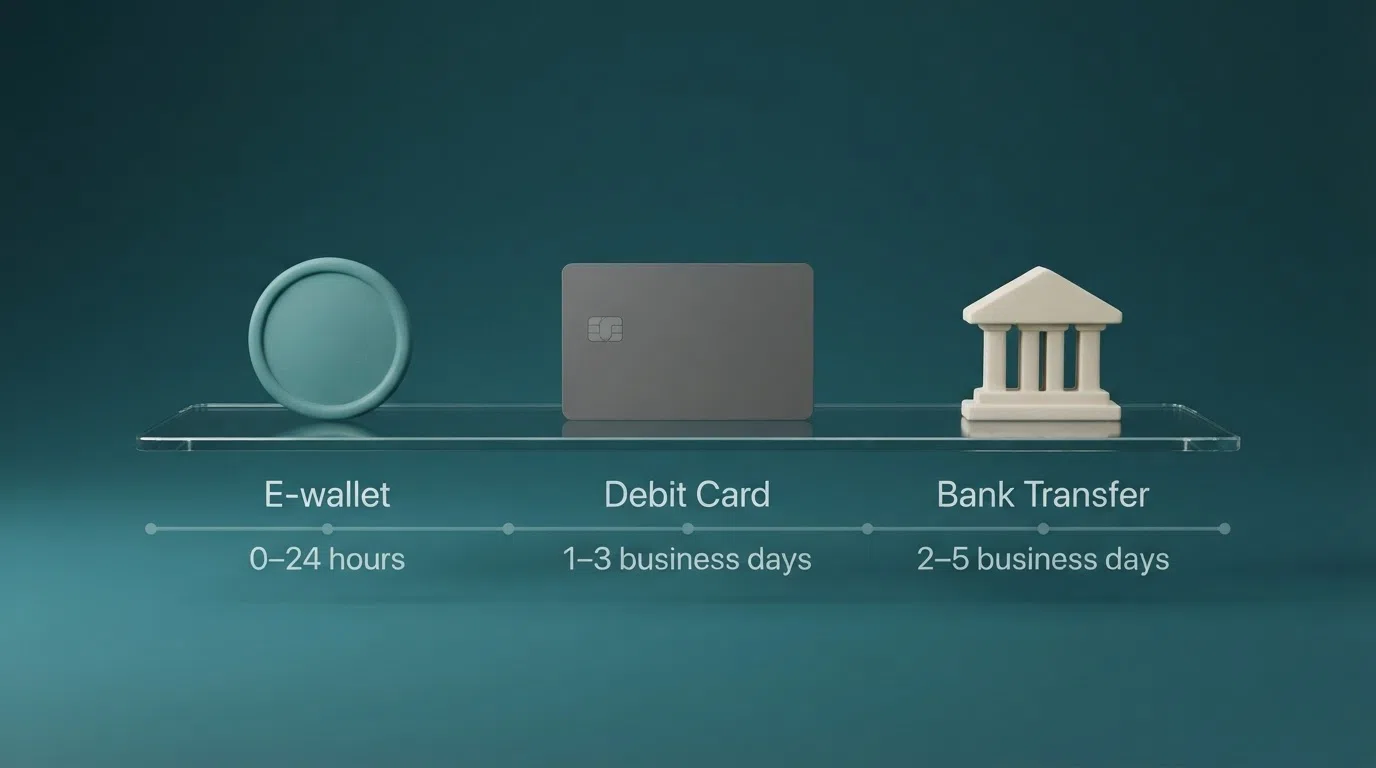
The trade-off lives in three columns: how fast the method gets money in, how fast it gets money out, and whether it carries the money both ways or only in. The first column is mostly instant. The second column is where the spread opens. The third column is the trap a reader most often walks into.
| Method | Deposit speed | Withdrawal speed | Two-way? |
|---|---|---|---|
| Debit card (Visa, Mastercard) | Instant | 1–3 business days | Yes |
| PayPal | Instant | 0–24 hours after release | Yes |
| Skrill | Instant | 0–24 hours after release | Yes |
| Neteller | Instant | 0–24 hours after release | Yes |
| Trustly / open banking (Pay by Bank) | Instant | Same day, often within hours | Yes |
| Bank transfer (manual) | 1 working day | 2–5 business days | Yes |
| Paysafecard | Instant | Not supported | Deposit only |
| Apple Pay / Google Pay | Instant | Not supported — payout to underlying card or bank transfer | Deposit only |
| Pay by mobile (Boku, Payforit, Fonix) | Instant | Not supported — payout by bank transfer or e-wallet | Deposit only |
The deposit side is a tie. Every modern UK rail is instant. What the table says is the spread on the way out: e-wallets and Trustly within a working day, debit cards over the same day or two, a manual bank transfer up to five business days. The “two-way” column is the read-the-small-print column: a deposit that works on a method does not mean a payout back through it works too. Paysafecard is the most obvious case. Apple Pay and Google Pay are next. Pay-by-mobile is the third. A reader who picks a deposit-only method for privacy or convenience needs to name a second rail for the way out, before the first withdrawal asks them to.
E-wallets: PayPal, Skrill and Neteller
E-wallets are the fastest withdrawal rail at UK casinos once the casino releases the funds. PayPal, Skrill and Neteller deliver money within 24 hours of release, and often within a few hours. Deposits are instant and the casino never charges for them. The cost is on the way out, and it sits with the e-wallet provider rather than with the casino: Neteller charges a flat fee of about £5.50 for UK GBP bank withdrawals, Skrill charges 1.75% on bank withdrawals and 3.99% on Visa or Mastercard withdrawals, and neither charges for a casino deposit. PayPal sits in a different place on fees — most UK-licensed casinos do not pass a casino-side fee — and the spread between a free PayPal payout and a Skrill 3.99% card payout is the kind of number a player notices after the third withdrawal.
Debit cards: Visa and Mastercard
The debit card is the rail every operator accepts and the rail the rest of this page measures itself against. Deposits land instantly. Withdrawals take one to three business days once the casino has released the funds, and the casino does not charge for either. The debit card loses on the way out — to e-wallets by a working day, to Trustly by the same amount — but wins on what is almost never named: it is the rail that almost never blocks a welcome offer, the rail every cashier defaults to, and the rail a player falls back to when nothing else fits. Visa Fast Funds exists at William Hill and shortens that 1–3-day window to four hours for the card end; it is an issuer-side feature rather than a casino one, and the eligible cards are not every Visa in a wallet.
Bank transfer and open banking: Trustly and Pay by Bank
Open banking sits in the same family as the older manual bank transfer but behaves very differently on the way out. A standard bank transfer takes one working day to deposit and two to five business days to withdraw. Open banking, routed through PISPs under PSD2 and the Payment Services Regulations 2017, deposits instantly and authenticates the payment inside the player’s mobile banking app — the player approves the deposit from their bank, not from the casino’s page, and the casino never sees the card number. Trustly-style open banking withdrawals clear the same day, often within hours, and the providers carrying that rail at UK casinos include Trustly, Volt, Token and TrueLayer. The reason open banking has become the fastest-growing deposit method in the UK is not just speed: it costs operators less, chargebacks are harder to engineer through a bank-app approval, and the player keeps their card number out of the casino’s hands.
Paysafecard and other prepaid vouchers
Paysafecard is the privacy choice. A player buys a 16-digit PIN at a shop, redeems it at the cashier, and the casino never sees a bank account, a card number or a name that ties to a financial institution. The trade-off is that the voucher is deposit-only by design — withdrawals cannot return to a Paysafecard PIN — and the player must register an alternative rail, normally a bank transfer or an e-wallet, before they can take winnings out. The voucher wins where it matters: a player who wants to keep their bank details off a casino’s payment page has no other rail that does the same.
Apple Pay and Google Pay: the wallet shortcut
Apple Pay and Google Pay are widely accepted at UK casinos for deposits and are the tap-to-pay option on a phone that already holds the player’s debit card. The deposits are instant. The withdrawals are not — neither wallet supports a direct payout, and the winnings route to the underlying card or, where that fails, by bank transfer. The rail underneath is still a debit card, and the welcome offer rules that exclude certain debit cards are unaffected by going through Apple Pay or Google Pay; in some cases the wallet is the only path that gets a card through. Virgin Games operates on this principle and accepts nothing else.
Revolut and the newer banking apps
Revolut is a fully licensed UK bank as of 2026, having received its restricted UK banking authorisation in July 2024. Deposits are accepted at UK casinos and the funds come from a UK-regulated account, which is the headline and the reason Revolut sits in this guide alongside Visa and Mastercard debit. The second feature is what separates Revolut from a debit card clone: an in-app gambling block, switched on by the user, that uses the merchant category code for gambling (MCC 7995) to refuse gambling-related card payments at the bank-app level. A player who turns the block on cannot deposit through Revolut at any UK casino until they turn it off again. The feature is the strongest payment-side brake any UK rail carries today.
How a deposit and a withdrawal actually work
A deposit starts with choosing a method at the cashier, entering an amount that is at or above the operator’s minimum for that rail, and confirming the payment in the method’s own interface — a 3-D Secure step for a debit card, an app approval for open banking, a one-tap confirm for Apple Pay, a PIN entry for Paysafecard. The funds land on the operator’s balance once the provider authorises the transaction, which is instant for every modern rail except a manual bank transfer. The casino-side check runs in the background; the player sees the balance update within seconds.
A withdrawal starts with the player requesting a payout from the cashier back to the method that funded the deposit, where that method supports a two-way flow. The casino runs an internal release process — verification on the first withdrawal, anti-fraud review on larger ones, bonus-related checks if bonus funds are still in play — and the funds then leave to the provider. The provider’s delivery time is the figure on the page: e-wallets within hours, Trustly within hours, debit cards one to three business days, manual bank transfer up to five business days. The two steps together — casino release and provider delivery — are what a withdrawal takes, and only the second step is the figure in the comparison table.
The fastest routes from casino to bank
The withdrawal ladder is short. E-wallets clear within 24 hours of release, often within a few hours. Trustly-style open banking clears the same day. A debit card takes one to three business days. A manual bank transfer takes two to five business days. The casino’s “release” is the variable underneath every figure, and is the reason a PayPal withdrawal from one operator is faster than from another despite the provider being the same — the casino’s release time is the part the player cannot see. A reader chasing speed reads the provider-side figure, picks the operator whose release time is shortest, and uses the e-wallet or open banking rail.
The smaller e-wallets and emerging options
MuchBetter, MiFinity, ecoPayz and AstroPay appear at UK casinos as the smaller e-wallet and prepaid-route choices behind PayPal and Paysafecard. Their terms vary by operator, so the role they are named for here is availability rather than a like-for-like comparison. A player who finds one of these listed at an operator they like can use it, but should not assume the same fee or timing as the household-name e-wallet on the same cashier.
Paying by phone in 2026: convenience with a built-in brake
Pay-by-mobile is a phone-bill charge, not a wallet. The deposit lands on the player’s mobile phone bill rather than on a card or a bank account, and the carrier — Boku, Payforit or Fonix — settles with the casino on the back end. The trade-off is two-fold: the spending caps the network enforces on a phone-bill charge, and the absence of any payout back through the same rail.
How pay-by-mobile and SMS billing work
A player picks “pay by mobile” at the cashier, enters a mobile number, receives an SMS confirming the amount, and confirms with a one-tap reply. The deposit lands at the casino immediately. The phone bill carries the charge at the end of the month, or it is deducted from a prepaid balance. There is no card number, no bank account, no e-wallet account in the flow — the carrier sits between the player and the casino for the deposit, and the player carries the charge on their existing mobile contract. The carriers at UK casinos are Boku, Payforit and Fonix.
The spending caps built into carrier billing
The Payment Services Regulations 2017 cap charge-to-mobile gambling deposits at £40 per single transaction and £240 per calendar month. The Phone-paid Services Authority enforces a £40 daily cap on top. Unlike a debit card, where the player sets their own deposit limit on the operator’s site, carrier billing enforces the cap at the network level and the player cannot override it. The caps are the method’s defining feature, and they are the reason pay-by-mobile is named as the controlled-spend rail rather than the convenience rail — the convenience is the SMS confirmation, the control is the cap that prevents the player from spending more than £240 a month through it.
Carrier billing at the casino: deposits yes, payouts no
Pay-by-mobile is deposit-only. Winnings leave the casino by bank transfer or e-wallet, never by phone bill, because the rail does not have a payout direction. The first withdrawal is the step where a pay-by-mobile player registers a second rail, and the time the second rail takes is the time the first withdrawal takes. There is no published UK figure for a pay-by-mobile withdrawal time beyond the standard rail figure of the method chosen to receive the funds.
Why the UK cashier looks the way it does: the ban and the caps
The UK cashier is the shape it is because one ban and a stack of statutory caps make it so. The credit card ban cuts the rail set. The Payment Services Regulations define the rails a licensee can accept. The 2025 stake caps and the 2025 wagering cap cut what an offer can be. The 2026 Remote Gaming Duty and the statutory levy cut what an operator can pass back as a bonus. Every method on this page sits inside that frame.
The credit card ban, five years on
Since 14 April 2020 the Gambling Commission has banned every credit card payment for remote gambling, under LCCP licence condition 6.1.2, including credit-card-funded payments routed through money service businesses such as e-wallets. The Commission’s stated ground was consultation evidence that 22% of online gamblers who used credit cards were problem gamblers — a higher rate than the rest of the gambling population. The ban was not extended to debit cards, bank transfers, prepaid vouchers or mobile wallets, all of which fund from money the player already holds rather than money the player is borrowing. The most common misunderstanding of the ban is the e-wallet extension: a player cannot deposit through PayPal if PayPal is funded by a credit card, even though no credit card ever touches the casino’s page.
What a GB licence demands at the cashier
A GB licensee is required to accept payment only via methods involving payment services as defined in the Payment Services Regulations 2017. A GB licence is compulsory at point of consumption under the Gambling (Licensing and Advertising) Act 2014 — any operator serving GB customers, wherever it is based, must hold one. The Gambling Commission’s public register of licence holders is the whitelist a player checks before depositing, and it was last updated 29 July 2026 with 2,663 records of licensed gambling businesses. An operator that does not appear on the register is not licensed to take a GB deposit, however well-known the brand.
Where UK payment protection actually comes from
The safeguard a UK deposit sits behind is not a single encryption standard — it is the combination of the licence regime, the payment services regulation and the bank-app authentication that open banking routes the player through. Open banking authenticates every deposit in the player’s own mobile banking app, which is the strongest payment-side identity check any UK rail offers today. E-wallet tokenisation — the e-wallet keeping the card number on file and passing the casino a token — is the older safeguard. The licence regime underneath sits on three Gambling Act 2005 objectives: preventing gambling from being a source of crime, ensuring it is conducted fairly and openly, and protecting children and other vulnerable persons from harm. None of those is a named encryption standard, and a comparison that names one without a source is fabricating.
The caps and costs behind every UK offer
The numbers behind every offer on a UK cashier. Online slots carry an age-banded stake cap: £5 per game cycle for players aged 25 and over, in force 9 April 2025, and £2 per game cycle for players aged 18–24, in force 21 May 2025, imposed by SI 2025/215. The wagering requirement on casino bonuses is hard-capped at 10× under LCCP Social Responsibility Code 5.1.1, in force 19 December 2025, and mixed-product promotional offers are banned — a “bet on football, get free spins” shape is no longer legal. The Remote Gaming Duty on operators rose from 21% to 40% on 1 April 2026, and a 1.1% statutory levy on gross gambling yield took effect from 6 April 2025 for remote operators. Those figures are why offers look the way they do in 2026: a 40% duty cuts the budget for a bonus, a 1.1% levy cuts it again, and a 10× wagering cap limits how the offer is structured. The player sees the result as fewer and smaller bonuses; the figures behind it are duty, levy and the cap.
10 GB-licensed casino operators, compared on payments
All ten operators below are active on the Gambling Commission public register as of 29 July 2026. The table compares them on payment-method roster, the fastest withdrawal any of their methods offers, and the shape of the welcome offer. Operator-specific notes follow in the write-ups beneath.
| Operator | GB licence | Payment methods | Fastest withdrawal | Welcome bonus |
|---|---|---|---|---|
| bet365 | Active | Visa/Mastercard Debit, PayPal, Skrill, Apple Pay, Trustly, Bank Transfer, Paysafecard | E-wallet and Trustly 1–4 hours | Up to 50 free spins daily for 10 days |
| William Hill | Active | Visa/Mastercard Debit, Maestro, Apple Pay, PayPal, Paysafecard, Pay by Bank, Skrill, Neteller | Visa Fast Funds up to 4 hours | Casino bonus (separate from sports free bets) |
| Sky Vegas | Active | Visa/Mastercard Debit, PayPal, Trustly | PayPal and Trustly within 6 hours | Deposit and spend £10, get 200 no-wagering free spins |
| Ladbrokes | Active | Visa/Mastercard Debit, Apple Pay, Google Pay, PayPal, Skrill, Pay by Phone, Bank Transfer | E-wallets 1–3 hours | Play £10 get 100 no-wagering free spins |
| Paddy Power | Active | Visa/Mastercard Debit, Apple Pay, PayPal, Trustly | PayPal and Trustly within 2 hours | Deposit £10, stake £10, get 50 no-wagering free spins |
| Coral | Active | Visa/Mastercard Debit, Apple Pay, Google Pay, PayPal, Paysafecard, Bank Transfer | E-wallets within hours | Play £5 get 100 free spins and a £10 bonus (10× on bonus) |
| Betfred | Active | Visa/Mastercard Debit, Bank Transfer, Revolut, Instant Bank Transfer, Paysafecard | Debit 1–3 days | Stake £10 get 200 wager-free spins |
| Betfair | Active | Visa/Mastercard Debit, PayPal, Skrill, Neteller, Paysafecard, Bank Transfer | E-wallets within hours | Deposit and spend £10 on Jackpot King, get 50 + 50 free spins |
| 888 Casino | Active | Visa/Mastercard Debit, Apple Pay, Pay by Bank, Trustly, Luxon Pay | E-wallet and Trustly within hours | Deposit £10 and wager £10, get 100 free spins |
| Virgin Games | Active | Visa/Mastercard Debit, Apple Pay, Google Pay | Debit 1–3 days | Deposit and wager £10, get free spins on selected game |
bet365
bet365 sits on the widest roster in the comparison: Visa and Mastercard Debit, PayPal, Skrill, Apple Pay, Trustly, Bank Transfer and Paysafecard. Eight methods at a cashier that takes debit, e-wallet, mobile wallet, open banking, prepaid and a manual bank transfer. The e-wallet and Trustly withdrawals clear in one to four hours — the figure that puts bet365 at the top of the speed column for the ten operators on this page. Minimums vary by method: £5 for Paysafecard and Trustly, £10 for debit cards, £25 for PayPal. The welcome offer is fifty free spins a day for ten days, qualifying by deposit and stake, and PayPal, Paysafecard and prepaid cards are excluded by default unless the player completes full ID verification. Choosing bet365 gives the player access to the largest available selection of banking options alongside market-leading payout speeds.
William Hill
William Hill’s roster carries Visa Fast Funds on the debit side — up to four hours from card to bank — and adds Apple Pay, PayPal, Paysafecard, Pay by Bank, Skrill and Neteller. The Pay by Bank and the Visa Fast Funds rail are what separate William Hill from a generic debit-and-e-wallet setup. Minimums are £5 on debit and Apple Pay, £10 on PayPal, e-wallets and online banking. The sports welcome offer is bet £10 get £30 in free bets; the casino welcome is a separate package. Paysafecard is deposit-only. Players holding a Visa card compatible with Fast Funds will find William Hill the clear choice for accelerated card payouts.
Sky Vegas
Sky Vegas runs the tightest roster of any operator on the page — Visa and Mastercard Debit, PayPal and Trustly, four methods — and runs the fastest single-day payout on that roster: PayPal and Trustly clear within six hours, debit within one to three working days. The minimum is £10. The welcome offer is two hundred no-wagering free spins for a £10 deposit and stake, paid as cash winnings with zero wagering, and the player chooses between seventy spins at £0.10 or seven spins at £1. The welcome offer requires a debit card or Apple Pay, which is not in this roster — Apple Pay is not listed for Sky Vegas — so the qualifying route is the debit card. This streamlined cashier is the preferred option for players prioritising a clean, low-complexity banking experience.
Ladbrokes
Ladbrokes is the only operator on this page that takes Apple Pay, Google Pay and Pay by Phone billing alongside Visa and Mastercard Debit, PayPal, Skrill and Bank Transfer. The mobile wallet plus carrier billing combination is Ladbrokes’ distinguishing feature. E-wallet withdrawals clear in one to three hours, debit in one to three days, bank transfer in three to five. Minimums are £5 on debit and the mobile wallets, £10 on PayPal. The welcome offer is play £10 get one hundred no-wagering free spins at £0.10, valid for seven days, and the qualifying route is debit, Apple Pay or Google Pay — e-wallet deposits are excluded from the welcome bonus. Mobile-first players who rely on carrier billing or mobile wallets will find Ladbrokes the most compatible destination.
Paddy Power
Paddy Power’s roster is Visa and Mastercard Debit, Apple Pay, PayPal and Trustly. The PayPal and Trustly withdrawals clear within two hours — among the fastest on the page — and debit in one to two working days. The minimum is £10. The welcome offer is deposit £10, stake £10 on any slot, get fifty no-wagering free spins, valid for seven days. Apple Pay deposits qualify; PayPal and e-wallets are excluded at some promotions. Trustly users chasing rapid payout times will likely identify Paddy Power as the optimal operator.
Coral
Coral’s roster is Visa and Mastercard Debit, Apple Pay, Google Pay, PayPal, Paysafecard and Bank Transfer. The minimum is £5 on debit and the mobile wallets and £10 on PayPal and Paysafecard. E-wallet withdrawals clear within hours, debit in one to three days, bank transfer in three to five.
Betfred
Betfred’s roster is Visa and Mastercard Debit, Bank Transfer, Revolut, Instant Bank Transfer and Paysafecard. The Revolut and Instant Bank Transfer entries are what separate Betfred from a generic setup. Debit withdrawals clear in one to three days, and manual bank transfers take three to five. The welcome offer is stake £10 get two hundred wager-free spins, valid for seven days and a qualifying stake within fourteen. Debit card is required for the welcome; PayPal and e-wallets are not eligible. Players using Revolut or those who value wager-free bonuses will find Betfred fits their requirements.
Betfair
Betfair’s roster carries PayPal, Skrill, Neteller and Paysafecard alongside Visa and Mastercard Debit and Bank Transfer — four e-wallets, more than any other operator on this page. The minimum is £30 across all methods, the highest on the page and a deliberate barrier at the entry. E-wallet withdrawals clear within hours, debit in one to three days, bank transfer in three to five. The welcome offer is deposit and spend £10 on eligible Jackpot King games, get fifty plus fifty free spins, valid for seven days; wagering is not disclosed. A reader who wants four e-wallets behind a £30 entry and is comfortable with a Jackpot King welcome reads Betfair as the right match.
888 Casino
888 Casino’s roster is Visa and Mastercard Debit, Apple Pay, Pay by Bank, Trustly and Luxon Pay. E-wallet and Trustly withdrawals clear within hours, debit in one to three days. The minimum is £10–£20 depending on the offer. The welcome offer is deposit £10 and wager £10 on slots within seven days, get one hundred free spins at £0.10 on selected Pragmatic slots, with 30× wagering on the standard bonus policy subject to the UKGC 10× cap; Skrill and Neteller are excluded; winnings from the bonus are capped at £500 — the only bonus cashout cap on this page. A reader who wants Trustly and Pay by Bank and is comfortable with a £500 bonus cashout cap reads 888 as the right match.
Virgin Games
Virgin Games runs the narrowest roster on the page: Visa and Mastercard Debit, Apple Pay and Google Pay. No PayPal, no Skrill, no Neteller, no Trustly, no Paysafecard. Debit withdrawals clear in one to three days; Apple Pay and Google Pay do not support direct payouts and route to the underlying card or bank transfer. The minimum is £5 in principle, defaulting to £10 in practice. The welcome offer is deposit and wager £10 on slots, get free spins on a selected game, paid as cash with zero wagering and a thirty-day expiry. The closed-loop withdrawal policy means Apple Pay or Google Pay users provide bank details at the first withdrawal — the rail the deposit came through is not necessarily the rail the payout goes to. A reader who wants the simplest roster, accepts debit only, and is happy to enter bank details on first withdrawal reads Virgin Games as the right match.
Keeping deposits in check: the payment-side safety net
The safety net that attaches to a UK deposit is set by the licence, not by the method. The limit-setting prompt, the reality check, the self-exclusion register and the help lines are features of the operator, but the payment-side levers — Revolut’s gambling block, the carrier billing caps — sit on the rail itself. The combined effect is a brake a player can pull at three layers.
Deposit limits: what you can set and what the rules demand
Deposit limits are customer-set, not state-imposed — the operator is required to offer the limit, not to set an amount. From 31 October 2025 every UK gambling business must prompt the customer to set a financial limit before the first deposit, and any request to decrease a limit is actioned immediately. From 30 September 2026 only gross deposit limits may be called “deposit limits”; net-of-withdrawals figures can be displayed but not under that label. The pay-by-mobile rail carries a different limit shape: a £40 single-transaction cap and a £240 monthly cap, enforced by the carrier rather than by the casino. The two regimes layer — a player who deposits by phone can set their own casino-side limit on top of the carrier-side cap, and the lower of the two is what binds.
GAMSTOP, self-exclusion and payment blocking
GAMSTOP is the national multi-operator online self-exclusion register, mandatory for every GB-licensed online operator since 31 March 2020. A player signs up once and is excluded from every GB-licensed gambling site at once, for a period they choose: six months, one year, five years, or five years with auto-renewal. The exclusion cannot be cancelled early. The second lever is payment-side: Revolut’s in-app gambling block, switched on by the user, refuses gambling-related card payments at the bank-app level using the gambling merchant category code. A player who turns the Revolut block on cannot deposit through Revolut at any UK casino until they turn it off again, regardless of what the casino’s cashier allows. The two levers together — GAMSTOP on the operator side, the Revolut block on the payment side — are the strongest combination a UK player can put in place.
Reality checks and the tools tied to your payments
A licensed cashier must display the session’s total losses and wins and the time played, in a reality check that interrupts play at intervals the operator sets. Auto-play is banned, spin speed is set at a minimum 2.5 seconds, and reverse withdrawals — the practice of cancelling a withdrawal request and gambling the funds back — were banned permanently in 2021. The reality check is tied to the deposit the player just made and the time since that deposit, and it is one of three safer-gambling prompts a UK player sees — alongside the deposit-limit prompt at first deposit and the GAMSTOP option at account opening. The scale of the problem the rules address: the National Gambling Support Network treated 11,960 clients in 2024–25, an 11% increase on the year before; 37% of GB adults participated in some form of online gambling in the past four weeks.
How we compared these payment methods
The comparison uses leading UK gambling publications and dedicated industry guides — Casino org, Gambling com, Racing Post, The Independent, Talksport, OLBG and Compare bet — alongside operator-banking pages for the per-brand roster figures. Every featured operator was checked against the UK Gambling Commission’s public register, last updated 29 July 2026, holding 2,663 records of licensed gambling businesses. The criteria that ordered the comparison are payment-method roster, deposit and withdrawal speeds, provider-side fees and minimum deposits — no weighting was invented, and the order the operators appear in reflects the breadth of the roster and the speed of the fastest withdrawal, not a quality score. The credit card ban, the stake caps, the wagering cap and the duty and levy figures are sourced to UK Gambling Commission publications and to the Payment Services Regulations 2017, SI 2025/215, LCCP 6.1.2, LCCP SR Code 5.1.1 and the 2026 Budget. Where a value was not surfaced from a source — a per-brand fee on a smaller e-wallet, a specific withdrawal time for pay-by-mobile — the comparison does not name one.
Your cashier decision in 2026: match the method to the priority
The fastest payout is e-wallet or open banking, both clearing within a working day of release and often within hours. The private deposit is Paysafecard, the only rail that lets a player fund a casino without giving it bank or card details. The controlled spend is pay-by-mobile, with its £40-a-go and £240-a-month caps enforced at the network level rather than by the player. The convenience deposit is Apple Pay or Google Pay, one tap on the phone, no card number entered. The fallback is the debit card, the rail every cashier accepts and the rail the welcome offers most often require. The reader’s job is to pick one of those five priorities and accept the trade-off — the e-wallet fee, the prepaid’s deposit-only catch, the pay-by-mobile cap, the mobile wallet’s payout routing, the debit card’s slower withdrawal — because no rail wins on all five.
A reader who chases speed picks e-wallet or open banking and accepts the provider-side fee on the way out. A reader who wants privacy picks Paysafecard and registers a bank or e-wallet as the payout rail before the first withdrawal. A reader who wants controlled spend picks pay-by-mobile and accepts the £240 monthly cap as the upper bound. A reader who wants convenience picks Apple Pay or Google Pay and accepts that the payout routes to the underlying card or by bank transfer. A reader who wants the rail every offer accepts picks the debit card and accepts a one-to-three-working-day withdrawal. The five methods do not trade against each other; they trade against the priority that brought the player to the cashier in the first place.
Frequently asked questions
Are e-wallet deposits eligible for casino welcome bonuses in the UK?
It varies by operator, and the answer is often no. Several of the operators on this page — bet365, Ladbrokes, Coral, Betfred — exclude PayPal, Skrill, Neteller or Paysafecard from welcome offers by default unless full ID verification is completed on a different rail. The qualifying rail is most often a debit card or Apple Pay. Read the offer terms before depositing, because the welcome bonus is the most common place an e-wallet deposit disqualifies.
What is the minimum deposit at UK online casinos?
Most operators sit at £5 to £10 for debit cards and mobile wallets, £10 for PayPal, and £5 for Paysafecard and Trustly. Betfair is the outlier at £30 across all methods, and Betfred’s standard bank transfer carries an £85 minimum — by far the highest on this page. A player who wants a low entry point should look at Coral’s £5 debit minimum and the £5 routes at bet365.
Why can’t I withdraw to Paysafecard at UK casinos?
Paysafecard is a prepaid voucher and the rail carries no payout direction by design. The PIN a player redeems at the cashier is a deposit token, not a bank account, and there is no destination for a casino to send winnings to. A Paysafecard depositor must register a bank account or e-wallet for the first withdrawal.
How long do bank transfer withdrawals take at UK casinos?
Two to five business days is the figure across the operators on this page, once the casino has released the funds. Trustly and the open banking PISPs — the same family of providers, routed through the player’s bank app — clear the same day. A manual bank transfer is the slowest rail on this page and is the one to avoid if speed matters.
Can I use a credit card to deposit at a UK casino?
No. Since 14 April 2020 the Gambling Commission has banned every credit card payment for remote gambling under LCCP licence condition 6.1.2, including credit-card-funded payments routed through e-wallets. The ban covers PayPal, Skrill or Neteller deposits funded by a credit card, even where no credit card ever touches the casino’s payment page. A debit card, or a bank transfer, or a prepaid voucher, or a mobile wallet are the legal rails.
Are my payment details safe at UK-licensed online casinos?
Three layers sit between a deposit and the casino. The Payment Services Regulations 2017 define the rails a licensee can accept. Open banking authenticates the deposit inside the player’s own mobile banking app. E-wallet tokenisation means the casino holds a token, not a card number. A GB-licensed operator is the whitelist check; the Commission’s public register, updated 29 July 2026 with 2,663 records, is the list a player checks against before depositing.
Payments – trustedcasinos-notongamstop
Content created by the «trustedcasinos-notongamstop» team