
The Best UK Online Casinos for High-Limit Play in 2026
 Available in GB
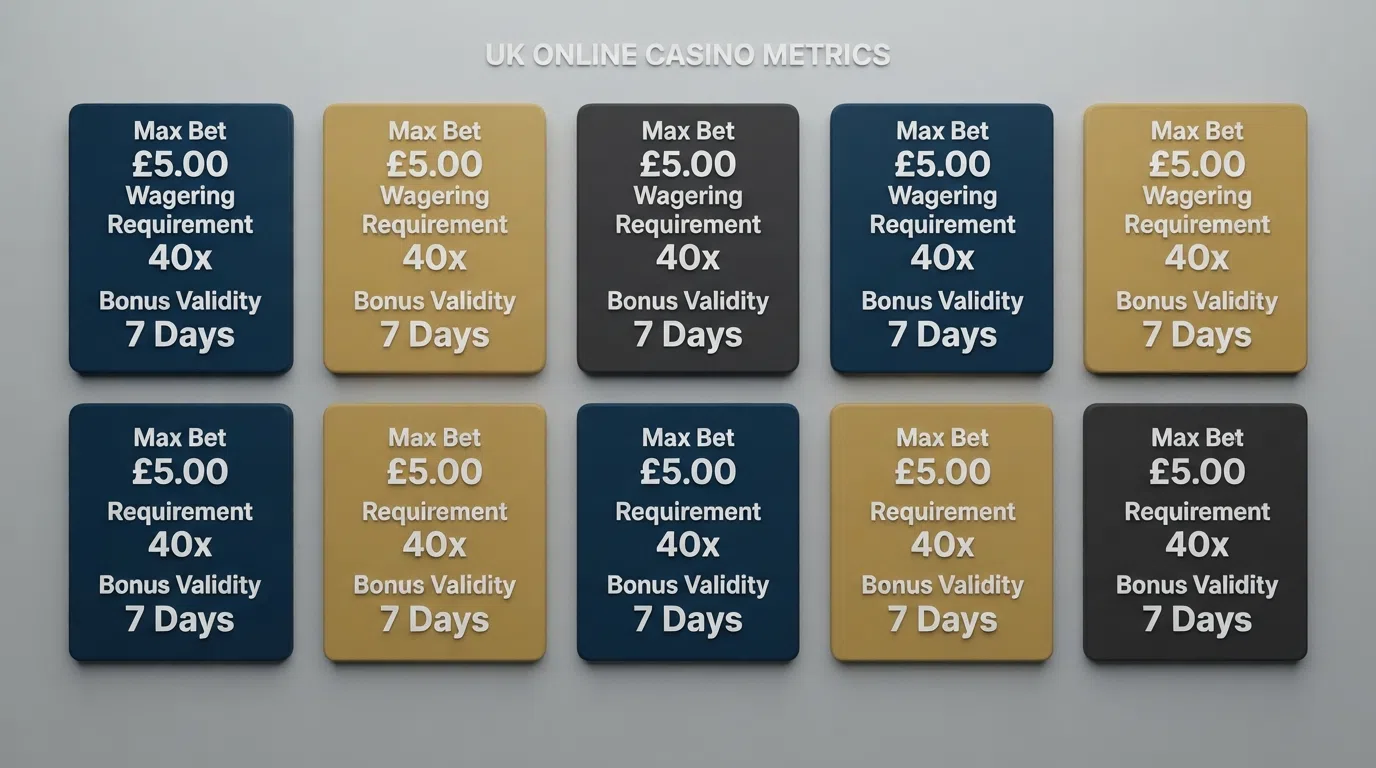
Most players who search for “no limits” are looking for one of three things: a slot they can spin for £100 a pop, a blackjack hand big enough to make a session feel real, or a withdrawal ceiling that doesn’t strangle a big win on its way out. The British market answers each of those wants differently, and not in a way the marketing copy tends to explain. The reason sits in a single piece of secondary legislation — SI 2025/215 — which since 2025 has put a hard age-banded cap on what one spin of an online slot can cost. The ceiling is £5 for adults aged 25 and over, and £2 for adults aged 18 to 24. So in the strict sense, a GB-licensed online casino cannot offer no-limit slots at all, because the law will not allow one. What it can offer is something narrower and more interesting: the highest regulated ceilings the British market has ever had, the best table-game and live-dealer headroom a UK player can access legally, and a bonus market that was rebuilt from the floor up at the start of 2026 when a 10× wagering cap replaced the 40× and 60× multiples that used to be routine.

This page ranks ten UK-licensed operators on that evidence, explains which game category carries the cap and which one escapes it, walks through the deposit and withdrawal rules that govern every British account, and is honest about what an offshore site offers that a GB-licensed one does not. The choice between the two is not a question of which is better; it is a question of which trade-off a player is prepared to make. Data current as of September 9, 2026 and verified against the UK Gambling Commission’s public register of licensed businesses.
Why a UK Casino Can Never Offer Truly Unlimited Play
A UK online casino is, in regulatory terms, a far more constrained thing than its offshore equivalent. Three layers sit on top of the product: a statute, a licence condition, and a software design rule. Each one places a ceiling somewhere the player eventually feels, and together they define what “no limits” can possibly mean at a British operator.
What “No Limits” Means — and What It Doesn’t
The phrase “no limits casino” is shorthand, not a description. Players use it for a casino where they expect high stake ceilings, fast withdrawals, generous bonus terms and an absence of friction. A subset of those players mean it literally: no stake cap, no withdrawal cap, no deposit ceiling. That version of the product does not exist inside the British regulatory perimeter, and has not since SI 2025/215 took effect. The “no limits” casino a UK player can actually access is one where the limits are higher than at the median — where the £5 slot cap applies but the table limits are lifted, where the welcome bonus is structured around a wagering multiple no higher than 10×, and where the withdrawal queue does not strangle a five-figure payout. That is a different product from a no-limits casino. The distinction matters because a player who arrives expecting the second product and gets the first will be disappointed, and a player who arrives expecting the first and gets the second will be relieved.
The slot cap is the part the marketing copy never quite addresses. It makes truly unlimited slots impossible onshore: every GB-licensed operator is bound by the same £5 (£2 for younger players) statutory ceiling, set by reference to the per-game-cycle maximum stake. What the term survives in is a different product category. Table games — roulette, blackjack, baccarat — have no statutory stake cap at all. The phrase “high-limit UK casino” is therefore most honestly applied to an operator whose live dealer and table product reaches further than its slots, and the comparison below treats exactly that distinction.
High-Limit vs No-Limit Casinos — the Critical Difference
High-limit and no-limit are not the same word in a different font. A high-limit casino is one where elevated ceilings exist; the operator has chosen, within the regulatory perimeter, to push the maximum stakes and withdrawal thresholds as high as commercial sense allows. A no-limit casino is one where the ceilings are absent entirely. The first describes what a UK-licensed operator can build; the second describes an offshore proposition the operator cannot lawfully offer. Confusing the two is the mistake that pushes a player from a regulated £5,000 live blackjack table onto a Curaçao-licensed site that offers the same game at ten times that ceiling, and that is a choice which carries consequences no bonus headline can offset.
What does this mean in practice for a player choosing where to deposit? A high-limit UK casino offers the legal protections a regulated operator is required to provide: GAMSTOP coverage, ADR access, a UKGC complaints route, financial vulnerability checks, and the duty of affordability assessment on the operator’s part. The game ceilings sit inside a defined envelope, and the most generous a UK player can reach is on a live dealer table. A no-limit offshore casino offers none of those protections and trades them for stake ceilings that start where the British market stops — slots at £100 or more per spin, live tables at £25,000 or more, and bonuses that would be unlawful under the 10× cap. The player’s decision is not between two versions of the same product. It is between two different products.
How Online Casino Betting Limits Are Actually Set
Three separate limit-setting processes run in parallel at every UK-licensed operator, and a player who understands all three gets a clearer picture of the room to manoeuvre.
At the top sits the statute. SI 2025/215 sets the per-game-cycle maximum stake for online slots, age-banded at £5 (£2 for younger adults). RTS 14 sets the game-design rules: no auto-play, no spin faster than 2.5 seconds, no losses disguised as wins, no reverse withdrawals. LCCP SR Code 5.1.1 caps bonus wagering at 10× from 19 January 2026. These are floors and ceilings the operator cannot move, and the same limits apply at every brand reviewed on this page.
Beneath the statute sits the operator’s own risk appetite. Table maximums, live dealer ceilings, withdrawal thresholds and the velocity of the payout queue are all commercial decisions the operator makes within the regulatory envelope. The same slot title at two different operators will carry the same statutory stake cap but a different withdrawal ceiling, a different live blackjack max, and a different bonus structure. That is where the meaningful spread between the ten operators ranked below actually lives.
At the bottom sits the player’s own settings. From 31 October 2025, every operator must prompt a customer to set a financial limit before the first deposit. Decreases apply immediately; increases wait 24 hours. The operator must also run a financial vulnerability check once a customer’s net deposits reach £150 in a rolling 30-day period. These are player-level controls, layered on top of the statutory and operator-level ones.
The UK’s Approach to Gambling Limits — Caps Other Markets Don’t Have
Britain is an outlier among major regulated jurisdictions in capping the spin itself. No other G20-style market places a statutory maximum on what one game cycle of an online slot can cost. Malta, Curaçao and Gibraltar have no equivalent. Several of them have voluntary limits or self-exclusion registers, but the per-spin ceiling is a British invention, and it is the single most distinctive feature of the UK market.
Two further constraints arrive through the same regulatory channel. The 10× wagering cap that took effect on 19 January 2026 replaced a market where 40× and 60× were not unusual on welcome bonuses; the change is large enough that the British bonus market now looks materially different from its European neighbours. The game-design rules — auto-play banned, minimum 2.5-second spin speed, no features that speed up play, no losses disguised as wins — have been in force since October 2021, and they push slot play toward a slower and more deliberate cadence. The data shows the change has landed. Online slots sessions lasting longer than an hour fell 12% year-on-year to 8.9 million in the fourth quarter since the cap was introduced; the average session length dropped by two minutes to fifteen minutes. A slot machine in Britain in 2026 is a different object from a slot machine in a less-regulated market, both in the stakes it accepts and the speed at which it runs.
UK Casinos With the Highest Play Limits in 2026
The table below ranks ten GB-licensed operators on the figures that matter most to a high-stakes player: the welcome offer, the wagering requirement applied to it, the bonus validity window, and the provider roster behind the games. Every operator holds an active UKGC licence confirmed on the public register, which was last updated on 29 July 2026 and contains 2,663 licensed business records. The ranking reflects how close each operator pushes to the regulatory ceilings on table games and how favourable the bonus terms are for a player who plans to clear them at speed.
| Casino | UKGC Licence | Welcome Offer | Wagering Requirement | Bonus Validity | Game Providers |
|---|---|---|---|---|---|
| Bet365 | Hillside (UK Gaming) ENC | Up to 500 free spins over 10 days (5–50 per daily reveal) | 0× (no wagering) | 7 days from credit; 30 days to claim | Playtech, Microgaming, NetEnt, IGT, Evolution, Pragmatic Play |
| Sky Vegas | Bonne Terre Limited (Flutter) | 50 no-deposit + 200 deposit free spins | 0× (no wagering) | 7 days from credit | Evolution, Pragmatic Play, NetEnt, Blueprint, IGT |
| Paddy Power | PPB Entertainment Limited (Flutter) | 60 no-deposit + 200 deposit free spins | 0× (no wagering) | 7 days from credit | Evolution, Playtech, Pragmatic Play, NetEnt |
| Betfair | PPB Entertainment Limited (Flutter) | Free spins (count varies by promotion) | 0× (no wagering) | 7 days | Playtech, Evolution, NetEnt, Pragmatic Play |
| Betfred | Petfre (Gibraltar) Limited | 200 free spins on selected titles | 0× (no wagering) | 7 days from credit; 14 days to qualify | Playtech, IGT, Evolution, Pragmatic |
| 888 Casino | 888 UK Limited (evoke) | 100% deposit match up to £100, or 100 free spins | 10× (deposit match); 10× on free-spin winnings | 90 days (match); 7 days (spins) | Playtech, Evolution, NetEnt, Pragmatic Play, Red Tiger |
| William Hill | William Hill Organization Limited (evoke) | 200 free spins on Big Bass Splash | 10× on free-spin winnings (capped at £30) | 72 hours from credit | Playtech, Evolution, IGT, NetEnt, Blueprint |
| Ladbrokes | LC International Limited (Entain) | 100 free spins on selected slots | 10× on free-spin winnings | 7 days from credit | Playtech, Evolution, NetEnt, IGT, Pragmatic Play |
| Coral | LC International Limited (Entain) | 100 free spins on selected games | 10× on free-spin winnings | 7 days from credit | Playtech, Evolution, NetEnt, IGT |
| Betway | Betway Limited (Super Group) | £50 bonus on £10 deposit, or 150 free spins on £20 casino wager | 10× (regulatory maximum) | Not stated in published terms | Microgaming, Evolution, Pragmatic Play, NetEnt |
| Casino | Max Live Blackjack Bet |
|---|---|
| Bet365 | £10,000 |
| Betway | £10,000 |
| Grosvenor | £10,000 |
| 888 Casino | £5,000 |
What the table shows at a glance is that the welcome offers in the British market in 2026 sit in two distinct camps. The 0× wagering group — Bet365, Sky Vegas, Paddy Power, Betfair, Betfred — turns free-spin winnings into withdrawable cash from the first spin. The 10× group — 888, William Hill, Ladbrokes, Coral, Betway — applies the regulatory maximum, which in 2026 is the most any British operator can lawfully demand. A player who plans to withdraw a bonus win quickly belongs in the first camp; a player who plans to convert a deposit match into a long session belongs in the second. The wagering multiple is the only number on the table that determines the time and money required to make a bonus real.
The second thing the table shows is how thin the spread is on the slots side. Because every operator faces the same £5 per-spin ceiling, the meaningful headroom is at the table and live dealer end of the product, not the slots. The figures there are dealt with in the next section.
Bet365 — 500 Free Spins, Zero Wagering and £10,000 Live Blackjack Hands
Bet365 sits at the top of the table on the combination that matters most: the largest wager-free spin allocation in the featured set, paired with the joint-highest live blackjack ceiling. Up to 500 free spins are credited at £0.10 each over ten days — between 5 and 50 per day depending on the daily reveal — with zero wagering on winnings. A player who keeps the daily allocation and uses it has 50 wager-free spins a day for ten days, all at a £0.10 stake. The seven-day validity starts on credit; the player has 30 days from registration to claim the package. Behind the bonus sits a six-provider roster that covers Playtech, Microgaming, NetEnt, IGT, Evolution and Pragmatic Play — the broadest in the featured set — and live blackjack at £10,000 per hand. For a player who values a clean bonus with no rollover and a table product that does not force them down a tier to play seriously, Bet365 is the standout. The 0× multiple sits well below the regulatory 10× maximum, and that is the point.
Sky Vegas — 50 No-Deposit Spins Plus 200 More, All Wager-Free
Sky Vegas is the only operator in the featured set that puts free spins in the player’s account before they deposit a penny. The structure is 50 no-deposit free spins, credited on registration, plus 200 more on a £10 deposit and spend — 250 wager-free spins in total. No cashout cap is stated on the free-spin winnings; the 0× multiplier means everything won is real money from the first spin. Sky Vegas is operated by Bonne Terre Limited under Flutter Entertainment, and the provider roster is led by Evolution and Pragmatic Play, with NetEnt, Blueprint and IGT rounding it out. The seven-day validity from credit is the only friction, and on an offer this clean it is a minor one. For a player who wants to test a casino without committing a deposit, and to keep whatever the welcome package produces, Sky Vegas is the obvious fit.
Paddy Power — 60 No-Deposit Free Spins and 200 Deposit Spins, Zero Wagering Throughout
Paddy Power’s welcome package is the largest no-deposit free-spin allocation in the featured set. Sixty no-deposit free spins are credited on registration — 50 on selected slots and 10 on Paddy’s Mansion Heist — and 200 more are added on a £10 deposit and wager. That is 260 wager-free spins in total, all under the same Flutter platform as Sky Vegas, with Evolution, Playtech, Pragmatic Play and NetEnt behind the games. As with Sky Vegas, there is no stated cashout cap, and the seven-day validity applies from credit. The wagering requirement is 0× throughout. This makes Paddy Power the premier choice for volume-driven bonus seekers.
Betfred — 200 Free Spins With No Wagering on Any Winnings
Betfred’s package is the cleanest structure in the table. Two hundred free spins on selected titles for a £10 deposit and stake on slots, with 0× wagering — winnings are withdrawable cash from the first spin. The offer is operated by Petfre (Gibraltar) Limited, with Playtech, IGT, Evolution and Pragmatic Power behind the games. The bonus is valid for seven days from credit, with 14 days to qualify from registration. There is no cashout cap and no rollover to clear. Betfred offers a streamlined experience with no conditions to track beyond the validity window.
Betfair — Zero-Wagering Free Spins From the Flutter Group Stable
Betfair sits in the same Flutter group as Paddy Power, and the welcome package carries the same architecture: 0× wagering on no-deposit free-spin winnings. The free-spin count varies by the current promotion, and the bonus is valid for seven days. The provider roster covers Playtech, Evolution, NetEnt and Pragmatic Play, and the offer is operated by PPB Entertainment Limited. The reason Betfair is grouped with the wager-free operators is the multiple — the same 0× as Paddy Power and Sky Vegas — even if the headline spin count moves with the calendar.
William Hill — 200 Free Spins on Big Bass Splash, 10× Wagering on Winnings
William Hill’s 200 free-spin package is locked to Big Bass Splash, with each spin valued at £0.10. The headline number is the same as Betfred’s, but the conditions are different: winnings are subject to 10× wagering and capped at £30. The 10× multiple is the regulatory maximum and the most an operator can demand in 2026, and the £30 cap means a big hit on a single spin is worth no more than thirty pounds. The 72-hour validity from credit is the tightest window in the featured set, and the provider roster — Playtech, Evolution, IGT, NetEnt and Blueprint under evoke/888 Holdings — is the standard mid-market breadth. This deal is tailored for Big Bass Splash enthusiasts comfortable with a capped win, while bonus purists may prefer alternatives.
Ladbrokes — 100 Free Spins on Selected Slots, 10× Wagering Applies
Ladbrokes’ welcome package is a £10 stake on slots for 100 free spins at £0.10 each on selected games, with 10× wagering on the winnings and a seven-day validity from credit. The operator is LC International Limited under Entain, with a five-provider roster led by Playtech and Evolution. The structure is identical to Coral’s, which sits immediately below it on this list; the two brands share the same platform and the same bonus template. Ladbrokes and Coral offer an identical bonus architecture, meaning the decision comes down to personal preference regarding game library and brand familiarity.
Coral — 100 Free Spins With 10× Wagering, Entain Platform
Coral’s 100-spin welcome is the same package as Ladbrokes’ — £10 staked on slots for 100 free spins at £0.10 each, 10× on the winnings, seven days from credit. The operator is also LC International Limited under Entain, and the provider roster covers Playtech, Evolution, NetEnt and IGT. Where Coral and Ladbrokes differ from the Flutter group brands is the multiple: 10× is the regulatory maximum and the most a British operator can demand on a free-spin welcome in 2026, against the 0× that Bet365, Sky Vegas, Paddy Power, Betfair and Betfred now run. Coral remains a strong contender for players prioritising game variety, though those seeking lower wagering requirements have several no-wager alternatives.
888 Casino — £100 Deposit Match or 100 Free Spins, £5,000 Live Blackjack
888 Casino is the only operator in the featured set that offers a cash match bonus alongside free spins. The structure is a choice: a 100% deposit match up to £100 with 10× wagering within 90 days, or 100 free spins at £0.10 each on a £10 deposit and wager within seven days. The deposit match carries a £100 cap on winnings, and the free spins carry a £300 cap. The 90-day validity on the deposit match is the longest in the featured set and gives a player who wants to convert the bonus over time a long runway. Behind the games sits Playtech, Evolution, NetEnt, Pragmatic Play and Red Tiger under evoke plc, and the live blackjack ceiling is £5,000 per hand. This operator is the sole provider of a cash-match bonus with a 90-day validity, setting it apart from the free-spin-focused alternatives.
Betway — £50 Bonus Cash or 150 Free Spins, £10,000 Live Blackjack Hands
Betway’s welcome is a £50 bonus on a £10 deposit, or 150 free spins on a £20 casino wager. The regulatory 10× wagering cap applies, and the operator is Betway Limited under Super Group, with Microgaming, Evolution, Pragmatic Play and NetEnt behind the games. The live blackjack ceiling of £10,000 per hand is the joint-highest in the featured set alongside Bet365, and it is the reason Betway features in a high-limit comparison at all. For a player whose interest is in the live table product and who can live with the 10× multiple on the welcome bonus, Betway is one of two operators — Bet365 is the other — that genuinely justify the “high-limit” tag in the British market in 2026.
Where UK Limits Hit Hardest — Slots, Tables and Live Dealers
The three product categories in a UK online casino live under three different limit regimes, and the gap between them is wider than most comparison pages acknowledge. Understanding these limits is key to managing a bankroll effectively.
The UK Slot Stake Cap — £5 or £2 Depending on Your Age
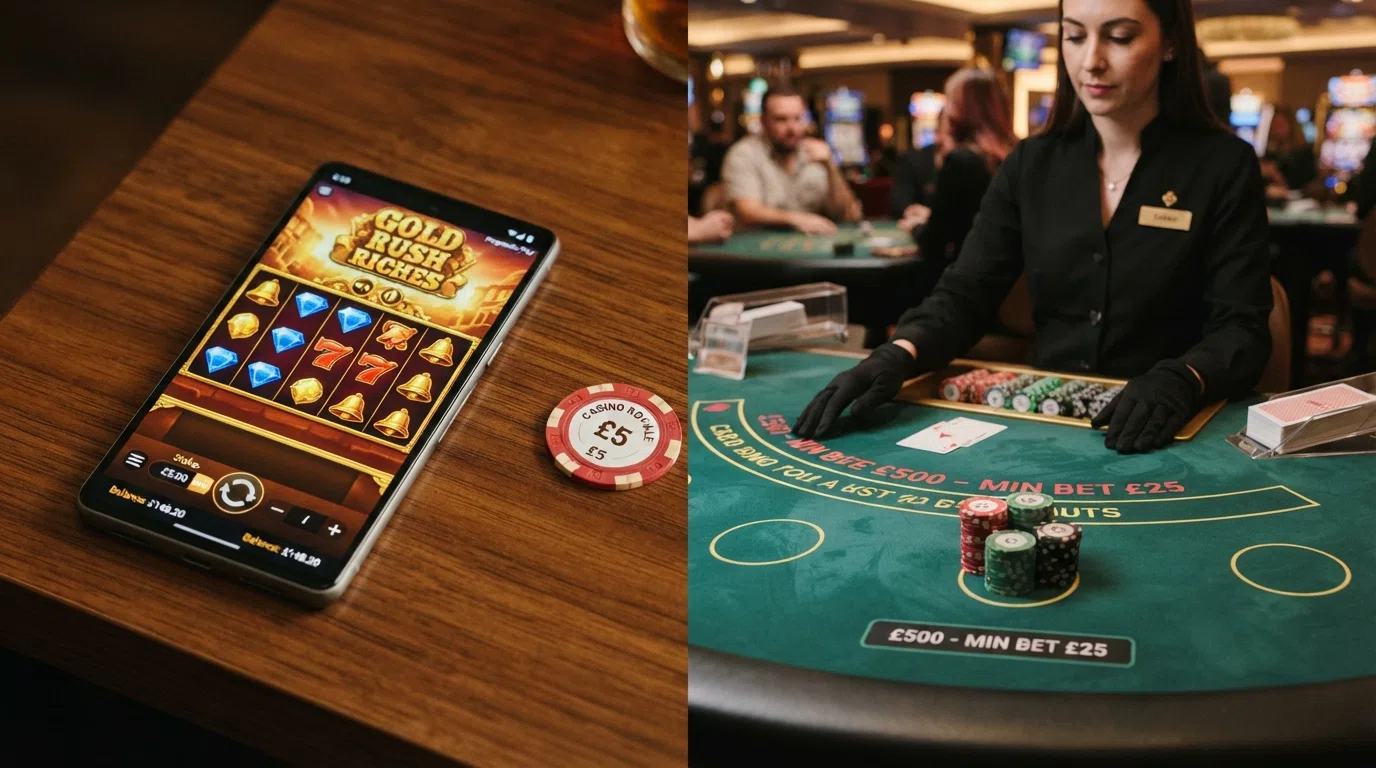
The age-banded online slots stake cap is the single most distinctive feature of the British market, and the one that the international affiliate pages almost never explain. Two adults playing the same slot at the same GB-licensed casino will, in many cases, face different maximum stakes — because the ceiling is set by reference to the player’s age, not the operator’s licence. The Gambling Commission has confirmed in its online slots stake limit guidance that the £5 limit for adults went live on 9 April 2025 and the £2 limit for adults aged 18 to 24 went live on 21 May 2025. Both dates are within the same secondary legislation, SI 2025/215, and both are binding on every GB-licensed operator.
What has the cap done? The Gambling Commission’s market data, drawing on operator returns to March 2026, shows that the number of online slots sessions lasting longer than an hour fell by 12% year-on-year to 8.9 million — the fourth quarter since the cap was introduced. The average session length dropped by two minutes to fifteen minutes. The trend is not a one-off; it is the fourth consecutive quarter of decline, and it is the clearest behavioural signal the regulator has that the cap is doing what it was designed to do. For a high-stakes player, the practical consequence is that a serious slots session is a £5-per-spin session, full stop. The cap is not a target. The cap is a ceiling, and it is not going anywhere.
Table Games — Roulette, Blackjack and the Games the Cap Missed
Table games carry no statutory stake cap at all. The Gambling Commission’s guidance is explicit on this point: the stake limits apply to online slots only, and other casino games such as roulette, blackjack, live casino and bingo have no equivalent ceiling. What that means in practice is that the operator sets the per-round maximum, and the operator’s ceiling is the only one in force. RNG roulette, RNG blackjack and the table variants in between are subject to commercial decisions rather than statutory ones, and the spread between the lowest and highest table maximum at a single British operator can be wide.
The distinction is the central reason the British market still has a high-limit product at all. A player who arrives at a UK-licensed casino looking for a £500 hand of blackjack or a £1,000 spin of roulette is not looking for the slot product — that ceiling is £5 — they are looking for the table product, which is unregulated at the stake level. The headroom a UK player can reach is on a table, and the spread on offer within the table category is wide enough that the choice of operator matters more than the choice of game.
Live Dealer Tables — Where the Highest Limits Live
The highest limits a UK-licensed player can reach are on a live dealer table, and the spread is meaningful. Live blackjack at Betway carries a £10,000 per-hand maximum, matched at Bet365. Live blackjack at 888 Casino carries a £5,000 per-hand maximum. Grosvenor’s Salon Privé tables reach the same £10,000 figure. These are not theoretical ceilings; they are operator-set maximums that any funded account can wager at, subject to the affordability checks triggered automatically when net deposits hit £150 within a 30-day window.
The reason the live product carries the highest ceiling is structural, not accidental. A live dealer table costs the operator more to run than an RNG table — the studio, the camera crew, the dealer, the bandwidth — and the players who play at these tables are a smaller, more concentrated group with a higher average stake. The operator has a commercial reason to push the ceiling up; the player who reaches it has a regulatory reason to be confident the offer is real, because affordability checks are in force regardless. The £10,000 live blackjack hand is the genuine ceiling of the British regulated market, and a player who is going to play at that level is already inside the framework.
No-Limit Slots — What the Term Means When Every Spin Is Capped
The phrase “no-limit slot” in the British market is a contradiction in terms. SI 2025/215 makes a no-limit slot impossible at any GB-licensed operator: the per-game-cycle maximum is £5 for adults, and that ceiling cannot be moved by an operator’s marketing copy. The phrase survives in SEO and affiliate content because players search for it, and because the offshore sites that target British players do offer slots with no upper stake — £100 or more per spin, on titles the GB-licensed market does not have.
What does a player who searches for “no-limit slots UK” actually find? Two things. The first is a GB-licensed operator whose slot product is capped at £5 (£2 for younger players) but whose table product is high-limit by design — that is the “high-limit” product the table above describes. The second is an offshore site, licensed in Curaçao or Malta, where the same slot title may run at £100 or more per spin. The first comes with every UKGC protection: GAMSTOP coverage, ADR access, affordability checks, and a regulator with enforcement teeth. The second comes with none of those, and a different set of consequences if a payout goes wrong. Distinguishing these options is the most valuable step a reader can take.
RNG vs Live Dealer — Why the Same Game Has Different Ceilings
The format of the same game carries a different ceiling, and the reason sits in the cost structure rather than the rules. RNG blackjack — software-driven, no human dealer — typically carries a lower operator-set maximum than live dealer blackjack, which runs from a studio with a croupier and a stream. The studio costs money, the dealer costs money, and the player who chooses the live product is, on average, a higher-stakes customer than the player who chooses the RNG product. The operator prices the ceiling accordingly.
The same pattern holds for roulette. Live roulette tables carry higher maximums than RNG roulette, and the gap is not the game — it is the format. A second reason the live product carries higher ceilings is the game-design rules. The 2.5-second minimum spin speed and the no-auto-play rule apply to online slots; they do not bind the dealer’s hand at a live blackjack table, where the cadence is set by the dealer and the player. A high-stakes player who wants the fastest possible pace finds it at a live table; a player who wants the regulatory cap to apply strictly finds it on a slot.
Why Getting Your Winnings Out Takes Longer Than You Expect
The withdrawal experience at a UK-licensed casino has more moving parts than the welcome bonus does, and the parts that move slowest are not the ones the bonus headline advertises.
Cashing Out — Standard Payout Caps and the Casinos That Go Beyond Them
Withdrawal limits are operator-set and the range across the British market is wide. The published daily and monthly payout ceilings at GB-licensed casinos vary by brand and by player tier, with the standard customer-facing ceiling sitting well below the upper tier that high-roller or VIP accounts are routed to. A specific player’s withdrawal ceiling depends on their account history, their deposit pattern, and the operator’s affordability assessment. VIP programmes across the featured set — the Flutter, Entain, evoke and Super Group high-roller tiers — lift the standard ceiling, sometimes substantially, but the specific figure is player-specific and not something a comparison page can pin to a brand.
What the page can say is that withdrawal speed interacts with the ceiling in a way the headline number alone does not capture. A high ceiling processed slowly is a low ceiling in practice: a player who has won a five-figure sum and is waiting ten working days for the payout queue has a worse experience than a player with a slightly lower ceiling whose withdrawal is processed the same day. The British market’s standard payout windows are not slow by international standards, but they are not the instant the marketing copy implies, and a player who plans to play at a level where the ceiling is the binding constraint should check the published payout time, not just the headline number.
Deposit Limits — From a Voluntary Tool to a Mandatory Offer
Deposit limits have moved from a player-elected tool to a mandatory operator offer over the last twelve months. From 31 October 2025, every GB-licensed operator must prompt a customer to set a financial limit before the first deposit. The prompt is not optional. The operator must also make it easy for the customer to review and change the limit afterwards. Where the limit decreases, the new lower ceiling applies immediately. Where the limit increases, the operator must apply a 24-hour cooling-off period before the higher limit takes effect — a delay that gives the customer a full day to reconsider.
The distinction between a deposit limit the player sets and a spending cap the operator imposes is worth holding in mind. A player-set deposit limit is the customer’s own ceiling — the maximum they will deposit over a chosen period, set at the prompt before the first deposit, and changeable at any time subject to the rules above. An operator-set spending cap, by contrast, sits on top of the player’s choice and reflects the operator’s own assessment of what the customer can afford. The £150 net-deposit threshold in a rolling 30-day period triggers a financial vulnerability check, which is a soft form of that operator-set cap. The two systems run in parallel: the customer’s choice, and the operator’s judgement. A player who values the lowest possible friction will set the deposit limit high; a player who values the strongest possible protection will set it low, and the operator may set it lower still.
The UK’s New Gross Deposit Limit Rule — What Changes in September 2026
A further change to the deposit-limit regime takes effect on 30 September 2026, having been extended from the original 30 June 2026 date. Under RTS 12, the term “deposit limit” may only refer to a gross deposit limit — that is, money paid into the account over a set period, with bonus funds credited and winnings recycled excluded from the count. Operators must comply across all ten brands in the featured set; the rule is universal for GB licensees.
Why does this matter for a high-stakes player tracking their net position? Because the old “deposit limit” was a net-of-bonuses figure, and a player who deposited £500, claimed a £200 bonus and recycled £400 of winnings would have seen a net deposit figure that did not match the cash they had paid in. Under the gross deposit limit regime, the figure the player sees is the figure they have actually paid — bonuses and recycled winnings do not dilute it. The change is a clarity improvement, and for a player who has been tracking their spend against a deposit limit, the headline number will rise once the new definition lands. The compliance burden sits on the operator, not the player; the effect the player feels is a more honest accounting of the cash that has actually left their account.
The Legal Reality of High-Limit Play for UK Players
The British regulatory framework is one of the more prescriptive in the world, and the prescription runs in both directions. The UKGC’s enforcement teeth are real, the protections are concrete, and the obligations on the operator are extensive. The trade-off is that the same framework is what produces the slot cap and the 10× wagering cap and the deposit-limit prompt. Navigating these trade-offs is simply part of the decision-making process for high-stakes play.
The UKGC Licence — What It Demands of Every British Casino
A Gambling Commission licence is not optional for any operator taking British custom. The point-of-consumption reform introduced by the Gambling (Licensing and Advertising) Act 2014 brought remote operators inside the UKGC’s perimeter, and the Gambling Act 2005 sets the three licensing objectives the Commission is required to pursue: preventing gambling from being a source of crime or disorder, ensuring it is conducted in a fair and open way, and protecting children and other vulnerable persons from harm. Section 1 of the Act is the foundation; the working instruments are the Licence Conditions and Codes of Practice (LCCP) and the Remote Technical Standards (RTS), which translate the statute’s principles into concrete operator obligations.
The financial burden on the operator is now substantial. From 6 April 2025 a statutory levy has replaced voluntary contributions; the top rate of 1.1% applies to remote casino, remote bingo and remote general betting licences, with the proceeds split 50% to treatment, 30% to prevention and 20% to research. From 1 April 2026 the Remote Gaming Duty has risen from 21% to 40%, announced at the Autumn Budget 2025. The combined effect is a tax-and-levy load of more than 41% on remote casino GGY, which is one of the reasons the slot cap and the bonus cap are the prices they are. A high-stakes player who sees the 10× wagering cap as restrictive should also see the duty figure alongside it: the operator is paying nearly half its yield to the Treasury before the player has placed a stake.
Offshore Casinos and UK Law — Accessible but Unprotected
The offshore proposition is real and it is accessible. A Curaçao, Maltese or Gibraltar-licensed casino will accept a UK player, will offer slots at £100 or more per spin, will run live tables at £25,000 or more, and will pay bonuses that would be unlawful under the 10× cap. The player can reach the site in under a minute. What the player gives up is the framework the previous paragraphs describe.
The legal position is asymmetric. Providing gambling facilities to GB customers without a UKGC licence is a criminal offence under section 33 of the Gambling Act 2005 — up to 51 weeks’ imprisonment, a fine at level 5, or both. No penalty is established for the player who merely plays there. The UKGC’s enforcement is disruption rather than blocking: cease-and-desist notices, search-engine delisting referrals, payment-provider referrals, and domain registrar pressure. Between April 2024 and June 2025 the Commission issued 3,140 disruption notices, referred 447,778 URLs to search engines, and saw 287,961 of those URLs removed. The Commission does not currently hold statutory ISP or DNS blocking powers — legislation has been proposed but not enacted. The offshore site stays reachable for the player who wants to reach it.
What the player loses by going offshore is concrete. There is no GAMSTOP coverage, so a self-exclusion registered with a British operator does not reach a Curaçao-licensed site. There is no UKGC complaints route, so a dispute over a withheld payout has no statutory adjudication. There is no ADR provider and no affordability check, which means a player with a self-set limit at a British operator can still deposit the same day at an offshore site. The trade is simple: higher ceilings, no recourse. A player who is prepared to make that trade is making it with eyes open; a player who is not has the ten operators on the table above.
GAMSTOP and Self-Exclusion — What Happens When You Press Pause
GAMSTOP is the national multi-operator self-exclusion scheme for Great Britain, and participation in it is a mandatory condition of every GB-licensed online operating licence — a position the Commission took on 31 March 2020. The exclusion periods on offer are six months, one year, five years, or five years with auto-renewal. Once active, the exclusion cannot be cancelled early. A player who has self-excluded is locked out for the full period they selected.
What GAMSTOP does not do is reach offshore sites. A player who has registered a five-year exclusion with a British operator can still deposit at a Curaçao-licensed casino the same day, and the Commission has no power to extend the exclusion across unlicensed brands. The tool is comprehensive within the licensed market and porous at its edge. A player whose self-exclusion is genuine should understand both halves of that description before assuming the registration has closed the door entirely.
Player Protections — Affordability Checks, Credit Card Bans and Game-Design Rules
The British player-protection architecture is broader than most players realise, and several of the pieces are now stricter than they were a year ago. From 28 February 2025, financial vulnerability checks under LCCP Social Responsibility Code 3.4.4 are mandatory for most remote licensees when a customer’s net deposits reach £150 in a rolling 30-day period. The checks use publicly available data only — bankruptcy, county court judgments, individual voluntary arrangements, debt relief orders. A high-stakes player who crosses the threshold in a quiet month will see the check trigger automatically, and the operator will use the result to inform any subsequent affordability assessment.
Since 14 April 2020 the credit card ban has prevented GB-licensed operators from accepting credit card payments for gambling, and the ban has been extended to credit-card-funded payments routed through e-wallets such as Skrill, Neteller and PayPal. The game-design rules that took effect on 1 October 2021 — auto-play banned, minimum 2.5-second spin speed, no features that speed up play, no losses disguised as wins, no reverse withdrawals — apply on top of the payment and affordability controls. The result is a market in which the player cannot fund from credit, cannot withdraw and redeposit within a session, and cannot play a slot at faster than the regulatory minimum cadence. The framework is restrictive, and it is also the reason the framework works.
Playing Safely at High Stakes — Responsible Gambling Tools That Work
The British responsible-gambling infrastructure is more developed than the marketing copy suggests, and the recent data shows it is being used at scale. The tools exist at three levels — the operator’s own, the regulator’s, and the NHS’s — and a player who knows all three has more options than they realise.
Deposit Limits as a Protective Tool, Not Just a Rule
The mandatory deposit-limit prompt is the visible part of a wider architecture. The prompt itself, which every operator must run before the first deposit from 31 October 2025, is a behavioural intervention: a moment of friction between the player’s decision to play and the act of funding the account, and a chance to set a ceiling the player has not had to ask for. The decrease-immediately / increase-after-24-hours split is the same principle in operation. Decreasing a limit removes no friction from the player’s experience; increasing one imposes a full day’s delay. The asymmetry is deliberate.
Above the player-set limit sits the operator’s own affordability check, triggered at the £150 net-deposit threshold in a rolling 30-day period. The two systems are complementary. A player who has set a high personal limit and then triggers the operator’s check has not bypassed protection; the operator’s check is a second look, run independently of the player’s own choice. A player who has set a low personal limit and stays below the £150 threshold is protected by their own ceiling before the operator’s check ever runs. The architecture is layered, and a player who understands the layering is in a stronger position to use it.
Self-Exclusion Beyond GAMSTOP — Operator Tools and GamCare
GAMSTOP is the national register, and it is mandatory for every GB-licensed operator. Beneath it sits a set of operator-level tools that a player can use without registering on the national scheme. Reality checks are the simplest: a notification that pops up during a long session to show time played and net position. Time-outs run from 24 hours to six weeks and are reversible after the period expires — a softer version of self-exclusion that lets a player take a break without committing to a six-month minimum. Both tools are available at every GB-licensed casino the page features, and both are reversible in a way GAMSTOP is not.
For a player who wants confidential advice outside the operator, GamCare’s National Gambling Helpline is the entry point. The line is free, the conversation is confidential, and the contact channels cover telephone, web chat, WhatsApp and Facebook Messenger. The number is 0808 8020 133. GamCare also runs in-person consultations and a network of treatment providers across England, Scotland and Wales. The infrastructure is free at the point of use, and it is independent of the operator.
Where to Get Help — NHS Clinics, Helplines and Peer Support
The NHS’s specialist gambling treatment infrastructure has expanded sharply over the last two years. As of December 2024 there were 15 specialist NHS gambling treatment clinics across England, Scotland and Wales, with service use up 130% over the preceding year. NHS gambling treatment referrals rose to 4,355 in 2024/25 — April 2024 to March 2025 — nearly double the 2,284 in 2023/24. The numbers show more people are coming forward, and the infrastructure is in place to receive them.
The prevalence picture underneath those figures is set by the Adult Psychiatric Morbidity Survey 2023/24. The survey found 0.4% of adults experienced problem gambling (PGSI 8+) and 1.6% experienced at least moderate risk gambling (PGSI 3+). In a country of roughly 67 million, those percentages translate to several hundred thousand people in the highest-risk category and more than a million at moderate risk. The help infrastructure below exists for that population, and the recent expansion is a response to the demand it has revealed.
- The National Gambling Helpline on 0808 8020 133 — free, confidential, available by phone, web chat, WhatsApp and Facebook Messenger, run by GamCare.
- 15 specialist NHS gambling treatment clinics across England, Scotland and Wales, with referrals running at 4,355 in 2024/25.
- Gamblers Anonymous — peer-support meetings, the longest-running help format in the British market.
- GambleAware — the charity that funds prevention and treatment, separately from the operator-funded and statutory-levy-funded research streams.
- The GP — the first port of call for a player who would rather start the conversation with a clinician they already know.
How We Selected and Ranked These Casinos
The evaluation basis for the ranking on this page is the public record, not the marketing claim.
Every operator’s UKGC licence status was verified against the Commission’s public register, which was last updated on 29 July 2026 and contains 2,663 licensed business records. Each of the ten operators is listed and active, and the trading names match the brand names used in the welcome offers above. The data behind the offers — the spin count, the wagering multiple, the validity window, the provider roster — was drawn from published terms and conditions, the relevant LCCP and RTS instruments, and competitor research cross-checked for consistency.
The ranking criteria were the height of live table limits where stated, the wagering requirement applied to the welcome offer, the bonus validity window, the breadth of the provider roster, and the presence or absence of a cashout cap on free-spin winnings. No numerical weighting was applied. The ranking reflects how close each operator pushes to the regulatory ceiling on the figures that matter to a high-stakes player, and the table above is the basis for the comparison.
- Licence verification: UKGC public register, 29 July 2026, 2,663 records.
- Offer data: published terms and conditions at each operator.
- Regulatory context: LCCP and RTS instruments as cited above.
- Cross-checking: market research and competitor reviews for consistency on bonus terms and table limits.
What Betting Big in the UK Actually Looks Like in 2026
The British regulated market in 2026 offers the highest limits a UK player can reach legally, and they are not on the slots. They are on the live dealer tables, where £10,000 per hand at Bet365 and Betway is the genuine ceiling of the onshore market, and where 888 Casino’s £5,000 figure gives a player a mid-tier alternative below. The table games underneath those ceilings carry no statutory cap at all, and the spread between operators is real. The slot product, by contrast, is capped at £5 per game cycle for adults and £2 for the younger band, and the cap is not going to move. A player who arrived at this page looking for high-stakes slots has arrived at the wrong product; a player who arrived looking for high-stakes table action has arrived at the right one.
The ten operators ranked above are all GB-licensed, and the differences between them are real but bounded by the same statutory framework. The 0× wagering operators — Bet365, Sky Vegas, Paddy Power, Betfair, Betfred — turn free-spin winnings into cash from the first spin and ask for nothing in return. The 10× wagering operators — 888, William Hill, Ladbrokes, Coral, Betway — apply the regulatory maximum, which is the most any British operator can lawfully demand. A player who plans to clear the bonus quickly and withdraw will favour the first group; a player who plans a long session will favour the second.
Offshore sites offer higher ceilings and fewer restrictions, and they remove every UKGC protection in the same transaction. No GAMSTOP coverage, no Commission complaints route, no ADR provider, no affordability check. The choice is between higher limits and legal recourse, and it is a choice the page cannot make for the reader. What the page can do is make the framework visible: the £5 slot cap, the £10,000 live blackjack hand, the 10× wagering multiple, the 1.1% statutory levy, the 40% Remote Gaming Duty, and the regulator with 2,663 licensed businesses on its register. A player who knows those numbers is in a position to make the choice themselves.
Frequently Asked Questions
Are there online casinos with no betting limits available to UK players?
A truly no-limit online casino is not available inside the British regulatory perimeter. Online slots are capped by statute at £5 per game cycle for adults aged 25 and over and £2 for those aged 18 to 24, imposed by SI 2025/215. Table games and live dealer products have no statutory stake cap, and the highest ceiling a UK player can reach at a GB-licensed operator is £10,000 per hand on live blackjack at Bet365 or Betway. Offshore sites licensed in Curaçao, Malta or Gibraltar do offer slots and tables with no upper stake, but they operate outside the UKGC framework and offer none of the protections a British licence provides.
Is it legal for UK residents to gamble at casinos outside GamStop?
The law is asymmetric. Providing gambling facilities to GB customers without a UKGC licence is a criminal offence under section 33 of the Gambling Act 2005; playing at an unlicensed site is not itself an offence. The UKGC enforces through disruption rather than blocking — cease-and-desist notices, search-engine delisting, payment-provider referrals — and does not currently hold statutory ISP or DNS blocking powers. A player who chooses to play at an offshore casino is choosing to forgo GAMSTOP coverage, the Commission’s complaints route, ADR access and the affordability checks the regulator requires. The choice is legal, but the protections are not.
Which UK casinos have the highest withdrawal limits?
The published withdrawal ceilings at GB-licensed casinos vary by brand and by player tier, and the specific figure a player can withdraw depends on their account history and the operator’s affordability assessment. Standard customer-facing ceilings are below those available to high-roller or VIP accounts on the same platform, and the Flutter, Entain, evoke and Super Group high-roller programmes across the featured set lift those ceilings further. The specific daily and monthly figures are not published in a way that allows a like-for-like comparison, and the meaningful variable in practice is payout speed rather than ceiling size. A player who plans to withdraw at the upper end of a brand’s range should check the published payout window at the same time as the headline ceiling.
What is the new 10× wagering requirement cap and how does it affect bonuses?
From 19 January 2026, LCCP Social Responsibility Code 5.1.1 caps bonus wagering requirements at 10×. A player must wager the bonus no more than ten times before the winnings become withdrawable. The cap replaced a market where 40× and 60× wagering multiples were not unusual on welcome bonuses, and it has driven the British bonus market to a lower-rollover structure than most European neighbours. The most generous offer in the featured set is 0× wagering, available at Bet365, Sky Vegas, Paddy Power, Betfair and Betfred. The regulatory maximum of 10× is the ceiling on the rest.
How do I set or change my deposit limit at a UK online casino?
Every GB-licensed operator must prompt a customer to set a financial limit before the first deposit, and the prompt has been mandatory since 31 October 2025. The limit can be reviewed and changed at any time through the account’s responsible-gambling settings. Decreases to a limit are actioned immediately; increases are subject to a 24-hour cooling-off period before the higher limit takes effect. The cooling-off period is a deliberate friction designed to give the customer a full day to reconsider, and it cannot be waived by the operator.
What player-protection features do UK-licensed casinos offer?
The British player-protection architecture runs in three layers. At the operator level, every GB-licensed casino must offer deposit limits, time-outs, reality checks, GAMSTOP registration, and the financial vulnerability check that triggers at the £150 net-deposit threshold in a rolling 30-day period. At the regulator level, the UKGC’s LCCP and RTS instruments set the obligations the operator must meet, and the public register allows a player to verify a brand’s licence status. At the public-health level, the NHS runs 15 specialist gambling treatment clinics across England, Scotland and Wales, GamCare runs the National Gambling Helpline on 0808 8020 133, and Gamblers Anonymous and GambleAware complete the free, confidential support network. The system is restrictive, and it is also the reason the British market is the most protected in the world.
Limits – trustedcasinos-notongamstop
Content created by the «trustedcasinos-notongamstop» team