
Best Bitcoin Cash Casinos for UK Players in 2026: An Honest Comparison
 Available in GB
A Bitcoin Cash casino looks, on the surface, like any other online casino: thousands of slots, a live dealer floor, a welcome bonus pitched in bold type. What sits underneath is different. Every BCH casino a UK player can actually register with sits outside the Gambling Commission’s licence perimeter, because the UKGC does not authorise cryptocurrency as a payment method on any GB-licensed platform. That single regulatory fact shapes everything on this page: the licence badges on the operators below are Curaçao, Anjouan or Costa Rican, not British, and the protections British players take for granted (GAMSTOP, ADR, financial vulnerability checks, statutory stake caps) stop at the border with the regulator’s authority.

This comparison is written for the UK player who already knows they want to deposit in BCH and wants to know which offshore operator to choose, what the welcome offers actually cost to clear, how fast a withdrawal lands, and what they give up by playing outside the licensed market. The ten operators below are ranked on what they deliver, not on whether they hold a UKGC licence, because none of them does. The ranking compares the choices that exist, not the market a reader might wish existed.
Current as of September 9, 2026. Licence claims verified against the UK Gambling Commission’s public register and the relevant offshore regulator’s database (Curaçao GCB, Curaçao GCA, Anjouan).
The Offshore Crypto Casino Landscape for UK Gamblers — Speed, Access and the Trade-Offs
A Bitcoin Cash casino is an online casino that accepts BCH as a deposit and withdrawal method, alongside the usual roster of cryptocurrencies and sometimes fiat. The “casino” part is familiar: slots, live dealer, table games, bonuses, the same. The “Bitcoin Cash” part changes three things — how money moves in and out, what it costs to move it, and which regulatory body, if any, oversees the operator. UK players should understand all three before signing up anywhere.
The landscape in 2026 is simpler than it looks. No UKGC-licensed casino accepts BCH, Bitcoin, Ethereum or stablecoins for deposits or withdrawals. The UKGC’s current position, repeated across Commission guidance and industry coverage, is that cryptocurrency is not an authorised payment method on licensed platforms, and no GB-licensed operator advertises itself as a “UK Bitcoin casino” because doing so would breach its licence conditions. Every casino a UK player reaches by typing “Bitcoin Cash” into a search engine is therefore offshore-licensed, and the regulatory regime that applies to it is the one in Curaçao, Anjouan, Costa Rica or wherever the licence was issued. That places these operators in what industry sources call a “regulatory grey area” for UK players: not illegal for the player to use, but operating outside every British consumer-protection framework the reader may have assumed applied.
The core trade-off is straightforward. BCH deposits settle in roughly ten minutes (one block confirmation on the Bitcoin Cash network, with a single confirmation generally treated as safe for crediting) and cost fractions of a penny in network fees. Withdrawals at the faster operators complete in under twenty minutes end-to-end, which is the kind of speed a UK debit card cannot match. What is traded away is everything a UKGC licence mandates: the £5 slot stake cap, the 2.5-second spin speed minimum, the auto-play ban, the 10× wagering ceiling, the financial vulnerability check at £150 in net deposits, the GAMSTOP self-exclusion scheme, and the route to Alternative Dispute Resolution if an operator withholds funds. The page that follows describes what each of the ten operators on this list offers, what it costs, and which reader profile each one suits.
What Bitcoin Cash Actually Is — and How BCH Casinos Work
Bitcoin Cash is a peer-to-peer digital currency that forked from Bitcoin in 2017, splitting off over a disagreement about block size. The split produced a network with larger blocks, lower transaction fees and faster confirmation times than Bitcoin retains today, and those three properties (cheap, fast, on-chain) are exactly what makes BCH useful for casino deposits. A transaction costs well under a US cent in network fees even during busy periods, and a single block confirmation arrives in roughly ten minutes. For a player depositing the equivalent of £20 to £200 to play slots, the fee is effectively invisible and the wait is short.
A BCH casino deposit flows in four steps. The player opens the cashier, selects Bitcoin Cash, and the casino generates a one-time deposit address (or a QR code) tied to their account. The player sends BCH from their wallet to that address, paying a network fee that is typically a fraction of a US cent. The transaction is broadcast to the Bitcoin Cash network, included in a block, and after a small number of confirmations — one is often credited instantly, while some operators wait for six — the balance appears in the casino account. The whole sequence usually completes in ten to fifteen minutes. Withdrawals reverse the flow: the player requests a payout in BCH, the operator’s internal processing queue approves it, the BCH is sent to the player’s wallet address, and the on-chain settlement adds another four minutes or so. The bottleneck is the operator’s queue, not the blockchain.
The term “BCH casino” covers a wider scope than slots alone. The same operators that take BCH deposits also run sportsbooks (pre-match and in-play), poker rooms, and live-dealer casino floors. Provably fair games — a category pioneered by crypto-native operators like Stake and BC.Game — let the player verify each spin or hand against a cryptographic hash published before the bet, so the outcome can be checked after the fact. It is a verification model UKGC-licensed casinos do not need and do not offer, because the Commission’s testing regime covers the same ground through accredited test houses.
BCH vs BTC: Why Bitcoin Cash Matters for Casino Deposits
Bitcoin Cash and Bitcoin share a name, a logo and a transaction format that confuses newcomers, but the practical difference for casino play is large. Bitcoin’s block size is smaller and its mempool fills during busy periods, pushing fees up; a Bitcoin deposit of the equivalent of £50 can carry a network fee that eats a meaningful percentage of the deposit value during a fee spike. Bitcoin Cash’s larger blocks keep fees consistently low, and a BCH transaction of the same size typically costs a small fraction of a US cent regardless of network activity. For a player making repeated small deposits, the difference is the gap between BCH being a sensible payment method and BTC being a frustrating one.
Confirmation speed tells the same story. Bitcoin blocks average ten minutes, but during congestion confirmation can stretch longer, and most exchanges and casinos require three to six confirmations before crediting. Bitcoin Cash’s ten-minute block with one confirmation widely treated as sufficient for deposits means a BCH deposit is typically playable within a quarter of an hour, while a BTC deposit may take an hour or more during heavy network use. For a player who wants to deposit, play a session and withdraw winnings in a single sitting, BCH is the practical choice and BTC is the legacy one.
The trade-off is liquidity and acceptance. Bitcoin is more widely known, more deeply integrated with exchanges, and accepted at more casinos than BCH. For a UK player choosing between the two, the calculus is: BCH is faster and cheaper for the deposit itself, BTC is more universally understood. The casinos on this list accept both, and the rest of the page treats BCH as the operative payment method for the comparison.
The UK Bitcoin Cash Casino Landscape in 2026
The state of the UK market in 2026 can be stated in one sentence: no UKGC-licensed casino accepts cryptocurrency, every BCH casino accessible to a UK player is offshore-licensed, and that is unlikely to change before late 2027. The operators that have left the UK regulatory perimeter are not coming back on their own. Stake surrendered its UKGC licence in March 2025 and closed Stake.uk.com; BC.Game had its UKGC licence revoked in December 2024 and migrated to an Anjouan licence whose terms specifically prohibit operators from servicing UK players. Other major crypto casinos (BitStarz, Cloudbet, FortuneJack, MyStake, 7Bit, JustCasino, Jack) either hold Curaçao licences that exclude the UK by default, or operate without a UK-facing licence at all. The result is a UK-facing crypto casino market that exists entirely outside the Commission’s enforcement reach.
The offshore licences themselves are real regulatory instruments, even if they are not British. Most crypto casinos targeting UK players hold Curaçao Gaming Control Board licences issued under the LOK framework, the National Ordinance on Offshore Games of Hazard that came into force in 2023, which tightened operator solvency, AML and responsible-gambling requirements compared with the previous master-licence regime. Anjouan (Comoros) has emerged as a cheaper alternative, and at least one operator in this ranking (BC.Game) has moved there after revocations elsewhere. Costa Rica, by contrast, does not issue gambling licences at all, and any operator stating it is “not under any domestic licensing regime” is not licensed in any meaningful sense.
The landscape this comparison describes will not be the same in eighteen months. The UKGC announced in February 2026, at the Betting and Gaming Council’s AGM, that it had opened an exploratory review of a potential pathway for crypto payments at licensed operators, with regulations potentially taking effect from late 2027. The parallel track is the FCA’s Financial Services and Markets Act 2000 (Cryptoassets) Regulations 2026, passed by Parliament on 4 February 2026, which bring cryptoassets within the FCA’s regulatory perimeter for the first time; the full scope of regulated activities under that regime expands from 25 October 2027. The UKGC separately raised the AML risk rating for gambling software from “low” to “medium” in August 2026, citing the rise of e-wallets, pre-paid cards and cryptoasset-linked funds in remote gambling. None of that changes the situation today, but it sets a date by which a licensed, UKGC-regulated BCH casino could plausibly exist for the first time.
The 10 Best BCH Casino Sites for UK Use in 2026 — Ranked and Compared
The table below ranks the ten offshore operators accessible to UK players by what they offer: licence status, headline welcome bonus, wagering requirements, and game-library depth. Every operator on this list is offshore-licensed, every one is accessible to UK players via direct registration, and none holds a UKGC licence. The ranking compares what exists, not a market a UK player might prefer.
| Casino | Licence & Regulator | UKGC Status | Welcome Bonus (headline) | Wagering Requirement | Game Count |
|---|---|---|---|---|---|
| Stake | Curaçao GCB (LOK) | Surrendered March 2025 | No traditional welcome bonus; VIP rakeback | N/A (rakeback model) | 4,500+ |
| BitStarz | Curaçao GCA (OGL/2024/165/0185) | Restricted | 300% up to 5 BTC (BCH equivalent) + 180 free spins | 40× on bonus | 4,500+ |
| BC.Game | Anjouan (Comoros) | Revoked Dec 2024; Anjouan licence prohibits UK players | $4,000 + 400 free spins | 40× on deposit + bonus | 8,000+ |
| Cloudbet | Curaçao eGaming (Halcyon Super Holdings B.V.) | Restricted | $2,500 no-wagering rakeback | 0× | 3,000+ |
| Jack | Curaçao (OGL/2024/1049, Ryker B.V.) | No UKGC licence | 100 wager-free spins | 0× (winnings as cash) | 9,000+ |
| FortuneJack | Curaçao GCB | Restricted | 500% mission-based free spins | Not confirmed | 3,000+ |
| MyStake | Curaçao GCB (Santeda International B.V.) | No UKGC licence | 170% up to £1,500 + 30 free spins | Not confirmed | 5,600+ |
| 7Bit Casino | Curaçao GCB (OGL/2023/174/0082, Dama N.V.) | No UKGC licence | 325% up to $10,800 + 250 free spins | 35× on bonus | Not confirmed (large) |
| JustCasino | Curaçao (LOK, Just Entertainment B.V.) | No UKGC licence | 20% daily cashback, up to $100/day | 0× (paid as real money) | 14,000+ |
| BetPanda | None confirmed (Costa Rica — no domestic licensing regime) | Restricted | Not confirmed | Not confirmed | Not confirmed |
A note on reading the table. The “UKGC Status” column tracks what the UKGC register actually shows, which for two of these operators is the worst possible answer. Stake surrendered its licence voluntarily; BC.Game had its revoked. A UK player who reaches Stake.com or BC.Game today is reaching a platform whose UK-facing operations are explicitly closed. BitStarz, Cloudbet, FortuneJack and BetPanda carry “Restricted” status, meaning the operator’s terms list the UK as a restricted country and the player is accessing the offshore platform on that operator’s discretion. The remainder (Jack, MyStake, 7Bit, JustCasino) hold no UKGC licence at all, having never applied for one. None of these statuses is a regulatory endorsement; they are the only statuses that exist for BCH casinos in the UK.
A second note on the bonus column. Headline figures are quoted in the denominations operators use, and these differ: BitStarz quotes in BTC (with BCH equivalent at current rates), BC.Game and 7Bit in US dollars, MyStake in pounds, and several in mixed crypto. The comparison is meaningful for the multiplier and the wagering attached, less so for the absolute cap, which moves with the BTC/USD/GBP price. The wagering column is where the real cost lives, and 40× at BitStarz or BC.Game is four times the UKGC’s 10× ceiling for licensed operators.
Stake: VIP Rakeback Without a Welcome Bonus — and Without a UK Licence
Stake is the largest crypto casino by traffic, and it is the operator on this list whose UK status has changed most visibly. In March 2025 Stake surrendered its UKGC licence and closed Stake.uk.com; British players can no longer reach Stake under a British regulatory umbrella, and the platform is now reached via Stake.com under a Curaçao GCB licence issued under the LOK framework. The change is not subtle: the UK-facing branding, the UKGC complaints route and the British responsible-gambling obligations all went with the licence surrender. What remains is the offshore platform, with its full game library, its VIP rakeback model and its speed.
Stake does not run a traditional welcome bonus. There is no matched-deposit offer, no free-spins package, no first-deposit boost. The model is pure VIP rakeback and reloads: a percentage of the house edge on every bet returns to the player, scaled by VIP tier, and reload promotions for active accounts are issued regularly rather than as a one-off welcome. For a player who would grind through a welcome bonus in a few sessions and never look at it again, the rakeback model pays more over the long run; for a player who wants a single large bonus to chase, Stake is the wrong fit.
The game library runs to more than 4,500 titles, with Pragmatic Play, Evolution, Hacksaw Gaming and Nolimit City alongside Stake’s own in-house “Stake Originals” — the provably fair games that use cryptographic hashes so the player can verify each outcome. BCH deposits start at 0.001 BCH, an entry point that is more accessible than any other operator on this list, and withdrawals at the casino end process in five to fifteen minutes, with on-chain settlement adding roughly four minutes more. Ultimately, Stake offers a highly competitive offshore experience; it lacks the regulatory oversight of the UKGC, but it excels in catalogue depth and transactional efficiency, making it a leading contender in the crypto-native space.
BitStarz: A 300% Welcome Bonus with 40× Wagering to Clear
BitStarz runs a Curaçao Gaming Authority licence (OGL/2024/165/0185) under Gareton B.V. and lists the UK as a restricted country, which means the platform is accessible to UK players but the operator’s terms place the burden of jurisdictional compliance on the player. The welcome offer is the most generous on this list in headline terms: a 300% match up to 5 BTC (or its BCH equivalent) plus 180 free spins. Read closely, the 300% means a £100 deposit is matched with £300 in bonus funds, taking the total playable balance to £400. The 180 free spins are added on top, attached to a specific slot or set of slots.
The wagering requirement is 40× on the bonus, which is where the headline meets the arithmetic. A £100 deposit with a £300 bonus means £300 in bonus funds carries a turnover requirement of £300 × 40 = £12,000 before the bonus converts to withdrawable cash. At an average slot RTP of 96%, the expected loss on £12,000 of turnover is roughly £480, and that expected loss exceeds the £300 bonus by a comfortable margin. The bonus is not a gift; it is a paid-for chance to play with a larger balance, and the price is the negative expected value across the wagering. The 180 free spins carry their own wagering terms and are typically the smaller part of the value.
BCH deposits at BitStarz start at 0.02 BCH (around $4) and require six on-chain confirmations before crediting, which makes the deposit slower than the one-confirmation operators but still well under an hour in normal conditions. Withdrawals process in approximately eight minutes at the operator’s end, plus the on-chain settlement of around ten minutes — a total of around eighteen minutes for a clean withdrawal. The game library runs to more than 4,500 titles across nineteen categories, with Pragmatic Play, Evolution, BGaming and Endorphina as the headline providers. Players opting for BitStarz are essentially trading off the high wagering requirements for access to one of the most generous headline offers currently available on the offshore market.
BC Game: 8,000+ Games from a Platform the UKGC Ordered to Close
BC.Game had its UKGC licence revoked in December 2024 and migrated to an Anjouan (Comoros) licence; the licence terms prohibit servicing UK players. The current status for a UK-based reader is that the UKGC licence is gone. The platform itself remains operational, accepts BCH deposits, and offers a game library of more than 8,000 titles from 38+ providers, including 75+ provably fair BC Originals.
The welcome package offers up to $4,000 in matched funds plus 400 free spins across the first four deposits, with a 40× wagering requirement on deposit plus bonus. The free spins are spread across the four deposits rather than delivered upfront, and the wagering on spin winnings follows the same multiplier. BCH withdrawals at BC.Game average around fifteen minutes from request to wallet credit, and the deposit side supports the usual mix of crypto assets.
The catalogue is the strongest argument for the platform: more than 8,000 titles is materially deeper than the 3,000 to 5,000 range that most offshore competitors offer, and the BC Originals are a substantial provably fair suite. The licence position is the strongest argument against. A UK player using BC.Game is doing so against the operator’s own jurisdictional terms, with no recourse to the UKGC, no GAMSTOP coverage, and no British ADR route if a dispute arises. For a player prioritising catalogue depth and provably fair originals over jurisdictional clarity, BC.Game delivers; BC.Game offers the widest catalogue available on this list, but players should weigh this depth against the lack of a UK-facing licence and the explicit exclusion in its terms of service.
Cloudbet: Zero-Wagering Rakeback with the Lowest BCH Deposit Minimum
Cloudbet runs a Curaçao eGaming licence under Halcyon Super Holdings B.V. and lists the UK as a restricted country. The welcome structure is unusual: $2,500 in no-wagering rakeback paid incrementally as the player bets, not as a lump-sum bonus that requires turnover to clear. The wagering multiplier is 0×, which means whatever the rakeback returns is withdrawable as soon as it lands — there is no playthrough hurdle, no conversion from bonus cash to real cash, and no cap on winnings derived from the rakeback itself.
The BCH deposit minimum is 0.0002 BCH, which at recent prices is a tiny fraction of a US cent. That is the most accessible entry point of any operator on this list, and it makes Cloudbet a practical option for a player who wants to test a platform with a nominal stake before committing. Withdrawals total around twelve minutes, split between an eight-minute operator queue and roughly four minutes of BCH mainnet settlement. There is a two-tier withdrawal limit: at the base tier (L1) withdrawals cap at $2,200 per day, and at the elevated L2 tier the daily limit is removed. Reaching L2 requires the operator’s standard KYC progression.
The game library is smaller than several competitors, at 3,000+ titles, with Pragmatic Play, Evolution, Microgaming and Betsoft as the headline providers. Cloudbet is the right fit for a player who values the no-wagering model above all else, who wants the lowest possible deposit floor, and who is comfortable with a smaller catalogue in exchange for the cleanest bonus structure on this list. The L1 daily withdrawal cap is the trade-off: a player withdrawing more than $2,200 in a single day will be limited or asked to complete verification.
Jack: 100 Wager-Free Spins Across 9,000+ Games
Jack operates under Ryker B.V. with a Curaçao licence (OGL/2024/1049) and does not hold a UKGC licence. The headline offer is 100 wager-free spins on a £50 minimum deposit (or its crypto equivalent), with winnings paid as cash rather than as bonus funds. The wagering multiplier is 0×, which means whatever the 100 spins return is immediately withdrawable, subject to the casino’s standard withdrawal rules.
The catch sits in the activation floor. The £50 minimum to trigger the spins is a meaningful step above the deposit minima at Stake, Cloudbet or BitStarz, and a player depositing £20 will not see the offer. A player depositing £50 in BCH (at roughly 0.1 BCH at recent prices) and using the spins at an average slot RTP of 96% can expect a return in the region of £48 over the course of the spins, which is close to break-even on the activation deposit. The value of the offer is the entertainment of the spins and the chance of a higher-than-expected return, not a guaranteed profit.
The game library runs to more than 9,000 titles from Pragmatic Play, Evolution, Hacksaw Gaming, NetEnt and Play’n GO, which is the second-deepest catalogue on this list behind JustCasino. BCH withdrawals are reported at 24 to 48 hours in practice, though the operator claims instant processing; the gap between the marketing claim and the reported reality is the kind of discrepancy a UK player should expect from an offshore platform. Jack suits a player who wants a wager-free bonus and a deep game library, and who is willing to commit a £50 floor to access both.
FortuneJack: A 500% Mission-Based Bonus Structure
FortuneJack runs a Curaçao GCB licence and lists the UK as a restricted country. The headline 500% bonus number is real, but it is delivered as mission-based free spins rather than a flat matched deposit. The player completes defined tasks — typically a sequence of deposits, gameplay milestones or specific game activations — and the bonus is unlocked in stages rather than as a single 500% match on the first deposit. The wagering multiplier is not confirmed in the operator’s standard terms pages, which is itself information: where a clear number is published, the reader can do the arithmetic; where it is not, the cost of the bonus is hidden.
BCH withdrawals average around ten minutes, which is among the faster figures on this list, and the BCH minimum deposit is $50. The game library runs to 3,000+ slots from Pragmatic Play, Evolution, Betsoft and Yggdrasil, which is a respectable but not industry-leading depth. The provider mix is mainstream and the catalogue is well-curated; the question is whether the mission-based bonus structure delivers more or less than a flat-match welcome from a competitor. Without a confirmed wagering multiple, the comparison is incomplete. FortuneJack suits a player who has read the mission structure and is comfortable with the staged delivery; for a player who wants a single large matched deposit and a clear turnover number, the offer is harder to value.
MyStake: 170% Welcome Match with a £20 Crypto Deposit Floor
MyStake operates under Santeda International B.V. with a Curaçao GCB licence and does not hold a UKGC licence. The welcome offer is a 170% match up to £1,500 plus 30 free spins, denominated in pounds rather than BTC or USD, which is a more stable reference point for a UK-based reader comparing offers. The wagering multiplier is not confirmed in the operator’s published terms, which is the same caveat that applies to FortuneJack: an unstated wagering figure is an unmeasured cost.
The BCH minimum deposit is £20, which is the lowest fiat-equivalent floor on this list for a UK player thinking in pounds. The game library is among the deepest outside the top two: 5,600+ titles from 59+ providers, with Pragmatic Play, NetEnt, Play’n GO, Evolution, Nolimit City and Hacksaw Gaming all present. Crypto withdrawals range from minutes to two hours, with the variance driven by the operator’s queue and the size of the withdrawal request. MyStake is a good fit for a player who wants a large game catalogue at a low deposit floor, and who is comfortable with a Curaçao licence; the missing wagering figure is the reason the offer is hard to compare head-to-head with BitStarz or 7Bit, where the multiplier is published.
7Bit Casino: 325% Welcome Package from the Dama N.V. Stable
7Bit Casino runs a Curaçao GCB licence (OGL/2023/174/0082) under Dama N.V., the same operator group that runs BitStarz. The welcome package is 325% up to $10,800 plus 250 free spins, with a 35× wagering requirement on the bonus. The 325% figure is larger than BitStarz’s 300%, and the 35× wagering is lower than BitStarz’s 40×, which makes 7Bit the cheaper bonus to clear of the two on a pure multiplier basis. The exact slot count is not confirmed in the available data, though the library is described as large and the provider mix overlaps heavily with BitStarz’s.
BCH is supported alongside BTC, ETH, USDT, LTC and DOGE, and BCH withdrawals complete in 15 to 30 minutes. The 7Bit platform shares Dama N.V.’s operational backbone with BitStarz, which means the cashier, KYC flow and game-loading infrastructure are likely similar; the practical difference is in the bonus structure, not the underlying service. For a player who has used BitStarz and prefers a slightly cheaper wagering multiple at the cost of a smaller headline match, 7Bit is the closer fit; 7Bit presents a compelling alternative to BitStarz for those seeking a more favourable wagering structure, though the exact game count remains less transparent.
JustCasino: 14,000+ Games and Daily Cashback Paid as Real Money
JustCasino runs a Curaçao Gaming Authority (LOK) licence under Just Entertainment B.V. and does not hold a UKGC licence. The headline offer is 20% daily cashback during the first week, up to $100 per day, paid as real money with 0× wagering. Cashback is the cleanest bonus model on this list: the player loses, and a percentage of the loss is returned as cash; no turnover requirement, no conversion from bonus to real money, no max-cashout cap on the cashback itself.
The game library is the largest on this list at 14,000+ titles from more than 90 studios, which gives JustCasino a catalogue depth that no other operator in the ranking matches. BCH is supported alongside BTC, ETH, USDT, LTC, DOGE, TRX, XRP, ADA, BNB, and BCH withdrawals typically complete within 24 hours. The withdrawal window is the longest on this list among the no-wagering operators, which is the trade-off for the largest catalogue and the daily cashback. JustCasino is the right fit for a player who values catalogue depth and a no-wagering cashback model, and who can tolerate a withdrawal window that stretches to a day rather than minutes.
BetPanda: Crypto-First Access with No Confirmed Gambling Licence
BetPanda is the only operator on this list operating without a recognised gambling regulator. Costa Rica does not issue gambling licences, and the operator states that it is “not under any domestic licensing regime.” The UK is listed as a restricted country, and the platform is crypto-first, accepting BCH alongside other cryptocurrencies for deposits and withdrawals. The welcome bonus, free spins count, slot count and wagering multiplier are not confirmed in publicly available data, which is itself the clearest signal of where BetPanda sits in the comparison: the platform makes a claim of “instant” withdrawals, and the larger payouts trigger KYC checks.
The game library includes Evolution and Pragmatic Play Live for the live dealer floor, plus slots from named studios, but the depth and breadth cannot be specified because the operator does not publish a count. For a UK player, the absence of a confirmed licence is not a marketing problem to overlook: there is no regulator to escalate a complaint to, no ADR scheme, and no solvency oversight comparable to a Curaçao LOK framework. The “instant” withdrawal claim is the operator’s word against the absence of a regulatory backstop. BetPanda is the right fit for a player who has decided that speed and crypto-native access are the only criteria that matter, and who is comfortable with the regulatory vacuum; for any other player, the absence of a confirmed licence is reason enough to choose one of the nine above.
Offshore Bonus Maths: Why the Headline Welcome Offer Shrinks Fast
Offshore welcome offers compete on size, and the sizes are large: 300% at BitStarz, 325% at 7Bit, 500% at FortuneJack, $4,000 plus 400 free spins at BC.Game. A UK player accustomed to licensed-operator welcome packages of 100% up to £100 with 10× wagering sees these figures and reasonably wonders what is being given away. The answer is the wagering multiplier. UKGC-licensed operators are subject to a 10× wagering cap (in force from 19 December 2025 under LCCP Social Responsibility Code 5.1.1), and mixed-product promotional offers are banned. Offshore operators are not subject to either rule, and the wagering multiples on this list range from 0× (Cloudbet, Jack, JustCasino) to 40× (BitStarz, BC.Game). The headline percentage and the wagering multiplier are two numbers that move in opposite directions: the larger the match, the more the player typically has to turn over to convert the bonus to withdrawable cash.
The arithmetic is unforgiving. Take BitStarz’s 300% welcome as the worked example the UKGC’s own data makes the most natural. A deposit of 0.1 BCH (roughly £50 at recent prices) is matched with 0.3 BCH (£150) in bonus funds, taking the playable balance to 0.4 BCH (£200). The 40× wagering applies to the bonus only, so the required turnover is 0.3 BCH × 40 = 12 BCH, which is the equivalent of roughly £6,000 at the same rate. At an average slot RTP of 96% — a reasonable working assumption across the Pragmatic Play, Hacksaw and Nolimit City catalogue BitStarz carries — the expected loss on £6,000 of wagering is £6,000 × 4% = £240. The bonus paid £150. The expected value of the bonus, in pure turnover terms, is negative £90, and the variance around that figure is wide enough that a player can finish well above or well below the expectation. The same calculation with a 10× wagering cap — what a UKGC-licensed operator would apply — gives a required turnover of £1,500 and an expected loss of £60, leaving a positive expected value of £90 against the £150 bonus. The 40× multiplier at BitStarz costs the player roughly £150 of expected value relative to a 10× UKGC alternative, on a bonus of the same headline value.
The arithmetic does not mean the bonus is worthless. It means the bonus is not a profit centre; it is a paid-for session extension, and the player is buying time at the slots with a negative expected return. For a player who would have played the £200 balance anyway, the bonus is a discount on the entertainment; for a player who deposits specifically to chase the bonus, the cost is the gap between the bonus value and the expected loss across the wagering. Reading the wagering multiple before depositing is the single most useful habit on this page.
BCH Welcome Bonuses: What the Numbers Actually Deliver
The welcome offers across the ten operators fall into three structural groups. The first is the matched-deposit bonus with a published wagering multiple: BitStarz at 300% with 40×, 7Bit at 325% with 35×, and BC.Game at $4,000 with 40× on deposit plus bonus. The second is the no-wagering model: Cloudbet’s $2,500 rakeback at 0×, Jack’s 100 wager-free spins at 0×, and JustCasino’s 20% daily cashback at 0×. The third is the operator without a traditional welcome offer (Stake’s VIP rakeback) and the operators whose bonus terms are not confirmed in the available data (FortuneJack, MyStake, BetPanda).
The free-spin counts follow the same pattern. BitStarz attaches 180 spins to its welcome; BC.Game attaches 400 across four deposits; 7Bit attaches 250; MyStake attaches 30. The free-spin value depends on the slot, the spin value and the wagering on the resulting winnings, and the wagering on free spins typically matches the bonus wagering at the same operator. A 180-spin package at BitStarz with 40× wagering on spin winnings is worth less per spin than the same number at an operator with 0× on the spins, even when the headline count is identical.
The denominational point matters. BitStarz quotes in BTC, with BCH equivalent at the spot rate at the time of deposit; BC.Game and 7Bit quote in US dollars; MyStake quotes in pounds. A player reading the BitStarz headline in BTC needs to convert to their own currency at the current rate, and the rate moves. A player reading the MyStake headline in pounds sees a stable figure that does not move with the BCH price. For a UK player budgeting in sterling, the MyStake offer is the easiest to value at a glance, and the BitStarz or 7Bit offers require a conversion step before the comparison is fair.
Wagering Requirements: Why 40× at an Offshore Casino Hurts More Than 10× at a UK One
The UKGC’s 10× wagering cap, in force from 19 December 2025 under LCCP Social Responsibility Code 5.1.1, is the baseline against which every offshore offer on this page should be read. A 10× cap means a £100 bonus requires £1,000 of turnover before withdrawal. Offshore operators are not bound by the cap, and the wagering multiples on this list are 35× (7Bit), 40× (BitStarz, BC.Game), 0× (Cloudbet, Jack, JustCasino) and unconfirmed (FortuneJack, MyStake, BetPanda). The 35× and 40× figures are 3.5× and 4× the UKGC cap respectively, and that ratio translates directly into the cost of clearing the bonus.
The worked example with BitStarz’s 300% bonus at 40× wagering is the cleanest illustration. A £50 deposit matched 300% produces £150 in bonus funds, with a turnover requirement of £150 × 40 = £6,000. The same bonus at a hypothetical 10× UKGC cap would require £1,500 of turnover, which is one quarter of the offshore figure. At a 96% RTP the expected loss on £6,000 is £240, against a bonus value of £150, and the same RTP on £1,500 gives an expected loss of £60, leaving a positive expected value against the bonus. The offshore operator is, in effect, charging four times the negative expected value for the same headline bonus.
The mixed-product ban at GB-licensed operators is a separate point. A UKGC casino cannot offer a single bonus that combines casino, bingo, lottery and sportsbook play into one turnover requirement; the offshore operators on this list are not bound by the same rule, and a single bonus may apply across product types. That sounds like a flexibility benefit, but the practical effect is that the wagering contribution rates from slots, table games and live dealer can be set independently, with slots typically contributing 100% and table games often contributing 10% or 0%. A player who assumes the bonus clears at the same rate across all games is often surprised at how slowly a non-slot bonus converts.
The no-wagering operators (Cloudbet, Jack, JustCasino) are the exceptions that make the rule visible. A £50 deposit at Cloudbet triggers $2,500 of no-wagering rakeback, paid incrementally as the player bets, with 0× turnover required. The headline number is smaller than BitStarz’s 300% match, but the cost of clearing is zero, meaning players retain more of their initial deposit. This alternative approach offers significantly better value than traditional matched-deposit models.
No-Wagering and Cashback: The Bonuses That Actually Pay Out
The three no-wagering operators on this list approach the bonus problem from different angles, and the comparison between them and the matched-deposit operators is the most useful piece of arithmetic on the page. Cloudbet offers $2,500 in no-wagering rakeback, paid incrementally as the player bets; Jack offers 100 wager-free spins with winnings paid as cash, on a £50 minimum activation deposit; JustCasino offers 20% daily cashback during the first week, up to $100 per day, paid as real money. All three carry 0× wagering, which means whatever the bonus returns is immediately withdrawable, and none of them caps the winnings derived from the bonus.
The Cloudbet model is the most direct. A player who deposits and bets receives a percentage of the theoretical house edge back, scaled by play volume, and the rakeback is paid in cash with no turnover. The £50 example: at Cloudbet’s rakeback rate on a typical slot with a 4% house edge, the player is receiving back a percentage of the £2 they lose per £50 wagered, accumulating over time. The total rakeback depends on play volume, and a player who deposits £50 and plays it through once receives a fraction of the headline $2,500; a player who plays through £5,000 receives substantially more. The headline is the ceiling, not the floor.
Jack’s 100 wager-free spins convert spin winnings to cash at the moment the spin completes. At an average slot RTP of 96%, 100 spins at the operator’s default spin value returns approximately 96% of the total spin value as cash, with no further turnover. A player who deposits the £50 activation floor and uses the spins sees the £50 returned as winnings (less the house edge), withdrawable immediately, with the £50 deposit still on the casino balance and available for further play. The model is closer to a free trial than a traditional bonus, with the £50 deposit the price of admission.
JustCasino’s daily cashback returns 20% of net losses during the first week, up to $100 per day, paid as real money. A player who deposits £200 and loses the full amount over the first day receives £40 back in cash the next day, withdrawable. The cashback does not protect the deposit; it softens the loss, and a player who wins does not receive cashback because there are no losses to apply it to. The model rewards losing sessions more than winning ones, which is the inverse of the matched-deposit bonus.
Comparing the three to the matched-deposit model closes the loop. A £50 deposit at BitStarz triggering the 300% bonus produces £150 in bonus funds with £6,000 of required turnover and an expected loss of £240. A £50 deposit at Cloudbet, Jack or JustCasino produces no equivalent bonus figure but no turnover requirement either, and the expected loss on the £50 deposit itself is the house edge, with the cashback or rakeback returning a portion of that loss. The matched-deposit model charges the player to play; the no-wagering model pays the player to play. The choice is structural, and the answer depends on whether the player wants a larger balance to grind through or a smaller balance with more of it returned as cash.
Bitcoin Cash Casino Payments: Faster Than Fiat, Fewer Safety Nets
BCH deposits and withdrawals work because of the Bitcoin Cash network’s design, and the same design is what makes them cheap. A BCH transaction is broadcast to the network, included in a block roughly every ten minutes, and confirmed by subsequent blocks; a single confirmation is widely treated as sufficient for casino deposits, and a small handful of confirmations (BitStarz requires six) is treated as sufficient for any deposit size. The on-chain settlement time is roughly four minutes on top of the operator’s processing time, and the network fee is typically a fraction of a US cent. The end-to-end timing for a BCH withdrawal at the faster operators (Stake, Cloudbet, FortuneJack) is in the ten-to-fifteen-minute range, and the slower operators (JustCasino within 24 hours, Jack reported at 24 to 48 hours) take longer because of operator-side processing rather than network conditions.
What the BCH flow does not provide is the consumer protection a UKGC-licensed card deposit includes. A debit card deposit at a GB-licensed casino carries Section 75 protection on transactions over £100, chargeback rights on fraudulent or disputed transactions, and the UKGC’s mandatory Alternative Dispute Resolution scheme if the operator withholds funds. A BCH deposit at any of the operators on this list carries none of these. There is no Section 75 equivalent for a crypto wallet-to-wallet transaction; there is no chargeback because there is no payment intermediary; there is no ADR because there is no UKGC-licensed operator to require one. The BCH payment is faster, cheaper and irreversible, and the irreversibility is the price of the speed.
The practical flow at the cashier is the same at every operator. The player opens the deposit screen, selects Bitcoin Cash, and is shown a deposit address (often as a QR code). The player sends BCH from their wallet, paying a network fee that is usually well under $0.01. The transaction is broadcast, included in a block, and after the operator’s required confirmations (one at most operators, six at BitStarz) the balance appears. Withdrawals reverse the flow: the player requests a payout to their BCH wallet, the operator’s compliance and processing queue approves it, and the BCH is sent to the player’s wallet address, with on-chain confirmation taking another four minutes or so.
Depositing with Bitcoin Cash: Limits, Confirmations, and What to Expect
The BCH deposit floor varies more than the deposit ceiling. Cloudbet accepts deposits as small as 0.0002 BCH, which is a fraction of a US cent and the lowest entry point on this list; Stake’s floor is 0.001 BCH; BitStarz’s is 0.02 BCH (around $4); MyStake’s is £20 in BCH equivalent; FortuneJack’s is $50; and Jack’s is £50 in crypto equivalent (to activate the welcome spins, not the deposit itself). The pattern is that operators with high wagering requirements (BitStarz, BC.Game) have low deposit floors, because the bonus structure subsidises the deposit; operators with mission-based or no-wagering models tend to have higher floors, because the activation threshold is built into the welcome.
The confirmation requirement is the only operator-controlled variable in the on-chain deposit flow. Most operators credit after one confirmation, which means roughly ten minutes between the transaction being broadcast and the balance appearing. BitStarz requires six confirmations, which adds roughly fifty minutes on top of the first confirmation and is the slowest deposit on this list by design. The six-confirmation policy is conservative, not unusual, and the deposit is no less safe at one confirmation in practice; the difference is operational, not security-driven.
Network fees are not a meaningful variable. A BCH transaction costs well under a US cent in fees even during busy periods, and the operator does not add a fee on top. The total cost of a BCH deposit is the network fee plus the BCH price movement between the moment the player sends the transaction and the moment the operator credits it, and that price movement is the more meaningful of the two. A player depositing when BCH is at $400 and withdrawing when BCH is at $380 has taken a 5% price hit on top of the house edge, and that hit is invisible in the casino’s reporting. The casino credits BCH, not pounds, and the pound value of the balance moves with the coin.
Anonymous deposits are not a feature of any operator on this list that runs KYC, and the offshore operators’ “no KYC” marketing should be read as “no KYC at registration”, not “no KYC ever”. Larger withdrawals at every operator on this list trigger compliance checks, and the threshold varies. A player who deposits 0.1 BCH and withdraws 0.05 BCH may pass through without verification; a player who wins a large progressive jackpot will be asked for documents before the withdrawal is processed. The “anonymous crypto casino” framing is a marketing claim, not a guarantee.
BCH Withdrawals: How Fast Your Winnings Actually Arrive
Withdrawal speed is the variable that distinguishes one offshore operator from another, and the difference is operator-side rather than network-side. The on-chain settlement of a BCH transaction is consistently around four minutes, and the network fee is consistently a fraction of a cent; the operator’s processing queue is where the variance lives. The fastest operators on this list process withdrawals in five to fifteen minutes (Stake, BitStarz, BC.Game, Cloudbet, FortuneJack), the middle tier completes in fifteen to thirty minutes (7Bit) or minutes to two hours (MyStake), and the slower end of the ranking takes up to 24 hours (JustCasino) or reports 24 to 48 hours in practice (Jack).
Stake’s five-to-fifteen-minute processing is the fastest operator-side figure on the list, and the end-to-end time (operator queue plus on-chain settlement) is typically under twenty minutes. BitStarz reports roughly eight minutes operator-side plus ten minutes on-chain, which totals around eighteen minutes for a clean withdrawal. BC.Game averages around fifteen minutes end-to-end, and Cloudbet’s twelve-minute total (eight-minute operator queue plus four-minute BCH mainnet) is the most efficient combination on the list. The middle tier is 7Bit at 15 to 30 minutes and MyStake at minutes to two hours, with the variance driven by the size of the withdrawal and the operator’s manual approval queue.
The slow end of the ranking tells a different story. JustCasino’s within-24-hour window is the longest published figure on the list, and the platform processes withdrawals as a batch rather than in real time. Jack’s 24 to 48 hours reported figure is in tension with the operator’s “instant” claim, and the gap between the marketing and the reported reality is the kind of discrepancy a UK player should expect from an offshore platform. BetPanda’s “instant” claim is the operator’s word against the absence of a regulatory backstop; a player using a no-licence platform has no escalation route if “instant” turns out to be three days.
What slows a withdrawal is the same set of factors at every operator. Manual approval on larger sums adds hours; KYC checks on first withdrawal or on a withdrawal above a threshold add days; weekend processing gaps add 24 to 48 hours depending on the operator’s staffing. A player withdrawing on a Friday evening at an operator with a weekend gap may not see the BCH until Monday, and that delay is the operator’s queue, not the network.
BCH vs Fiat Payouts: Where Bitcoin Cash Wins and Loses
- Withdrawal speed: BCH at the faster operators completes in under twenty minutes end-to-end; UKGC-licensed debit card withdrawals take 1 to 5 business days; UK bank transfers can take longer.
- Network and operator fees: BCH network fees are typically under $0.01 per transaction, and offshore operators do not typically surcharge; UKGC-licensed operators may charge withdrawal fees on certain payment methods.
- Consumer protection: UKGC-licensed card deposits over £100 carry Section 75 protection; UKGC-licensed operators must offer Alternative Dispute Resolution; offshore BCH deposits carry none of these.
- Chargeback rights: a debit card deposit at a UKGC-licensed operator can be charged back through the card issuer in cases of fraud or non-delivery; a BCH transaction cannot, because there is no payment intermediary to approach.
- Bank friction: some UK banks block or flag transactions to known crypto-related merchants, which can delay fiat deposits; BCH deposits are not routed through a UK bank and avoid the block.
- Credit card ban: since 14 April 2020, GB-licensed operators cannot accept credit cards for gambling (LCCP 6.1.2), so the fiat comparison is with debit cards and bank transfers, not credit.
The comparison comes down to what the player values. BCH is faster and cheaper, and that is the entire case for it. Fiat at a UKGC-licensed operator is slower and more expensive in fees, but the consumer protection is real and recourse exists if the operator withholds funds. A player who wants speed and has decided the consumer protection is not worth the wait chooses BCH; a player who values the regulatory framework chooses fiat at a UKGC-licensed operator and accepts the slower withdrawal. Neither choice is wrong in itself, but the trade-off is the trade-off, and a player who picks BCH without registering the absence of chargeback rights has not made the choice at all.
Bitcoin Cash Casino Games: Thousands of Titles, Zero UK Safeguards
The game libraries across the ten operators on this list are large by any standard. JustCasino runs more than 14,000 titles from over 90 studios, Jack runs more than 9,000, BC.Game runs more than 8,000, and MyStake runs more than 5,600. Even the smallest catalogue on the list, FortuneJack’s 3,000+ slots, is comparable to the largest UKGC-licensed operators. The provider names are the same too: Pragmatic Play, Evolution, NetEnt, Play’n GO, Hacksaw Gaming, Nolimit City, BGaming, Betsoft, Yggdrasil, Endorphina. A player who has used any UKGC-licensed casino will recognise every studio on the list.
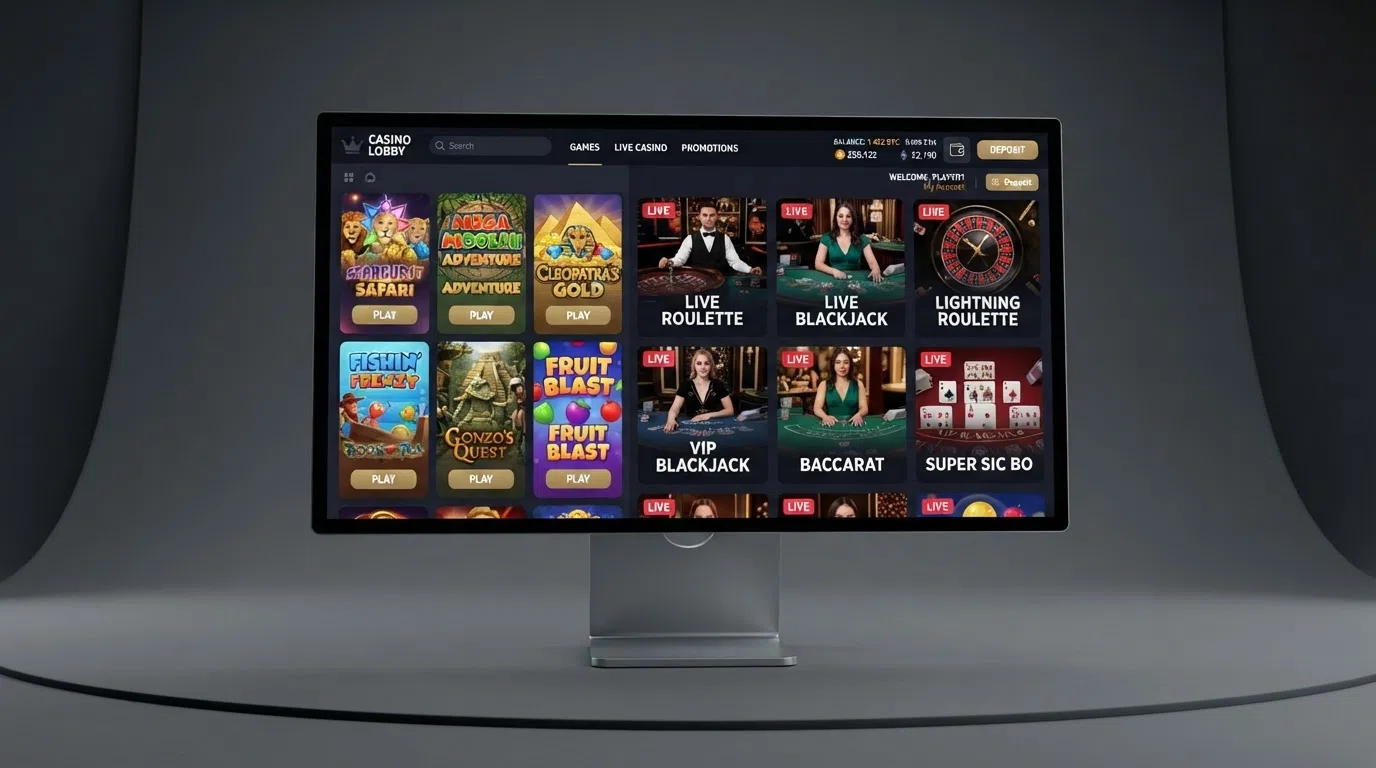
What changes at the offshore operators is the regulatory layer above the games. The UKGC’s game-design rules, in force since 31 October 2021, impose specific constraints on how slots operate: a minimum spin speed of 2.5 seconds per game cycle, a ban on auto-play, a ban on features that speed up play, a ban on “losses disguised as wins” (slot celebrations for wins smaller than the stake), a ban on reverse withdrawals, and a statutory maximum stake per game cycle that is age-banded at £5 for players 25 and over (in force 9 April 2025) and £2 for players 18 to 24 (in force 21 May 2025) under SI 2025/215. None of these rules apply at the offshore operators on this list. A slot at BitStarz, Cloudbet or BC.Game can offer auto-play, a sub-2.5-second spin speed, and a £100 stake per spin; the only ceiling is the operator’s own policy.
The practical effect for a UK player is that the offshore game floor is more permissive in every dimension the UKGC restricts. The games are the same, the maths behind them is the same, and the house edge is comparable, but the player has fewer guardrails. The £5 stake cap is the most-cited loss: a UK player 25 or over cannot place a £10 spin at a UKGC-licensed casino, but can do so at any offshore operator on this list. The 2.5-second spin speed is the subtler loss: at 1.5 seconds per spin, a player completes 40 spins per minute rather than 24, and the session budget evaporates faster. The auto-play ban removes the option to set a slot to spin a fixed number of times unattended, which is a tool some players use to enforce a session limit; offshore, the option is available.
Bitcoin Cash Slots: From Classics to Progressive Jackpots
Slot catalogues on this list range from 3,000+ at FortuneJack and Cloudbet to 14,000+ at JustCasino, and the provider mix is consistent across the range. Pragmatic Play is present at every major operator; Evolution is present for live dealer and contributes its own slot studio; Hacksaw Gaming and Nolimit City are present at the high-volatility end of the market; NetEnt and Play’n GO round out the mid-volatility range. The same game titles appear across operators, because the studios supply the same catalogue to every licensee. A player looking for a specific Pragmatic Play title like “Gates of Olympus” or a specific Nolimit City title will find it at BitStarz, Stake, Cloudbet and most of the others.
The crypto-native category that distinguishes the offshore operators from the UKGC-licensed market is provably fair originals. Stake runs the “Stake Originals” suite (Dice, Plinko, Crash, Mines, Limbo, Keno, Hilo, Wheel, Slide, Blackjack), each using a cryptographic hash that lets the player verify the outcome after the bet. BC.Game runs a similar suite under the “BC Originals” brand, with more than 75 titles. The verification model is the inverse of the UKGC’s RTS testing: instead of an accredited test house auditing the game, the player can audit each individual bet themselves. It is a different model of trust, not a higher one, and a player who values provably fair mechanics will find the category at these two operators and largely nowhere else.
UK slot stake caps do not apply at any operator on this list. The £5 cap for players 25 and over and the £2 cap for players 18 to 24 are statutory limits under SI 2025/215 that bind GB-licensed operators only, and the offshore platforms are free to accept any stake the player chooses to place. The loss of the stake cap is a real one for players who would otherwise use it as a budget enforcement tool. A player who is not confident in their own session limits will find the offshore environment more permissive than the UKGC-regulated one, and that is the design.
Live Dealer Tables and Table Games Accepting BCH
The live dealer floor at the offshore operators is powered by the same two studios that power the UKGC-licensed market: Evolution and Pragmatic Play Live. Evolution is present at Stake, BitStarz, Cloudbet, Jack, FortuneJack, MyStake, 7Bit and BetPanda; Pragmatic Play Live is present at every major operator on the list. The live games on offer are the same as the UKGC-licensed market: blackjack, roulette, baccarat, game-show titles like Crazy Time and Monopoly Live, and the standard range of side-bet variants.
A small number of operators on this list run dedicated crypto-dealer tables. BitStarz and Stake have run bitcoin and ethereum-denominated live tables in the past, though availability varies by season. The crypto-denomination is a presentation choice rather than a structural difference: the game plays identically to a fiat-denominated live table, with the same rules, the same RTP, and the same house edge. The denomination in BCH rather than GBP is a convenience for a player who does not want to think in two currencies during a hand.
The game-design rules that apply to UKGC-licensed live tables do not extend to the offshore operators. The UKGC’s auto-play ban, the 2.5-second spin speed minimum, the losses-disguised-as-wins ban, and the reverse-withdrawal ban all apply to UKGC-licensed slots and live games. The offshore operators are not bound by any of these, and the practical effect on live tables is limited (live games do not have spin speeds or auto-play in the same sense) but the absence of the reverse-withdrawal ban is the meaningful loss. A UK player at a UKGC-licensed casino cannot reverse a withdrawal request and continue playing with the funds; an offshore player can, at an operator that allows it.
The Providers Behind BCH Casino Games
The studios behind the BCH casino games are the same studios that power the UKGC-licensed market, and the player will recognise the names. Pragmatic Play is the most-cited provider on the list, present at every major operator with a full slot catalogue and a live dealer suite. Evolution supplies the bulk of the live dealer floor at every operator that runs Evolution games, including game-show titles like Crazy Time, Monopoly Live and Lightning Roulette. NetEnt, Play’n GO, Hacksaw Gaming, Nolimit City, BGaming, Betsoft, Yggdrasil, Endorphina and Microgaming round out the catalogue at the larger operators, with each studio contributing its specific catalogue of slots and table games.
What the offshore operators cannot offer is the UKGC’s regulatory layer above the provider. A UKGC-licensed casino operates under Remote Technical Standards (RTS) that require accredited test houses to verify the RNG, the RTP and the game logic of every title before it goes live. A complaint about a game’s behaviour at a UKGC-licensed operator can be escalated to the UKGC, which has the power to investigate, sanction and require remediation. A complaint about a game’s behaviour at an offshore operator can be raised with the operator’s own support team, escalated to the operator’s complaint handler, and beyond that the player’s only recourse is the courts in Curaçao or Anjouan (or, in BetPanda’s case, no jurisdiction at all).
Provably fair is the alternative model some operators offer. Stake Originals and BC.Game Originals use cryptographic hashes that the player can verify after each bet, so the outcome can be independently checked against the published hash. The verification does not cover RTP in the aggregate sense (the long-run return of the game) but it does cover the integrity of the individual outcome: the player can confirm that the result was not changed after the bet was placed. A player who trusts the cryptographic verification more than they trust the regulatory testing has a model at Stake and BC.Game that the UKGC-licensed market does not provide.
Is Bitcoin Cash Gambling Legal in the UK? The Offshore Reality
Bitcoin Cash gambling is not illegal for a UK player, but it is not licensed in Britain either. The legal architecture that governs UK online gambling is the Gambling Act 2005, extended to remote operators by the Gambling (Licensing and Advertising) Act 2014, which established the point-of-consumption regime that requires any operator serving UK customers to hold a UKGC licence. The UKGC’s three licensing objectives are preventing gambling from being a source of crime or disorder, ensuring gambling is conducted in a fair and open way, and protecting children and vulnerable persons. Cryptocurrency as a payment method is not currently authorised on UKGC-licensed platforms because it challenges the source-of-funds traceability the first objective requires and the responsible-gambling protections the third objective mandates.

The player’s legal position is straightforward. There is no confirmed penalty for a UK resident who merely gambles on an unlicensed site, and Section 33 of the Gambling Act 2005, which makes it a criminal offence to provide gambling without a licence, applies to the operator, not the player. What the player loses is the protection: no UKGC complaints route, no mandatory Alternative Dispute Resolution, no GAMSTOP coverage, no British consumer redress if funds are withheld. The legal exposure sits with the operator; the practical exposure sits with the player.
The UKGC’s enforcement model against unlicensed operators is disruption rather than blocking. Between April 2024 and June 2025 the Commission issued 3,140 disruption notices and referred 447,778 URLs to search engines, of which 287,961 were removed, with an average 32% fall in engagement across 160 disrupted sites. The model works against operators that depend on search visibility; an operator reached via a known URL or a community-shared link is not affected. The UKGC does not currently hold statutory ISP or DNS blocking powers, though legislation has been proposed.
The coming shift is the most important context for the page. The UKGC announced in February 2026, at the Betting and Gaming Council’s AGM, that it had opened an exploratory review of a potential pathway for crypto payments at licensed operators, with regulations potentially taking effect from late 2027. The parallel regulatory track is the FCA’s Financial Services and Markets Act 2000 (Cryptoassets) Regulations 2026, passed by Parliament on 4 February 2026, bringing cryptoassets within the FCA’s regulatory perimeter; the full scope of regulated activities under that regime expands from 25 October 2027. The UKGC separately raised the AML risk rating for gambling software from “low” to “medium” in August 2026, citing rising use of e-wallets, pre-paid cards and cryptoasset-linked funds in remote gambling. None of this changes the regulatory picture today, but it sets a date by which a licensed, UKGC-regulated BCH casino could plausibly exist for the first time.
Why No UKGC-Licensed Casino Accepts Bitcoin Cash
The UKGC’s current position, repeated in Commission guidance and industry coverage, is that cryptocurrency is not an authorised payment method on UKGC-licensed platforms. No GB-licensed operator accepts Bitcoin, Ethereum, stablecoins or Bitcoin Cash for deposits or withdrawals, and the regulatory rationale is the source-of-funds traceability the Gambling Act 2005’s first licensing objective requires. Crypto transactions are pseudonymous rather than anonymous, and the on-chain record is permanent, but the link between a wallet address and a verified player identity is not something the UKGC’s current supervisory model can reliably enforce. A licensed operator accepting crypto would need to verify the source of funds for every deposit, which is operationally heavier than the equivalent check on a UK bank account, and the Commission has not yet published a model that licensed operators can implement at scale.
The February 2026 exploratory review, announced by UKGC executive director Tim Miller at the BGC AGM, is the first formal step toward changing this. The review is exploratory, not committed: the Commission has not stated that crypto payments will be authorised, only that the question is being examined. Regulations potentially taking effect from late 2027 is the working timeline, and the parallel FCA track (the Cryptoassets Regulations 2026, passed on 4 February 2026, with full scope from 25 October 2027) is the regulatory foundation any UKGC crypto regime would build on. The UKGC’s August 2026 AML risk upgrade, raising the rating for gambling software from “low” to “medium” and explicitly citing crypto-linked funds, signals that the Commission is taking the risk seriously, even before the regulatory framework is in place.
The practical effect for a UK player in 2026 is that no GB-licensed casino is an option for BCH play. The choice is between offshore operators under Curaçao, Anjouan or no licence, and waiting for the UKGC to publish a workable crypto framework. While offshore operators provide immediate BCH access, they carry inherent risks that the licensed market would otherwise mitigate; the current regulatory landscape means the onus remains on the player.
Offshore Licences: What Curaçao and Anjouan Actually Mean for UK Players
The Curaçao Gaming Control Board is the most common offshore regulator on this list, and the LOK framework (the National Ordinance on Offshore Games of Hazard, in force from 2023) is the regulatory regime most of the operators operate under. The LOK framework tightened the previous master-licence regime: it requires operators to demonstrate solvency, runs basic AML checks, and requires responsible-gambling tools, but it does not impose the same level of player protection as the UKGC. There is no UKGC-equivalent Alternative Dispute Resolution scheme; there is no GAMSTOP participation requirement; there is no statutory stake cap on slots; and the Commission’s enforcement reach is limited to operators whose servers or holding companies are within Curaçao’s jurisdiction.
The Anjouan (Comoros) licence is a cheaper and newer alternative, and at least one operator on this list (BC.Game) holds one. Anjouan licences are issued faster and cost less than Curaçao LOK licences, and the regulatory requirements are correspondingly lighter. The BC.Game Anjouan licence terms specifically prohibit operators from servicing UK players, which puts a UK player using BC.Game in the awkward position of being on a platform whose own licence excludes their jurisdiction. The operator’s terms are the contract, and breaching them is a breach of the operator’s own conditions even where the player faces no direct penalty.
Costa Rica is the third category, and it is the weakest. Costa Rica does not issue gambling licences at all, and any operator stating it is “not under any domestic licensing regime” is making a literal statement: there is no domestic regulator. BetPanda is the operator on this list in that position, and the absence of a licence means the absence of a regulatory backstop entirely. There is no regulator to escalate a complaint to, no ADR scheme, and no solvency oversight. A player using BetPanda has the operator’s own word as the only assurance, and the operator’s word is the only recourse.
The common thread across all three offshore categories is the absence of the British protections a UK player may take for granted. There is no GAMSTOP participation, no UKGC complaints route, no British ADR scheme, and no recourse under UK consumer law if the operator withholds funds. The offshore licence is a real regulatory instrument in the sense that it imposes some obligations on the operator, but it is not a substitute for the UKGC’s framework, and a player who assumes otherwise has not read the small print.
GamStop, Chargebacks, and the Protections You Lose Offshore
- GAMSTOP: mandatory for every GB-licensed online operator since 31 March 2020, with exclusion periods of six months, one year, five years, or five years with auto-renewal. The scheme covers GB-licensed sites only and does not reach any offshore operator on this list.
- Chargeback rights: a debit card deposit at a GB-licensed operator can be charged back through the card issuer in cases of fraud or non-delivery, and Section 75 of the Consumer Credit Act 1974 protects card transactions over £100. A BCH wallet-to-wallet transaction carries neither protection.
- UKGC complaints and ADR: every GB-licensed operator must offer an internal complaints process and, if that fails, signpost an independent Alternative Dispute Resolution provider. Offshore operators are not required to offer ADR, and the BC.Game Anjouan terms specifically prohibit UK players.
- Financial vulnerability checks: mandatory under LCCP SR Code 3.4.4 at a £150 net deposit threshold in a rolling 30-day period (in force from 28 February 2025), using publicly available data. Offshore operators do not run these checks.
- Deposit limits and the gross deposit limit: GB-licensed operators must prompt a customer to set a financial limit before first deposit (from 31 October 2025) and offer a gross deposit limit (RTS 12, by 30 September 2026). Offshore operators offer deposit limits as a feature, not a requirement, and the limit is whatever the operator chooses to allow.
Each of these protections exists because the UKGC’s licensing regime mandates it. The offshore operators are not bound by the regime and the protections are not provided. A player who self-excludes via GAMSTOP will be blocked at every GB-licensed site but will still be able to register and deposit at any of the ten operators on this list, because none of them participate in GAMSTOP. A player who loses a dispute at an offshore operator has no UKGC to escalate to and no ADR provider to approach. The protections a UK player is used to are absent at the offshore operators, and the only backstop is the player’s own session discipline.
Staying in Control When Your Casino Has No UK Licence
Offshore casinos may offer responsible-gambling tools (deposit limits, session time-outs, self-exclusion) but the UK safety net is absent, so the player is their own backstop. The tools are operator-dependent and not mandated; some offshore casinos offer them as a feature, others offer them in name only, and the operator’s customer support is the only escalation route if a limit fails. The UKGC’s mandatory tools (deposit-limit prompts, gross deposit limits, financial vulnerability checks, GAMSTOP coverage) do not extend to the offshore operators on this list, and the only national self-exclusion scheme that does cover them is the one the player sets up directly with each operator.
The extra risk crypto adds is the volatility of the coin during play. The casino credits BCH, not pounds, and the pound value of the balance moves with the BCH price between deposit and withdrawal. A player who deposits when BCH is at $400 and withdraws when BCH is at $380 has taken a 5% loss on top of the house edge, and that loss is invisible in the casino’s reporting. The opposite is also possible (a player who deposits at $400 and withdraws at $420 has a 5% gain on top of any casino winnings), but the player has no control over the coin price and the casino does not hedge it on the player’s behalf. The risk is asymmetric in the sense that the player cannot opt out of it.
UK help resources exist regardless of where the player gambles. The National Gambling Helpline, run by GamCare, is free on 0808 8020 133 and available 24 hours a day. GamCare provides free treatment sessions using Cognitive Behavioural Therapy techniques across the UK, including remote areas like the Scottish Highlands and Islands, and the service is funded by the statutory levy on operators (1.1% of gross gambling yield for remote casino licences, in force from 6 April 2025, with 50% of the proceeds allocated to treatment). The NHS runs gambling harm clinics in England, Scotland and Wales. GambleAware provides information and support. Gamblers Anonymous runs peer-support meetings. None of these services require the player to be gambling at a UKGC-licensed site, and a player who recognises the signs of problem gambling in their own behaviour can reach any of them directly.
The Tools Offshore Casinos Offer — and the Ones They Cannot
Offshore operators may offer deposit limits, session time-outs and self-exclusion as site-level features, and the availability varies by operator. The research underlying this comparison does not carry a per-operator audit of responsible-gambling tools, so the description here is qualitative rather than operator-specific. A player who wants to set a deposit limit at an offshore casino will usually find the option in the account settings; a player who wants to self-exclude will usually need to contact customer support, and the exclusion applies to that operator only, not to the offshore market as a whole.
The UKGC baseline for comparison is more demanding. From 31 October 2025, every GB-licensed operator must prompt the customer to set a financial limit before first deposit, and decreases in the limit must take effect immediately. From 30 September 2026, a gross deposit limit must be offered, which is a hard ceiling the operator applies regardless of the customer’s stated preference. From 28 February 2025, financial vulnerability checks run at a £150 net deposit threshold in a rolling 30-day period, using publicly available data. GAMSTOP covers every GB-licensed online operator and is the national multi-operator self-exclusion scheme. None of these apply at the offshore operators on this list, and a player who values the UKGC’s framework as a guardrail will not find it offshore.
The game-design rules (auto-play ban, 2.5-second spin speed minimum, losses-disguised-as-wins ban, reverse-withdrawal ban) are also UKGC-only. The offshore operators are not bound by these rules, and a slot at an offshore casino can offer auto-play, a sub-2.5-second spin, and a reverse-withdrawal option that a UKGC-licensed casino cannot. The effect on a player’s session is real: auto-play and faster spins both increase the rate at which the session budget is consumed, and the reverse-withdrawal option removes the cooling-off period a UKGC-licensed operator is required to impose. The player who wants the UKGC’s game-design guardrails is not going to find them at an offshore operator, and that is by design.
UK Help Resources: GamCare, GAMSTOP, and the NHS
The National Gambling Helpline, run by GamCare, is the first port of call. The number is 0808 8020 133, the call is free, and the line is available 24 hours a day. GamCare also provides free treatment sessions using Cognitive Behavioural Therapy techniques, with a particular focus on remote and underserved areas of the UK including the Scottish Highlands and Islands; the expansion is part of the 2026 service delivery plan funded by the statutory levy. A player who is concerned about their own gambling or someone else’s can call the helpline directly, without going through the casino, and the call is confidential.
GAMSTOP is the national multi-operator self-exclusion scheme and is free to use. Registration blocks the player from opening new accounts or depositing at every GB-licensed online operator for the chosen exclusion period (six months, one year, five years, or five years with auto-renewal). The exclusion cannot be reversed early. The critical limitation for the offshore market is that GAMSTOP does not cover any operator on this list; a player who self-excludes via GAMSTOP and then registers at Stake or BitStarz will be able to deposit, because those operators do not participate in the scheme. The only route to self-exclusion at an offshore operator is to request it directly from the operator, and the request applies to that operator only.
The NHS runs gambling harm clinics in England, Scotland and Wales, providing specialist treatment for gambling-related harm. Referral routes vary by clinic; a GP or the National Gambling Helpline can signpost the nearest service. GambleAware provides information and support, including a self-assessment tool and a directory of local services. Gamblers Anonymous runs peer-support meetings across the UK, with both in-person and online formats. The statutory levy (1.1% of gross gambling yield for remote casino licences, in force from 6 April 2025, with 50% of proceeds allocated to treatment, 30% to prevention, 20% to research) funds a large part of this infrastructure, and the funding is tied to the licensed market, not the offshore one. A player who needs help is not required to be gambling at a UKGC-licensed site to access any of these services.
The Extra Risk Crypto Adds: Volatility on Top of the House Edge
BCH price volatility introduces a second layer of risk that the house edge does not capture. The casino credits BCH, not pounds, and the pound value of the balance moves with the BCH price between deposit and withdrawal. A player who deposits when BCH is at $400 and plays through a session with a 4% house edge has two simultaneous exposures: the 4% expected loss to the casino and the BCH price movement between deposit and withdrawal. If BCH drops 5% during the session, the player has taken a 5% loss on top of the 4% casino loss, and the combined loss is 9% of the deposit, before any win. If BCH rises 5% during the session, the player has offset some of the casino loss with a 5% coin gain, and the combined effect can be positive even on a losing session.
The volatility is not the casino’s risk; it is the player’s. The casino’s house edge is calculated in BCH, not pounds, and the casino neither gains nor loses from the BCH price movement. The player is the only party holding the coin-price exposure, and the player is the only party who can be hurt (or helped) by it. For a player with a short session (deposit, play, withdraw in under an hour), the volatility is usually small. For a player who holds a balance across multiple days, the volatility can be material.
Irreversibility is the second crypto-specific risk. A BCH transaction cannot be reversed by the sender or by any intermediary, and a withdrawal to a wrong wallet address is lost permanently. The casino’s cashier systems are designed to prevent this (the address is usually copied from the player’s verified account, not typed in), but the risk is non-zero and the player carries it alone. There is no chargeback route, no Section 75 protection, and no payment-provider dispute process for a crypto transaction. The same property that makes BCH fast (no intermediary) is what makes it irreversible, and the player trades the consumer protection for the speed.
The KYC gap is the third. Many offshore crypto casinos market “no-KYC” registration, and the marketing is accurate at the registration step: a player can sign up with an email address and deposit BCH without providing identification. The marketing is misleading at the withdrawal step: every operator on this list, including those that market themselves as no-KYC, triggers compliance checks on larger withdrawals. The threshold varies by operator; a player who wins a small amount may withdraw without verification, and a player who wins a large amount will be asked for documents. The “no-KYC” label refers to the entry point, not the exit point, and a player who assumes the withdrawal side is also KYC-free has read the marketing rather than the terms.
How We Evaluated These Bitcoin Cash Casinos
The ten operators on this list were evaluated on five criteria: licence status against the UKGC public register and the relevant offshore regulator’s database, bonus terms and wagering requirements as published on the operator’s terms pages, game-library depth and provider mix as published on the operator’s site, BCH payment speed and minimums as reported by independent review sites and the operators themselves, and the responsible-gambling tools the operator publishes. The licence check is the most important criterion, because it determines whether the operator holds a UKGC licence (none do), whether the operator is UK-restricted (several are), and whether the operator’s licence is current and verifiable against the relevant offshore regulator.
The ranking is built on the data the operators and the public sources publish, and it is not weighted by any criteria the ranking invents. The table at the top of the page lists every operator on five columns (Licence & Regulator, UKGC Status, Welcome Bonus, Wagering Requirement, Game Count) and the operator-by-operator reviews below the table add the details that do not fit the columns. The ranking compares what the operators offer, not a market a UK player might prefer, and the comparison is the comparison that exists.
The ranking’s main limitation is the absence of UKGC licensing from every ranked operator. A ranking that compared BCH casinos to UKGC-licensed alternatives would be a different document, and it would conclude that the UKGC alternatives do not accept BCH and therefore are not in the comparison. The ranking this page produces is the ranking of the operators that exist, and the reader is left to weigh the comparison against the wider market on their own terms.
What UK Players Should Actually Do About Bitcoin Cash Casinos
The numbers on this page add up to a clear trade-off, and the trade-off is the page. BCH casinos are faster and often cheaper than UKGC-licensed alternatives, and they offer larger welcome bonuses and deeper game libraries than the licensed market can match. They are also outside every British player-protection framework: no GAMSTOP, no ADR, no financial vulnerability checks, no statutory stake caps, no auto-play ban, no 2.5-second spin speed minimum, no Section 75 protection, no chargeback right. A player who wants speed and depth and has decided the regulatory framework is not worth the wait will find the offshore operators deliver on those terms. A player who values the regulatory framework above the speed and the depth will find the offshore operators do not deliver on that priority at all.
The risk arithmetic is what it is. A 300% welcome bonus at 40× wagering costs more to clear than the bonus is worth unless the player runs well above expected RTP, and “well above expected RTP” is the kind of outcome the house edge is designed to prevent. The UK statutory stake caps (£5 for 25+, £2 for 18–24) are not in force at any of the ten operators, and the spin speed, auto-play and reverse-withdrawal rules are not in force either. The protections the licensed market mandates are not provided offshore, and the player is the backstop for all of them. A player who has registered at an offshore casino and wants the UKGC’s tools is not going to find them.
The figures on a deposit and a withdrawal are not the only figures that matter. A £50 BCH deposit at an offshore casino clears faster than a £50 debit-card deposit at a UKGC-licensed site, and that is real. If a dispute arises, the UKGC site offers an internal complaints process, an independent Alternative Dispute Resolution provider, and the UKGC’s own complaints route; the offshore site offers the operator’s own customer support, with no escalation beyond the operator. The cost of the speed is the cost of the protections, and a player who weighs only the deposit and the withdrawal is not weighing the dispute that may follow.
This page rates and compares the available BCH casinos; it does not tell the reader to play or not to play, because that decision is the reader’s, and the figures are the figures. What the figures show is that the cost of playing at an offshore BCH casino is not the deposit or the wagering; it is the protections the player leaves behind. The landscape this page describes will look different in eighteen months. The UKGC’s exploratory review and the FCA’s Cryptoassets Regulations 2026 are the regulatory tracks that may bring crypto into the licensed market from late 2027, and a licensed, UKGC-regulated BCH casino is a plausible outcome of those tracks. Until then, the choice is the choice the player makes today, with the figures on this page and the framework absent from them.
BCH Payment Performance
| Casino | Min BCH Deposit | Typical Payout Speed |
|---|---|---|
| Stake | 0.001 BCH | 5–15 mins |
| BitStarz | 0.02 BCH | ~8 mins |
| BC.Game | Crypto equivalent | ~15 mins |
| Cloudbet | 0.0002 BCH | 8 mins |
| Jack | £50 equiv | 24–48h |
| FortuneJack | $50 equiv | 10 mins |
| MyStake | £20 equiv | 1–2h |
| 7Bit | Crypto equivalent | 15–30 mins |
| JustCasino | Crypto equivalent | <24h |
| BetPanda | Crypto equivalent | Instant (claims) |
Frequently Asked Questions
Can I use GamStop to self-exclude from Bitcoin Cash casinos?
No. GAMSTOP is the national self-exclusion scheme for GB-licensed online operators, mandatory since 31 March 2020, and it covers every operator that holds a UKGC licence. None of the casinos on this list hold a UKGC licence, and none of them participate in GAMSTOP. A player who self-excludes via GAMSTOP will be blocked at every GB-licensed site but will still be able to register and deposit at Stake, BitStarz, BC.Game, Cloudbet, Jack, FortuneJack, MyStake, 7Bit, JustCasino or BetPanda, because those operators are not part of the scheme. The only self-exclusion route at an offshore operator is to request it directly from that operator’s customer support, and the request applies to that one operator, not to the offshore market as a whole. A player who wants to self-exclude from offshore play needs to do it at each operator individually, and the operator’s compliance with the request depends on the operator’s own policy.
Are Bitcoin Cash casino winnings taxable in the UK?
No. Gambling winnings are not taxable for UK players, whether the winnings are in pounds at a UKGC-licensed casino or in BCH at an offshore one. The tax that applies is on the operator, not the player: Remote Gaming Duty on online casino operators rose from 21% to 40% with effect from 1 April 2026, and a statutory levy of 1.1% of gross gambling yield for remote casino licences came into force on 6 April 2025. Both of these are operator-level taxes, and neither is deducted from the player’s winnings. A player who wins BCH at an offshore casino and withdraws it to their wallet receives the full amount, with no UK tax to declare. The position is the same as for a UKGC-licensed casino; the tax treatment of gambling winnings does not depend on where the operator is licensed.
Is it safe to gamble with cryptocurrency at offshore casinos?
The honest answer is that “safe” depends on what the player is worried about. The casino’s games are the same games that run at UKGC-licensed casinos (Pragmatic Play, Evolution, NetEnt, Play’n GO), and the RNG and RTP are audited by the providers’ own test houses. The wallet-to-wallet BCH transaction is cryptographically secure and irreversible, and the network fee is negligible. The risks that the offshore operators do not address are the consumer-protection risks: there is no UKGC complaints route, no Alternative Dispute Resolution, no GAMSTOP coverage, no Section 75 protection, and no chargeback right. A player who defines “safe” as “the games are fair and the funds arrive” will find offshore BCH casinos safe; a player who defines “safe” as “there is a regulator to escalate a complaint to” will find them unsafe by definition. The right answer for a UK player is to read the consumer-protection gap as a feature of the offshore market, not a flaw to be surprised by, and to decide whether the speed and the bonuses are worth the absence of the backstop.
How do I choose a trustworthy Bitcoin Cash casino?
The first filter is the licence, and a UK player should read the offshore licence as a baseline, not an endorsement. Curaçao GCB under the LOK framework (in force from 2023) is the strongest of the three categories on this list and is the licence most of the operators hold. Anjouan is a real licence but lighter, and at least one operator (BC.Game) has it under terms that specifically exclude UK players. Costa Rica does not issue gambling licences at all, and BetPanda’s “not under any domestic licensing regime” statement is literal. The second filter is the bonus terms: a 40× wagering multiplier at BitStarz or BC.Game is four times the UKGC’s 10× cap, and the headline bonus is not as generous as the marketing suggests once the wagering is accounted for. The third filter is the withdrawal time, which is operator-controlled rather than network-controlled, and the faster operators (Stake, Cloudbet, FortuneJack) process withdrawals in ten to fifteen minutes while the slower ones (JustCasino within 24 hours, Jack reported at 24 to 48 hours) take much longer. A player who has decided to play offshore is choosing between offshore operators, and the criteria that distinguish one from another are licence strength, bonus cost, catalogue depth and withdrawal speed, in that order.
How long does a Bitcoin Cash casino withdrawal take to reach my wallet?
The on-chain settlement of a BCH transaction takes around four minutes after the operator’s processing queue releases the funds, and the network fee is a fraction of a US cent. The operator’s processing queue is where the variance lives: Stake processes in five to fifteen minutes, BitStarz in around eight minutes operator-side plus ten minutes on-chain (total around eighteen minutes), BC.Game in around fifteen minutes average, Cloudbet in around twelve minutes total, FortuneJack in around ten minutes, 7Bit in 15 to 30 minutes, MyStake in minutes to two hours, JustCasino typically within 24 hours, and Jack reported at 24 to 48 hours in practice. BetPanda describes withdrawals as “instant” though the absence of a regulatory backstop means the claim is the operator’s word only. A player who values the fastest possible withdrawal should look at Stake, Cloudbet or FortuneJack; a player who can tolerate a 24-hour window has more operators to choose from. A withdrawal requested on a Friday evening at an operator with a weekend processing gap may not complete until Monday, and that delay is the operator’s queue, not the BCH network.
Payments – trustedcasinos-notongamstop
Content created by the «trustedcasinos-notongamstop» team