
Casinos That Accept Click2Pay UK
 Available in GB
Click2Pay has not been a working payment method at any UK casino for more than a decade. The e-wallet was discontinued on 1 October 2014, the UK Gambling Commission banned credit card gambling in April 2020 (a rule that would have killed Click2Pay’s main funding route anyway), and no UKGC-licensed operator currently lists it as an accepted deposit method. What this page covers instead is what the UK’s 2,663 licensed gambling businesses do accept, which ten of them offer the best value in 2026, and why the modern alternatives (debit cards, PayPal, Trustly, Apple Pay) are faster and better regulated than the wallet that vanished.

*Data current as of September 9, 2026; licence status verified against the UK Gambling Commission public register.*
What Click2Pay Was, and Why UK Casinos No Longer Accept It
Click2Pay was an e-wallet designed to sit between a player’s bank and an online casino. You funded the wallet by credit card, debit card, or bank transfer, then deposited from the wallet to the casino. The credit card funding route carried a 3% fee; deposits themselves were instant; withdrawals typically cleared in 24 to 48 hours. For a stretch of the 2000s and early 2010s, it was a familiar name in UK cashier screens.
That model is gone. The service was discontinued on 1 October 2014. A reader landing on this page in 2026 is almost certainly looking at a search term left over from that era, or following a list of “accepted payment methods” recycled from a pre-2014 source.
A separate UK company called CLICK2PAY LIMITED (company number 13031743) was incorporated on 19 November 2020 and remains active on the Companies House register, with its next accounts due 30 September 2026. The connection between this new company and the original e-wallet service is not established in any public source. The two share a name and nothing else that the record confirms.
The credit card ban makes the question largely academic anyway. LCCP licence condition 6.1.2, in force from 14 April 2020, prohibits any UKGC licensee from accepting credit card payments for gambling, including credit-card-funded payments routed through money service businesses. Click2Pay’s signature product (a credit card funded e-wallet) would have been blocked at the casino till even if the service had survived.
How Click2Pay Worked as a Casino Payment Method
The mechanics were simple by design. Players opened a Click2Pay account, linked a funding source, and used the wallet as a buffer between the bank and the casino. Credit card funding attracted a 3% fee; bank transfer and debit card funding were free. Deposits appeared in the casino balance instantly. Withdrawals moved the other way at a slower 24 to 48 hours, slower than a direct debit card payout but faster than a wire.
The appeal was the buffer. Players who did not want their credit card number stored by a casino, or who wanted a single statement line for gambling spend, used an e-wallet. The model also let players set spending limits at the wallet level, separate from the casino’s own controls.
Both of those reasons have weaker force in 2026. UKGC licensees must verify name, address, and date of birth before any deposit or gambling, so the identity question that the e-wallet once answered is now answered by the casino. And the buffer’s purpose (separation of card from casino) matters less in a market where the casino cannot accept a credit card in the first place.
The Click2Pay Timeline: 2014 Shutdown, 2020 Company, No Return
The service was discontinued on 1 October 2014, a fact the SlotCatalog payment-method reference confirms directly: “Click2Pay is no longer operational as a consumer payment method. The original wallet service was discontinued effective 1 October 2014.” No relaunch has been announced. No press release from the original operator has surfaced in the years since. The domain that once hosted the wallet redirects to unrelated content.
CLICK2PAY LIMITED, the UK company incorporated on 19 November 2020, exists as a legal entity but carries no public connection to the discontinued e-wallet. Its registered status is active. The next accounts are due 30 September 2026. Whether it trades, what it trades in, and whether it has any consumer-facing product are not visible in the public record.
The credit card ban from 14 April 2020 would have rendered the original Click2Pay model non-viable at any UKGC casino regardless. A wallet that funded itself by credit card and deposited into a casino would have run straight into LCCP 6.1.2. The rule closes the credit-card-to-e-wallet-to-casino route the wallet relied on, so even a relaunch under a different operator would face the same ceiling.
How UK Casino Deposits Work in 2026
No UKGC-licensed casino accepts Click2Pay. Every operator on the UK register uses one or more of a smaller set of payment rails: debit card, e-wallet, mobile wallet, Open Banking bank transfer, prepaid voucher, or direct bank transfer. The set is narrower than the pre-2014 landscape but each surviving method is faster, more strictly regulated, or both.
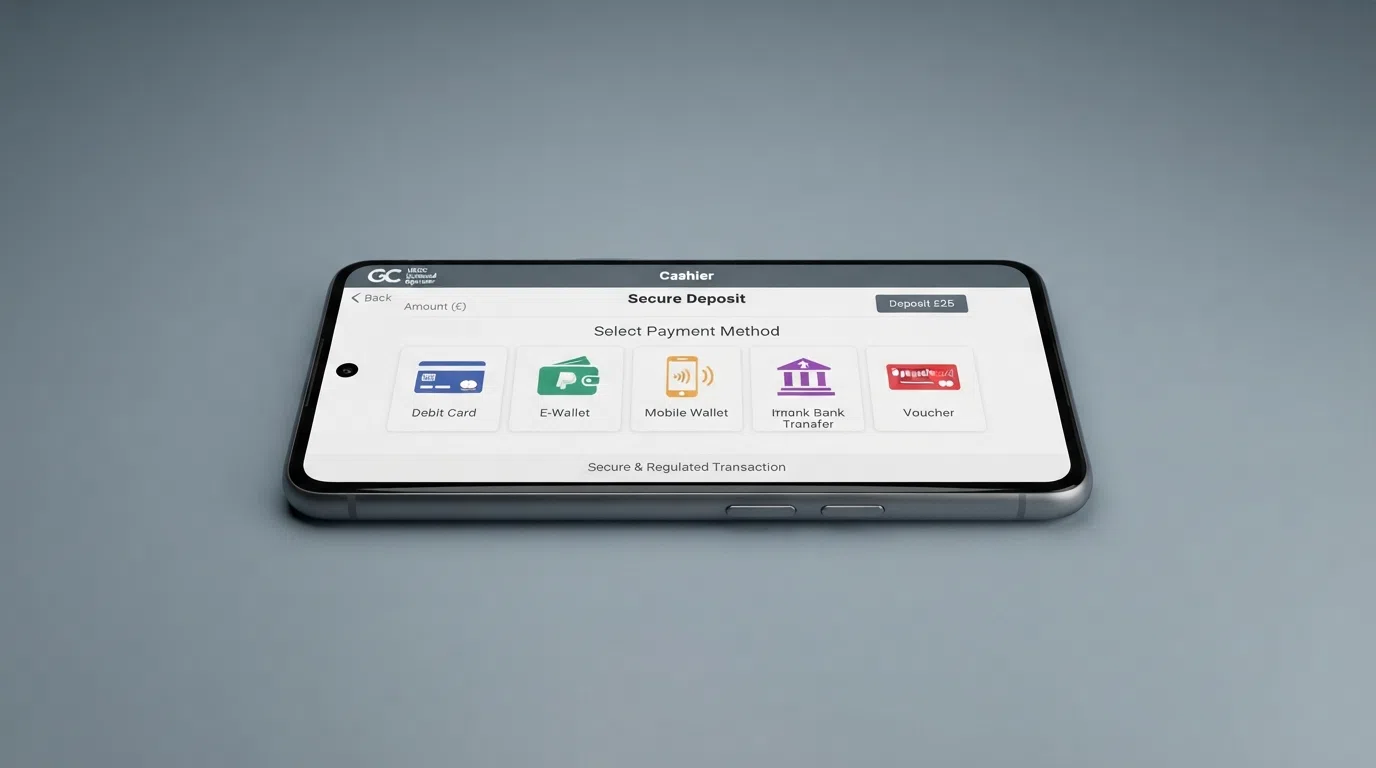
Debit cards remain the universal baseline. Visa Debit and Mastercard Debit are accepted at every operator on the UK register, deposit instantly, and carry no casino-side fee. E-wallets (PayPal, Skrill, Neteller) hold roughly 26% of UK gambling deposit share according to Paysafe research, with the caveat that several major operators (Betfred is the most prominent) have pulled out of PayPal, Skrill, and Neteller in recent years. Open Banking, branded at the cashier as Pay by Bank, Trustly, Volt, or TrueLayer, is the fastest-growing deposit route. Apple Pay is accepted at most featured operators; Google Pay less so.
Every method available in 2026 is faster than Click2Pay’s 24 to 48 hour withdrawal timeline. Debit card payouts now route through Faster Payments and typically clear in one to three working days. E-wallet payouts often complete within hours. Open Banking payouts follow the same Faster Payments rails. The wallet that vanished in 2014 has been overtaken by every method that replaced it.
Debit Cards: The Universal UK Casino Deposit Method
Every operator on the UK Gambling Commission register accepts Visa Debit or Mastercard Debit (often both). Deposits credit instantly. No casino imposes a fee on a debit card transaction; the card issuer may apply a cash-advance treatment in rare cases, but UK consumer debit cards are not credit products, so the treatment is unusual.
The minimum deposit floor sits between £5 and £20 across the featured set, with most operators clustered at £10. Betway, Betfair, and Betfred open at £5. Bet365, William Hill, Sky Vegas, Ladbrokes, Paddy Power, and Gala Bingo open at £10. 888casino sits at £20, the highest minimum in the set. The £5 to £10 cluster covers the majority of UKGC-licensed brands.
A point worth stating clearly: the £5 and £2 statutory maximum stake rules on online slots do not apply to table games, live dealer, or bingo. The cap is a product-level rule, not a payment-level one, so the deposit method has no direct interaction with it.
E-Wallets: PayPal, Skrill and Neteller for Casino Deposits
E-wallets add speed and a layer of separation between the bank and the casino. PayPal, Skrill, and Neteller are the three brands a UK player will see most often. Deposits are instant. Withdrawals usually complete within 24 hours, often inside a few hours, and that is the one durable advantage e-wallets hold over debit cards.
The catch is bonus eligibility. Some operators exclude e-wallet deposits from welcome offers. Betfair is the clearest example in the featured set: its 50 no-deposit spins plus 100 more on a £10 deposit are not available if you deposit via Skrill or Neteller. Betfred has gone further and stopped accepting PayPal, Skrill, Neteller, and Paysafecard entirely, leaving only debit card, instant bank transfer, and Apple Pay.
The trend is the warning. E-wallet acceptance at UKGC operators has narrowed, and the operators most committed to bonuses (the ones offering no-deposit spins, match bonuses, and wager-free packages) are the ones most likely to exclude e-wallet deposits from qualification. For a player choosing a payment method purely to claim a welcome offer, the answer is often debit card.
Open Banking and Pay by Bank: The Fastest-Growing Deposit Route
Open Banking payments, branded at the casino cashier as Pay by Bank, route a deposit through the player’s own banking app rather than through a card network. Trustly, Volt, and TrueLayer are the providers a UK player is most likely to see. The flow is: choose Pay by Bank, select your bank, authenticate in the banking app using Face ID, fingerprint, or passcode, confirm the deposit, and the money lands in the casino balance within seconds.
No card details are shared with the casino. The casino receives a tokenised reference from the Open Banking provider, not a card number, so the player’s debit card sits behind the bank’s authentication. Biometric confirmation has become the standard login method for the step, and Faster Payments is the rail underneath.
Open Banking is the fastest-growing deposit method at UKGC casinos in 2026. Bet365, Sky Vegas, Ladbrokes, and Betway are among the featured operators already supporting it. Withdrawal flows follow the same rails, so an Open Banking deposit can become a Faster Payments payout to the same bank account, often within hours.
Apple Pay and Google Pay: Mobile Wallets at the Casino Till
Apple Pay is the dominant mobile wallet at UKGC casinos. All ten featured operators accept it. Deposits authenticate with Face ID, Touch ID, or device passcode and credit the casino balance instantly. The card behind Apple Pay must be a debit card, because credit card gambling is banned, so the mobile wallet respects the same rule that governs every other deposit method.
Google Pay has narrower acceptance. Several featured operators do not yet list Google Pay in their deposit methods. Where it is accepted, the flow is identical to Apple Pay: confirm in the Google Pay prompt, authenticate with the device biometric, deposit credits instantly. The underlying card must be a UK debit card.
Paddy Power’s welcome offer is the clearest illustration of how mobile wallets interact with bonus terms. Its 60 no-deposit spins and 200 additional spins on a £10 deposit are only available to players who deposit by debit card or Apple Pay. Other deposit methods at Paddy Power are excluded from bonus qualification. A player depositing by Skrill or Neteller would still be able to play, but would not unlock the spins.
Minimum Deposits, Maximum Limits and Hidden Fees
UKGC licensees cannot charge a deposit fee. The cashier page for a UKGC-licensed casino will not show a fee line for any payment method; the operator absorbs the cost. The minimum deposit across the featured set is £5 (Betway, Betfair, Betfred) and the maximum is £20 (888casino), with most operators at £10.
There is no state-set maximum deposit. The Gambling Commission has not imposed a nationwide deposit ceiling, and neither has any other arm of UK regulation. What the rules do require is a customer-set limit, prompted before the first deposit. From 31 October 2025 every UKGC licensee must ask the customer to set a financial limit before processing a first deposit. Decreases to the limit take effect immediately; increases are subject to a cooling-off period. A gross deposit limit must be offered with at least equal prominence to other financial limits (RTS 12, effective 30 September 2026).
The £150 net deposit threshold for a financial vulnerability check is a separate rule, set under LCCP Social Responsibility Code 3.4.4 and in force from 28 February 2025. A player whose net deposits (deposits minus withdrawals) reach £150 over a rolling 30-day period triggers a check using publicly available data (bankruptcy, County Court Judgments, IVAs, DROs). The check is the operator’s responsibility, not the player’s, so the player does not need to provide anything unless the operator asks.
Withdrawal Times: How Fast UK Casinos Actually Pay Out
The two numbers that decide a withdrawal are the pending period and the payout rail. Every UKGC licensee operates a pending period, sometimes called a reversal period, during which the player can cancel the withdrawal. It runs up to 72 hours in principle but most featured operators sit closer to 24 hours.
Once the pending period ends, the payout moves to its rail. E-wallets (PayPal, Skrill, Neteller) typically complete within hours. Debit card withdrawals route through Faster Payments and clear in one to three working days, sometimes same day. Bank transfers follow the same Faster Payments rail. Open Banking payouts, where supported, are fastest of all and can land within minutes.
Click2Pay’s old 24 to 48 hour window has been comprehensively beaten. The slowest modern method (a pending period at the long end, then a debit card payout) takes roughly four working days, and the fastest (Pay by Bank via Open Banking) takes minutes.
Why Credit Cards Cannot Fund Any UK Casino Deposit
The credit card ban sits at the centre of every UKGC payment story. Since 14 April 2020, LCCP licence condition 6.1.2 has prohibited any UKGC licensee from accepting credit card payments for gambling, including credit-card-funded payments routed through e-wallets. The Commission’s own language is unambiguous: “an e-wallet such as Skrill, Neteller or PayPal cannot be used to launder a credit card into a gambling account.”
The rule closes the entire credit-card-to-wallet-to-casino route. Click2Pay’s original product design was credit card funding of an e-wallet, so the wallet would have been blocked at the casino cashier under this rule. A reader searching for Click2Pay in 2026 is searching for a product whose funding model has been unlawful at any UKGC casino for over five years.
The ban extends across all remote gambling, so it covers online casino, online bingo, online betting, and the National Lottery’s online products. It does not cover land-based gambling (a player can still buy a scratchcard with a credit card in a shop, although the shop can choose not to accept one), and it does not cover lottery products bought in a physical outlet. For the online casino use case this page covers, the rule is total.
Alternatives to Click2Pay: A Payment Method Comparison
| Payment Method | Deposit Speed | Withdrawal Speed | Casino Fees | Bonus Eligible | Number of Featured Operators Accepting |
|---|---|---|---|---|---|
| Visa Debit / Mastercard Debit | Instant | 1–3 working days (Faster Payments) | None | Yes (all featured) | 10 of 10 |
| PayPal | Instant | Within 24 hours, often hours | None | Varies by operator | 7 of 10 (not Betfred) |
| Skrill | Instant | Within 24 hours, often hours | None | Often excluded | 5 of 10 (not Betfred, William Hill) |
| Neteller | Instant | Within 24 hours, often hours | None | Often excluded | 5 of 10 (not Betfred, William Hill) |
| Trustly / Pay by Bank (Open Banking) | Instant (bank app authentication) | Minutes to same day | None | Yes | 6 of 10 |
| Apple Pay | Instant (Face ID / Touch ID) | Routes to debit card rail | None | Yes at most operators | 9 of 10 |
| Google Pay | Instant (biometric) | Routes to debit card rail | None | Varies | 2 of 10 |
| Paysafecard | Instant | Withdrawals not supported (prepaid) | None | Varies | 5 of 10 (not Betfred) |
| Bank Transfer | Same day to 1 working day | 1–3 working days | None | Yes | 9 of 10 |
The columns the table leaves blank (Casino Fees across the board, deposit speed across the board) are the point. Every modern method deposits instantly and free of casino charge; the only meaningful differences are withdrawal speed and whether the operator treats the deposit as bonus-eligible. Click2Pay was a credit-card-funded e-wallet offering 24 to 48 hour withdrawals and 3% credit card fees, and every row of the table beats it on speed and cost.
Top 10 UK Online Casinos — Compared and Ranked
| Operator | UKGC Licence Status | Free Spins | Wagering Requirement | Bonus Validity | Payment Methods | Signature Trait |
|---|---|---|---|---|---|---|
| Bet365 | Active, confirmed on public register | Up to 500 FS (£0.10/spin) | 0x on FS | 7 days per batch, 20 days total | 8 methods including PayPal, Skrill, Apple Pay, Trustly | Widest payment selection; spins spread across 10 games |
| William Hill | Active, evoke plc | 200 FS on Big Bass Splash (£0.10/spin) | 0x on FS; £30 max redeemable | 72 hrs to accept, 7 days to use | 4 methods | Focused single-slot offer; longest-established brand |
| Sky Vegas | Active, Flutter Entertainment | 50 no-deposit + 200 on £10 wager (£0.10/spin) | 0x on FS | 7 days | 6 methods including PayPal, Apple Pay, Trustly | Only operator with a 50-spin no-deposit headliner |
| Ladbrokes | Active, Entain plc | 100 FS (£0.10/spin) + 300 LadBucks | — | 48 hrs to accept, 7 days to use | 7 methods | Loyalty-currency hybrid; high-street heritage |
| Betway | Active, Super Group | 150 FS on Big Bass Hold & Spinner + 100% match up to £50 | 10x on match, 0x on FS | 7 days | 6 methods including PayPal, Apple Pay, Trustly | Only featured match bonus at the regulatory 10x cap |
| Betfair | Active, Flutter Entertainment | 50 no-deposit + 100 on £10 deposit | 0x on FS | — | 10 methods including Pay By Bank, Neteller, Skrill | Most payment methods; e-wallets excluded from bonus |
| Paddy Power | Active, Flutter Entertainment | 60 no-deposit (50 slots + 10 Paddy’s Mansion Heist) + 200 on £10 deposit & wager | 0x on FS | — | Debit Card, Apple Pay (bonus qualifying) | Highest no-deposit spin count; tight bonus-eligibility rules |
| Betfred | Active, Petfre Ltd | 200 FS | 0x on FS | — | Debit card, instant bank transfer, Apple Pay only | Stripped payment list; e-wallets and Paysafecard removed |
| Gala Bingo | Active, Entain plc | 100 FS on £10 slot spend (£0.10/spin) | — | 7 days to claim, 7 days to use | 7 methods | Only bingo-first brand in the set |
| 888casino | Active, evoke plc | 100% match up to £200 on £20+ deposit | 30x on match bonus | 48 hrs to claim, 90 days to use | 9 methods | Highest match-bonus cap; pre-cap wagering rate |
The order reflects bonus value, payment method breadth, and game provider diversity, not commercial arrangements. No operator paid for inclusion, and no operator on this page accepts Click2Pay (the service was discontinued in 2014). All ten were confirmed on the UK Gambling Commission public register (2,663 records as of 29 July 2026) at the time of writing.
Bet365 Casino — 500 Free Spins and the Widest Payment Selection
Bet365’s casino offer is built around volume. Deposit £10 and stake it on any qualifying game to unlock up to 500 wager-free spins, credited in batches across 20 days, ten games at a time, with each batch valid for seven days. Spin value sits at £0.10. The wagering requirement is zero on the free spin winnings, so anything won is paid as cash.
Payment breadth is the differentiator. Bet365 accepts Visa Debit, Mastercard Debit, PayPal, Skrill, Apple Pay, Trustly, Bank Transfer, and Paysafecard, eight methods and the most of any featured operator. A player who prefers Open Banking can use Trustly; a player who prefers a mobile wallet can use Apple Pay; a player who wants an e-wallet can use PayPal or Skrill. The breadth is rare in a market where operators have been trimming their lists.
For a player who values volume and payment flexibility over a single-slot focus, Bet365 is the strongest offer in the set.
Sky Vegas — 250 Free Spins, 50 With No Deposit Required
Sky Vegas is the only featured operator that opens with a 50-spin no-deposit welcome. Register an account, and 50 wager-free spins land without a deposit. Stake a further £10 on any qualifying game, and 200 more wager-free spins credit, taking the total to 250. Spin value is £0.10, expiry is seven days, and the free spin winnings carry no wagering requirement.
The brand sits inside Flutter Entertainment, alongside Betfair and Paddy Power in the featured set. Sky Vegas’s identity is closer to a slots-first product than its sister brands, and the no-deposit offer reflects that positioning.
For a player who wants to test a casino before committing money, Sky Vegas is the most accommodating opening in the set. The 50 free spins are paid as cash, with no playthrough, so any winnings are withdrawable after the standard identity check.
Paddy Power — 260 Free Spins, 60 With No Deposit Required
Paddy Power offers the largest no-deposit spin count in the featured set: 60 wager-free spins on registration (50 on slots plus 10 on Paddy’s Mansion Heist, a Paddy Power branded game), with a further 200 wager-free spins after depositing and wagering £10. Total exposure: 260 spins.
The catch lives in the bonus eligibility rules. Paddy Power’s welcome offer is only available to players who deposit by debit card or Apple Pay. Other methods are accepted at the cashier but do not trigger the bonus. A player using Skrill, Neteller, or a bank transfer for the qualifying £10 would deposit successfully but would not unlock the 200 additional spins.
For a player depositing by debit card or Apple Pay, Paddy Power offers the most generous no-deposit opening in the market. For a player who insists on an e-wallet, the offer is closed off.
Betfair — 150 Free Spins With No Wagering, 50 No-Deposit
Betfair’s welcome offer pairs 50 no-deposit spins with 100 more on a £10 deposit, all wager-free. The 10 payment methods on the cashier page (Visa, Mastercard, Apple Pay, Neteller, Skrill, MuchBetter, Paysafecard, Instant Bank Transfer, PayPal, and Pay By Bank) make it the most flexible cashier in the set.
E-wallet deposits are excluded from the welcome bonus. A player depositing by Skrill or Neteller to claim the 100 additional spins will not see them credit. The 50 no-deposit spins are available regardless of payment method, because no deposit is required, but the 100-spin package requires a qualifying payment rail.
The minimum deposit is £5, the lowest in the set alongside Betway and Betfred. For a player who pays in by debit card or Pay by Bank, the full 150-spin offer unlocks for a £5 stake. The casino sits inside Flutter Entertainment and shares operational DNA with Sky Vegas and Paddy Power, but the offer structure is its own.
William Hill — 200 Free Spins on Big Bass Splash
William Hill’s offer is the most focused in the set: 200 free spins on a single slot, Big Bass Splash by Pragmatic Play, for a £10 deposit and stake. Spin value is £0.10. Wagering is zero. Maximum winnings redeemable are capped at £30.
The 72-hour acceptance window is the tightest in the featured set, and the 7-day use window follows. A player who accepts the spins and lets them sit will lose them, which is the trade-off for a single-slot package at this scale. William Hill accepts Debit Card, Apple Pay, Instant Bank Transfer, and Paysafecard. E-wallets are not on the list.
The £30 cap is worth noting. A player who hits the maximum on a single spin will see the same winnings as a player who hits it across twenty, because the cap flattens anything above. The single-slot restriction creates a clear ceiling, though the volume itself remains high.
Betway — The Only Deposit-Match Bonus on This List
Betway is the only featured operator still offering a deposit match bonus alongside free spins. Deposit £10 or more and the casino matches it 100% up to £50, with a 10x wagering requirement on the bonus funds (the regulatory cap under LCCP SR Code 5.1.1). Alongside the match, 150 wager-free spins on Big Bass Hold & Spinner credit over three days, each spin at £0.10, no wagering on the winnings.
The 10x wagering figure is the regulatory ceiling. From 19 December 2025, no UKGC bonus may impose a wagering requirement above 10x, and Betway is at that ceiling. The free spin component, by contrast, is wager-free, so the package is two offers in one: a constrained match bonus and an open-ended free spin package.
Payment methods are six: Visa, Mastercard, Apple Pay, PayPal, Trustly, and Instant Bank Transfer. Minimum deposit is £5. The combination of a match bonus at the regulatory cap, wager-free free spins, six payment methods, and the lowest minimum deposit in the set makes Betway the strongest balance-of-features option.
Betfred — 200 Wager-Free Spins, Apple Pay Only for Non-Card Deposits
Betfred’s offer is 200 wager-free spins for a £10 stake. The free spin winnings are paid as cash. The 7-day validity window applies. The minimum deposit is £5.
The payment list is the story. Betfred accepts Debit Card, Instant Bank Transfer, and Apple Pay only. PayPal, Skrill, Neteller, and Paysafecard have been removed. The reduction is unusual in the featured set, where most operators are adding Open Banking rather than cutting e-wallets, and it is the clearest market signal in the Betfred write-up: the brand has chosen to narrow the cashier and lean on the remaining rails.
For a player who pays in by debit card or Apple Pay, the offer is competitive. For a player who prefers an e-wallet, Betfred is no longer an option.
Ladbrokes — 100 Free Spins Plus 300 LadBucks
Ladbrokes pairs 100 free spins on a £10 slot spend with 300 LadBucks, the operator’s loyalty currency redeemable against further bonuses. Spin value is £0.10. The 48-hour acceptance window and 7-day use window apply, the same structure as most featured operators. Ladbrokes accepts Debit Card, PayPal, Apple Pay, Skrill, Neteller, Trustly, and Bank Transfer, the broadest e-wallet support in the Entain group.
Ladbrokes sits inside Entain, alongside Gala Bingo and Coral in the wider group. The LadBucks element is the differentiator. A player who values loyalty-currency stacking (LadBucks convert to further bonus credit, free bets, or free spins at set exchange rates) gets a package the other featured operators do not match.
For a player who plans to stay at one operator, the LadBucks make the offer more durable than a pure free spin package. Ladbrokes rewards long-term engagement far more effectively than the average welcome offer.
Gala Bingo — 100 Free Spins for Slot and Bingo Players
Gala Bingo is the only featured operator with a bingo-first brand identity. The casino offer is 100 free spins on a £10 slot spend, spin value £0.10, on selected games only, with a 7-day claim window and a 7-day use window. The brand extends to bingo rooms, slot games, and a smaller live dealer section than the other featured operators.
Gala Bingo accepts Debit Card, PayPal, Apple Pay, Skrill, Neteller, Trustly, and Bank Transfer, a broad payment set for a brand whose primary product is bingo. Minimum deposit is £10. The casino sits inside Entain, alongside Ladbrokes and Coral in the wider group.
For a player who wants both slot spins and a bingo product on the same licence, Gala Bingo is the clearest answer. For a player who wants live dealer depth or a wider game catalogue, the other featured operators carry more.
888casino — 100% Match to £200, the Highest Bonus Cap
888casino offers the highest deposit match cap in the set: 100% up to £200 on a £20 or more deposit. The wagering requirement is 30x on the match bonus, with 48 hours to claim and 90 days to use the bonus once claimed. The 30x figure was the standard rate before the December 2025 cap; whether the operator has since moved to the 10x ceiling on the match component is a question the live terms page answers, and the page should be checked before staking.
Payment methods are nine: Debit Card, PayPal, Apple Pay, Skrill, Neteller, LuxonPay, MuchBetter, Paysafecard, and Bank Transfer. The minimum deposit is £20, the highest in the featured set. 888casino also carries the brand’s proprietary game catalogue alongside NetEnt, Pragmatic Play, and Evolution, which is the operator’s only differentiator against the other featured brands.
The 90-day bonus expiry is the longest in the set, and the highest minimum deposit filters out the low-stake player. For a player who plans to deposit at the £20 minimum or higher and wants the largest match bonus, 888casino is the strongest offer on the match component alone. For a player who wants free spins rather than a match, Betway’s 100% to £50 plus 150 wager-free spins is the cleaner package.
Why Your 2026 Casino Bonus Is Smaller Than It Looks
Three rules from late 2025 and early 2026 reshape every UK bonus. The 10x wagering cap under LCCP SR Code 5.1.1, in force from 19 December 2025, prevents the 35x to 50x playthroughs that defined the pre-2025 UK market. The mixed-product promotional ban under the same code stops an operator from conditioning a casino bonus on the player betting on sports or playing bingo, a structure that used to be common. The Remote Gaming Duty rise from 21% to 40%, effective 1 April 2026, squeezes operator bonus budgets and explains why match bonuses have all but disappeared.
The result is a market where free spins carry no wagering and match bonuses are the exception rather than the rule. Eight of the ten featured operators now run on free-spin-only welcome offers, with Betway and 888casino the two that still publish a match bonus component. The 10x cap made match bonuses uneconomical at scale, so most operators moved to wager-free free spins rather than offer smaller match bonuses with lighter wagering.
A worked example illustrates the cost. Betway’s 100% match up to £50 at 10x wagering requires a player to turnover the bonus amount ten times. At the maximum £50 bonus, that is £500 of qualifying wagers. The £5 maximum stake per spin (age 25+) means the player can clear the bonus across 100 spins at the £5 cap, or across 500 spins at the £8 minutesimumimum. At a 2.5-second minimum spin interval plus a typical 5-second inter-spin gap (7.5 seconds per spin), 500 spins take roughly 42 minutes of actual play; 100 spins at the £5 cap take about 8 minutes. The expected loss on the wagering requirement depends on the slot’s RTP, but at a typical 96% return, £500 of wagers carries a £20 expected cost on the bonus alone, before any deposit is at risk.
The calculation is a statistical estimate over many spins. A single session can land anywhere on the variance curve.
Welcome Bonuses and Deposit-Match Offers — What Is Left
Two featured operators still publish a deposit match component. Betway offers 100% up to £50 at 10x wagering, sitting exactly at the regulatory cap. 888casino offers 100% up to £200 at 30x wagering, a pre-cap rate that may have been moved to 10x on the live terms page since the figure was published.
The 10x cap explains why match bonuses have nearly disappeared. A 100% match at 10x wagering costs the operator roughly the same as a 100% match at 50x wagering, all else equal, but a player at 10x clears the bonus far faster. The faster clearing compresses the operator’s edge on the bonus funds, so the matched amount has to fall. The economics point toward small match bonuses (£20 to £50 cap) and large free spin packages, which is the shape the market has taken.
Most of the featured operators responded by dropping the match entirely. Bet365, Sky Vegas, Paddy Power, Betfair, William Hill, Betfred, Ladbrokes, and Gala Bingo all run free-spin-only welcome offers. The wager-free structure means the operator carries the cost of the free spin winnings upfront, rather than rolling the cost into a wagering multiple.
No-Deposit Free Spins: The Bonus You Get Before You Pay
Three featured operators offer no-deposit free spins as part of the welcome package. Sky Vegas offers 50 wager-free spins on registration. Paddy Power offers 60 (50 on slots plus 10 on Paddy’s Mansion Heist). Betfair offers 50. Spin value is £0.10 across the three, winnings are paid as cash with no wagering requirement, and the 7-day expiry is standard.
The no-deposit offer is the cleanest test of a casino before staking. A player can register, claim the 50 or 60 spins, play them through on the qualifying games, and withdraw any winnings as cash after the standard identity check. The check is mandatory (UKGC licensees must verify name, address, and date of birth before processing a withdrawal) and is the same check a player would face on any UKGC site.
The 50 to 60 spin range is the market ceiling for no-deposit offers among the featured operators. Anything larger usually comes with a deposit condition or a wagering multiple that the no-deposit label does not advertise. Sky Vegas, Paddy Power, and Betfair sit at the no-strings end of the spectrum.
No-Wagering Free Spins: Why UK Bonuses Let You Keep What You Win
Every featured operator offers zero wagering on free spin winnings. The pre-2025 UK market carried 35x to 50x wagering on bonus funds as the standard; the 10x cap from 19 December 2025 reduced that ceiling, and operators responded by moving most of their offers to wager-free structures.
The player-side effect is a sharp change in expected value. A wagering requirement of 35x on a £10 bonus requires £350 of qualifying wagers; at a 96% RTP slot, the expected cost of clearing the bonus is £14, so the £10 bonus carries a negative expected value to the player. A wagering requirement of 0x on free spin winnings requires no qualifying wager; whatever the free spin wins is the player’s, with the operator’s edge sitting in the difference between the spin cost and the game’s payout rate.
For a player comparing offers across operators, the wager-free structure is a meaningful win. Two offers of 100 free spins at £0.10 each are not equivalent if one carries 35x wagering and the other carries 0x; the second is genuinely worth more in expected terms, and the audit that looks at the headline numbers will not catch the gap.
Slots, Live Dealer and Table Games at UK Casinos
The UK slots market in 2026 runs on the smallest set of game-design rules in any major regulated market. The £5 per spin cap (age 25+, in force 9 April 2025) and £2 per spin cap (age 18 to 24, in force 21 May 2025) imposed by SI 2025/215 are the headline. The auto-play ban (in force since 31 October 2021) and the 2.5-second minimum spin speed are the underlying rules that change the feel of every UK slot.
Live dealer is dominated by Evolution and Pragmatic Play across the featured set. Both providers run roulette, blackjack, baccarat, and game-show variants at every operator carrying live dealer. Bingo is the Entain-family speciality (Ladbrokes, Gala Bingo, Coral) and is available as a side product at most of the other featured brands. Table games outside live dealer (RNG roulette, RNG blackjack) are available at all featured operators, with no statutory stake cap.
Demo and free-play mode is a UKGC requirement. Every UKGC licensee must offer a demo mode for slots, and the player can usually access it without registering an account. Demo mode does not pay real winnings, and it does not contribute to a bonus playthrough, but it does let a player understand a game’s mechanics and confirm the stated RTP before staking real money.
Online Slots Under the 2026 Rules: £5 Spins, No Auto-Play, 2.5-Second Minimum
The two-tier stake cap is the most unusual feature of the UK market. A player aged 25 or over can bet up to £5 per spin. A player aged 18 to 24 can bet up to £2 per spin. Two adults at the same casino, on the same slot, can face different maximum bets, because the cap is age-tiered at the licence level.
The auto-play ban removes the convenience of pre-setting a spin count. A player who used to set 100 auto-spins at £0.10 and walk away now has to press spin manually, or to use the quick-spin or turbo-spin feature where the operator offers it within the 2.5-second minimum. The 2.5-second minimum spin interval is the floor; any spin cycle shorter than 2.5 seconds is non-compliant.
Losses disguised as wins are banned. The “win” line that lights up when the spin lands a return smaller than the stake, accompanied by a celebratory sound, is prohibited. The audio and visual cues around any spin must not misrepresent the outcome. Reverse withdrawals are permanently banned; a player cannot cancel a withdrawal after requesting it, which closes the “deposit, lose, cancel, redeposit” cycle that once defined the most harmful play patterns.
The result is a slower, more deliberate slots experience. The £5 cap also compresses the upside on high-volatility titles; a player who used to spin £10 or £20 per spin on a single game cycle now has half or a quarter of that exposure, which shifts the optimal slot choice toward mid-volatility titles where the win frequency is high enough to make the lower stake meaningful.
Live Dealer and Table Games: Roulette, Blackjack and Bingo
Live dealer at UKGC casinos is dominated by Evolution and Pragmatic Play. Both providers stream from studios in Malta, Latvia, Romania, and elsewhere in the EU, with English-speaking dealers running roulette, blackjack, baccarat, casino hold’em, and game-show variants like Monopoly Live, Crazy Time, and Mega Wheel. Bet365, William Hill, Sky Vegas, Ladbrokes, Betway, Betfair, Paddy Power, Betfred, Gala Bingo, and 888casino all carry one or both providers in their live dealer lobbies.
There is no statutory stake cap on live dealer or table games. The £5 / £2 cap applies to online slots, and only online slots, so a live roulette or blackjack player is bound by the table’s minimum and maximum, not the slot cap. Live dealer minimums at UKGC casinos typically sit at £0.50 to £1, with maximums scaling up to several thousand pounds on the high-roller tables.
Bingo is the Entain speciality, with Gala Bingo and Ladbrokes carrying the full Entain bingo product. Other featured operators (Bet365, Paddy Power, Betfair) carry bingo as a side product, usually branded as a separate room with smaller prize pools. A player whose primary interest is bingo will find the deepest product at Gala Bingo, with Ladbrokes the natural Entain alternative.
Free-Play and Demo Slots: Try Before You Deposit
UKGC licensees must offer demo or free-play mode on slot games. The rule sits in the LCCP and applies to every licensee; an operator that hides demo mode behind a registration wall, or removes it from the public site, is out of compliance. In practice, every featured operator offers demo mode without registration on the bulk of their slot catalogue.
Demo mode does not pay real winnings. The game runs on the same mechanics, the same RTP, and the same volatility as the real-money version, but the balance is virtual. A player can use demo mode to confirm the stated RTP, test a bonus feature, or understand a game’s hit frequency without risking a deposit.
The 2.5-second minimum spin interval and the £5 / £2 stake cap apply in demo mode at most operators, because the underlying game client is the same client used for real-money play. A player who sets a £10 stake in demo mode will see the £5 cap enforced, which is a useful way to experience the UK-specific product design before committing real money.
Mobile Casino Deposits: Faster Than You Expect
Mobile casino deposits at UKGC operators are functionally identical to desktop. The same cashier, the same payment methods, the same minimum deposit floor, and the same instant credit to the balance. The only differences are the authentication step (biometric on mobile, password or 2FA on desktop) and the convenience of the saved card or wallet on the device.
Apple Pay and Google Pay are mobile-native and faster than the desktop equivalent. A player with Apple Pay set up can deposit at a UK casino with Face ID confirmation in a few seconds, without typing a card number. Google Pay offers the same flow on Android, with narrower acceptance at UKGC operators. Both methods require a UK debit card as the funding source, so the credit card ban is respected.
Dedicated casino apps are available from Bet365, Sky Vegas, William Hill, Ladbrokes, Betway, Paddy Power, and 888casino. The apps save payment details for one-tap repeat deposits, support biometric login, and run the same game catalogue as the desktop site. Choosing an app provides the smoothest repeat experience, while browser play avoids device storage overhead entirely.
Android Casino Deposits: Google Pay and Beyond
Android users get Google Pay at the operators that accept it (a narrower set than Apple Pay), plus every standard method: debit card, PayPal, Skrill, Neteller, Trustly, Apple Pay alternatives (Samsung Pay, where supported), and instant bank transfer. There is no OS-specific deposit gap. A player moving from iOS to Android sees the same cashier, the same methods, and the same minimum deposit.
Google Pay at UKGC casinos is accepted at fewer featured operators than Apple Pay. The Google Pay button is not always present in the cashier, even when the underlying card is supported. A player with a strong Google Pay preference should check the cashier before registering, because switching payment method after the welcome offer has been claimed is not always possible.
The same Faster Payments rail and the same Open Banking providers sit behind the methods regardless of OS. The deposit is processed by the same backend whether the player is on an iPhone, a Samsung Galaxy, or a Pixel. The OS only changes the wallet layer above.
New UK Online Casinos in 2026: What to Check Before You Join
The UK Gambling Commission public register lists 2,663 licence records as of 29 July 2026, and a steady stream of new operators enters the market each year. Newer is not automatically better, but the checks a player runs on a new brand are the same checks a player runs on any brand, and they are short.
Verify the licence. The public register at gamblingcommission.gov.uk lists every UKGC-licensed operator with the licence number, the licence type, the operating company, and the licence status. A new casino that is not on the register is operating outside the UKGC’s remit, and the protections that come with a UKGC licence (GAMSTOP, ADR, Commission complaints, British consumer redress) do not apply. The search is free and takes a minute.
Check the operating company. The licence belongs to a legal entity, not a brand, and the entity is named on the register. A new brand under a known operating company (Flutter, Entain, evoke, Super Group, Petfre) carries the same parent-company governance as the parent’s other brands. A new brand under an unknown operating company carries the unknown company’s record, which is what to assess.
Check the payment methods. The new brand’s cashier should list standard UKGC methods (debit card, PayPal, Trustly or Pay by Bank, Apple Pay) and not lean on payment rails outside the UKGC’s view. E-wallets or cryptocurrencies as the primary deposit method, with no debit card option, are a warning sign.
The 40% Remote Gaming Duty from 1 April 2026 affects new entrants more than established brands, because the higher duty rate compresses margins on smaller player bases. A new casino that offers an unusually generous welcome package relative to the established brands may be funding the package from below-cost margin, which is not a permanent state. The £150 net deposit threshold for a financial vulnerability check (in force from 28 February 2025) applies at every UKGC operator regardless of age, so the player-facing safeguard is identical at the new brand and the established one.
Your Legal Rights: UKGC Casinos vs Offshore Sites
A UKGC licence is a bundle of enforceable rights. The bundle is built from the Gambling Act 2005, the LCCP, the RTS, and a series of secondary rules, and every UKGC-licensed operator is bound by all of it. An offshore operator operates outside of the Gambling Act 2005’s oversight, with no UKGC licence to protect the player. The operator risks criminal prosecution, while the player loses all regulatory protections.
The three licensing objectives in section 1 of the Gambling Act 2005 are the framework: preventing gambling from being a source of crime, ensuring gambling is conducted fairly and openly, and protecting children and vulnerable persons. The LCCP and the RTS are the working instruments that translate the framework into specific requirements, and the public register is the audit trail. The point-of-consumption rule, in force since the Gambling (Licensing and Advertising) Act 2014, means a GB licence is compulsory for any operator taking GB players, wherever the operator is based.
The Commission does not currently hold statutory ISP or DNS blocking powers. The proposed legislation has not been enacted, so the enforcement tool is the disruption model: between April 2024 and June 2025, the Commission issued 3,140 disruption notices, referred 447,778 URLs to search engines, and saw 287,961 URLs removed, with a 32% average fall in engagement across 160 disrupted sites. The player is not prosecuted for gambling on an unlicensed site, but the player loses every UKGC protection: GAMSTOP, Commission complaints, ADR, and British consumer redress.
UKGC Licensing: What the Gambling Commission Actually Requires
The Gambling Commission is a single statutory regulator, an executive non-departmental public body sponsored by DCMS. Its remit covers Great Britain (England, Scotland, and Wales); Northern Ireland operates under separate law and is outside the Commission’s reach. The Commission issues operating licences, personal licences, and ancillary licences, and maintains the public register that lists every licensee.
A UKGC operating licence requires the operator to verify the customer’s name, address, and date of birth before any deposit or gambling, a rule in force since 7 May 2019. The check is the operator’s responsibility, not the player’s, but the player will be asked to provide the documents and may see the deposit blocked until the check completes. The same rule requires the operator to verify the payment method belongs to the player, so a deposit from a third party’s card is declined.
The LCCP and the RTS are the working instruments. The LCCP sets licence conditions and codes of practice, broken into operating licences and personal management licences. The RTS sets technical standards for remote gambling, covering game design, RNG certification, and player fund protection. Both are publicly available, both are enforceable, and both are what the audit uses to assess compliance.
The public register is the practical check. A player can search for the operator by name or licence number, confirm the licence is active, and identify the operating company behind the brand. A brand that does not appear on the register is not UKGC-licensed, and the protections described in this section do not apply.
GamStop and Self-Exclusion: How It Protects UK Players
GAMSTOP is the national multi-operator self-exclusion scheme, mandatory for every UKGC online operating licence since 31 March 2020. A player who registers with GAMSTOP is excluded from every UKGC-licensed online gambling site simultaneously, and the exclusion cannot be reversed early. The exclusion periods are six months, one year, five years, or five years with auto-renewal. If the operator does not contact the player after the exclusion expires, the exclusion continues for up to seven further years.
The scheme is online-only and licence-bound. It covers every UKGC-licensed online operator, and a self-excluded player cannot open a new account, deposit, or gamble at any of them. It does not cover land-based gambling (bookmakers, casinos, arcades) or any operator outside the UKGC’s remit. An offshore casino is not in the GAMSTOP scheme, and a self-excluded player can still create an account at one.
A self-exclusion is a serious commitment, and the design reflects that. The early-cancellation ban exists because the evidence on early reversal is that players reverse and then re-exclude at higher rates. The seven-year tail is the safeguard for players who are not contacted at the end of their chosen period, because the absence of contact is itself a signal that re-engagement is not in the player’s interest.
Offshore Casinos: What You Lose When You Play Outside the UKGC
The operator commits an offence under section 33 of the Gambling Act 2005 by accepting a GB-based player without a GB licence. The penalty is up to 51 weeks’ imprisonment, an unlimited fine, or both. The player is not criminalised, but the player loses every protection a UKGC licence provides.
What the player loses: GAMSTOP coverage (the offshore site is not in the scheme, so a self-excluded player can still create an account), Commission complaints route (the Commission will not investigate a complaint about a non-licensed operator), ADR access (the offshore site’s alternative dispute resolution body is not bound by UK rules), and British consumer redress (the player cannot bring a claim in a British court under the consumer protection framework that applies to UKGC operators).
The Commission’s enforcement tool is the disruption model, not ISP blocking. Between April 2024 and June 2025, the Commission issued 3,140 disruption notices and referred 447,778 URLs to search engines, with 287,961 URLs removed. The average engagement fall across 160 disrupted sites was 32%. The model disrupts the operator’s marketing footprint rather than the player’s access, and the player who knows where to look can still find an offshore site. The point of the model is to make the site harder to find, not impossible.
The proposed ISP and DNS blocking legislation has not been enacted. The Commission’s 2024 and 2025 consultations have signalled an intent to introduce statutory blocking, but the primary legislation is not in force. Offshore gambling remains a high-risk route without the protections of a GB licence.
Bitcoin, Crypto and Click2Pay: A Payment Path That Never Materialised
Cryptocurrency is not a UKGC-recognised or regulated casino payment method. No UKGC-licensed operator accepts Bitcoin, Ethereum, Tether, or any other cryptocurrency for gambling deposits. The closest a UK player can get is a casino that accepts a crypto deposit and pays out in GBP, but the operator behind that flow is not UKGC-licensed, and the protections described in this section do not apply.
Click2Pay was a fiat-only e-wallet. It funded from credit card, debit card, or bank transfer, and it paid out to a bank account. It had no crypto functionality, and the crypto-plus-Click2Pay hybrid that some search queries imagine never existed as a product. The two payment methods belong to different eras of online gambling: Click2Pay to the pre-2014 e-wallet boom, crypto to the post-2017 decentralised finance wave, and the two never overlapped in a UKGC-compatible product.
A player searching for “Click2Pay crypto casino” is searching for a product that was never built. The honest answer is that the original Click2Pay service is closed, the 2020 UK company is a separate entity, the credit card ban would have blocked the original model, and crypto was never part of the wallet’s design. The two payment stories are not connected.
Safer Gambling: The Tools Every UK Player Should Know
The UKGC’s safer gambling framework runs on a layered set of tools, and every UKGC licensee must offer all of them. The framework has tightened significantly in the last 18 months, and a player who registered an account in 2022 will see a different set of prompts in 2026.
Deposit limits are customer-set, with the offer mandatory. From 31 October 2025, the operator must prompt the customer to set a financial limit before the first deposit. Decreases take effect immediately; increases are subject to a cooling-off period. A gross deposit limit must be offered with at least equal prominence (RTS 12, effective 30 September 2026). Reality checks and time-out tools are available at every UKGC casino, and a player can set them in the responsible gambling section of the account settings. GAMSTOP covers all UKGC online operators simultaneously.
Financial vulnerability checks trigger at a net deposit of £150 in a rolling 30-day period, in force from 28 February 2025 under LCCP Social Responsibility Code 3.4.4. The check uses publicly available data: bankruptcy, County Court Judgments, IVAs, DROs. The check is the operator’s responsibility, and the player does not need to provide anything unless the operator asks. Financial risk assessments (the deeper affordability check) are announced but not yet commenced; the Commission’s 7 July 2026 announcement confirmed the staged rollout, with Stage 1 thresholds of £5,000 net deposits in 24 hours (age 25+) and £2,500 (under 25), and final thresholds of £1,000 to £3,000 (25+) and £750 to £2,000 (under 25). The start date is pending.
The prevalence figures frame why the framework matters. The Adult Psychiatric Morbidity Survey 2023-24 found 0.4% of adults in England experienced problem gambling (PGSI 8+) and 1.6% experienced at least moderate risk gambling (PGSI 3+). The NHS gambling clinic network, 15 clinics across England since 2019, handled 4,355 referrals in 2024/25, up from 2,284 in 2023/24. The National Gambling Helpline (operated by GamCare, on 0808 8020 133, available 24/7) takes over 52,000 calls a year. The National Gambling Support Network treated 11,960 clients in 2024/25, an 11% increase on the previous year.
A player who is worried about their own gambling, or someone else’s, can call the National Gambling Helpline on 0808 8020 133, 24/7, free and confidential. The NHS gambling clinics are free at the point of use and accept self-referrals. GambleAware (gambleaware.org) provides self-assessment tools and a treatment directory. Gamblers Anonymous UK (ga-uk.org) runs peer support groups. GAMSTOP (gamstop.co.uk) is the self-exclusion route. None of these requires the player to involve the casino.
How We Chose and Ranked These Casinos
The ranking is built from four criteria, applied uniformly across the featured set. The first is UKGC licence verification: every featured operator was confirmed on the Gambling Commission public register (2,663 records as of 29 July 2026), and the licence status is stated for each write-up. The second is bonus value, assessed on free spin count, wagering terms, no-deposit availability, and the validity window. The third is payment method breadth, scored on the number of deposit methods accepted and the inclusion of the modern rails (debit card, PayPal, Open Banking, Apple Pay). The fourth is game provider diversity, assessed on the count of proprietary and third-party studios.
No operator paid for inclusion. The ranking is editorial, and the data is sourced from the operator sites and review aggregators in August 2026. The featured set is not the full UK market; the Gambling Commission’s public register lists 2,663 licence records, of which the ten featured here are a sample. The featured brands are the strongest offers across the four criteria as of the publication date, and the list is updated when a material change occurs.
A note on what is not on this list. Click2Pay is not on this list because the service was discontinued in 2014, and no UKGC operator accepts it. Offshore operators are not on this list because the operator commits an offence under section 33 of the Gambling Act 2005 by accepting a GB-based player, and the protections this page describes do not apply at an offshore site. The featured set is a UKGC-licensed sample, ranked on the criteria described above.
What to Do Instead of Searching for Click2Pay
Click2Pay is not coming back. The service was discontinued in 2014, the credit card ban from 2020 would have blocked its funding model at any UKGC casino, and the 2020 UK company of the same name is a separate entity with no public connection to the original wallet. The honest answer to “casinos that accept Click2Pay UK” in 2026 is none, and the honest next step is to use the methods that replaced it.
Every modern alternative deposits faster than Click2Pay’s 24 to 48 hour withdrawal timeline. Debit card deposits credit instantly and payouts clear in one to three working days via Faster Payments. E-wallet deposits credit instantly and payouts complete within hours. Open Banking deposits credit instantly and payouts can land within minutes. Apple Pay deposits credit instantly via Face ID. The wallet that vanished in 2014 has been comprehensively overtaken on every dimension a player cares about.
The UKGC-regulated market in 2026 also offers stronger player protections than existed when Click2Pay was operational. Mandatory deposit limits, GAMSTOP, the 10x wagering cap, the 2.5-second spin interval, the £5 / £2 stake cap, the auto-play ban, and the financial vulnerability check at £150 net deposit in 30 days are all post-2014 features. A player who deposits at a UKGC casino today is playing under a tighter set of rules than at any point in the market’s history.
The reader’s next step: pick a payment method from the comparison table, pick a UKGC-licensed casino from the ranked list, set a deposit limit before playing, and use the free help services (National Gambling Helpline on 0808 8020 133, NHS gambling clinics, GambleAware, GAMSTOP) if the play stops being fun. The house edge does not depend on the payment method, and the player who forgets that forgets the only number that matters.
Frequently Asked Questions
What happened to Click2Pay and when was it discontinued?
Click2Pay was discontinued as a consumer payment method on 1 October 2014. The e-wallet funded casino deposits from credit card, debit card, or bank transfer, with a 3% credit card fee and 24 to 48 hour withdrawals. A separate UK company called CLICK2PAY LIMITED (company number 13031743) was incorporated in November 2020, but no public source connects it to the original e-wallet service. No UKGC-licensed casino currently accepts Click2Pay.
Can I use a credit card through an e-wallet to fund a UK casino deposit?
No. LCCP licence condition 6.1.2, in force from 14 April 2020, prohibits any UKGC licensee from accepting credit card payments for gambling, including credit-card-funded payments routed through e-wallets. The Commission’s own language is that an e-wallet such as Skrill, Neteller, or PayPal cannot be used to launder a credit card into a gambling account. The rule covers all remote gambling and closes the credit-card-to-wallet-to-casino route at every UKGC-licensed operator.
Which mobile wallets do UK casino sites accept for deposits?
Apple Pay is accepted at nine of the ten featured operators (888casino is the exception in the set, based on the public operator page). Google Pay has narrower acceptance, with no current public listing at several featured operators. Both require a UK debit card as the funding source, so the credit card ban is respected. The deposit authenticates with Face ID, Touch ID, or device passcode and credits the casino balance instantly. Standard UKGC responsible gambling rules (deposit limits, GAMSTOP, financial vulnerability checks) apply at every operator regardless of payment method.
What is the maximum wagering requirement allowed on UK casino bonuses?
Wagering requirements on UK casino bonuses are capped at 10x under LCCP Social Responsibility Code 5.1.1, in force from 19 December 2025. The pre-2025 market carried 35x to 50x wagering as the standard. Most UKGC operators responded by moving to wager-free free spins, with eight of the ten featured operators running on free-spin-only welcome offers. Betway and 888casino are the two featured operators still publishing a match bonus component, at 10x and 30x respectively, with the 30x figure a pre-cap rate that should be checked against the live terms page.
How do I check if a casino holds a real UK Gambling Commission licence?
Search the Gambling Commission public register at gamblingcommission.gov.uk. The register lists every UKGC-licensed operator with the licence number, licence type, operating company, and current status. The register is free to search, and the result either shows the operator on an active licence or it does not. A brand not on the register is not UKGC-licensed, and the protections this page describes (GAMSTOP, Commission complaints, ADR, British consumer redress) do not apply. The 2,663 licence records on the register as of 29 July 2026 cover the full UK market, and the featured operators on this page are all on it.
Is it illegal for a UK player to gamble at a casino not on GamStop?
UK law does not criminalise the player for gambling on an unlicensed site. The operator commits an offence under section 33 of the Gambling Act 2005 (up to 51 weeks’ imprisonment, an unlimited fine, or both), but the player is not prosecuted. What the player loses is every UKGC protection: GAMSTOP coverage, the Commission complaints route, ADR access, and British consumer redress. GAMSTOP covers every UKGC-licensed online operator, so a casino not on GAMSTOP is by definition not UKGC-licensed, and the player is outside the UKGC’s protective framework.
Casino Apps vs Mobile Browser: Which Is Better for Deposits?
The trade-off is storage versus speed. A dedicated casino app takes 50 MB to 200 MB of device storage (Bet365’s casino app sits at the high end of that range, with the full game client bundled in), but it saves the payment details once and reuses them on every return visit. A mobile browser site uses no storage, but the player re-enters card details on each session or relies on the browser’s autofill.
The deposit flow is the same on both. Choose the payment method, enter the amount, authenticate, and the balance credits instantly. The 2.5-second minimum spin interval and the £5 / £2 stake cap apply on both. The bonus terms are the same on both. The only difference is the authentication speed: the app uses biometric on a saved device, the browser uses the OS-level biometric on the payment method itself (Apple Pay or Google Pay) or the card’s 3D Secure step.
For a player who plays often, the app is faster on the second visit and every visit after. For a player who plays rarely, the mobile browser site is the right choice.
Payments – trustedcasinos-notongamstop
Content created by the «trustedcasinos-notongamstop» team