
Twenty Pounds, Ten Casinos, One Regulatory Net
 Available in GB
The £20 deposit tier sits in an odd place. Too steep to be the cheapest way in, too modest to be the headline offer at the biggest brands. What it gets you depends entirely on which operator you hand it to, and on whether you read the small print before the money lands.
“£20 minimum deposit” means the casino will not let you fund your account with less than that figure — or, more often, will not unlock its welcome offer unless you deposit at least £20. A lower deposit still opens the door to play, but it leaves the bonus on the table. Grosvenor’s welcome offer, for example, requires £20 to activate. Drop to £15 and you have a playable balance with no free spins and no matched funds. The rule exists because operators price their welcome packages around a number, and that number is almost always £20 or above.
The wider UK low-deposit market clusters around three thresholds: £5, £10 and £20. Each buys something different. A £5 deposit gets you through the door of any major brand with almost no friction but rarely unlocks a meaningful welcome package. A £10 deposit sits at the sweet spot for the household names — bet365, William Hill and Sky Vegas all run their headline free-spin offers off a £10 minimum. A £20 deposit steps you up into the territory where genuine matched bonuses and large free-spin bundles appear, though it also narrows your choice of operator.
Three rules shape what your £20 actually does once it lands. First, a UKGC stake cap limits every spin to £5 if you are 25 or over, or £2 if you are 18 to 24. Your twenty pounds is therefore four spins or ten spins of the bankroll, depending on your age, before the balance hits zero. Second, credit cards have been banned for online gambling since April 2020 — the only practical deposit route is a debit card, bank transfer or e-wallet funded from a debit source. Third, every UK-licensed operator must verify your identity before accepting your first deposit. There is no anonymous route. GAMSTOP coverage comes with that licence too: if you have self-excluded through the national scheme, the operator will refuse to let you in.
The good news is that these restrictions apply to every operator on this page. The bad news is the same. A level regulatory field means you cannot find a £20 casino that sidesteps the stake cap or accepts credit cards. What you can find is one whose bonus terms, payment methods and game library suit your situation — and that is what the rest of this page works through.
Data current as of September 9, 2026 and verified against the UK Gambling Commission’s public licence register.
What “£20 Minimum Deposit” Means in Practice
The mechanic is simple. The casino names a number. You meet it or you do not get the offer. Where the rule bites is when the headline bonus looks generous but the qualifying deposit quietly climbs above what the headline suggests. Grosvenor’s welcome offer advertises a 100% match — the qualifying deposit is £20. Casumo’s 50% match up to £100 also carries a £20 floor.
Operators set £20 rather than £10 because the bonus economics shift. A 100% match on £10 costs the operator £10 of bonus money plus the wagering exposure. A 100% match on £20 doubles that exposure. Some operators decide the £10 ceiling is too thin for a meaningful headline. Others use £20 as the entry threshold because it guarantees the player has enough bankroll to engage with the wagering requirement. Whatever the reasoning, the £20 floor is now the norm for matched bonus offers, and the £10 floor survives mainly among free-spin-only packages.
A regulatory change from October 2025 added another step. From that date, every GB-licensed operator must prompt a new customer to set a financial deposit limit before accepting a first deposit. You can still deposit £20 — the prompt is a choice, not a block — but you will see the limit-setting screen before the cashier opens. The Commission made the prompt mandatory because too many players were funding accounts without ever deciding what they were willing to spend.
Deposit less than £20 and the consequences vary. Some operators accept a £10 deposit but withhold the welcome offer entirely. Others let you in with a £5 deposit, allow play on real-money games, but deny the bonus and any associated free spins. A handful will accept a £5 deposit and still credit free spins — though usually with reduced volume. The point is that £20 is rarely a floor on play and almost always a floor on the bonus. Check the difference before you fund.
How £20 Compares to £5 and £10 Deposit Thresholds
The step from £10 to £20 is where the bonus maths changes. William Hill’s 200 free-spin offer on Big Bass Splash activates at £10 and carries 10× wagering on winnings with a 72-hour window — a tight deal that rewards quick play. bet365’s welcome structure, also at £10, distributes up to 500 free spins across twenty days with no wagering on winnings whatsoever — a slower burn but a cleaner one.
At £20, the offers change shape. Grosvenor adds a 100% matched deposit to the mix, doubling the starting balance. Casumo opens a 50% match up to £100, which at a £20 deposit produces only £10 of bonus funds — the ceiling is generous but the percentage punishes smaller deposits. The £20 tier is also where free-spin bundles grow: PlayKasino offers 200 free spins on Book of Dead for £20, the largest single free-spin allocation at this deposit level on the UK licensed market.
The trade-off going down to £5 or £10 is breadth. The biggest UK brands — bet365, William Hill, Ladbrokes, Coral, Paddy Power — all accept deposits from £5 or £10 and run their headline offers off those lower floors. Their brand recognition, game libraries and mobile apps are larger than the £20 specialists. A player choosing by operator reputation alone will often end up at a £10-tier brand rather than a £20 one.
The case for staying at £20 is the bonus package itself. Matched bonuses, larger free-spin bundles and occasional wager-free offers cluster around the £20 floor. The 10× wagering cap that took effect in December 2025 applies equally across all deposit tiers — that particular lever does not favour one over another — but the headline value of the offers does.
Real-Money Play at the £20 Deposit Level
Twenty pounds buys fewer spins than it used to. The UKGC’s age-banded stake cap changed the arithmetic: £5 per game cycle if you are 25 or over, £2 per spin if you are between 18 and 24. A £20 bankroll therefore translates to four spins at the higher cap or ten spins at the lower one. That is the entire session before the money runs out, which is a deliberately compressed window designed to slow play and reduce harm.
The rules around those spins are also tighter than at any point in the past. Auto-play is banned — you press the button each time. The minimum interval between spins is 2.5 seconds, so even rapid clicking hits a floor. Features that disguise losses as wins — the celebratory animation for a spin that pays back less than the stake — are banned outright. The operator must display your running session losses, wins and time played throughout.
What this means for a £20 session is that the experience is shorter and slower than the equivalent bankroll in an unregulated market. Four or ten spins is enough time to feel the volatility of a slot — a single bonus round can swing the balance — but not enough to grind through wagering at any meaningful pace. That is the point. The stake cap is designed to make high-stakes play uneconomic and to make prolonged play deliberate rather than reflexive.
The session-length reality also interacts with bonus wagering. A £400 wagering requirement at the £5 stake cap means eighty spins. At the mandated 2.5-second minimum, that is a minimum of 200 seconds of button-pressing — under four minutes — but the bonus clock usually gives you seven or thirty days. The constraint is not time but the stake-per-spin ceiling itself.
Online vs Land-Based £20 Deposit Access
Grosvenor straddles both worlds. It runs high-street casinos on UK city centres and a digital casino on the same brand. The land-based Grosvenor on your local high street will sell you a seat at the roulette table for a minimum stake that usually starts above £20. The online Grosvenor will accept your £20 and match it. The two products are different in almost every respect except the name.
Land-based UK casinos carry higher table minimums as a function of their cost base. A £5 blackjack table is vanishingly rare outside of promotional periods. Most London and major-city floors open blackjack and roulette at £10 or £15 per round, with baccarat and punto banco starting higher. Poker rooms often charge a tournament entry above £20 plus a rake. The minimum deposit concept barely applies to a bricks-and-mortar casino — what matters is the minimum stake per round, and that is consistently higher than the equivalent online threshold.
The online £20 deposit therefore offers something the land-based floor cannot: full table access from the lowest reasonable stake level, plus slot play within a bankroll that the regulator has explicitly capped at the spin level. For a player who wants an evening’s entertainment for twenty pounds, the online route is the more accommodating one by a considerable margin. The land-based alternative requires a larger bankroll to engage with at all.
Game range follows the same pattern. A high-street casino runs perhaps fifty to one hundred slot machines and a dozen or so table games. An online casino carries hundreds or thousands of slot titles across multiple providers, plus live-dealer tables streamed from studios around the world. The £20 deposit buys vastly more game-time variety online than the same twenty pounds would at a physical venue.
What to Look for Beyond the Deposit Figure
The deposit amount is the entry ticket. Whether the ticket is worth buying depends on four filters.
Licence status comes first. The UKGC public register lists every operator licensed to take remote bets from GB customers, with a status flag (active, suspended, revoked) and an account number. The register was last updated 29 July 2026. Any operator offering gambling to UK customers without an active entry on that register is operating illegally — a criminal offence under the Gambling Act 2005. The check takes thirty seconds and is the single most important step before depositing.
Bonus terms determine what the welcome package is actually worth. The headline figure — “100% match up to £20” or “200 free spins” — is the starting position. What matters is the wagering multiple (capped at 10× under LCCP since December 2025), the base it applies to (deposit plus bonus, or bonus only, or free-spin winnings only), and the expiry window. A 100% match with 10× on deposit plus bonus and thirty days to clear is a different proposition from the same match with 10× on bonus only and seven days.
Payment-method fit affects both deposits and withdrawals. Credit cards are banned. Debit cards, PayPal and bank transfers work everywhere. Some e-wallets floor at £10 or carry fees on small deposits. Withdrawal speed varies by method — e-wallets are fastest, debit cards take one to five working days. Pick a method that works in both directions.
Reputation signals round out the picture. How long has the operator been licensed? Is the bonus terms page complete and readable? Does the customer-support route include a phone line, live chat and an ADR provider? A multi-year track record on the UKGC register with no enforcement action is the background a £20 player should be looking for.
Top 10 £20 Minimum Deposit Casinos Compared: Bonuses, Terms and Real Value
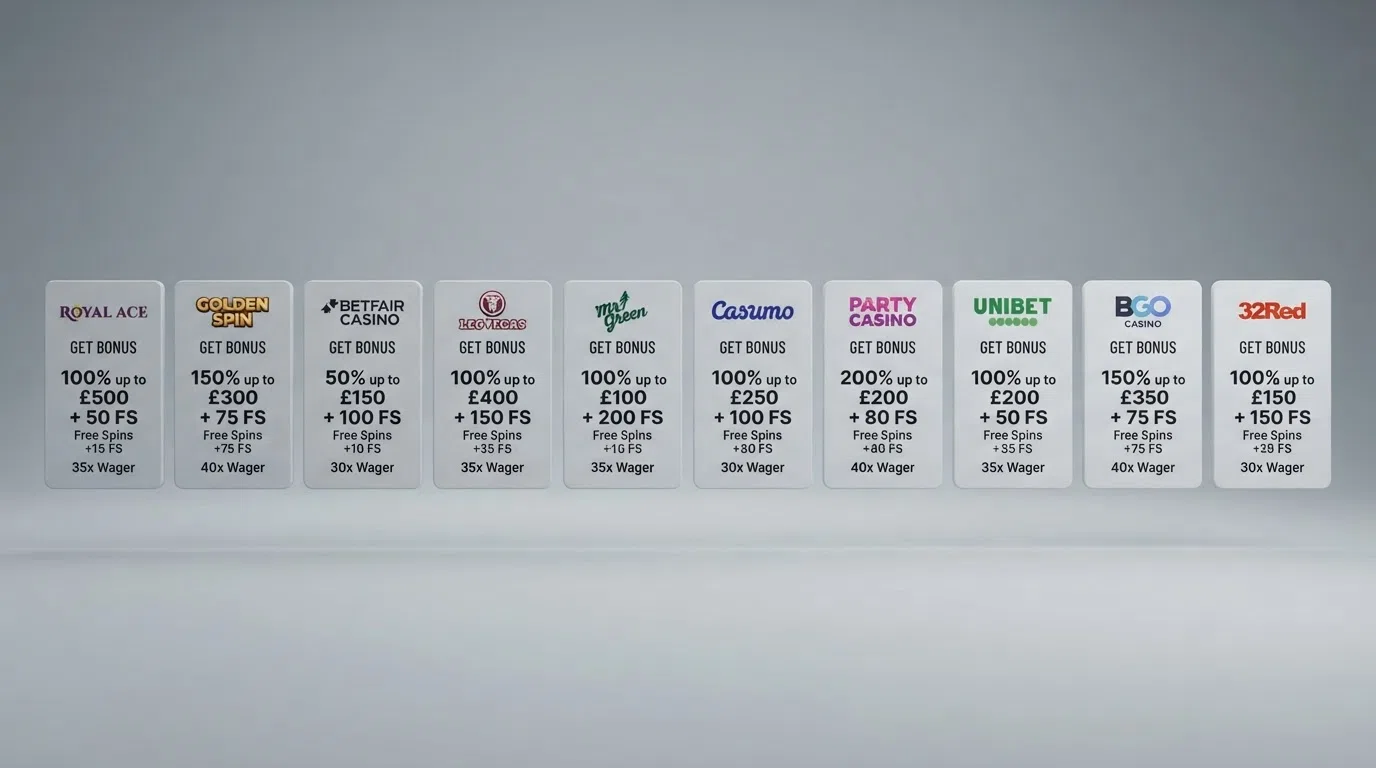
The table below ranks ten UK-licensed operators where £20 is the qualifying deposit for the welcome offer, or where the operator confirms £20 as the standard minimum deposit. Every entry holds an active UKGC remote casino licence. The ranking reflects how cleanly each operator’s £20-specific bonus is documented — operators with full terms ahead, those with sparse published detail noted but included for completeness.
| Operator | UKGC Licence | Min Deposit | Welcome Bonus | Free Spins | Wagering | Bonus Validity |
|---|---|---|---|---|---|---|
| Grosvenor Casinos | 39384 (active) | £20 | 100% match up to £20 | 100 on Big Bass Splash | 10× on deposit + bonus (£400) | 30 days |
| PlayKasino | Active (Skill on Net) | £20 | — | 200 on Book of Dead | 10× on FS winnings only | 30 days |
| GeckoPlay | 39326 (active) | £20 | — | 50 on Big Bass Bonanza | Zero (wager-free) | — |
| Regal Wins | Active (Broadway Gaming) | £20 | 100% match up to £20 | — | 10× on deposit + bonus (£400) | 7 days |
| Casumo | 45402 (active) | £20 | 50% match up to £100 | — | 10× on bonus | 7 days |
| The Vic | Active (Rank Digital Gaming) | £20 | 100% match up to £20 | — | 10× on deposit + bonus (£400) | 7 days |
| PlayUK | Active (Nektan) | £20 | — | 50 on Big Bass Football Bonanza | 10× on FS winnings | 7 days |
| SpinYoo | Active (White Hat Gaming) | £20 | — | 100 | — | — |
| Dream Vegas | Active (White Hat Gaming) | £20 | — | — | — | — |
| Casimba | Active (White Hat Gaming) | £20 | — | — | — | — |
Em-dashes in the table mark values the published terms did not surface in the materials reviewed for this page. SpinYoo, Dream Vegas and Casimba all carry a confirmed £20 minimum deposit and active UKGC licences, but the specifics of their welcome packages — wagering multiples, free-spin games, expiry windows — were not consistently documented in the sources available. The gap is real, and a reader choosing one of these three should verify the current bonus terms on the operator’s own promotions page before depositing.
The table reveals two patterns. First, the wagering burden sits at 10× across every matched-bonus operator — that is the legal ceiling, and the market has converged on it. Second, free-spin-only offers split into two camps: those with 10× on winnings (PlayKasino, PlayUK) and the rare wager-free entry (GeckoPlay). The matched-bonus offers all carry tight seven-day windows except Grosvenor’s thirty-day extension, which is the outlier and a genuine advantage for a player who does not want to rush.
Grosvenor Casinos — The High-Street Name with a Straightforward £20 Match
Grosvenor’s welcome offer is the cleanest 100% match on this list. Deposit £20, the casino matches it to £40 total balance, and you receive 100 free spins on Big Bass Splash at £0.10 per spin. The wagering is 10× on deposit plus bonus — £400 of turnover to clear — with a thirty-day expiry window that is more generous than the seven-day standard at most rivals. Maximum cashout from bonus winnings is capped at £2,000.
The maths are honest. A £20 deposit turning into £400 of required turnover is the same workload as the other 100% matches on this page, but thirty days is a long clock. A player who spreads the wagering across the full month faces a session load of about £13 of wagering per day — entirely achievable in a few short slots sessions without rushing. The £2,000 cap on cashable winnings is generous enough to be irrelevant at this deposit level; the realistic ceiling on winnings from £20 of bonus money is far below it.
What Grosvenor offers that the smaller operators cannot is brand recognition. The Rank Group has run UK high-street casinos for decades, and the digital arm carries that reputation. For a £20 player who values a familiar name over a flashier headline, Grosvenor is the balanced choice.
PlayKasino — 200 Free Spins and One of the Newest £20 Entrants
PlayKasino launched in March 2026 as a Skill on Net brand, licensed in both the UK and Malta. The welcome offer is 200 free spins on Book of Dead at £0.10 per spin — £20 of spin value total — with 10× wagering on free-spin winnings only and a thirty-day expiry. There is no percentage match bonus.
The shape of this offer rewards players who want free-spin volume without matched-fund exposure. Book of Dead runs at 96.21% RTP, slightly below the Big Bass series’ 96.71%, but the headline figure of 200 spins dwarfs every other free-spin allocation on this list except bet365’s 500. The wagering on winnings only — not on the deposit — is a lighter model than Grosvenor’s deposit-plus-bonus structure. A player who converts even a modest portion of the free spins stands to clear wagering faster.
The risk is recency. PlayKasino has been live for months at the time of this page’s review, not years. A newer licence means a shorter compliance track record. The Skill on Net platform behind it is established, which provides some operational reassurance, but a player who weighs brand longevity heavily may prefer an older operator.
GeckoPlay — The Only Wager-Free Spins Offer on This List
GeckoPlay launched in May 2025 and offers the simplest welcome package on the UK licensed market: 50 free spins on Big Bass Bonanza, with zero wagering requirements on winnings. Whatever the spins produce lands directly in the withdrawable balance. The UKGC licence number is 39326, active on the public register.
The economics of wager-free are stark. Compare to a 10×-on-winnings structure: a £5 win from a free spin under 10× wagering needs to be turned over to £50 before withdrawal, with the house edge eating into the balance at every spin. Under zero wagering, the same £5 win is yours to withdraw immediately. The house edge on the spins themselves still applies — Big Bass Bonanza runs at 96.71% RTP, so the free spins will on average return £9.67 from a £10 stake — but none of that return is locked behind further play.
The £20 minimum deposit is required to trigger the spins, but the deposit itself does not carry wagering. A player depositing £20, claiming 50 wager-free spins and withdrawing whatever the spins produce has spent £20 of real money and received the spin output minus the built-in house edge, with no further obligation. It is the closest thing the UK licensed market offers to a clean transaction.
Regal Wins — A Plain £20-for-£20 Match with a Tight Deadline
Regal Wins offers a 100% match up to £20 on a £20 minimum deposit. Ten times wagering on deposit plus bonus amounts to £400 of turnover. The expiry window is seven days.
The terms are identical to The Vic’s on the headline figures, and identical to Grosvenor’s except for the deadline. The difference is the clock: seven days to clear £400 of wagering means roughly £57 of wagering per day, achievable in short sessions but less forgiving than Grosvenor’s thirty-day equivalent. The Broadway Gaming platform behind Regal Wins is established in the UK bingo and casino space, and the licence is active, but the brand carries less name recognition than the Rank Group operators.
For a player who wants to deposit, play through the wagering and move on within a week, Regal Wins is a serviceable option. For a player who prefers a longer fuse, Grosvenor is the same offer with more breathing room.
Casumo — The Biggest Match Ceiling, but Only Half Your Deposit
Casumo’s welcome offer is a 50% deposit match up to £100 — the highest ceiling on this list. The minimum qualifying deposit is £20. The wagering is 10× on the bonus only, with a £5 maximum bet while the bonus is active and a seven-day expiry.
The maths at a £20 deposit are underwhelming. A 50% match on £20 produces £10 of bonus funds — half what a 100% match gives you. The 10× wagering applies to that £10 bonus only, so the turnover requirement is £100, lower than the £400 at Grosvenor. But the bonus value is also lower, and the seven-day clock is tight. The £5 maximum bet while the bonus is active is a standard restriction but worth noting: it prevents any attempt to clear the wagering with one or two large spins.
Casumo’s offer rewards a player who deposits more. At £200, the 50% match returns £100 of bonus and the wagering rises to £1,000 — still clearable within seven days at modest stakes. At £20, the offer is functional but not generous.
The Vic — Another Rank Group £20 Match, Shorter Fuse
The Vic is a Rank Group brand alongside Grosvenor, and the welcome offer mirrors Regal Wins in structure: £20 bonus on £20 deposit, 10× wagering on deposit plus bonus (£400 turnover), seven-day expiry. The terms page confirms the wagering and the deadline without fanfare.
What The Vic offers over Regal Wins is the Rank Group backing. Same platform, same ownership, same compliance track record as Grosvenor. What it does not offer is Grosvenor’s thirty-day expiry. A player choosing between the two Rank Group brands on a £20 deposit is choosing between a month to clear the wagering and a week to clear it. Grosvenor wins on that basis.
PlayUK — Free Spins with a Catch: You Must Wager £20 First
PlayUK’s welcome offer is 50 free spins on Big Bass Football Bonanza, but the trigger is a two-step process. You must deposit £20 and then wager £20 of your own cash on slots before the free spins credit. The wagering on free-spin winnings is 10×, with a £50 maximum redemption cap and a seven-day expiry.
The £20 cash-wager trigger is unusual. Most free-spin offers credit the spins on deposit; PlayUK requires a separate playthrough first. That adds friction — and it adds twenty pounds of real-money exposure before the bonus spins even begin. For a player whose budget is exactly £20, the trigger spends the entire bankroll before the free-spin offer activates. The £50 redemption cap is also tight: anything above £50 of free-spin winnings is forfeited.
The structure is not dishonest, but it is not generous. PlayUK is best suited to a player who was planning to wager £20 on slots anyway and treats the free spins as a rebate on that spend.
SpinYoo — 100 Free Spins, but the Small Print Is Thin
SpinYoo confirms a £20 minimum deposit and a 100-free-spin welcome offer, run on the White Hat Gaming platform. The UKGC licence is active. What the materials reviewed did not surface is the wagering multiple, the bonus slot, or the expiry window.
The gap matters. A 100-free-spin offer at 10× wagering on winnings is a different proposition from 100 free spins at zero wagering. SpinYoo is likely one or the other, but the published terms page would need to confirm which before a deposit. The White Hat Gaming platform behind it carries multiple UK-licensed brands and has a multi-year compliance record, which provides background reassurance but does not substitute for reading the specific bonus terms.
Dream Vegas — A Familiar White Hat Brand with Sparse Bonus Detail
Dream Vegas confirms a £20 minimum deposit and an active UKGC licence through the White Hat Gaming platform. The specific welcome bonus, free-spin allocation, wagering terms and expiry window were not surfaced in the materials reviewed for this page.
Dream Vegas has name recognition in the UK online casino market — the brand has been live for several years under White Hat Gaming. That track record is meaningful. But the absence of a documented £20-specific welcome offer in the sources available means a player would need to check the operator’s own promotions page for current terms before depositing. The £20 minimum is confirmed; the value proposition attached to it is not.
Casimba — £20 Entry, No PayPal, and Few Published Terms
Casimba confirms a £20 minimum deposit, an active UKGC licence, and a defined payment-method set: Visa, Trustly, MasterCard, Paysafecard, Neteller, Skrill, Neosurf and Instant Bank Transfer. PayPal is not on the list. The specific welcome bonus, free-spin allocation and wagering terms were not surfaced in the materials reviewed.
The payment-method exclusion is the most concrete fact. A player who prefers PayPal for deposits and withdrawals can rule Casimba out without checking anything else. The bonus-terms gap means the rest of the value proposition requires checking the operator’s own page. The White Hat Gaming platform behind it shares infrastructure with SpinYoo and Dream Vegas, so the operational quality is comparable across the three.
FAQ
Can I get a welcome bonus if I deposit exactly £20 at a UK casino?
Yes, many UK-licensed casinos require a minimum deposit of £20 to trigger welcome bonuses, such as matched deposits or free-spin bundles. However, others may allow smaller deposits for play while withholding the welcome offer. Always verify the qualifying terms on the operator’s promotions page before making your first deposit.
Which UK casinos accept a £20 minimum deposit via PayPal?
PayPal is widely accepted across many UK-licensed casinos, including operators like GeckoPlay. However, availability varies by brand; for example, Casimba does not offer PayPal. Always check the banking or cashier page of your chosen operator to confirm if PayPal is supported for both deposits and withdrawals before funding your account.
How does a £20 deposit casino compare to a £10 deposit casino in terms of bonus value?
A £20 deposit tier often unlocks larger matched bonuses and more extensive free-spin bundles compared to a £10 tier. While £10 casinos—often major brands—are excellent for accessibility, £20 sites frequently provide higher-value bonus structures and longer expiry windows, making them preferable if you seek a more substantial welcome package.
What free spin totals can a £20 deposit unlock?
A £20 deposit can unlock significant free-spin bundles, with some operators offering up to 200 spins on popular titles like *Book of Dead* or *Big Bass* series. The specific total depends on the operator’s current welcome package; some offer higher volumes at the £20 level to incentivise larger initial deposits.
Do recently launched casino sites give you more for a £20 buy-in?
Recent entrants, such as PlayKasino and GeckoPlay, often use generous free-spin volume or wager-free structures to compete. While they lack the long compliance track records of established brands, their bonus offers—like 200 free spins or wager-free play—can offer a fresh value proposition compared to traditional £20 matched-bonus sites.
The headline bonus figure is the starting position. What reaches your pocket depends on the wagering requirement, the base it applies to, the expiry window and the games it is locked to.
The 10× wagering cap that took effect on 19 December 2025 is the single most important number on every bonus in this market. Before that date, UK bonuses routinely carried wagering requirements of 35×, 40× or higher on deposit plus bonus. A £20 deposit matched to £40 with 40× wagering meant £1,600 of turnover before any withdrawal — a workload that took most players days of sustained play and often expired before completion. The new cap means a £20 deposit matched to £40 carries a £400 wagering requirement. The reduction is not marginal; it is the difference between a bonus that is realistically completable and one that is designed to expire.
Grosvenor’s £400 wagering on a £20 deposit plus bonus is the benchmark at this deposit level. PlayKasino’s 10× on free-spin winnings only is a lighter model: the deposit itself is not subject to wagering, so the obligation sits on whatever the free spins produce. GeckoPlay’s zero wagering is the lightest possible model — there is no obligation at all on free-spin winnings, though the spins still carry the house edge in their payout structure.
The three models produce very different workloads. A player who deposits £20 at Grosvenor and converts the bonus into £40 of playable balance must turn over £400 at the statutory stake cap — eighty spins at £5 or two hundred spins at £2 — before any withdrawal. The same player at PlayKasino must wager only the free-spin winnings, which start as a fraction of the £20 deposit and grow or shrink depending on spin outcomes. At GeckoPlay, the wagering obligation is zero.
Expiry windows cut across all three models. Seven days is tight. Thirty days is comfortable. A seven-day expiry on a £400 wagering requirement at the £5 stake cap means fifty-seven spins per day, which is manageable in short sessions but leaves no margin for a bad run. A thirty-day window cuts the daily requirement to thirteen spins, which any player can absorb.
Welcome Bonuses You Can Actually Claim with a £20 Deposit
Three bonus shapes appear across the ten operators. The 100% match up to £20 — Grosvenor, Regal Wins, The Vic — doubles the starting balance to £40 and requires £400 of wagering at the 10× cap. The free-spin-only offer — PlayKasino, GeckoPlay, PlayUK, SpinYoo — credits a bundle of spins without matched funds. The 50% match outlier is Casumo, where the ceiling is higher but the percentage means a £20 deposit only draws £10 of bonus.
What a £20 deposit does not unlock is the higher-tier welcome package. Casumo’s full £100 bonus requires a £200 deposit. Operators that run multi-tier welcome packages typically gate the top tier at £50 or above. A player with a £20 ceiling is excluded from the largest headline bonuses in the UK market by design.
The choice between the three shapes is a question of what you value. A matched bonus doubles your playable balance immediately but carries a wagering obligation. Free-spin volume at 10× on winnings is a lighter workload but ties the value to slot outcomes. Wager-free spins are the cleanest transaction but are rare — GeckoPlay is the only operator on this list offering them.
No-Deposit Bonus Offers Alongside a £20 Minimum
None of the ten featured operators currently pairs a no-deposit bonus with a £20 minimum deposit requirement. The UK licensed market has moved away from no-deposit offers, partly because the bonus-wagering cap and the mixed-product promotional ban introduced in December 2025 have tightened the economics of free-credit signups. A no-deposit bonus sits in a regulatory grey area where the wagering cap applies but the player has not deposited any funds to measure against.
This is not a gap in the market that a £20 player should expect to be filled. The structural shift toward deposit-triggered bonuses means the entry point for any welcome package is now a real-money deposit. The £20 threshold is the lowest meaningful entry point across most of the featured operators.
Bonus-Wagering Requirements at the £20 Tier
The 10× statutory cap means wagering requirements at the £20 tier now cluster in a narrow band. Grosvenor, Regal Wins and The Vic all sit at £400 of turnover for a £20 deposit plus bonus. Casumo sits at £100 of turnover for the £10 bonus only that a £20 deposit produces. PlayKasino and PlayUK sit at 10× on free-spin winnings, which is a variable quantity rather than a fixed one. GeckoPlay sits at zero.
The pre-2025 era saw wagering requirements at 35× to 50× on the same deposit sizes. The reduction from 35× to 10× is a 71% cut in the turnover burden — a structural shift that has changed what a welcome bonus is worth. A £20 deposit with a 10× wagering requirement is now a realistic proposition; a £20 deposit with a 35× requirement was not.
The base matters as much as the multiple. “10× on deposit plus bonus” at Grosvenor means the player wagers both their own £20 and the matched £20 — a £400 total. “10× on bonus only” at Casumo means the player wagers only the £10 of bonus funds that the 50% match produces — a £100 total. The headline number (10×) is the same, but the workload is four times larger at Grosvenor because the base is four times larger.
Bonus and Deposit Combinations That Maximise Value
The expected-loss calculation is the real measure of what a bonus costs. At Grosvenor, the £400 of required turnover at Big Bass Splash’s 96.71% RTP produces an expected loss of about £11.69 — the house edge applied to the wagering volume. That is the statistical cost of clearing the bonus, averaged across many players and many spins.
At GeckoPlay, the expected loss on the wagering itself is zero because there is no wagering. The house edge still applies to the free spins — fifty spins at £0.10 with a 96.71% RTP returns about £4.84 on average — but that loss is paid by the spin outcomes, not by additional wagering.
At PlayKasino, the 10× on free-spin winnings creates a second-order cost. Two hundred spins at £0.10 on Book of Dead (96.21% RTP) returns about £19.24 on average. That return then faces 10× wagering — roughly £192 of additional turnover at 96.21% RTP, producing an expected additional loss of about £7.25. The total expected cost is higher than GeckoPlay’s but lower than Grosvenor’s because the wagering base (winnings only) is smaller.
The conclusion is uncomfortable for matched bonuses. GeckoPlay’s wager-free structure is the cheapest path to withdrawable funds at this deposit level. Grosvenor’s matched bonus is the most expensive, despite carrying the same 10× wagering cap. The difference is the base — deposit plus bonus versus winnings only versus zero.
How You Actually Get Money In and Out at a £20 Deposit Casino
Payment methods at UK-licensed casinos converge on three families: debit cards, e-wallets and bank transfers. Credit cards are banned for gambling since April 2020, and that ban extends to credit-card-funded e-wallet payments. Anonymous play is not possible — identity must be verified before the first deposit.
Debit cards are the universal baseline. Every operator on this page accepts Visa and MasterCard debit. Deposits land instantly. Withdrawals take one to five working days depending on the bank. Some banks block gambling transactions by default and require the customer to opt in through their banking app.
PayPal availability varies. GeckoPlay accepts PayPal. Casimba does not. The other eight operators’ PayPal status was not fully documented in the materials reviewed, though PayPal is widely supported across the UK licensed market. A PayPal deposit funds the casino account from your PayPal balance, which in turn must be funded from a debit source — the credit card ban extends through this chain.
Paysafecard, the prepaid voucher, works at most operators for deposits. Casimba lists it alongside Neteller, Skrill, Neosurf and Instant Bank Transfer. Paysafecard is deposit-only — you cannot withdraw to a Paysafecard voucher — so a player funding with Paysafecard needs a separate withdrawal method.
Pay-by-phone (Boku) deposits are available at some UK-licensed operators, though the £20 threshold is at the upper end of what Boku carriers typically accept. Boku deposits carry a per-transaction fee and a daily cap. They are best suited to small, one-off deposits rather than a regular funding method.
PayPal Casinos Accepting a £20 Minimum Deposit
PayPal’s appeal at the £20 deposit level is the combination of speed and separation. Deposits land instantly. Withdrawals are typically processed within twenty-four hours — faster than debit card withdrawals. The casino never sees your bank details, only your PayPal account identifier. Buyer protection does not extend to gambling transactions, but the privacy advantage is real.
Among the ten featured operators, GeckoPlay confirms PayPal acceptance. Casimba confirms it does not offer PayPal — its payment set runs through Visa, Trustly, MasterCard, Paysafecard, Neteller, Skrill, Neosurf and Instant Bank Transfer. For the remaining eight operators, PayPal availability should be checked on the operator’s banking page before depositing if PayPal is the preferred method.
Pay-by-Phone and Alternative Deposit Options at £20
Pay-by-phone (Boku) deposits work by adding the deposit amount to your mobile phone bill. The mechanics suit small deposits — typically £5, £10 or £15 — and the £20 ceiling sits at the top of what most Boku carriers process. A £20 pay-by-phone deposit is possible at some operators but may trigger a per-transaction fee that erodes the value.
Paysafecard vouchers work in the opposite direction. You buy a voucher at a retail outlet with cash, redeem the sixteen-digit code at the casino cashier, and the deposit lands. Paysafecard is deposit-only — withdrawals require a different method. The £20 voucher is a common denomination and works seamlessly at operators that accept it, including Casimba.
E-wallets (Skrill, Neteller) carry their own restrictions. Some casinos exclude e-wallet deposits from bonus eligibility — check the bonus terms before funding through Skrill or Neteller if a welcome package is the goal. The credit card ban extends to credit-card-funded e-wallet payments, so the e-wallet balance must originate from a debit source.
Deposit and Withdrawal Speed at the £20 Level
Deposits land instantly across every method. The variable is the withdrawal.
Debit card withdrawals take one to five working days, depending on the issuing bank. Some banks process faster; others impose an internal review period. E-wallet withdrawals (PayPal, Skrill, Neteller) are typically processed within twenty-four hours by the operator, then land in the e-wallet account immediately. Bank transfer withdrawals sit between the two.
The identity-verification gate sits before any withdrawal. Since May 2019, UK-licensed operators must verify name, address and date of birth before accepting a first deposit. The same verification applies to withdrawals — a player who deposited without full verification will be asked to supply documents before the first cashout. Passport, driving licence and a recent utility bill are the standard requirements.
The reverse-withdrawal ban, in force since October 2021, means a player cannot cancel a withdrawal and return the funds to the casino balance. Once a withdrawal is requested, it must be processed. This closes a behavioural loophole where players would cancel withdrawals to keep playing with funds they had already mentally committed to cashing out.
Payment-Method Compatibility and Limits
Method-specific minimum deposits vary by operator. Some e-wallets floor at £10. Paysafecard vouchers come in fixed denominations (£10, £20, £25, £50 and upwards), so a £20 deposit is a natural fit. Debit cards generally have no method-specific minimum above the operator’s overall minimum.
The customer-set deposit limit interacts with payment choice. A player who sets a £20 weekly deposit limit at a £20-minimum casino will fund exactly once per week before hitting the ceiling. A player who sets a £20 monthly limit will deposit once and wait. The mandatory limit prompt introduced in October 2025 forces this decision before the first deposit.
The £150 net deposit vulnerability check is a separate system. It triggers an automated check using publicly available financial data (bankruptcy orders, county court judgments, IVAs) when a player’s net deposits cross £150 in a rolling thirty-day period. The check does not block deposits — it surfaces a flag for the operator to review. It is not a payment-method limit.
£20 Deposits on Mobile: What the Apps Actually Deliver
Mobile play at a £20 deposit casino is functionally identical to desktop play under UK regulation. The stake caps apply regardless of device. The game-design rules (no auto-play, minimum 2.5-second spin interval, mandatory session display) apply to mobile interfaces as they do to desktop. A spin on a phone costs the same £5 or £2 as a spin on a laptop.
What differs is the delivery channel. Dedicated apps offer push notifications, biometric login and a streamlined deposit flow. Mobile-browser play requires no download, updates automatically and works on any device with a modern browser. Both channels carry the same game library in most cases, though some older games may be desktop-only.
The £20 deposit flow works identically on both channels. The cashier, the deposit-limit prompt, the identity verification — all appear in the same sequence. The deposit lands instantly on either channel.
Mobile Casino Apps Supporting £20 Minimum Deposits
The Skill on Net brands (PlayKasino, GeckoPlay) typically offer dedicated iOS and Android apps. The White Hat Gaming brands (SpinYoo, Dream Vegas, Casimba) do the same. The Rank Group brands (Grosvenor, The Vic) have long-standing mobile apps. Casumo maintains a mobile app across both platforms.
App availability is best confirmed by searching the operator’s name in the Apple App Store or Google Play Store directly. App ratings and recent reviews provide a signal of operational quality, though ratings can be gamed and should be read alongside the UKGC compliance record.
Mobile-Browser vs Dedicated-App Experience at £20
The trade-off is convenience against features. A dedicated app offers push notifications for bonus offers, biometric login for faster access, and a deposit flow tuned for mobile screens. It also requires storage space, manual updates and an app-store approval process that can delay new features.
A mobile browser requires no download. The casino loads through the device’s browser, typically as a progressive web app that behaves like a native application. Updates deploy instantly without user action. Storage space is not consumed. The trade-off is slightly slower load times and the absence of push notifications.
For a £20 player depositing occasionally, the browser experience is sufficient. For a player who logs in daily, the app’s push notifications and biometric login save meaningful friction.
Mobile-Specific Bonuses at the £20 Deposit Tier
None of the ten featured operators runs a mobile-exclusive bonus at the £20 deposit level. The UK regulatory framework — the LCCP and the 10× wagering cap and the mixed-product ban — applies equally across all channels. A bonus offered on mobile must be offered on desktop at the same terms. A mobile-only free-spin bundle would require separate terms pages, separate tracking and separate compliance reviews, which most operators judge not worth the operational cost.
This is unlikely to change. The regulatory architecture does not differentiate between channels, and the market has settled on channel-agnostic bonus terms. A £20 player should not expect a mobile-only sweetener at any of the featured operators.
The Slots Worth Playing with a £20 Bankroll
Four slot titles appear as bonus games across the ten featured operators, and all four carry RTPs in a narrow band between 96.21% and 96.71%.
| Slot Title | RTP |
|---|---|
| Big Bass Splash | 96.71% |
| Big Bass Bonanza | 96.71% |
| Big Bass Football Bonanza | 96.71% |
| Book of Dead | 96.21% |
The Big Bass series dominates the bonus-slot landscape at this deposit level. Three of the four featured bonus slots come from Pragmatic Play’s fishing-themed franchise, each running at the same 96.71% RTP. Book of Dead, from Play’n GO, sits slightly lower at 96.21% but remains one of the most recognisable high-volatility slots in the UK market.
Slot Titles with the Best RTP at a £20 Stake Level
The RTP spread across these four titles is half a percentage point — meaningful over thousands of spins, almost invisible over a single session. A £20 bankroll at the £5 stake cap produces four spins. At the £2 cap, ten spins. In neither case does the RTP have time to express itself. The difference between 96.21% and 96.71% over ten spins is a matter of pennies in expected return.
What RTP does tell you is the long-run cost of play. If you deposited £20 every week for a year and wagered the same volume each time, the 0.5% RTP gap between Book of Dead and the Big Bass titles would compound into a small but real difference in total return. Over a single session, the gap is noise.
The better question for a £20 player is volatility, not RTP. High-volatility slots concentrate payouts into rare bonus rounds — a single feature trigger can return fifty times the stake. Low-volatility slots pay smaller amounts more frequently. With only four or ten spins in a session, high volatility is the only structure that gives the bankroll a chance of a memorable outcome. The Big Bass series runs at medium-to-high volatility. Book of Dead runs at high volatility.
Dedicated Slot Sites with £20 Minimum Deposits
The featured operators all carry substantial slot libraries, though none is exclusively a slot site. Casumo and Grosvenor run broader casino products. PlayKasino and GeckoPlay lean slots-heavy within the Skill on Net template. White Hat Gaming brands (SpinYoo, Dream Vegas, Casimba) carry the deepest game libraries, often exceeding one thousand titles across multiple providers.
For a slots-focused player, the relevant comparison is library depth and provider mix, not the deposit minimum. A slots-first brand may carry more titles, but the £20 deposit threshold and the bonus terms attached to it are the primary economic factors. The library is a secondary differentiator.
Slot Providers and RTP at the £20 Tier
The major providers behind the featured operators’ bonus slots are Pragmatic Play (Big Bass series) and Play’n GO (Book of Dead). Both run RTPs in the 96% range, which is the industry standard for modern online slots. Lower-RTP slots exist in the 92%–94% range and should be avoided for bonus wagering where possible, since the higher house edge extends the cost of clearing the requirement.
RTP is published in each game’s information or paytable panel, usually behind a question-mark icon. The number is a long-run theoretical figure — the return the game is programmed to deliver over millions of spins. A £20 session at £2 or £5 per spin is too short for RTP to express.
Online Slots vs Other Games at This Deposit Level
Slots dominate the £20 deposit conversation because the regulatory architecture centres on slots. The stake cap, the spin-speed minimum, the auto-play ban and the session-display rules all apply to online slots. Table games and live casino operate under different rules, with no statutory per-round cap.
Live casino games (live-dealer blackjack, roulette, baccarat) carry higher minimum stakes per round than slots. A £5 blackjack table is achievable at some operators, but most live-dealer floors open at £10 or higher. A £20 bankroll buys two or four rounds at those levels, which is not enough for a meaningful session. Standard RNG table games (virtual roulette, blackjack) carry lower minimums and a lower house edge than slots — European roulette sits at 2.7%, blackjack can be below 1% with optimal play — but the stake-cap architecture was designed around slots, not tables.
For a £20 player who wants the lowest house edge, European roulette or blackjack with optimal strategy offers a better long-run return than any slot. The catch is that the wagering requirements on welcome bonuses typically exclude table games or contribute at a reduced rate (often 10% of slots). A player clearing a Grosvenor bonus through blackjack wagering would need to wager £4,000, not £400, to meet the same requirement.
How to Pick a £20 Deposit Casino That Works for You
The deposit figure is the entry ticket. Whether the ticket is worth buying depends on four filters applied in sequence.
Licence status is the first and most important. Every operator on this page holds an active UKGC remote casino licence, confirmed on the public register. That fact eliminates a category of risk — no GAMSTOP gaps, no ADR absence, no fund-segregation failures. But it does not eliminate the second-order question: which licensed operator offers the best terms for your specific situation.
Bonus terms are the second filter. The headline figure (100% match, 200 free spins, 50% match up to £100) is the starting position. The wagering multiple (10× across the board), the base it applies to (deposit plus bonus, bonus only, or winnings only) and the expiry window (seven or thirty days) determine what the bonus is actually worth.
Payment-method fit is the third filter. PayPal availability, debit-card compatibility and withdrawal speed vary by operator. A player whose preferred method is PayPal can eliminate Casimba immediately. A player who needs fast withdrawals may prefer e-wallet-supporting operators.
Reputation is the fourth filter. Length of UKGC licensure, absence of enforcement action, completeness of published terms and customer-support availability all contribute. The Rank Group brands (Grosvenor, The Vic) carry the longest track record. The Skill on Net brands (PlayKasino, GeckoPlay) are newer but backed by an established platform. The White Hat Gaming brands (SpinYoo, Dream Vegas, Casimba) sit in between.
Low vs Lowest Deposit Thresholds Compared
The £10 tier is where the major UK brands compete. bet365’s welcome structure activates at £10 lifetime deposits and distributes up to 500 free spins with no wagering on winnings. William Hill Vegas offers 200 free spins at £10 with 10× wagering on winnings within seventy-two hours. These are the offers that dominate the SERPs for “minimum deposit casino” because the major brands have built their welcome packages around the £10 floor.
The £20 tier buys different value. Matched bonuses, larger free-spin bundles and wager-free offers cluster around £20. The trade-off is that the £20 tier excludes the largest UK brands (whose offers activate at £10) and includes operators with smaller brand recognition but potentially better bonus terms for the £20 deposit specifically.
The case for staying at £20 is bonus value. The case for dropping to £10 is brand quality and market share. A player choosing between them should decide whether they value a familiar brand name or a more generous welcome package.
What to Check Beyond the Deposit Figure
- UKGC licence status — search the operator’s name or account number on the public register; the status should read “active” and the licence type should be “Remote Casino.”
- Wagering multiple and base — 10× is the legal ceiling; any offer above 10× is non-compliant. The base (deposit plus bonus, bonus only, free-spin winnings only) determines the workload.
- Withdrawal processing and any caps — debit card withdrawals take one to five working days; e-wallets are faster. Some bonuses carry maximum cashout caps (Grosvenor’s £2,000, PlayUK’s £50).
- Customer-support availability and ADR coverage — every GB-licensed operator must offer an alternative dispute resolution provider. Live chat, email and phone support are the standard channels; the ADR route is the escalation path if those fail.
Trade-Offs of Picking the Cheapest Deposit Tier
The cheapest deposit is not always the best deal. A £5 deposit gets you into any major brand but rarely unlocks a welcome package. A £10 deposit unlocks the major-brand welcome offers (bet365, William Hill, Sky Vegas) but typically with free-spin structures rather than matched bonuses. A £20 deposit unlocks matched bonuses and larger free-spin bundles at the cost of excluding the major-brand offers.
The operator pool narrows at each step down. At £5, almost every UK-licensed operator is available. At £10, the major brands are fully available but some smaller operators impose £20 floors. At £20, the pool concentrates on operators whose welcome packages are explicitly priced at that threshold — Grosvenor, PlayKasino, GeckoPlay, Regal Wins, Casumo, The Vic, PlayUK, SpinYoo, Dream Vegas, Casimba.
Payment-method availability follows the same gradient. All ten featured operators accept debit cards. PayPal availability narrows: GeckoPlay confirms PayPal, Casimba confirms it does not, the rest require checking. Pay-by-phone (Boku) works at some operators but often caps below £20.
The £20 sweet-spot argument is that the bonus package is meaningful — a matched bonus at 100% produces £40 of playable balance — while the wagering requirement remains completable at £400 of turnover under the 10× cap. The £5 and £10 tiers offer access but less bonus value per pound deposited.
A Practical Checklist for Comparing £20 Deposit Casinos
- Is the operator on the UKGC public register? Search the register by name; confirm the licence type is “Remote Casino” and the status is “active.”
- What is the wagering multiple and on which base? 10× is the legal ceiling. “On deposit plus bonus” produces the largest workload; “on bonus only” or “on free-spin winnings only” is lighter.
- What is the bonus expiry window? Seven days is tight; thirty days is comfortable. A short window combined with a large wagering requirement is a structural pressure.
- Which payment methods are available, and are any blocked? PayPal, debit cards and bank transfers are standard. Credit cards are banned. Some e-wallets exclude bonus eligibility.
- Does the operator participate in GAMSTOP? Every GB-licensed operator does. If the operator does not appear on GAMSTOP, it is not GB-licensed.
New £20 Minimum Deposit Casinos: What the Latest Entrants Bring
Two of the ten featured operators launched in 2025 or 2026. PlayKasino went live in March 2026 as a Skill on Net brand. GeckoPlay launched in May 2025, also on the Skill on Net platform. Both hold active UKGC licences.
The new entrants’ offers reflect the post-2025 regulatory landscape. The 10× wagering cap removed the wild-west bonus era where operators competed on wagering multiples. New entrants cannot offer 35× or 50× wagering as a differentiator — the cap is the same for everyone. So they compete on spin volume and wager-free structures instead. PlayKasino’s 200 free spins are the volume play. GeckoPlay’s 50 wager-free spins are the quality play.
The Remote Gaming Duty increase from 21% to 40%, effective 1 April 2026, adds cost pressure that may affect bonus generosity over time. Operators now pay 40p in duty for every pound of gross gambling yield — up from 21p. The margin available for bonus offers, free-spin volume and promotional credits has compressed. New entrants launching after this date are pricing their welcome packages against a tighter margin than the pre-2026 market.
Recently Launched £20 Deposit Casinos Worth Watching
PlayKasino’s March 2026 entry pairs 200 free spins on Book of Dead with a 30-day validity window. The wagering on free-spin winnings is 10×. The platform is Skill on Net, which provides operational stability — Skill on Net runs multiple UKGC-licensed brands and has an established compliance record. The dual UK and Malta licensing extends the brand’s regulatory footprint beyond the UK market.
GeckoPlay’s May 2025 launch paired 50 wager-free spins on Big Bass Bonanza with the same Skill on Net platform. The wager-free structure is the standout feature — no other featured operator on this page offers zero wagering on free-spin winnings. The twelve months of operational history since launch provide a track record, though a short one compared to the Rank Group and Broadway Gaming brands.
New vs Established Operators at the £20 Tier
The regulatory playing field is level. Every featured operator holds a UKGC remote casino licence. The 10× wagering cap applies equally. The mixed-product ban applies equally. The mandatory deposit-limit prompt applies equally. None of the structural advantages that new entrants once enjoyed — higher wagering multiples, looser bonus terms, creative promotional structures — survive the post-2025 framework.
What a new entrant can offer is a fresher bonus structure. GeckoPlay’s wager-free spins and PlayKasino’s 200-spin volume are the new-entrants’ competitive answers. What they cannot offer is a multi-year track record. Grosvenor’s UKGC licence (39384) has been active since the platform’s early years. The newer brands carry a shorter compliance history.
The trust trade-off runs in both directions. A new entrant with zero enforcement actions is clean by default — there has been no time for issues to arise. An established operator with a long compliance history has either maintained that record or accumulated visible enforcement data. Both readings are informative.
What New Entrants Offer to Compete on Deposit Terms
The post-cap competitive landscape has shifted the battleground. When wagering multiples were uncapped, operators competed on who could offer the highest multiple — a metric that served no player’s interest but generated headline numbers. The 10× cap eliminated that race. Now competition runs through free-spin volume (PlayKasino’s 200), wager-free structures (GeckoPlay’s 50) and game selection rather than through promotional gimmicks.
The RGD increase from 21% to 40% in April 2026 adds a margin squeeze that may constrain bonus generosity going forward. If operator costs rise and bonus budgets shrink, the volume of free spins or the size of matched offers may compress across the market. The featured offers at the time of this page’s review are priced against the 21% rate; future offers may reflect the 40% reality.
Is Your £20 Safe? Licensing, GamStop and What the UK Rules Actually Cover
The UK regulatory framework around a £20 deposit sits across four layers: the Gambling Commission licence, the GAMSTOP self-exclusion scheme, the product-level rules (stake caps, wagering caps, game-design restrictions) and the payment rules (credit card ban, identity verification).

| Protection | Amount or Rule | Applies To | Effective Date |
|---|---|---|---|
| UKGC remote casino licence | Mandatory for all operators serving GB customers | All online gambling operators | 2014 (point-of-consumption) |
| Online slots stake cap | £5 (25+), £2 (18–24) per game cycle | Online slots | 9 April 2025 / 21 May 2025 |
| Wagering requirement cap | 10× on bonus funds | All welcome bonuses | 19 December 2025 |
| Mixed-product promotional ban | No cross-product bonus offers | All welcome bonuses | 19 December 2025 |
| Credit card ban | No credit cards or credit-card-funded e-wallets | All remote gambling payments | 14 April 2020 |
| Identity verification before first deposit | Name, address, date of birth | All GB-licensed operators | 7 May 2019 |
| GAMSTOP self-exclusion | Mandatory; 6 months–5 years + auto-renewal | All GB-licensed online operators | 31 March 2020 |
| Deposit-limit prompt | Mandatory before first deposit | All GB-licensed operators | 31 October 2025 |
| Financial vulnerability check | At £150 net deposits in 30 days | All GB-licensed operators | 28 February 2025 |
| Statutory levy | 1.1% of GGY (50% treatment, 30% prevention, 20% research) | Remote casino operators | 6 April 2025 |
| Remote Gaming Duty | 40% of GGY | Remote casino operators | 1 April 2026 |
UKGC Licensing — What It Means for a £20 Deposit Player
The Gambling Commission is the single statutory regulator for gambling in Great Britain. It is an executive non-departmental public body sponsored by the Department for Culture, Media and Sport. The Commission’s role is to licence operators, licence personnel and licence software, and to enforce the Gambling Act 2005, the Licensing Conditions and Codes of Practice (LCCP) and the Remote Technical Standards (RTS).
Three licensing objectives sit at the core of the regulatory framework. First, preventing gambling from being a source of crime or disorder. Second, ensuring gambling is conducted fairly and openly. Third, protecting children and other vulnerable persons. Every rule the Commission enforces — the stake cap, the wagering cap, the credit card ban, the identity verification requirement — traces back to one of these three objectives.
The point-of-consumption reform in 2014 made a GB licence compulsory for any operator serving GB customers. A Curaçao, Maltese or Gibraltar licence is not a substitute. The Commission maintains a public register of all licensed operators, their licence numbers and their current status. The register was last updated 29 July 2026.
A UKGC licence mandates specific player protections. Identity verification before the first deposit. Fund segregation so customer balances are kept separate from operating funds. Participation in the GAMSTOP self-exclusion scheme. An alternative dispute resolution (ADR) provider for complaints that cannot be resolved directly. Advertising rules that limit how gambling products can be marketed. The licence is the single non-negotiable filter for a £20 deposit.
GamStop Self-Exclusion and Casinos That Operate Without It
GAMSTOP is the national self-exclusion scheme for online gambling. Every GB-licensed operator must participate. Exclusion periods run from six months to five years, with an option for five years with auto-renewal. Once registered, a player cannot cancel the exclusion early — the minimum period must run its course. If a player does not contact GAMSTOP after their minimum period, the exclusion continues for up to seven further years.
The protection that GAMSTOP offers is straightforward. A player who has self-excluded cannot deposit, cannot gamble and cannot access their account at any GB-licensed online operator. The exclusion covers every GB-licensed brand, not just the one where the player registered. A £20 deposit attempt by a self-excluded player will be refused at the cashier.
Casinos that operate without GAMSTOP are not GB-licensed. They may hold a Curaçao, Maltese or Gibraltar licence, but that licence does not impose the GB player-protection requirements. A player depositing £20 at such an operator has no UK consumer protection, no ADR route and no complaints mechanism to the Gambling Commission. The “not on GamStop” label is a warning, not a selling point.
Enforcement against unlicensed operators is disruption rather than blocking. Between October 2024 and September 2025, the Commission recorded 208,088 enforcement actions, with 447,778 URLs referred to search engines between April 2024 and June 2025. The Commission does not currently hold statutory ISP or DNS blocking powers — blocking legislation has been proposed but not enacted. Cease-and-desist notices, payment-provider referrals and domain-registrar pressure are the available tools.
A player who chooses to use an unlicensed site commits no criminal offence — the penalty falls on the operator, not the customer. What the player loses is protection: no GAMSTOP coverage, no ADR route, no fund-segregation guarantee, no UK complaints mechanism. The loss is structural rather than legal.
How to Verify a Legitimate vs Unlicensed £20 Deposit Operator
The verification process takes under a minute.
First, search the UKGC public register by operator name or account number. The register is available on the Gambling Commission’s website. The status field should read “active” and the licence type should be “Remote Casino.” If the operator does not appear on the register, or appears with a non-active status, the operator is not authorised to serve GB customers.
Second, check the operator’s website footer. Every GB-licensed operator displays its licence number and a link to the GAMSTOP self-exclusion scheme. The licence number should match the entry on the public register. The GAMSTOP logo confirms participation in the self-exclusion scheme.
Third, verify that the licence number on the website matches the register entry. Some unlicensed operators display fake licence numbers or display genuine numbers belonging to other operators. The cross-check is the step that catches this.
A Curaçao or MGA licence alone, without a GB licence, means the operator is not authorised to serve GB customers. Displaying a Curaçao badge prominently while omitting the GB licence number is a common pattern among unlicensed operators targeting UK search traffic.
Player Protections Tied to the UK Regulated Market
The online slots stake cap is the most visible protection. £5 per game cycle for players 25 and over, £2 for players 18 to 24. The cap applies to the total staked within a game cycle and cannot be defeated by splitting a spin into parts. A £20 deposit at the higher cap buys four spins; at the lower cap, ten spins.
Game-design rules surround the stake cap. Auto-play is banned. The minimum spin interval is 2.5 seconds. Features that speed up play are banned. Losses disguised as wins are banned. Reverse withdrawals are permanently banned. The operator must display total session losses, wins and time played throughout.
The bonus rules cap wagering at 10× on bonus funds and ban mixed-product promotional offers. A player at a GB-licensed casino cannot be asked to wager more than 10× before bonus winnings become withdrawable. A welcome offer cannot bundle a casino bonus with a bingo bonus or a sports betting bonus in a single promotional package.
The deposit-limit regime is mandatory. Operators must prompt a new customer to set a deposit limit before the first deposit. A gross deposit limit must be offered. Requests to decrease a limit are actioned immediately. Requests to increase a limit are subject to a cooling-off period.
The financial vulnerability check at £150 net deposits in a rolling thirty-day period triggers an automated review using publicly available financial data. It is not a deposit block — it is a flag for the operator to investigate. Financial risk assessments (affordability checks) were announced by the Commission on 7 July 2026, with staged thresholds starting at £5,000/£2,500 net deposits in 24 hours for the first stage. These are not yet in force.
The ADR requirement means every GB-licensed operator must offer an independent dispute resolution service. If direct complaint routes (live chat, email, phone) fail to resolve a dispute, the player can escalate to the ADR provider. The ADR decision is binding on the operator.
The statutory levy, effective from 6 April 2025, funds treatment, prevention and research. Remote casino operators pay 1.1% of gross gambling yield, split 50% to treatment, 30% to prevention and 20% to research. The levy replaced the previous voluntary funding arrangement.
Staying in Control: Tools That Work at the £20 Level
The responsible-gambling infrastructure around a £20 deposit is the most-developed element of the UK regulatory framework.
In 2024, 2.7% of adults aged 18 and over in Great Britain scored 8+ on the Problem Gambling Severity Index, indicating problem-level gambling behaviour. The figure is statistically stable compared to 2023. Forty-eight per cent of adults gambled in the past four weeks. The prevalence data sits behind every player-protection rule the Commission enforces.
Treatment data shows the infrastructure is being used. NHS gambling harm clinics recorded 4,355 referrals in 2024/25, up 91% from the previous year. The National Gambling Treatment Service treated 11,960 clients in the same period, with 93% of those completing treatment showing improvement. Half of NGTS clients had their first appointment within six days of referral. Thirty per cent of adults experiencing problem-level gambling now want treatment, up from 17% in 2020. An estimated 4.3 million adults in Great Britain are affected by a family member’s or friend’s gambling.
Deposit-Limit Tools and the £20 Threshold
The mandatory deposit-limit prompt, in force from 31 October 2025, requires every GB-licensed operator to prompt a new customer to set a financial deposit limit before accepting a first deposit. The prompt cannot be skipped. The player sets a limit, accepts the default, or actively chooses not to set one — but the choice must be made explicitly.
A “gross deposit limit” must be offered and given at least equal prominence. The gross figure counts deposits before any withdrawal is netted off — a stricter ceiling than a net deposit limit. Requests to decrease a limit are processed immediately. Requests to increase a limit are subject to a cooling-off period of at least twenty-four hours, designed to prevent impulsive limit increases.
For a £20 player, the limit-setting prompt is the moment to decide how often the casino account will be funded. A weekly limit of £20 funds exactly once per week. A monthly limit of £20 funds once and then waits. A daily limit of £20 funds once per day but no more.
The £150 net deposit vulnerability check is a separate system from the customer-set limit. It triggers at the operator level, not the customer level, and uses publicly available financial data (bankruptcy orders, county court judgments, individual voluntary arrangements) to flag customers who may be experiencing financial distress. The check does not block deposits; it surfaces a flag for operator review.
Self-Exclusion, Cooling-Off and Reality Checks
Three self-help tiers operate at the operator level. Reality checks are pop-up notifications that appear after a set period of play, showing session duration and net position. They are mandatory at GB-licensed operators and typically appear every thirty or sixty minutes during slots play.
Time-outs are short self-exclusions at a single operator, lasting twenty-four hours to six weeks. They are useful for a player who wants a break from a specific casino without committing to a national exclusion. A time-out blocks login and deposits at the chosen operator only — GAMSTOP coverage is separate and wider.
GAMSTOP is the national self-exclusion, covering every GB-licensed online operator. Exclusion periods run six months, one year, five years, or five years with auto-renewal. Registration cannot be cancelled early. If a player does not contact GAMSTOP after their minimum period, the exclusion continues for up to seven further years. The scheme has been mandatory for all GB-licensed online operators since 31 March 2020.
For a £20 player, the choice between a time-out and GAMSTOP depends on the scope of the break. A time-out addresses a single operator. GAMSTOP addresses every GB-licensed online casino at once. A player who gambles across multiple brands needs GAMSTOP. A player who plays at one brand and wants a short break can use a time-out.
Where to Get Help — Numbers, Services and What They Offer
The help infrastructure runs from a 24/7 helpline through specialist NHS clinics to peer support.
GamCare runs the National Gambling Helpline on 0808 8020 133, free and available around the clock. The helpline offers confidential advice, information and referral to treatment services. GamCare also runs online chat support and face-to-face counselling in some regions.
NHS gambling harm clinics provide specialist treatment in England, Scotland and Wales. Referral can come through a GP, through GamCare or self-directed. The 4,355 referrals in 2024/25 represent a 91% increase over the previous year, indicating both greater awareness and greater demand.
The National Gambling Treatment Service, funded through the statutory levy, treated 11,960 clients in 2024/25. Ninety-three per cent of those completing treatment showed improvement. Half had their first appointment within six days of referral. The NGTS network covers the full range of gambling harms, from online slots to sports betting to casino table games.
Gamblers Anonymous runs peer support meetings across Great Britain. The model is similar to Alcoholics Anonymous — shared experience, mutual support, no professional counselling. Meetings are free and open to anyone with a gambling problem.
GambleAware provides information, self-assessment tools and treatment referrals. The website hosts screening questionnaires that help a player assess whether their gambling is becoming problematic. GambleAware also funds research into gambling harm and prevention.
The statutory levy funds this infrastructure. Remote casino operators pay 1.1% of gross gambling yield, with 50% directed to treatment, 30% to prevention and 20% to research. The levy took effect on 6 April 2025.
How We Selected and Ranked These £20 Deposit Casinos
The evaluation began with the UK Gambling Commission’s public register of licence holders. Every operator on this page holds an active Remote Casino licence, confirmed against the register as last updated 29 July 2026. Operators without an active GB licence were excluded at this stage.
The second filter was the £20 minimum deposit requirement. Operators were included if their welcome offer requires a £20 deposit, or if their stated minimum deposit is £20. Operators whose welcome offers activate at £10 but who accept £20 deposits were noted but not ranked alongside the £20-specific operators, since their bonus structures are designed for a lower deposit tier.
The third filter was bonus-terms completeness. Operators with clearly documented £20-specific welcome packages — match percentage, free-spin allocation, wagering multiple, wagering base, expiry window, maximum cashout — were ranked ahead of those with sparse published detail. The sparse-detail operators (SpinYoo, Dream Vegas, Casimba) were included for completeness but marked with em-dashes in the comparison table for fields that the available materials did not confirm.
The fourth filter was platform and reputation. Operators backed by established platforms (Skill on Net, White Hat Gaming, Broadway Gaming, Rank Digital Gaming) carry operational stability that single-brand operators may lack. Recro Limited (Casumo) is an established Maltese-registered operator with a UKGC licence.
The ranking approach is straightforward: operators with the most complete and transparent £20-specific bonus terms appear first. Operators with the same bonus structure but tighter expiry windows appear below those with longer windows. Operators with sparse published detail appear at the end of the ranking, included for completeness but flagged for the reader to verify terms directly.
This review is not exhaustive and not real-time. Welcome bonus terms change. Free-spin allocations rotate. Wagering requirements may shift within the 10× statutory cap. The published terms page on each operator’s website is the definitive source, and a reader should check it before depositing. The UKGC public register is the definitive source for licence status.
What Your £20 Deposit Should Actually Buy You
The £20 deposit tier is the sweet spot of the UK low-deposit market, but only if the choice is made on the right criteria. The deposit figure is the entry ticket. What the ticket buys depends on the operator’s bonus terms, the payment-method fit and the licence status behind it.
Three filters matter more than the deposit amount. The UKGC public register is the first check — every operator on this page passes it, but a reader considering any other brand should verify. The wagering terms are the second — the 10× statutory cap is the ceiling, and the base it applies to (deposit plus bonus versus winnings only) determines the workload. The payment-method fit is the third — PayPal availability, debit-card compatibility and withdrawal speed vary by operator.
Which operator gives the most for £20 depends on what you value. GeckoPlay’s wager-free spins are the cleanest transaction — fifty spins on Big Bass Bonanza with no further wagering obligation. PlayKasino’s 200 free spins on Book of Dead offer the largest spin volume, at the cost of 10× wagering on winnings. Grosvenor’s 100% match with thirty-day expiry is the most balanced matched-bonus structure — generous on the percentage and forgiving on the clock. Casumo’s 50% match up to £100 is the best ceiling, but only rewards a deposit well above £20.
One action to take before depositing any £20 at any of these operators. Check the UKGC register for the current licence status. Read the bonus terms on the operator’s own promotions page — the comparison table above is a snapshot, not a live feed. Set a deposit limit when prompted, even if the limit is the maximum. The regulatory framework is designed to support informed choice; the £20 player who uses it gets a safer and more transparent experience than the player who treats the bonus headline as the whole story.
Limits – trustedcasinos-notongamstop
Content created by the «trustedcasinos-notongamstop» team